Psilocybin Pharmacokinetics
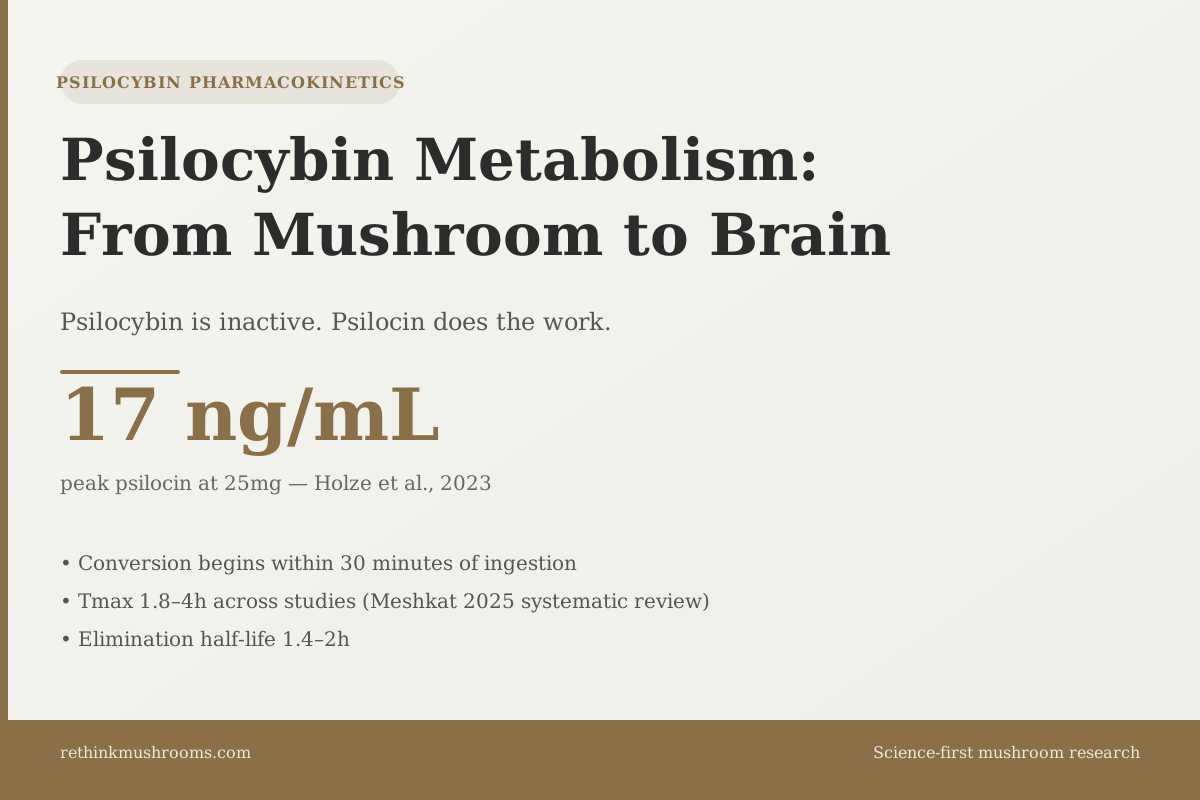
17 ng/mL peak psilocin
At a 25mg clinical dose, psilocin peaks at roughly 17 ng/mL in blood around 2 hours after ingestion, directly tracking with the peak of the psychedelic experience on validated scales.
Holze et al., Clinical Pharmacology & Therapeutics, 2023
< 30 min
for psilocybin to begin converting to psilocin in blood
1.8–4h
range for psilocin to reach peak plasma concentration
1.4–2h
psilocin elimination half-life across studies
Holze et al., Clinical Pharmacology & Therapeutics, 2023
 View as image ↗
Psilocybin doesn't produce any psychedelic effects. Not on its own, not in any dose, not by any mechanism. Understanding psilocybin metabolism starts with this fact: the compound in the mushroom is pharmacologically inert. It can't bind serotonin receptors. It can't cross the blood-brain barrier. What it can do is dissolve in water and survive being swallowed, two properties that make it an ideal delivery vehicle for the compound that actually does the work.
That compound is psilocin. Your body synthesizes it from psilocybin in the minutes after ingestion, and psilocin's journey from gut to brain determines everything about the experience: when effects begin, how strong they get, how long they last, and why SSRI antidepressants can blunt them substantially. This article traces that journey using pharmacokinetic data from studies that have actually measured psilocin in blood and mapped concentrations directly to subjective effects. For how psilocin behaves once it reaches the brain, the complete psilocybin pharmacology guide covers the downstream pharmacodynamics in full.
Key Takeaways
- Psilocybin is inactive on its own; the body converts it to active psilocin by removing its phosphate group, and the parent compound is barely detectable in blood even immediately after ingestion[3]
- The conversion enzyme, alkaline phosphatase, is present throughout the body (in gut lining, liver, and blood plasma), meaning conversion happens simultaneously across multiple sites, not in one location[4]
- At a 25mg clinical dose, psilocin peaks at approximately 17 ng/mL in blood around 2 hours after ingestion, directly tracking with peak psychedelic experience intensity on validated scales[2]
- Psilocin's elimination half-life is 1.4–2 hours across studies; most is cleared within 8–10 hours, though subjective effects typically end before complete clearance[1]
- Natural psilocybin mushrooms contain other tryptamine alkaloids including aeruginascin, which acts as a 5-HT3 antagonist in the gut and may reduce session nausea, suggesting natural preparations can behave differently than purified pharmaceutical psilocybin[6]
- SSRI antidepressants attenuate psilocybin's effects not by disrupting metabolism but by reducing the number of brain receptors available when psilocin arrives; this attenuation persists for weeks after stopping SSRIs[7]
The Psilocybin Metabolism Pathway, Step by Step
The journey from swallowing a mushroom to the peak of the psychedelic experience happens across nine stages:
-
Ingestion: Psilocybin enters the stomach and small intestine in its phosphate form: water-soluble, stable, and biologically inactive.
-
Gut absorption: The small intestine absorbs psilocybin into the cells lining the gut wall, where alkaline phosphatase (an enzyme concentrated throughout the intestinal lining) begins removing the phosphate group from psilocybin molecules.
-
First-pass conversion: Psilocybin that reaches the liver encounters alkaline phosphatase there as well, and more conversion to psilocin occurs during this initial pass through hepatic tissue.
-
Psilocin enters the bloodstream: Within approximately 30 minutes of ingestion, psilocin begins appearing in blood. In Brown and colleagues' pharmacokinetic dose-escalation study (which measured plasma concentrations across doses from 0.5mg to 25mg), psilocybin itself was barely detectable in blood at any time point, confirming that conversion is nearly complete before or as the compound reaches circulation.[3]
-
Rising plasma concentration: Psilocin levels in blood climb for 1.8–4 hours after ingestion. The 2025 systematic review by Meshkat and colleagues, which synthesized all published psilocybin pharmacokinetic studies, found this range for Tmax (the time to peak plasma concentration), with meaningful variability between individuals reflecting differences in absorption rate and genetic enzyme variation.[1]
-
Blood-brain barrier crossing: Unlike psilocybin, psilocin crosses from blood into the brain readily. The phosphate group on psilocybin makes it negatively charged and water-soluble at the pH normally found in the body, properties that block passage across the fatty membranes separating blood from brain. Removing that group creates psilocin, which is uncharged and fat-soluble enough to cross.
-
Receptor activation: Inside the brain, psilocin acts as a partial agonist at 5-HT2A receptors, the serotonin subtype concentrated heavily in the cortex. This binding pattern triggers the cascade of perceptual, emotional, and cognitive changes associated with the psychedelic experience.[5]
-
Enzymatic breakdown: Liver enzymes begin breaking down psilocin once plasma levels peak. CYP2D6 and CYP3A4 (cytochrome P450 enzymes present throughout hepatic tissue) perform hydroxylation, attaching oxygen atoms to specific positions on the psilocin molecule. MAO-A (monoamine oxidase A) handles a parallel breakdown route through oxidative deamination. Both pathways produce inactive metabolites: 4-hydroxyindole-3-acetic acid and 4-hydroxytryptophol.[4]
-
Elimination: The inactive metabolites exit the body primarily through urine. With an elimination half-life of 1.4–2 hours, most psilocin is cleared within 8–10 hours of ingestion, well after the subjective experience has ended.
The Enzyme at the Center: Why Alkaline Phosphatase Does the Work Everywhere at Once
Most descriptions of psilocybin metabolism say "the body converts it" as if one enzyme in one location handles the whole process. The reality is more distributed.
Alkaline phosphatase (ALP) is the enzyme responsible for removing psilocybin's phosphate group: the single chemical step that transforms an inactive storage form into the active compound psilocin. What makes alkaline phosphatase notable here is where it lives in the body. The gut mucosa (the cells lining the small intestine), the liver, and blood plasma all contain active alkaline phosphatase.
This multi-site distribution means conversion doesn't happen at one bottleneck step. As Dinis-Oliveira and colleagues described in their comprehensive metabolic pathway review, dephosphorylation begins in the gut wall during absorption, continues through hepatic first-pass metabolism in the liver, and can proceed in the bloodstream itself.[4]
The practical consequence: very little intact psilocybin ever makes it into general circulation. Brown and colleagues' dose-escalation study confirmed this across a wide dose range; the parent compound was essentially absent from blood samples even at early time points after ingestion.[3] By the time psilocin reaches the bloodstream and begins its trip to the brain, conversion from psilocybin is mostly complete.
This also clarifies what actually delays onset. The 30–60 minutes between swallowing and feeling anything isn't the time it takes psilocybin to "reach the brain." Psilocybin never reaches the brain. The delay is the time needed for gut absorption, first-pass conversion, circulation of psilocin into the brain, and accumulation of sufficient psilocin concentration at brain receptors to produce noticeable effects.
For a deeper look at the enzymatic mechanism specifically, the how your body converts psilocybin to psilocin article examines the dephosphorylation step in detail, including the structural chemistry of why the phosphate group prevents direct receptor binding.
The Blood-Brain Barrier: Why Psilocybin Stays Out but Psilocin Gets Through
The blood-brain barrier is a network of tightly packed cells lining the brain's blood vessels. It acts as a selective filter with a consistent logic: small, uncharged, fat-soluble molecules pass through; large, charged, water-soluble molecules are blocked.
Psilocybin fails that filter at multiple checkpoints simultaneously. The phosphate group attached to its structure carries a negative charge at the pH normally found inside the body. That charge makes psilocybin repelled by the fatty cell membranes forming the barrier. Beyond the transport problem, the same phosphate group prevents psilocybin from fitting into the binding site of serotonin receptors, cavities designed for smaller, uncharged compounds.
Geiger and colleagues laid this out in their comprehensive pharmacology review: psilocybin's phosphate group fundamentally prevents it from interacting with receptors, while psilocin (structurally identical except for the missing phosphate) acts as a partial agonist at 5-HT2A receptors, the brain's serotonin subtype most responsible for the psychedelic effect.[5]
The phosphate group also gives psilocybin one clear advantage over psilocin: stability. Psilocybin survives in dried mushrooms for months or years. Psilocin degrades quickly when exposed to air and light. The prodrug design, which stores the compound as an inactive phosphate ester and lets the body activate it on demand, solves a real chemical storage problem.
The why psilocybin is a prodrug article explores this design in full: why mushrooms evolved to store tryptamines as prodrugs, what this means for different administration routes, and what pharmaceutical researchers are doing with the insight. For the difference between psilocybin and psilocin as chemical entities, psilocybin vs. psilocin: understanding the active compound covers the comparison directly.
The Numbers That Map to What You Feel: Psilocin Plasma Concentrations
In 2023, Holze and colleagues conducted what remains the most rigorous combined pharmacokinetic and pharmacodynamic study of oral psilocybin, measuring psilocin concentrations in blood and subjective experience intensity at matched time points in the same participants.[2]
The plasma concentration data from that study:
| Dose | Peak psilocin (Cmax) | Time to peak (Tmax) | Total duration |
|---|---|---|---|
| 15mg | ~11 ng/mL | ~2 hours | ~5–6 hours |
| 25mg | ~17 ng/mL | ~2 hours | ~5–6 hours |
| 30mg | ~21 ng/mL | ~2 hours | ~5–6 hours |
Holze found a strong, direct relationship between these plasma levels and experience intensity measured on validated psychedelic effect scales. When psilocin was at its Cmax, subjects were at or near the peak of their experience. As psilocin levels declined, reported intensity fell proportionally.
The relationship is dose-proportional: doubling the dose roughly doubles plasma psilocin exposure. This pattern was also documented in Brown and colleagues' earlier dose-escalation study, which showed dose-proportional psilocin area-under-the-curve (a measure of total exposure) across a wide dose range.[3]
The 2025 systematic review by Meshkat and colleagues confirmed these patterns across all published pharmacokinetic studies: Tmax typically falls between 1.8 and 4 hours after ingestion, with elimination half-life of 1.4–2 hours.[1] The 1.8–4 hour range for Tmax isn't measurement error; it reflects real individual variation in gut absorption rate, first-pass conversion efficiency, and genetic differences in the enzymes that metabolize psilocin.
For a complete hour-by-hour breakdown of what these pharmacokinetics look like across different doses, the psilocybin pharmacokinetics: onset, peak, and duration article maps the full timeline.
How Psilocin Gets Cleared, and Why Coming Down Takes 5–6 Hours
After psilocin levels peak, the same liver enzyme systems that process many other drugs begin breaking it down.
CYP2D6 and CYP3A4 (cytochrome P450 enzymes present throughout hepatic tissue) perform hydroxylation, attaching oxygen atoms to specific positions on the psilocin molecule. MAO-A (monoamine oxidase A) handles a parallel breakdown route through oxidative deamination, cleaving the psilocin structure through a different chemical mechanism. Both pathways produce metabolites with no activity at serotonin receptors. Dinis-Oliveira and colleagues identified the primary end products as 4-hydroxyindole-3-acetic acid and 4-hydroxytryptophol, both of which are excreted in urine.[4]
With an elimination half-life of 1.4–2 hours, plasma psilocin falls to a small fraction of its peak within 4–6 hours. This is why the core psychedelic experience typically ends 5–6 hours after ingestion, while the compound remains measurable in blood for somewhat longer.
CYP2D6 deserves particular attention. It's one of the most genetically variable enzymes in human pharmacology; about 7–10% of Europeans carry gene variants that make them slow CYP2D6 metabolizers, while a small percentage are ultrarapid metabolizers who clear CYP2D6 substrates much faster than average. Slow metabolizers clear psilocin more slowly, potentially experiencing longer duration and higher effective plasma concentrations from the same dose compared to normal or rapid metabolizers. This genetic variability is one of the primary explanations for why identical doses produce dramatically different experiences in different people.
The full picture of what drives individual variation, including CYP2D6 genotype, body weight, and prior tolerance, is in the psilocin half-life and individual variation article.
Natural Mushrooms vs. Pure Psilocybin: The Other Alkaloids in the Mix
When pharmacokinetic researchers study psilocybin, they use pharmaceutical-grade synthesized compound: pure psilocybin, precise dose, no other alkaloids. Natural psilocybin mushrooms present a different chemical picture.
Rakoczy and colleagues' 2024 comprehensive pharmacological characterization identified three tryptamine alkaloids present alongside psilocybin in psilocybin-containing species: baeocystin, norbaeocystin, and aeruginascin, each with a distinct pharmacological profile.[6]
Baeocystin is structurally similar to psilocybin with a single methyl group difference, and like psilocybin, it's a prodrug. Rakoczy's animal data suggests baeocystin converts to an active form (norpsilocin) and carries a similar receptor binding profile to psilocin. Its contribution to the human experience of natural mushrooms isn't established by human trials, but it's unlikely to be completely inert given the similarity in structure and metabolism.
Aeruginascin works in a different place entirely. Rather than crossing into the brain, preclinical data indicates it acts primarily in the gut, where it blocks 5-HT3 receptors. The 5-HT3 receptor is directly involved in triggering nausea; it's one of the targets that anti-nausea medications like ondansetron work on. Aeruginascin's 5-HT3 antagonism in the gut may reduce the nausea that commonly occurs during psilocybin sessions, a side effect reported more frequently with pure synthetic psilocybin.
This data is preclinical (from mouse studies) and doesn't establish that natural mushrooms categorically produce less nausea than pharmaceutical psilocybin. What it does establish is that "psilocybin mushroom metabolism" and "psilocybin metabolism" are not interchangeable concepts. The clinical trial data on purified psilocybin may not capture the full pharmacological picture of natural preparations.
When SSRIs Are in the Picture: The Receptor Problem Psilocin Runs Into
SSRI antidepressants (selective serotonin reuptake inhibitors) raise serotonin levels in the brain over weeks to months of daily use. One well-documented consequence of chronically elevated serotonin is that the brain compensates by reducing the density of 5-HT2A serotonin receptors, a process called downregulation. The brain is trying to maintain equilibrium by becoming less sensitive to a persistently elevated serotonin signal.
Psilocin depends on 5-HT2A receptors to produce its effects. When fewer are present, psilocin, which still forms normally via the metabolic pathway described above and still reaches the brain, finds fewer targets.
Gukasyan and colleagues documented this directly in a 2023 study examining people who took psilocybin mushrooms while on or recently off SSRI and SNRI antidepressants.[7] SSRI and SNRI users showed substantially reduced subjective effects compared to people not taking these medications. The attenuation was real and large, not a minor shift.
Two things stand out from this finding. First, the attenuation is pharmacodynamic rather than pharmacokinetic. The metabolic journey from psilocybin to psilocin still happens normally. Plasma psilocin levels are not meaningfully affected. The problem is at the endpoint: the brain has fewer 5-HT2A receptors to respond to psilocin arriving from the bloodstream.
Second, receptor downregulation from SSRI use persists for weeks after stopping the medication. Someone who discontinued an SSRI several weeks before taking psilocybin may still experience substantially blunted effects while their receptor density is recovering. The SSRI's pharmacological footprint outlasts the drug itself.
This is among the most clinically relevant findings in psilocybin pharmacology for people with treatment-resistant depression, a population both likely to be on antidepressants and likely to be considering psilocybin therapy. For the receptor-level mechanics of why psilocin activates 5-HT2A specifically, the psilocybin receptor binding and 5-HT2A selectivity article covers the pharmacodynamic side. For what happens in the brain after receptor activation, what happens in your brain on psilocybin picks up where this article ends.
The Bottom Line
Psilocybin is a pharmacologically inert prodrug that the body converts to the active compound psilocin through a rapid, multi-site dephosphorylation process driven by alkaline phosphatase. Clinical pharmacokinetic studies have measured psilocin plasma concentrations with precision: peak levels of 11–21 ng/mL at clinical doses of 15–30mg, reached at roughly 2 hours, with elimination taking 1.4–2 hours per half-life, and these concentrations map directly to subjective effect intensity. Individual variation in CYP2D6 genetics, SSRI-driven receptor downregulation, and the presence of other alkaloids in natural mushroom preparations all shape the metabolic journey beyond the basic pathway.
Frequently Asked Questions
Sources & References
- 1RTHM-00945·Meshkat, Shakila et al. (2025). “Pharmacokinetics of Psilocybin: A Systematic Review..” Pharmaceutics.Study breakdown →PubMed →↩
- 2RTHM-00830·Holze, Friederike et al. (2023). “Pharmacokinetics and Pharmacodynamics of Oral Psilocybin Administration in Healthy Participants..” Clinical pharmacology and therapeutics.Study breakdown →PubMed →↩
- 3RTHM-00461·Brown, Randall T et al. (2017). “Pharmacokinetics of Escalating Doses of Oral Psilocybin in Healthy Adults..” Clinical pharmacokinetics.Study breakdown →PubMed →↩
- 4RTHM-00867·Dinis-Oliveira, Ricardo Jorge (2017). “Metabolism of psilocybin and psilocin: clinical and forensic toxicological relevance..” Drug metabolism reviews.Study breakdown →PubMed →↩
- 5RTHM-00509·Geiger, Haden A et al. (2018). “DARK Classics in Chemical Neuroscience: Psilocybin..” ACS chemical neuroscience.Study breakdown →PubMed →↩
- 6RTHM-00901·Rakoczy, Ryan J et al. (2024). “Pharmacological and behavioural effects of tryptamines present in psilocybin-containing mushrooms..” British journal of pharmacology.Study breakdown →PubMed →↩
- 7RTHM-00827·Gukasyan, Natalie et al. (2023). “Attenuation of psilocybin mushroom effects during and after SSRI/SNRI antidepressant use..” Journal of psychopharmacology (Oxford.Study breakdown →PubMed →↩