Turkey Tail & Breast Cancer
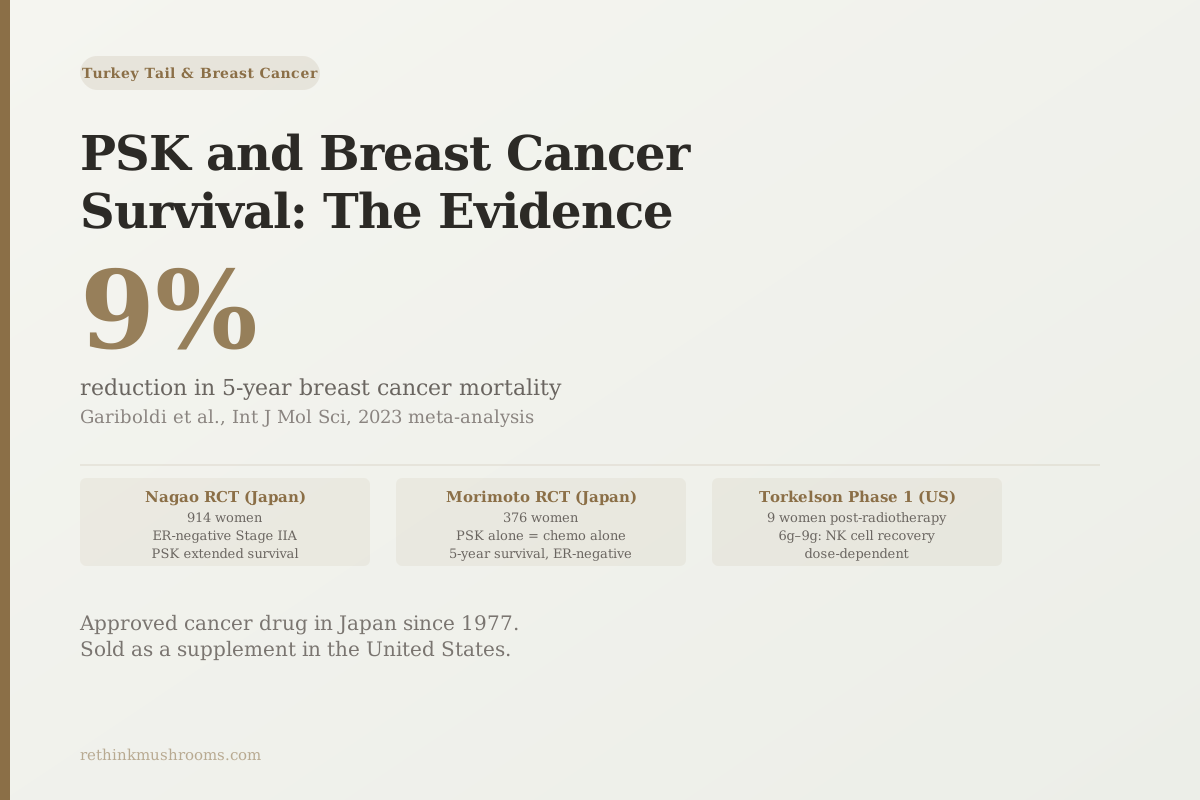
9% reduction in 5-year mortality
A 2023 meta-analysis found that Coriolus versicolor (turkey tail) may reduce 5-year breast cancer mortality by 9%. The strongest signal comes from Japanese randomized trials in estrogen-receptor-negative patients.
Gariboldi et al., Int J Mol Sci, 2023
914
women in the Nagao Japanese RCT; PSK extended survival in ER-negative patients
3,000 mg
daily PSK dose used in the Japanese breast cancer RCTs
1977
year PSK (Krestin) was approved in Japan as a cancer treatment
Gariboldi et al., Int J Mol Sci, 2023
 View as image ↗
PSK (polysaccharide K) is extracted from turkey tail mushroom. In Japan, it has been an approved cancer drug since 1977, sold under the name Krestin and widely prescribed alongside chemotherapy. In the United States, it is sold as a mushroom supplement with no approved medical use. The gap between those two regulatory facts is roughly 50 years of clinical trial data.
The breast cancer evidence within that data is more specific than it's usually reported. PSK's documented survival benefit has been concentrated in patients with estrogen-receptor-negative tumors — a breast cancer subtype where hormone-blocking therapies don't work because the cancer doesn't depend on estrogen. That subtype includes modern triple-negative breast cancer, the hardest breast cancer subtype to treat. A 2023 meta-analysis synthesizing the available data found that turkey tail may reduce 5-year breast cancer mortality by 9%.[2]
This article covers what the PSK breast cancer clinical trials actually showed, what doses were tested, what the limitations are, and where the research gap currently sits. For an introduction to turkey tail mushroom itself, the turkey tail overview covers the biology and compound profile. For the US immune recovery trial specifically, see Turkey Tail After Breast Cancer Treatment.
Key Takeaways
- The Nagao Japanese RCT (n=914) found PSK at 3,000mg/day for 24 months extended survival specifically in ER-negative (estrogen-receptor-negative) Stage IIA breast cancer patients
- The Morimoto Japanese RCT (n=376) found PSK alone produced comparable 5-year survival to chemotherapy alone in Stage II ER-negative breast cancer — a striking finding for any supplement
- A 2023 meta-analysis by Gariboldi and colleagues found Coriolus versicolor may reduce 5-year breast cancer mortality by 9%
- The only US Phase 1 trial (Torkelson 2012, n=9) found dose-dependent NK cell recovery after radiotherapy: 6g and 9g daily doses showed greater immune restoration than 3g
- PSK's strongest clinical evidence base is in gastrointestinal cancers (10–15% 5-year survival benefit); breast cancer data is promising but based on smaller and older trials
- PSK is approved in Japan (since 1977) and not FDA-approved in the US; the breast cancer evidence has not been replicated in a large US Phase 2 or Phase 3 trial
PSK Breast Cancer Clinical Trial Results
| Trial | Year | Patients | Design | Key Finding |
|---|---|---|---|---|
| Nagao RCT (Japan) | 1992 | 914 women | RCT, chemo + PSK vs. chemo alone | PSK 3,000mg/day extended survival in ER-negative Stage IIA breast cancer |
| Morimoto RCT (Japan) | ~1993 | 376 women | RCT, PSK vs. chemotherapy | PSK alone equaled chemotherapy alone for 5-year survival in Stage II ER-negative |
| Torkelson Phase 1 (US) | 2012 | 9 women | Phase 1, 3 dose arms | Dose-dependent NK cell recovery at 6g and 9g; established safety |
| Gariboldi meta-analysis | 2023 | Multiple trials | Systematic review | 9% reduction in 5-year breast cancer mortality |
Sources: Standish et al. 2008[1]; Torkelson et al. 2012[3]; Gariboldi et al. 2023[2]
The Japanese Trials: Where the Breast Cancer Evidence Began
The foundational clinical evidence for PSK in breast cancer comes from two Japanese randomized controlled trials, both conducted in the 1990s and summarized in a 2008 review by Standish and colleagues that proposed US clinical trials based on that data.[1]
The first, the Nagao trial, enrolled 914 women with breast cancer in an RCT comparing standard chemotherapy against chemotherapy combined with PSK at 3,000mg per day for 24 months. The headline result: PSK extended survival — but only in a specific subgroup. Women with ER-negative Stage IIA breast cancer, meaning tumors that lacked estrogen receptors and had not spread to lymph nodes, showed significantly improved survival when PSK was added to their chemotherapy regimen. Women with ER-positive tumors, who already responded to hormone-blocking drugs, did not show the same PSK benefit.
That subtype specificity is the critical detail that most summaries of this trial omit.
ER-negative breast cancer — cancer whose tumor cells don't carry estrogen receptors — cannot be treated with tamoxifen or aromatase inhibitors, the mainstay hormonal therapies for breast cancer. This subtype has fewer targeted treatment options. PSK's immunological mechanism, which works by activating the body's own immune cells to attack cancer cells, doesn't depend on receptor status. That's why the ER-negative subgroup is where the benefit appeared.
The second trial, the Morimoto RCT (376 women, Stage II ER-negative), took a different approach: PSK alone versus chemotherapy alone. Both groups showed similar 5-year survival rates. A supplement-class compound producing outcomes comparable to chemotherapy in a controlled trial is an unusual finding, and it underpins much of the subsequent interest in PSK for breast cancer.
The limits of these trials are real: they were conducted in Japan with different treatment protocols than current US standard of care. Japanese chemotherapy regimens, staging criteria, and supportive care in the 1990s differed meaningfully from what US oncologists use today. Neither trial used modern molecularly targeted therapies. Replication in a contemporary US population with current treatment standards would be necessary before these results could inform US clinical practice.[6]
The 2023 Meta-Analysis: What a 9% Mortality Reduction Means
In 2023, Gariboldi and colleagues published a comprehensive review and meta-analysis of anti-cancer medicinal mushrooms, including a specific synthesis of the Coriolus versicolor breast cancer evidence.[2]
Their meta-analysis found that Coriolus versicolor may reduce 5-year breast cancer mortality by 9%.
To understand what that number means in practical terms: if a breast cancer population had a 30% five-year mortality rate without PSK, a 9% reduction in that mortality would bring it to approximately 27%. It is a meaningful shift across a large population, not a dramatic cure-level effect for any individual patient.
The 2023 review also documented the preclinical evidence behind the clinical numbers: PSK and PSP suppress breast cancer cell proliferation through apoptosis induction, a process where cancer cells are triggered to self-destruct. In cell line studies, PSK upregulated p53, a tumor suppressor protein, and downregulated Bcl-2, a protein that normally prevents apoptosis. In animal models, mice given PSK showed reduced tumor weight and fewer lung metastases compared to controls.[2]
The mechanistic picture is consistent: PSK attacks breast cancer through both direct anti-proliferative effects on cancer cells and indirect immunological effects on the cells that normally hunt cancer.
The Torkelson Phase 1: The Only Dedicated US Breast Cancer Trial
The only published clinical trial of turkey tail in US breast cancer patients is the Torkelson Phase 1, published in 2012 and conducted in collaboration with Paul Stamets and the Bastyr University group.[3] It received FDA approval to proceed as an Investigational New Drug study.
Nine women with breast cancer who had just completed radiotherapy were assigned to one of three daily doses: 3g, 6g, or 9g of Trametes versicolor mushroom powder. Immune function was measured over six weeks.
The key finding was dose-dependent: the 6g and 9g groups showed faster and greater recovery of NK cell activity, CD8+ T cell counts, and overall lymphocyte levels compared to the 3g group. NK cells are the immune system's front-line cancer surveillance cells, the ones that identify and kill abnormal cells. CD8+ T cells are the immune system's cytotoxic killers, which destroy cancer cells directly after being activated.
Radiotherapy suppresses lymphocyte counts as a side effect — the immune cells that happen to be present in the radiation field are killed along with the tumor. This immune suppression leaves patients temporarily vulnerable, both to infection and to reduced immune surveillance of any remaining cancer cells. The Torkelson trial tested whether turkey tail could accelerate the restoration of that immune function.
At the 6g and 9g doses, recovery was meaningfully faster. Mean NK cell activity in the 9g group was highest at the six-week measurement point. However, a key limitation: mean lymphocyte counts across all groups remained below healthy control values at six weeks, meaning none of the doses restored full immune function within the trial's timeframe.
No serious adverse events were reported across all dose levels. The compound was well-tolerated.
The trial did not measure cancer outcomes — it was a Phase 1 safety and tolerability study, not a survival endpoint trial. The immune function data establishes a biological rationale and provides human dose-response data. A Phase 2 trial with cancer outcomes as the endpoint would be the logical follow-up. A Mayo Clinic Phase 2 trial (NCI-2024-03999) is currently recruiting post-menopausal, HER2-negative, ER-positive breast cancer patients — the first US breast cancer trial powered to measure clinical outcomes rather than just immune markers.
How PSK's Breast Cancer Data Compares to Its Strongest Evidence
PSK's clinical evidence base is not equally strong across all cancer types. To understand where the breast cancer data sits, it helps to know where PSK's evidence is most developed.
In gastrointestinal cancers, including gastric cancer, colorectal cancer, and esophageal cancer, a 2017 meta-analysis found that PSK produced 10–15% improvements in 5-year survival rates when added to standard treatment.[5] Japan approved PSK for gastric and colorectal cancer adjuvant use in 1977 specifically because of this GI cancer evidence. Dozens of trials across multiple cancer sites form the foundation for that approval.
The breast cancer evidence, by contrast, is based on two major Japanese RCTs and one US Phase 1 trial. It is promising and mechanistically coherent, but it is thinner than the GI cancer data. A 2023 systematic review of medicinal mushroom supplements in cancer found that turkey tail has the strongest overall evidence base among medicinal mushrooms, while also noting that breast cancer-specific clinical data in the US remains limited to that single Phase 1 trial.[8]
A broader review of PSK's clinical development, from its discovery in Mitsubishi's labs to approval across cancer indications, is in PSK (Krestin): Japan's Approved Mushroom Cancer Drug. For the compound-level comparison between PSK and PSP, see PSP vs. PSK: Comparing Turkey Tail's Two Anti-Cancer Compounds.
Why the ER-Negative Finding Matters for Modern Breast Cancer
The specificity of PSK's benefit for ER-negative breast cancer is worth explaining more carefully, because it connects directly to one of the most pressing unmet needs in current oncology.
Triple-negative breast cancer (TNBC) is a subtype defined by the absence of three receptors: estrogen receptor, progesterone receptor, and HER2. TNBC accounts for roughly 15–20% of all breast cancer diagnoses and has the fewest targeted treatment options. Hormone-blocking drugs don't work. HER2-targeted therapies like trastuzumab don't work. The main systemic options are chemotherapy and, increasingly, immune checkpoint inhibitors.
PSK's mechanism is immunological: it activates NK cells, CD8+ T cells, and macrophages without depending on any tumor receptor. That mechanism doesn't require the tumor to express estrogen receptors or HER2. The Kobayashi 2002 foundational review of PSK mechanisms documented this immune activation profile, including NK cell enhancement, T cell support, cytokine induction, and dendritic cell maturation.[7]
The Japanese ER-negative trial data and the TNBC mechanistic case are connected: the same patients who didn't benefit from PSK in the ER-positive arm of the Japanese trials (because they already had hormonal treatment options) are the opposite of TNBC patients, who have the fewest options. PSK's benefit appearing specifically where hormone-blocking therapy doesn't apply suggests the immune mechanism is doing real work.
A 2020 review of mushroom extracts in breast cancer specifically called out PSK's ER-negative clinical benefit as the critical evidence linking turkey tail to TNBC-adjacent populations.[6] The preclinical TNBC-specific evidence — including macrophage reprogramming data — is covered in detail in Turkey Tail and Triple-Negative Breast Cancer: Preclinical Findings.
The Regulatory Gap: Japan vs. the United States
PSK was approved in Japan in 1977 under the name Krestin, developed by Mitsubishi Chemical Industries after a decade of trials. The approval covered its use as an adjuvant therapy alongside chemotherapy in cancer patients. PSK has been prescribed in Japan for 50 years as a standard oncology support drug.
In the United States, PSK is not approved by the FDA for any medical use. It is sold as a dietary supplement — which means manufacturers cannot make disease treatment claims, and oncologists cannot prescribe it for breast cancer with any regulatory backing.
The comprehensive 2012 review of PSK's clinical development, from Mitsubishi's original work through its approved drug status, noted that breast cancer trials alongside other cancer types showed a trend favoring PSK-treated groups in 10-year overall survival data, though statistical significance varied across subgroups.[4]
What would change that picture in the US: a large Phase 2 or Phase 3 randomized trial in breast cancer patients with survival endpoints, conducted under FDA IND authorization. The forthcoming Mayo Clinic trial (NCI-2024-03999) is the first dedicated US breast cancer efficacy trial with clinical endpoints. For a full overview of turkey tail clinical trials across cancer types, see Turkey Tail Clinical Trials in Cancer. The evidence across the 40-year research history is broader than the breast cancer data alone; Turkey Tail and Cancer: 40 Years of Research Reviewed covers the full landscape.
The Bottom Line
PSK's clinical evidence in breast cancer centers on two Japanese randomized trials showing survival benefit specifically in ER-negative patients — a finding that becomes more significant as TNBC, which is ER-negative, remains one of the hardest breast cancers to treat. A 2023 meta-analysis found a 9% reduction in 5-year breast cancer mortality. The only US trial, a 9-patient Phase 1, established dose-dependent immune recovery at 6–9g per day but wasn't powered for clinical outcomes. PSK is an approved cancer drug in Japan and a supplement in the US. The breast cancer evidence is mechanistically coherent and clinically promising; it awaits a properly powered US trial with survival endpoints.
Frequently Asked Questions
Sources & References
- 1. Source details for this reference are not yet available.
- 2. Source details for this reference are not yet available.
- 3. Source details for this reference are not yet available.
- 4. Source details for this reference are not yet available.
- 5. Source details for this reference are not yet available.
- 6. Source details for this reference are not yet available.
- 7. Source details for this reference are not yet available.
- 8. Source details for this reference are not yet available.