Turkey Tail & Blood Cancers
1976 — Japan approved PSK; clinical use began 1977
PSK (polysaccharide K, brand name Krestin) has been a licensed cancer drug in Japan for four decades. The approval covers cancers of the digestive organs, lung and breast. For blood cancers, the evidence is preclinical — here's what it shows and where it stops.
Maehara et al., 2012
TLR2
the receptor PSK binds to activate NK cells and CD8+ T cells
1 of 33
hematological malignant cell lines that responded when PSK was screened against them directly
Zero
randomized trials enrolling leukemia, lymphoma or myeloma patients
Maehara et al., 2012
 View as image ↗
PSK (polysaccharide K) has been a licensed pharmaceutical in Japan since the 1970s. Four decades of clinical use make it one of the most extensively prescribed immunomodulatory compounds in oncology. When a blood cancer patient researches PSK, that history is real and relevant. But almost none of that clinical experience was accumulated in leukemia or lymphoma patients. The controlled trials that built PSK's evidence base studied solid tumors: gastric, colorectal, lung, esophageal, breast, nasopharyngeal and bladder cancer.[1] For hematologic malignancies specifically, the evidence is preclinical. That distinction matters enormously, and almost no source makes it clearly.
This article covers what the preclinical research actually shows, what PSK's mechanisms suggest about its potential relevance to blood cancer, and exactly where the clinical evidence ends. For the broader Turkey Tail mushroom context, see What Is Turkey Tail Mushroom? A Science-Based Introduction.
Key Takeaways
- PSK (Krestin) is a protein-bound polysaccharide from Trametes versicolor, approved in Japan in 1976 for cancers of the digestive organs, lung and breast, with clinical use beginning in 1977
- PSK is a selective TLR2 agonist; in mice its anti-tumor effect required both CD8+ T cells and NK cells and vanished entirely in TLR2-knockout animals
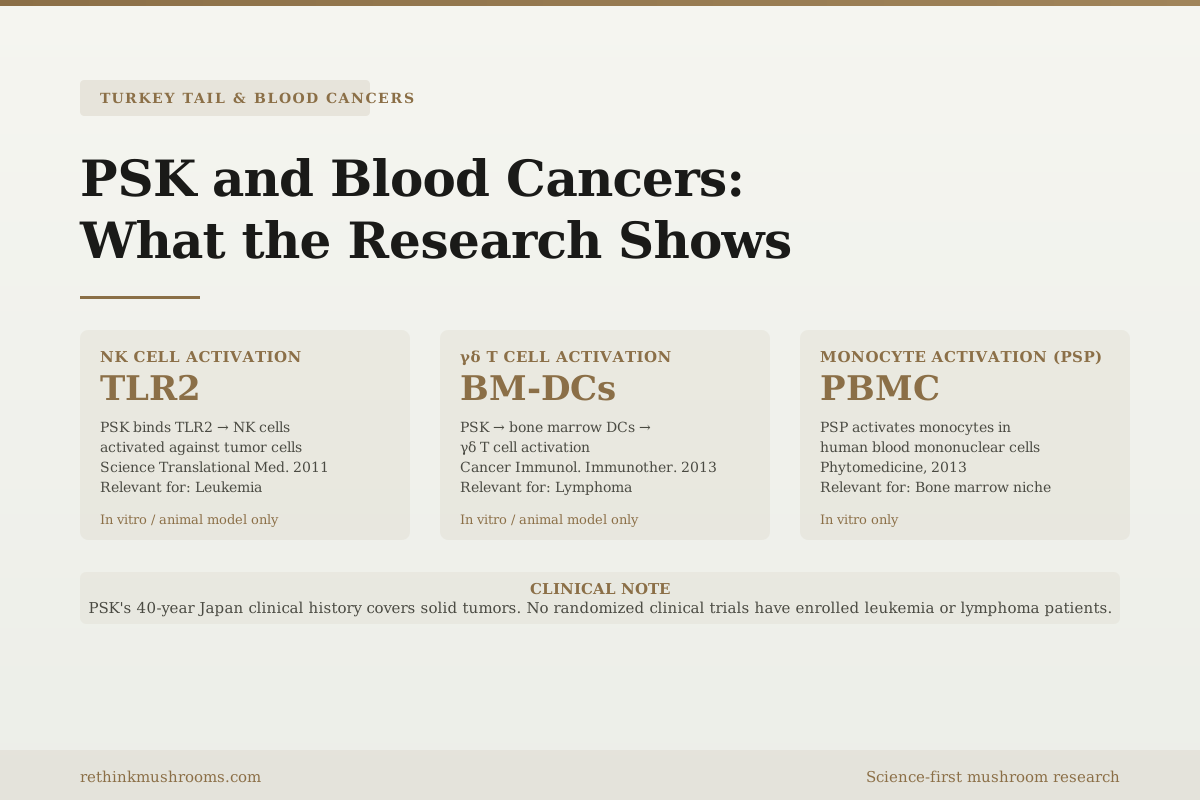
- PSK activates human NK cells to produce IFN-γ and lyse K562, a chronic myelogenous leukemia cell line — the closest human-cell evidence to a blood cancer
- PSK also activates γδ T cells, a lymphocyte population relevant to lymphoma surveillance; dendritic cell contact improves that activation but is not strictly required
- Screened directly against blood cancer cells, PSK inhibited just 1 of 33 hematological malignant cell lines tested — direct killing is the exception, not the pattern
- No randomized trial has enrolled leukemia, lymphoma or myeloma patients; all blood cancer evidence is in vitro, ex vivo, or from solid tumor animal models
What PSK Is and Why the Evidence Requires Careful Framing
PSK is not "turkey tail extract." It is a specific, well-characterized compound: a protein-bound polysaccharide isolated from cultured mycelium of Trametes versicolor (strain CM-101), with an average molecular weight of roughly 100,000 and a protein content reported between 18 and 38 percent.[1] That range matters for reading the literature: studies on PSK describe a standardized chemical entity with measurable receptor binding activity, not a variable whole-mushroom preparation whose active content depends on substrate, processing and extraction method.
The compound's defining mechanism is that it binds TLR2 (toll-like receptor 2) on immune cells. A 2002 review by Fisher and Yang in Anticancer Research catalogued the mechanisms documented up to that point: activation of natural killer (NK) and lymphokine-activated killer (LAK) cells, upregulation of immune cytokines, an antimetastatic action attributed partly to inhibition of metalloproteinases, antioxidant activity that may protect normal tissue during chemotherapy and radiotherapy, and — notably for this topic — induced differentiation of leukemic cells in vitro.[2]
The honest framing for blood cancer patients: PSK has real mechanism data, substantial clinical experience in other cancers, and relevant in vitro evidence for blood cancers. It does not have clinical trial evidence for leukemia, lymphoma or myeloma. This article covers both sides of that picture. For PSK's regulatory history and what Japan's approval actually entails, see PSK (Krestin): Japan's Approved Mushroom Cancer Drug.
Japan's Four Decades of Clinical Use: What It Covers and What It Doesn't
PSK was approved in Japan in 1976 for the treatment of cancers of the digestive organs, lung and breast, and clinical use began in 1977. Maehara and colleagues published a 2012 review in Surgery Today documenting the compound's development and clinical record. In patients with gastric or colorectal cancer, combining PSK with postoperative adjuvant chemotherapy prolongs survival, an effect confirmed across multiple meta-analyses. For small-cell lung carcinoma, PSK alongside chemotherapy prolongs the remission period. The review also reports that while chemotherapy induces leukopenia and depresses immunity, PSK inhibits these adverse effects.[1]
That last finding is the one blood cancer patients tend to seize on, and it deserves careful handling. Chemotherapy for leukemia, lymphoma and myeloma causes severe myelosuppression: neutropenia, thrombocytopenia and anemia. Restoring marrow and immune function after treatment is a central clinical problem. PSK's documented ability to blunt chemotherapy-induced leukopenia and immunosuppression in solid tumor patients is the most direct bridge from the existing clinical evidence to a blood cancer context.
But it is a bridge, not a road. Blunting leukopenia in a gastric cancer patient receiving adjuvant chemotherapy is not the same clinical situation as marrow recovery after induction chemotherapy for acute leukemia, where the marrow itself is the diseased organ. No randomized trial has enrolled blood cancer patients and measured whether PSK improves their count recovery, infection rates or survival. The gap between "reduces chemotherapy-induced leukopenia" and "helps blood cancer patients" is exactly where clinical evidence ends and inference begins.
A 2020 review by Habtemariam in Biomedicines scrutinized the Trametes versicolor polysaccharide literature at three levels — in vitro, in vivo and clinical outcomes — and its clinical section likewise reports on solid tumor indications.[3] Across the major reviews of PSK's clinical record, hematologic malignancies simply do not appear as a trial population.
- Cell studiescompleted
Human leukemia and lymphoma cell lines have been treated with PSK directly, and human immune cells have been activated by it ex vivo.
- Animal studiesmissing
The mouse work establishing PSK's mechanism used breast tumor models. No blood cancer animal model appears in this evidence base.
- Case reportsmissing
The major reviews of PSK's clinical record document solid tumor use; no blood cancer case series appears in them.
- Small trialsmissing
No pilot or phase 1 trial has enrolled leukemia, lymphoma or myeloma patients to test PSK.
- Large RCTsmissing
PSK has large randomized trials — all in solid tumors.
- Meta-analysesmissing
Meta-analyses exist for gastric and colorectal cancer. None exists for any hematologic malignancy.
For blood cancers specifically, PSK's evidence stops at cells in a dish. Everything above that rung is either absent or was established in a solid tumor context.
Maehara et al. (2012), Surgery Today; Habtemariam (2020), Biomedicines
For the solid tumor evidence in context, see Turkey Tail and Cancer: 40 Years of Research Reviewed.
PSK's TLR2 Mechanism: The Gateway to Blood Cancer-Relevant Immunity
The pivotal mechanistic paper came in 2011, when Lu and colleagues published in Clinical Cancer Research that PSK is a selective TLR2 agonist. Working with splenocytes from neu transgenic mice and from TLR2-knockout mice, they showed that PSK's activation of dendritic cells and T cells depends on TLR2. Oral administration of PSK significantly inhibited breast tumor growth in neu transgenic mice. Selectively depleting immune cell populations showed the anti-tumor effect required both CD8+ T cells and NK cells — but not CD4+ T cells. In TLR2-knockout mice, PSK did not inhibit tumor growth at all.[4]
Lu et al. (2011) · Clinical Cancer Research
- Population
- neu transgenic mice bearing breast tumors; TLR2-knockout and wild-type C57BL/6 mice
- Intervention
- Oral PSK
- Comparator
- Untreated tumor-bearing mice; TLR2-knockout mice as mechanistic control
- Finding
- Oral PSK significantly inhibited breast tumor growth. Depleting CD8+ T cells or NK cells removed the effect; depleting CD4+ T cells did not. In TLR2-knockout mice, PSK produced no tumor inhibition.
positive Unusually clean mechanistic proof — in a mouse solid tumor model. No blood cancer model was tested.
Lu et al. (2011), Clinical Cancer Research 17(1):67-76
The blood cancer relevance is specific and worth stating precisely. CD8+ cytotoxic T cells and NK cells are the two populations most responsible for immune surveillance against hematologic malignancies. Leukemia and lymphoma cells frequently downregulate the surface markers that normally identify a cell as healthy self-tissue, which is a way of hiding from T cells. NK cells are built to detect exactly that. A compound that reliably activates both arms is, on paper, aimed at the right targets.
For a deeper look at how these immune mechanisms function in Turkey Tail's broader anti-cancer research, see How Turkey Tail Enhances the Immune System's Anti-Cancer Response.
NK Cell Activation: The Closest Thing to Leukemia Evidence
Later in 2011, the same group published a follow-up in Clinical Cancer Research testing PSK on human cells rather than mouse cells. Human peripheral blood mononuclear cells stimulated with PSK produced IFN-γ and lysed K562 target cells. PSK also enhanced trastuzumab-mediated antibody-dependent cell-mediated cytotoxicity against breast cancer lines, and both direct and interleukin-12-dependent indirect effects appeared to be involved in how PSK acts on NK cells.[5]
K562 is worth pausing on, because most write-ups skate past it. K562 is a human chronic myelogenous leukemia cell line. It is the standard target used to measure NK cell killing precisely because it lacks the surface markers that would otherwise protect it. So the sentence "PSK-activated human NK cells lysed K562" is simultaneously a routine assay result and the single most blood-cancer-proximate human finding in the PSK literature.
Lu et al. (2011) · Clinical Cancer Research
- Population
- Human peripheral blood mononuclear cells from donors; neu transgenic mice for the in vivo arm
- Intervention
- PSK stimulation of human PBMC; oral PSK with anti-HER2/neu antibody in mice
- Finding
- PSK activated human NK cells to produce IFN-γ and lyse K562, a chronic myelogenous leukemia line. PSK also enhanced trastuzumab-mediated ADCC. Both direct and IL-12-dependent indirect routes were implicated.
narrow-scope Human cells and a leukemia-derived target — but a standard cytotoxicity assay, not a treatment study, and the therapeutic question being asked was about breast cancer.
Lu et al. (2011), Clinical Cancer Research 17(21):6742-53
There is one older human study that pushes this further than a cell line. In 1992, Vánky and colleagues took blood lymphocytes and tumor cells from the same patients — carcinoma, sarcoma and lymphoma — and tested whether PSK helped the lymphocytes kill their own tumor. Adding PSK to the cultures induced lytic activity in 9 of 13 short-term and 11 of 12 long-term cultures, compared with far lower rates without it. Strikingly, PSK also enabled lymphocytes to attack tumors expressing little or no MHC class I, which were otherwise poor at provoking a response. The effect was dose-dependent, optimal at 1 to 10 micrograms per millilitre.[6]
This is genuinely human, genuinely includes lymphoma, and directly tests the missing-self logic described above. It is also a small ex vivo experiment from 1992 that was never followed by a clinical trial in these patients.
For the direct in vitro leukemia cell line research, see Turkey Tail and Leukemia: Preclinical and Clinical Research.
γδ T Cells: PSK's Lymphoma-Relevant Pathway
In 2013, Inatsuka and colleagues published in Cancer Immunology, Immunotherapy a second distinct activation route. Using mouse splenocytes, they found that γδ T cells produce IFN-γ after PSK treatment and upregulate the activation markers CD25, CD69 and CD107a. To test whether the effect was direct or indirect, purified γδ T cells were cultured alone or with bone marrow-derived dendritic cells. Direct cell-to-cell contact with dendritic cells was required for optimal activation — but PSK could also co-stimulate γδ T cells alongside anti-TCR and anti-CD3 stimulation in the absence of dendritic cells entirely. The activation ran both ways: PSK-activated γδ T cells in turn drove dendritic cells to express more costimulatory molecules and produce more IL-12. In vivo, PSK activated γδ T cells among tumor-infiltrating lymphocytes, and depleting γδ T cells during treatment blunted PSK's anti-tumor effect.[7]
It is tempting to build a clinical inference here — that because dendritic cells come from bone marrow, and blood cancer treatment damages bone marrow, this pathway would only work in patients whose marrow has recovered. The data does not support that inference. Dendritic cell contact improved γδ T cell activation but was not strictly necessary for it, and none of this was tested in a marrow-suppressed animal, let alone a marrow-suppressed person. The pathway is real; its behaviour under myelosuppression is unknown.
For the lymphoma-specific evidence, see Turkey Tail for Lymphoma: Immune Modulation Evidence.
What Happens When PSK Meets Blood Cancer Cells Directly
Everything above is PSK acting on immune cells. A separate question is whether PSK does anything to blood cancer cells themselves — and here the literature is unusually candid.
The Maehara review reports a screen by Hattori and colleagues in which PSK was tested against 33 hematological malignant cell lines. It strongly inhibited the proliferation of one: Namalwa, a Burkitt lymphoma line, in which it also increased apoptosis.[1] One hit in thirty-three is a real finding and a real limit at the same time.
A second screen points the same direction. Hirahara and colleagues tested PSK against seven human malignant cell lines in 2011 — three colorectal, two gastric, plus HL-60 and U937, both blood cancer lines. PSK inhibited HL-60, a promyelomonocytic leukemia line, most profoundly of the seven, and the mechanism involved caspase-3 activation followed by apoptosis.[8]
Screening Ledger
What Happened When PSK Met Blood Cancer Cells Directly
Two screens tested PSK against blood cancer cell lines in a dish. Both found a real hit. Both also found that the hit was the exception, not the rule.
Screen 1 · Hattori et al. (2004)
33 hematological malignant lines
One of thirty-three hematological malignant cell lines responded to PSK.
Responded (1)
Namalwa — Burkitt lymphoma. Growth inhibited, apoptosis induced.
No reported response (32)
The remaining hematological lines in the panel.
Screen 2 · Hirahara et al. (2011)
7 human malignant lines
HL-60 — promyelomonocytic leukemia
most profoundly inhibited
Caspase-3 activation followed by apoptosis, at least in part.
U937 — histiocytic lymphoma (also a blood cancer line)
WiDr, HT29, SW480 — colorectal · KATOIII, AGS — gastric
A different kind of result
Separately, PSK-activated human NK cells lysed K562, a chronic myelogenous leukemia line. That is not PSK killing the cancer cell. That is PSK switching on an immune cell, which then kills it — a mechanism that requires a working immune system to exist in the first place.
Read together: PSK can act directly on a small minority of blood cancer cell lines, and indirectly through NK cells against at least one more. Neither result is a treatment effect in a person.
Sources: Hattori et al. (2004), Biomedicine & Pharmacotherapy, as reported in Maehara et al. (2012), Surgery Today; Hirahara et al. (2011), Anticancer Research; Lu et al. (2011), Clinical Cancer Research
Taken together, these screens say something more useful than either a promotional summary or a blanket dismissal. PSK does have direct anti-proliferative activity against some blood cancer cells, reproducibly enough to show up in two independent panels. It also fails to do so against the large majority of blood cancer lines tested. Any claim that "PSK kills leukemia cells" is true of specific lines under specific conditions and false as a generalization.
PSP's Monocyte Route
Turkey tail yields two major immunoactive preparations: PSK, developed in Japan from strain CM-101, and PSP (polysaccharopeptide), developed in China from strain COV-1. They are structurally similar but distinct, with different protein-to-polysaccharide ratios and different pharmacology.[2]
In 2013, Sekhon and colleagues published in Food Chemistry a study of PSP's effect on immune populations in resting human peripheral blood mononuclear cells. PSP significantly increased the number of monocytes, confirmed with two separate antibody panels. Proliferation of T cells, NK cells and B cells was not significantly changed.[9]
That null result is as informative as the positive one. PSP is often described as boosting NK activity by proxy; in this experiment, in resting human cells, it did not change NK numbers. The monocyte effect is the finding that survived. Separately, the Maehara review notes that PSK promotes interleukin-15 production by monocytes, which is a documented route by which a monocyte signal can feed back onto lymphocyte function.[1] Monocytes are marrow-derived and repopulate after chemotherapy, so this pathway is plausibly relevant to immune reconstitution — but that relevance has not been tested in blood cancer patients.
For the PSK versus PSP comparison, see PSP and Natural Killer Cell Cytotoxicity Against Blood Cancers. For bone marrow-specific evidence, see Turkey Tail and Bone Marrow Health: Research Review.
Evidence Reach
How Close Each PSK Finding Gets to a Blood Cancer Patient
The research is real at every level below the top. The top row is the one that would tell a patient whether PSK helps — and it is empty.
Blood cancer patients
No evidenceRandomized trials with leukemia, lymphoma or myeloma endpoints
No trial has enrolled blood cancer patients to test PSK.
Solid tumor patients
Evidence existsRandomized trials, PSK added to post-surgical chemotherapy
Prolonged survival in gastric and colorectal cancer, confirmed in meta-analyses; prolonged remission in small-cell lung carcinoma
Maehara 2012
Human cells, taken from people
Evidence existsEx vivo blood and tumor cells, treated in the lab
PSK activated blood lymphocytes to lyse a person’s own tumor cells — including tumors expressing little or no MHC class I, and including lymphoma
Vánky 1992
PSK activated human NK cells to produce IFN-γ and lyse K562 target cells
Lu 2011
PSP increased monocyte numbers in resting human PBMC; T, NK and B cell counts unchanged
Sekhon 2013
Blood cancer cell lines
Evidence existsImmortalized leukemia and lymphoma cells in a dish
Growth inhibition and apoptosis in Namalwa (Burkitt lymphoma) — 1 of 33 hematological lines screened
Hattori 2004
HL-60 (promyelomonocytic leukemia) inhibited most profoundly of 7 lines, via caspase-3 activation
Hirahara 2011
Animal models
Evidence existsMice — solid tumor models, not blood cancer models
Oral PSK inhibited breast tumor growth; effect required CD8+ T cells and NK cells, and disappeared in TLR2-knockout mice
Lu 2011
γδ T cells activated in tumor-infiltrating lymphocytes; depleting them blunted PSK’s anti-tumor effect
Inatsuka 2013
Every tier below the top is a reason to keep studying PSK in blood cancer. None of them is a reason to conclude it works there.
Sources: Maehara et al. (2012), Surgery Today; Vánky et al. (1992) and Inatsuka et al. (2013), Cancer Immunology, Immunotherapy; Lu et al. (2011), Clinical Cancer Research; Sekhon et al. (2013), Food Chemistry; Hattori et al. (2004), Biomedicine & Pharmacotherapy; Hirahara et al. (2011), Anticancer Research
Reading the Evidence Honestly
Fact Check
The approval argument
The claim
“PSK is an approved cancer drug in Japan, so it is a proven treatment for leukemia and lymphoma.”
PSK's Japanese approval and four decades of clinical use get quoted constantly — almost always without the approved indication attached.
What research shows
MisleadingJapan approved PSK in 1976 for cancers of the digestive organs, lung and breast. The survival evidence comes from randomized trials in gastric, colorectal, lung, esophageal, breast, nasopharyngeal and bladder cancer. No hematologic malignancy is among them.
The mechanism data — TLR2 activation, NK cells, CD8+ T cells, γδ T cells — is genuinely relevant to how the immune system polices leukemia and lymphoma. Mechanistically relevant is not the same as clinically tested.
Maehara et al. (2012), Surgery Today; Habtemariam (2020), Biomedicines
Safety
CriticalPSK and deliberate immunosuppression
Concern
Blood cancer care frequently involves intentional immunosuppression — stem cell and bone marrow transplant conditioning, and prophylaxis or treatment for graft-versus-host disease. PSK's entire mechanism is immune activation via TLR2.
What the research says
No study has tested PSK in transplant recipients or in people on immunosuppressive regimens. This is a mechanism-based concern rather than a documented harm — but it has not been ruled out, and there is no dosing or safety data in this population to fall back on.
Particularly relevant for: Transplant recipients, people taking immunosuppressants, anyone in active treatment for a blood cancer
What to do
Do not start PSK, PSP or turkey tail products during blood cancer treatment without clearing it with your hematology or transplant team first. This article summarizes research; it is not medical advice.
Mechanism from Lu et al. (2011), Clinical Cancer Research; no trial data exists in this population
The Bottom Line
PSK is a well-characterized immunomodulatory compound from Trametes versicolor, approved in Japan in 1976 for cancers of the digestive organs, lung and breast, with clinical use from 1977. For blood cancers, three immune activation routes are documented preclinically: TLR2-dependent activation of CD8+ T cells and NK cells (Lu 2011, Clinical Cancer Research), γδ T cell activation with dendritic cell involvement (Inatsuka 2013), and monocyte activation by the sister compound PSP (Sekhon 2013). PSK-activated human NK cells lyse K562, a leukemia line, and a 1992 human ex vivo study found PSK helped patients' own lymphocytes attack their own tumors, including lymphoma. Screened directly against blood cancer cells, PSK inhibited 1 of 33 hematological lines in one panel and HL-60 most strongly in another. No randomized trial has enrolled blood cancer patients. The mechanisms are biologically sound and the preclinical data is consistent, but clinical proof for hematologic malignancies does not exist. This article is research summary, not medical advice.
Frequently Asked Questions
Sources & References
- 1RTHM-00475·Maehara, Yoshihiko et al. (2012). “Biological mechanism and clinical effect of protein-bound polysaccharide K (KRESTIN(®)): review of development and future perspectives..” Surgery today.Study breakdown →PubMed →↩
- 2RTHM-00089·Fisher, Monte et al. (2002). “Anticancer effects and mechanisms of polysaccharide-K (PSK): implications of cancer immunotherapy..” Anticancer research.Study breakdown →PubMed →↩
- 3RTHM-01194·Habtemariam, Solomon (2020). “Trametes versicolor (Synn. Coriolus versicolor) Polysaccharides in Cancer Therapy: Targets and Efficacy..” Biomedicines.Study breakdown →PubMed →↩
- 4RTHM-00419·Lu, Hailing et al. (2011). “Polysaccharide krestin is a novel TLR2 agonist that mediates inhibition of tumor growth via stimulation of CD8 T cells and NK cells..” Clinical cancer research : an official journal of the American Association for Cancer Research.Study breakdown →PubMed →↩
- 5RTHM-00420·Lu, Hailing et al. (2011). “TLR2 agonist PSK activates human NK cells and enhances the antitumor effect of HER2-targeted monoclonal antibody therapy..” Clinical cancer research : an official journal of the American Association for Cancer Research.Study breakdown →PubMed →↩
- 6RTHM-00031·Vánky, F et al. (1992). “The polysaccharide K (PSK) potentiates in vitro activation of the cytotoxic function in human blood lymphocytes by autologous tumour cells..” Cancer immunology.Study breakdown →PubMed →↩
- 7RTHM-00291·Inatsuka, Carol et al. (2013). “Gamma delta T cells are activated by polysaccharide K (PSK) and contribute to the anti-tumor effect of PSK..” Cancer immunology.Study breakdown →PubMed →↩
- 8RTHM-00401·Hirahara, Noriyuki et al. (2011). “Protein-bound polysaccharide-K (PSK) induces apoptosis and inhibits proliferation of promyelomonocytic leukemia HL-60 cells..” Anticancer research.Study breakdown →PubMed →↩
- 9RTHM-00552·Sekhon, Bhagwant Kaur et al. (2013). “PSP activates monocytes in resting human peripheral blood mononuclear cells: immunomodulatory implications for cancer treatment..” Food chemistry.Study breakdown →PubMed →↩