Turkey Tail (Trametes versicolor)
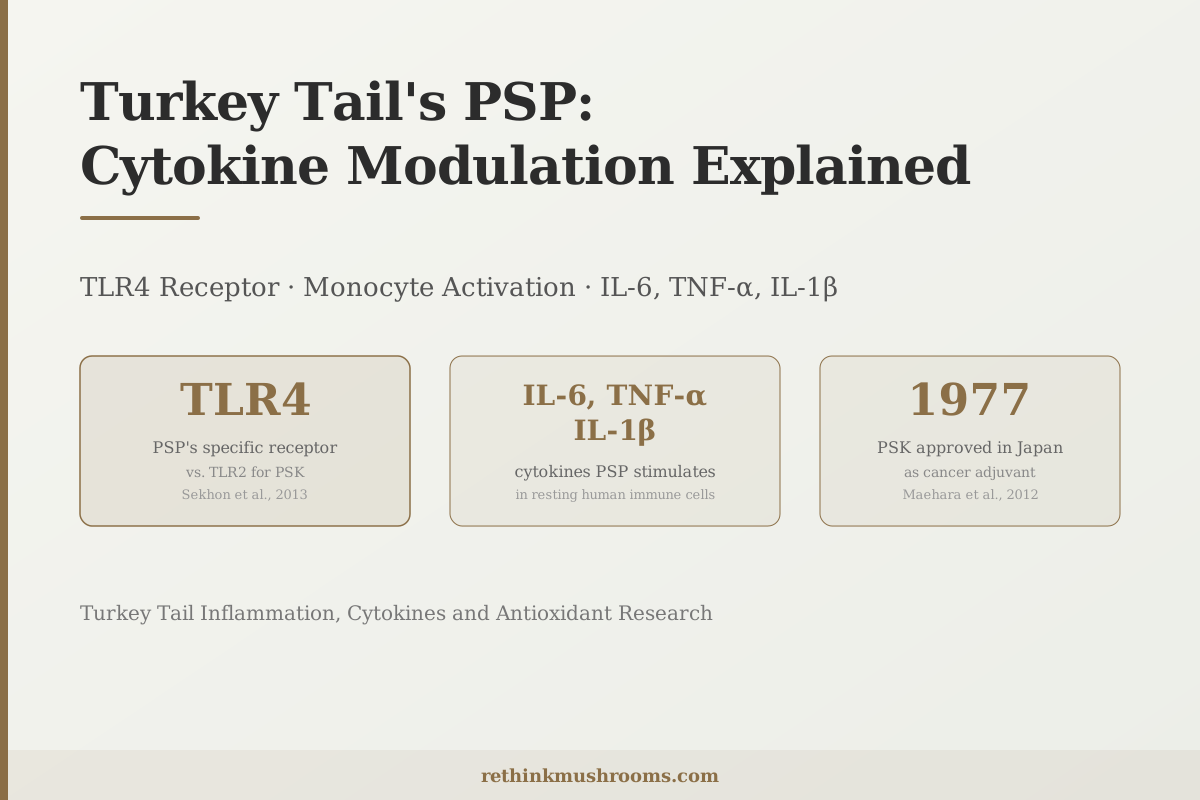
TLR4 — PSP's specific receptor target
Sekhon et al. (2013) showed PSP from turkey tail activates monocytes specifically through TLR4, stimulating release of three cytokines — IL-6, TNF-α, and IL-1β — in resting human immune cells. PSK, turkey tail's other major compound, uses a different receptor entirely.
Sekhon/Saleh et al., Cancer Immunol Immunother, 2013
TLR4
PSP's primary binding receptor — a danger-detection protein on monocytes that triggers rapid cytokine release
IL-6, TNF-α, IL-1β
the three cytokines PSP stimulates in resting human peripheral blood mononuclear cells
1977
year PSK (turkey tail's related compound) was approved as a cancer adjuvant in Japan, establishing the clinical precedent
Sekhon/Saleh et al., Cancer Immunol Immunother, 2013
 View as image ↗
Turkey tail mushroom (Trametes versicolor) contains two major bioactive compounds: PSK and PSP. Most consumer health content treats them interchangeably, as if turkey tail is one thing with one mechanism. The research tells a more precise story. PSP — polysaccharide peptide — and PSK — protein-bound polysaccharide — bind to different immune receptors, activate different immune cell types, and stimulate different cytokine profiles. Understanding PSP's cytokine modulation specifically requires understanding why TLR4 is different from TLR2, and what that receptor difference produces downstream.
This article focuses on PSP's mechanism: how it activates the immune system, which cytokines it modulates, and how that compares to PSK's different approach. For the broader introduction to turkey tail's properties and uses, see the complete guide to turkey tail mushroom.
Key Takeaways
- PSP (polysaccharide peptide) is one of two major bioactive compounds in turkey tail; it is structurally different from PSK (protein-bound polysaccharide) and isolated predominantly in Chinese and Hong Kong research
- Sekhon et al. (2013) demonstrated PSP activates monocytes in resting human immune cells by binding TLR4, a pattern-recognition receptor that triggers rapid innate cytokine release[1]
- PSP specifically stimulates IL-6, TNF-α, and IL-1β — three cytokines involved in acute-phase immune responses and inflammation signaling
- PSK binds a different receptor (TLR2) and primarily activates NK cells and T cells, producing a different cytokine profile (IL-2, interferon-γ) — not interchangeable with PSP in mechanism[2]
- Most PSP mechanistic evidence comes from in vitro (cell culture) studies; Saxe et al. (2026) provides the most recent human clinical evidence showing polypore mushroom mycelia (including turkey tail) modulate immune response in a randomized trial[5]
- PSK has a 45-year clinical record as a cancer adjuvant in Japan; PSP has less clinical data but offers mechanistic complementarity through its distinct TLR4 pathway[4]
PSP vs. PSK: Different Receptors, Different Cells, Different Cytokines
Before going into the mechanism, the comparison table orients the central distinction:
| Feature | PSP | PSK (Krestin) |
|---|---|---|
| Full name | Polysaccharide Peptide | Protein-Bound Polysaccharide |
| Primary receptor | TLR4 | TLR2 (and some TLR4 activity) |
| Primary cells activated | Monocytes, macrophages | NK cells, T cells, B cells |
| Cytokines stimulated | IL-6, TNF-α, IL-1β | IL-2, TNF-α, interferon-γ |
| Response type | Rapid innate immune activation | Sustained adaptive immune activation |
| Geographic research base | Hong Kong, China | Japan |
| Clinical status | No official approval | Approved cancer adjuvant in Japan since 1977 |
Both come from the same mushroom. Both are immunomodulatory. But they work through different cellular pathways — and that distinction matters when asking which compound, or which mechanism, is relevant for a specific context.
For a deeper exploration of PSK and PSP as paired compounds, see PSK vs. PSP: comparing turkey tail's two star compounds.
What Is PSP? The Compound Turkey Tail Research Split Two Ways
PSK was isolated from Trametes versicolor by Japanese researchers in the 1970s and developed into an approved cancer adjuvant (brand name Krestin) used widely in Japanese oncology. PSP was subsequently isolated by Hong Kong researcher Quentin Yang in the late 1980s from a different strain of the mushroom. The two compounds have structural similarities — both are polysaccharide-based — but differ in their protein content, molecular weight, and surface chemistry.
That surface chemistry difference is the key to the receptor story. Immune cells carry pattern-recognition receptors on their outer surface — proteins whose job is to detect molecular signatures of pathogens or tissue damage. Two of the most important are TLR2 (toll-like receptor 2) and TLR4. These receptors evolved to detect different types of molecular threats. TLR2 typically recognizes components of bacterial cell walls (peptidoglycans, lipoproteins). TLR4 classically recognizes lipopolysaccharide, the outer membrane component of gram-negative bacteria.
Polysaccharides from mushrooms can bind these receptors because their sugar chain geometry mimics some of the structural features of pathogen-derived polysaccharides. Different polysaccharide geometries bind different TLR subtypes. PSK's structure favors TLR2. PSP's structure favors TLR4.
PSP's Core Mechanism: TLR4, Monocytes, and Cytokine Release
Sekhon and Saleh and colleagues (2013) conducted the key in vitro study establishing PSP's mechanism in human immune cells.[1] They exposed resting human peripheral blood mononuclear cells — the circulating immune cells in human blood — to PSP and measured what happened.
The result: PSP activated monocytes. Monocytes are the first-responder cells of the innate immune system — short-lived, rapidly mobilized cells whose primary job is to sense threats and alert the broader immune network. When PSP bound TLR4 on the surface of these monocytes, the cells activated and released cytokines.
Three cytokines were specifically measured and confirmed as PSP-induced: IL-6 (interleukin-6), TNF-α (tumor necrosis factor-alpha), and IL-1β (interleukin-1 beta).[1]
These three cytokines are part of the acute-phase inflammatory response — the body's initial alarm-and-mobilize signal:
- IL-6 triggers the liver to produce specialized defense proteins and signals bone marrow to produce more immune cells. It is the key bridge between a local threat and a body-wide immune response.
- TNF-α (tumor necrosis factor-alpha) amplifies local inflammation, increases vascular permeability to allow immune cells to reach infected tissue, and activates macrophages. In cancer research, TNF-α has both anti-tumor and pro-inflammatory roles.
- IL-1β is one of the earliest cytokines released in response to tissue damage or infection, triggering fever and activating neighboring immune cells.
PSP's stimulation of these three cytokines is a pattern consistent with innate immune activation: fast, broad-spectrum, designed to alert the immune system that a potential threat is present. This is a different thing from chronic, damaging inflammation.
The Distinction That Matters: Immunomodulation vs. Immunosuppression
A critical framing point: stimulating these cytokines is not the same as causing harmful inflammation.
The cytokines IL-6, TNF-α, and IL-1β are pro-inflammatory in the sense that they amplify immune responses. But they are also essential for immune surveillance and defense. PSP's induction of these cytokines appears to function as immune activation — priming innate immune responses — rather than as persistent inflammatory excess.
The Sekhon 2013 data showed acute activation in resting immune cells. The key word is "resting." PSP appeared to shift quiescent monocytes into an activated surveillance state. This is relevant for cancer immunology contexts (where the immune system may be suppressed or poorly responsive) and for immune function in general. It is a different situation from the sustained cytokine overproduction that characterizes destructive inflammatory diseases.
For the broader anti-inflammatory picture, including how turkey tail's polysaccharides also reshape gut microbiota to reduce systemic inflammatory tone, see turkey tail and inflammation: anti-inflammatory mechanisms and how turkey tail changes gut bacteria composition.
PSK's Different Path: TLR2, NK Cells, and Adaptive Immunity
The contrast with PSK clarifies what makes PSP distinctive.
Lu and colleagues (2011) identified PSK as a TLR2 agonist in two related studies.[2][3] When PSK binds TLR2 instead of TLR4, it activates a different set of intracellular signals and ultimately reaches different cells. The cells that respond to TLR2 activation are NK cells (natural killer cells) and dendritic cells, rather than monocytes.
NK cells are part of the innate immune system but specialize in identifying and killing cells that display stress signals or tumor markers. Lu's 2011 work showed that PSK directly activates human NK cells through TLR2, enhancing their ability to recognize and kill tumor cells — and specifically enhancing the anti-tumor effect of the cancer antibody drug trastuzumab (Herceptin) in cell culture experiments.[3]
PSK's cytokine profile, reviewed comprehensively by Maehara and colleagues (2012), includes IL-2, TNF-α, and interferon-γ.[4] This is an adaptive-immune-leaning profile: IL-2 is the primary growth signal for T cells, and interferon-γ is produced by activated T cells and NK cells to amplify cellular immunity. The profile suggests PSK's mechanism emphasizes sustained cellular immune activation more than PSP's rapid monocyte-cytokine response.
For inflammation contexts: PSP's monocyte activation is faster but more transient; PSK's NK cell and T cell activation is slower to develop but may provide more durable immune surveillance. Neither is simply "better" — they operate at different speeds and through different cell types.
Maehara 2012 documents PSK's 45-year clinical record: approved in Japan in 1977 for use alongside surgery and chemotherapy in gastric, colorectal, and lung cancers. This is the deepest clinical validation any mushroom polysaccharide compound has received, and it was built on PSK's TLR2-mediated immune activation, not PSP's TLR4 pathway.[4]
Guggenheim and colleagues (2014) placed turkey tail among the five major medicinal mushrooms in integrative oncology, noting that PSK and PSP together provide complementary immune modulation that makes turkey tail among the most comprehensively studied mushrooms for immune function.[6]
The Most Recent Human Clinical Evidence
Saxe and colleagues (2026) conducted a randomized clinical trial of polypore mushroom mycelia — including turkey tail — as an adjunct to COVID-19 vaccination.[5] This is the most recent human trial evidence for turkey tail's immunomodulatory effects and the only one examining immune response in a controlled vaccination context.
The study provides human clinical anchoring for the in vitro TLR-mediated mechanisms documented by Sekhon and Lu. While the specific cytokine data from Saxe 2026 would need to be mapped onto the TLR4/TLR2 pathways described above, the RCT design provides the highest level of evidence currently available for turkey tail's immune modulation in humans.
It is important to note that most of the mechanistic data on PSP specifically remains in vitro. The Sekhon 2013 monocyte activation data was demonstrated in cell culture, not in a human clinical trial. The jump from in vitro TLR4 activation to clinical outcomes involves many steps of biological complexity that in vitro studies cannot capture. The Saxe 2026 RCT provides human evidence that the general category of polypore mushroom immunomodulation is real and measurable; the specific PSP/TLR4/cytokine pathway remains primarily a mechanistic finding from cell culture work.
The Bottom Line
PSP from turkey tail activates monocytes through TLR4, stimulating IL-6, TNF-α, and IL-1β cytokines — a rapid innate immune response distinct from PSK's TLR2-mediated NK cell and T cell activation. The distinction matters: PSP provides fast monocyte-based immune surveillance; PSK provides slower but more durable cellular immunity. Most mechanistic data is preclinical, with the 2026 Saxe RCT providing the most current human evidence for turkey tail immune modulation in a clinical context. PSK has a 45-year clinical approval record in Japan; PSP has less clinical validation but adds a complementary immune pathway.
Frequently Asked Questions
Sources & References
- 1. Source details for this reference are not yet available.
- 2. Source details for this reference are not yet available.
- 3. Source details for this reference are not yet available.
- 4. Source details for this reference are not yet available.
- 5. Source details for this reference are not yet available.
- 6. Source details for this reference are not yet available.