Bioactive Compounds in Mushrooms
25% of Japan's total anticancer drug spend in 1987
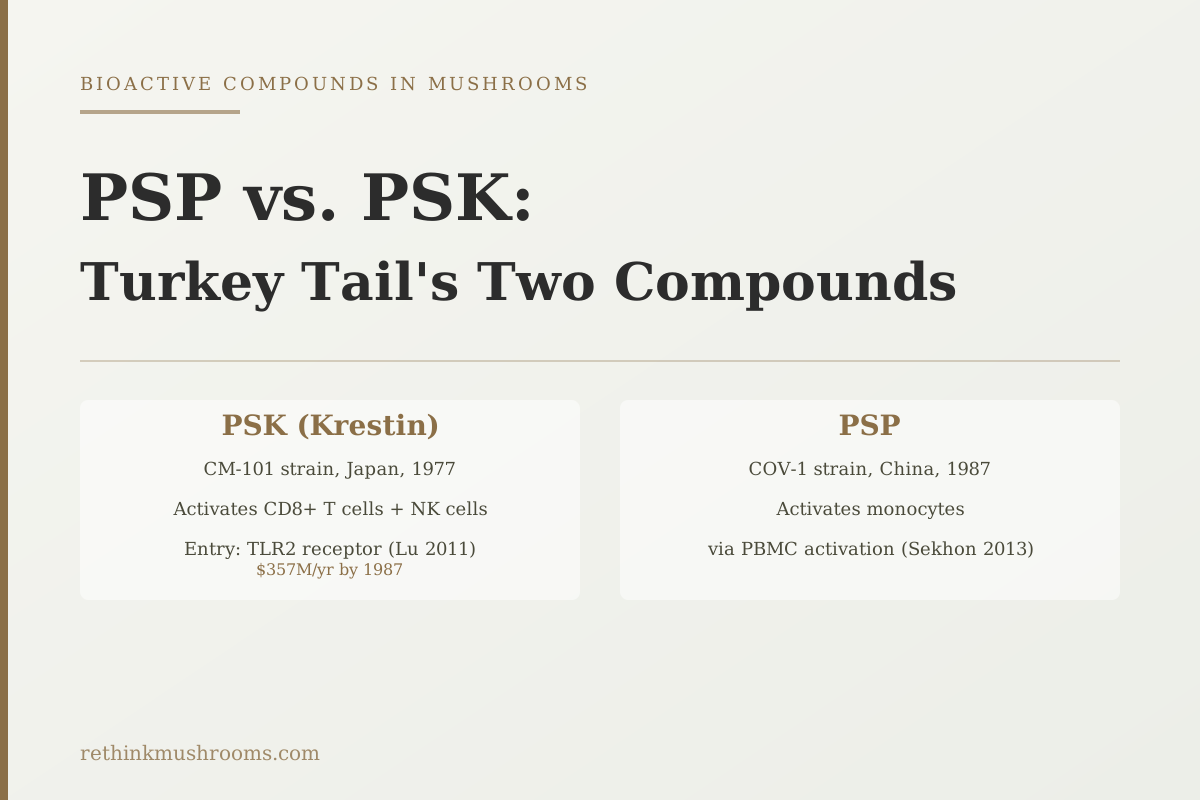
By 1987, PSK (Krestin) accounted for 25% of Japan's entire national expenditure on anticancer drugs, with annual sales of $357 million. PSP, developed in parallel in China, is a clinically distinct compound from the same mushroom.
Maehara et al., Surgery Today, 2012
1977
year PSK was approved as an adjuvant cancer therapy in Japan
TLR2 vs monocytes
the different immune cell entry points for PSK and PSP respectively
Not equivalent
standard turkey tail supplements vs. pharmaceutical-grade PSK or PSP
Maehara et al., Surgery Today, 2012
 View as image ↗
Both PSK and PSP come from Trametes versicolor, the turkey tail mushroom that grows as a shelf fungus on dead and dying trees across temperate forests. They were isolated from different strains of the same species, developed independently by different countries' pharmaceutical and research institutions, and they activate different populations of immune cells. Japan built one of the most commercially successful mushroom-derived drugs in history from PSK. China built a parallel clinical compound from PSP. Neither is available as a pharmaceutical in the United States, and neither is what most turkey tail supplements contain. Understanding the difference requires following each compound from its source strain to its clinical application. For foundational context on mushroom polysaccharides, see what are beta-glucans: the most important compound in medicinal mushrooms.
Key Takeaways
- PSK (polysaccharide-K) is extracted from the CM-101 strain of Trametes versicolor. PSP (polysaccharide-peptide) is extracted from the COV-1 strain. Both are protein-bound beta-glucan complexes, but they differ in structure and source strain.
- PSK was approved as an adjuvant cancer therapy in Japan in 1977. By 1987, it represented $357 million in annual sales and accounted for 25% of Japan's total national expenditure on anticancer drugs (Maehara et al., 2012).
- Lu et al. (2011) identified PSK as a TLR2 receptor agonist that activates CD8+ cytotoxic T cells and NK cells. The anti-tumor effect was completely absent in TLR2-knockout mice, proving TLR2 is PSK's immune entry point.[1]
- Sekhon et al. (2013) found that PSP activates monocytes in resting human peripheral blood mononuclear cells. This is a distinct immune target from PSK. The same mushroom, via two different extracts, mobilizes different immune cell populations.[5]
- He et al. (2022) reviewed PSP's evidence for colorectal cancer, finding evidence for anti-proliferative and apoptosis-inducing effects in cancer cells.[7]
- Standard turkey tail supplements sold to consumers contain polysaccharides from whole-mushroom powder. These are not the same as pharmaceutical-grade PSK or PSP, which require specific strain extraction and purification processes.
The Same Mushroom, Two Compounds: How PSK and PSP Were Isolated
Trametes versicolor grows across North America, Europe, and Asia. It is one of the most studied medicinal mushrooms in part because Japanese researchers spent decades investigating its immunological properties, beginning with observations in the 1960s.
PSK was isolated in Japan from a specific strain of the mushroom designated CM-101. The isolation and characterization work led to its development as a pharmaceutical compound branded Krestin. Japanese approval as an adjuvant cancer therapy followed in 1977, and the compound was subsequently approved for use in combination with chemotherapy in colorectal cancer and gastric cancer. By 1987, PSK had become extraordinary in scale for a natural-compound drug: $357 million in annual sales and a 25% share of Japan's entire national anticancer drug expenditure, as documented in Maehara and colleagues' authoritative 2012 review of PSK's development history.[2]
PSP was developed from a different strain of the same mushroom, designated COV-1, by Chinese researchers working in parallel. The compound reached clinical use in China in 1987. It has been studied primarily for colorectal cancer and lung cancer and remains a clinical compound in China's healthcare system. Unlike PSK, it has not achieved the same level of international academic documentation.
Both compounds belong to the same general chemical class: proteoglycans, meaning carbohydrate chains (specifically beta-glucans, with both 1,3 and 1,6 linkages) covalently attached to a protein or peptide component. PSK has a protein attachment; PSP has a peptide attachment. This structural difference affects how they interact with immune receptors, which in turn produces the different downstream immune effects documented in research. For the full PSK history, see the history of PSK: from Japanese lab to cancer clinic.
Side-by-Side: The Key Differences Between PSK and PSP
| Feature | PSK (Polysaccharide-K) | PSP (Polysaccharide-Peptide) |
|---|---|---|
| Source strain | CM-101 | COV-1 |
| Developed in | Japan | China |
| Protein component | Protein-bound | Peptide-bound |
| Approved since | 1977 (Japan) | 1987 clinical use (China) |
| Primary cancer evidence | Gastric, colorectal | Colorectal, lung |
| Primary immune target | CD8+ T cells and NK cells via TLR2 | Monocytes in PBMC |
| Brand name | Krestin (Sankyo/Kaken) | No equivalent brand |
| Western pharmaceutical status | Not FDA-approved | Not FDA-approved |
The most clinically important row in this table is the immune target row. PSK and PSP activate different populations of immune cells. This is not a trivial distinction. Different immune cells have different roles in anti-tumor responses, and the mechanistic pathways differ substantially between the two compounds.
How PSK Activates the Immune System: The TLR2 Discovery
For decades, researchers knew PSK boosted immune function but did not understand the precise molecular mechanism. The critical discovery came in 2011 when Lu and colleagues published two papers in Clinical Cancer Research identifying PSK as a selective agonist for TLR2, a Toll-like receptor on innate immune cells.[1]
Toll-like receptors are pattern recognition proteins on immune cells. They evolved to detect molecular patterns associated with pathogens and signal to the immune system that something foreign is present. TLR2 specifically recognizes certain molecular structures common in bacteria and fungi. PSK, as a fungal beta-glucan complex, contains structural features that trigger TLR2 in a way that initiates an immune cascade.
The cascade that PSK initiates via TLR2 activates two specific immune cell populations: CD8+ cytotoxic T cells, which kill cells directly, and NK (natural killer) cells, which are part of the innate immune response against tumor cells. The Lu 2011 study confirmed this in a particularly convincing way: when researchers used mice genetically engineered to lack the TLR2 gene entirely, PSK's anti-tumor effect disappeared. The mice without TLR2 showed no tumor suppression from PSK. The ones with intact TLR2 did. This is strong causal evidence that TLR2 is not just one of PSK's targets but its necessary entry point for anti-tumor activity.
Habtemariam's 2020 comprehensive review of Trametes versicolor polysaccharides adds further mechanistic detail: PSK also promotes IL-12 production (a cytokine that drives anti-tumor immune responses), shifts immune balance toward a Th1-dominant profile (more effective for tumor surveillance than Th2), and at higher concentrations, induces G0/G1 cell cycle arrest and apoptosis in cancer cells directly.[6] PSK's anti-cancer action is therefore dual: immune-mediated via TLR2 activation, and potentially direct via effects on cancer cell division.
For a full examination of PSK's mechanistic layers, see how PSK works: mechanisms of anti-cancer action.
How PSP Activates the Immune System: Monocyte Activation
PSP's immunological research is less extensive than PSK's, but a 2013 study by Sekhon and colleagues in Food Chemistry provided an important mechanistic data point. They found that PSP activated monocytes in resting human peripheral blood mononuclear cells (PBMC), immune cells drawn directly from human donors rather than animal models or cell lines.[5]
Monocytes are innate immune cells that circulate in the blood and can migrate into tissues where they mature into macrophages or dendritic cells. Activating monocytes can enhance both direct phagocytosis of tumor cells and the downstream adaptive immune response via antigen presentation. This is a different entry point than PSK's TLR2-mediated T cell and NK cell activation.
The Sekhon finding matters for the comparison precisely because it demonstrates that the two compounds, despite coming from the same mushroom, are not interchangeable activators of the same immune pathway. PSK and PSP have meaningfully different immunological profiles. Which is more effective for a given cancer type, assuming equivalent pharmaceutical-grade preparations, is not yet definitively established.
PSP's evidence base for colorectal cancer specifically was reviewed by He and colleagues in 2022.[7] They found evidence for PSP's anti-proliferative and apoptosis-inducing effects in colorectal cancer cells, including mechanisms involving cell cycle arrest. PSP also affects cancer cell migration and invasion in preclinical models. The review summarizes a developing but incomplete clinical evidence base compared to PSK's 50-year history of randomized trials.
Mechanism Divergence
One Mushroom, Two Immune Entry Points
Trametes versicolor (turkey tail)
Same species — protein-bound beta-glucan complexes from two different strains
PSK
strain CM-101 · Japan
Receptor
TLR2 agonist (Toll-like receptor 2)
- ↓
Cells activated
CD8+ cytotoxic T cells & NK cells
- ↓
Causal proof
Anti-tumor effect absent in TLR2-knockout mice
PSP
strain COV-1 · China
Target
Monocytes in resting human PBMC
- ↓
Cells activated
Circulating monocytes (innate immune cells)
- ↓
Evidence
Human ex vivo PBMC, not animal or cell-line model
The two compounds mobilize different immune cell populations. This is why PSK and PSP are not interchangeable, even though they come from the same mushroom — and why research on one does not automatically transfer to the other.
Sources: Lu et al. (2011), Clinical Cancer Research; Sekhon et al. (2013), Food Chemistry
What "Turkey Tail Supplement" Actually Means
Most consumers encounter PSK and PSP in the context of turkey tail mushroom supplements, but the relationship between the supplement and the pharmaceutical compounds is more complicated than product labels suggest.
Pharmaceutical PSK is extracted from the CM-101 strain using specific industrial processes that concentrate and purify the protein-bound beta-glucan fraction. The result is a defined pharmaceutical compound with consistent composition, measured in milligrams, dosed at specific levels validated in clinical trials, and standardized to the compound responsible for efficacy. This is Krestin. It is a prescription drug in Japan. It is not available over the counter there and it is not manufactured for Western pharmacy.
Pharmaceutical PSP has an analogous history in China: clinical-grade compound, specific strain, controlled manufacturing.
Turkey tail supplements sold in the United States and Europe are typically made from whole Trametes versicolor fruiting body or mycelium, hot-water extracted, standardized (if at all) to total beta-glucan content. This process does not separate PSK from other beta-glucans in the mushroom, does not use the CM-101 strain specifically, and does not match the purity or composition of pharmaceutical Krestin.
Torkelson and colleagues' 2012 Phase 1 clinical trial in women with breast cancer is worth noting in this context: they studied whole Trametes versicolor powder rather than purified PSK.[4] The trial found the preparation to be safe and identified an effective dose range. Western researchers are therefore investigating whole turkey tail as a distinct clinical option from purified PSK. This is a third category: not pharmaceutical-grade PSK, not a generic supplement, but clinically studied whole-mushroom powder.
Consumer Context
ModerateA supplement label citing PSK research is not selling PSK
Concern
Turkey tail supplements are often marketed using the clinical evidence for PSK and PSP, but a whole-mushroom powder or hot-water extract is not the strain-specific, purified, dose-standardized pharmaceutical compound that generated those trial results.
What the research says
The randomized-trial evidence base — including the PSK meta-analyses in gastric and colorectal cancer — was built on the CM-101-derived pharmaceutical, not on retail supplements. Whole turkey tail powder has its own (smaller, earlier-stage) evidence base, such as the Torkelson Phase 1 safety trial.
Particularly relevant for: Anyone considering turkey tail alongside cancer treatment
What to do
Treat these products as distinct from pharmaceutical PSK/PSP, and discuss any use during cancer care with your oncologist before starting. This article is informational and is not medical advice.
Torkelson et al. (2012), ISRN Oncology; Sun et al. (2012), Current Medicinal Chemistry
Sun and colleagues' 2012 review in Current Medicinal Chemistry made the argument directly: PSK is an underutilized agent in Western oncology, despite a decades-long Japanese evidence base.[3] The barrier isn't scientific uncertainty. It's the regulatory and economic cost of conducting FDA-level drug trials for an off-patent natural compound that no pharmaceutical company can profitably patent. Supplements bypass this barrier but also bypass the pharmaceutical standards that made PSK worth studying in the first place. For the full story of how Japan built its clinical evidence base around PSK, see PSK and PSP: how Japan turned turkey tail into a billion-dollar cancer drug.
PSK and PSP in the Broader Mushroom-as-Adjuvant Context
PSK is the most clinically documented mushroom-derived anti-cancer compound, but it is not the only one. Lentinan, derived from shiitake mushroom, is similarly approved as an injectable cancer adjuvant in Japan, with its own clinical evidence base. Reishi (Ganoderma lucidum) has clinical trial data as a cancer adjuvant, though with a different compound profile that includes both polysaccharides and triterpenes. For the reishi comparison, Ganoderma lucidum as a cancer adjunct: clinical evidence covers the parallel evidence base.
PSK and PSP represent a specific subtype within the mushroom bioactive landscape: pharmaceutical-grade, protein-bound beta-glucans with well-characterized receptor targets. They are not interchangeable with whole-mushroom beta-glucan supplements, even when those supplements are marketed with PSK research as the evidence base.
The Bottom Line
PSK and PSP are both protein-bound beta-glucan complexes extracted from Trametes versicolor, but from different strains, developed in different countries, and activating different immune cells. PSK (from CM-101 strain, Japan) is a TLR2 agonist that activates CD8+ T cells and NK cells. PSP (from COV-1 strain, China) activates monocytes via a different pathway. PSK has a 50-year clinical history in Japan as a prescription drug; PSP has clinical use in China. Standard turkey tail supplements contain whole-mushroom polysaccharides that are not the same as either pharmaceutical compound.
Frequently Asked Questions
Sources & References
- 1RTHM-00419·Lu, Hailing et al. (2011). “Polysaccharide krestin is a novel TLR2 agonist that mediates inhibition of tumor growth via stimulation of CD8 T cells and NK cells..” Clinical cancer research : an official journal of the American Association for Cancer Research.Study breakdown →PubMed →↩
- 2RTHM-00475·Maehara, Yoshihiko et al. (2012). “Biological mechanism and clinical effect of protein-bound polysaccharide K (KRESTIN(®)): review of development and future perspectives..” Surgery today.Study breakdown →PubMed →↩
- 3RTHM-00489·Sun, C et al. (2012). “Polysaccharide-K (PSK) in cancer--old story, new possibilities?.” Current medicinal chemistry.Study breakdown →PubMed →↩
- 4RTHM-00267·Torkelson, Carolyn J et al. (2012). “Phase 1 Clinical Trial of Trametes versicolor in Women with Breast Cancer..” ISRN oncology.Study breakdown →PubMed →↩
- 5RTHM-00552·Sekhon, Bhagwant Kaur et al. (2013). “PSP activates monocytes in resting human peripheral blood mononuclear cells: immunomodulatory implications for cancer treatment..” Food chemistry.Study breakdown →PubMed →↩
- 6RTHM-01194·Habtemariam, Solomon (2020). “Trametes versicolor (Synn. Coriolus versicolor) Polysaccharides in Cancer Therapy: Targets and Efficacy..” Biomedicines.Study breakdown →PubMed →↩
- 7RTHM-01535·He, Zhicheng et al. (2022). “Polysaccharide-Peptide from Trametes versicolor: The Potential Medicine for Colorectal Cancer Treatment..” Biomedicines.Study breakdown →PubMed →↩
- 8RTHM-00226·Oba, Koji et al. (2007). “Efficacy of adjuvant immunochemotherapy with polysaccharide K for patients with curative resections of gastric cancer..” Cancer immunology.Study breakdown →PubMed →↩
- 9RTHM-00200·Sakamoto, Junichi et al. (2006). “Efficacy of adjuvant immunochemotherapy with polysaccharide K for patients with curatively resected colorectal cancer: a meta-analysis of centrally randomized controlled clinical trials..” Cancer immunology.Study breakdown →PubMed →↩