Bioactive Compounds in Mushrooms
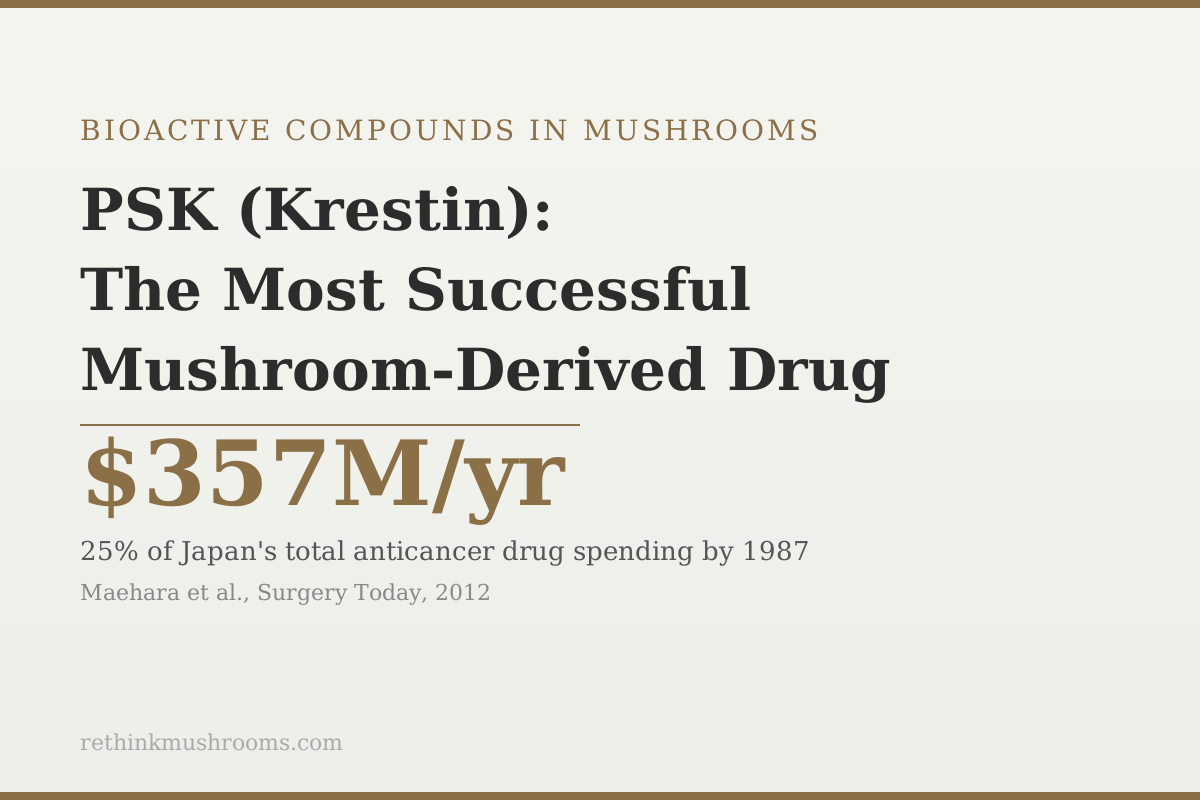
$357M in annual PSK sales by 1987, representing 25% of Japan's entire national anticancer drug spending
By 1987, a purified extract from turkey tail mushroom had become one of the most prescribed cancer adjuvant therapies in the world. Krestin (PSK) was generating $357 million per year and accounting for more than a quarter of Japan's entire anticancer drug budget.
Maehara et al., Surgery Today, 2012
1977
year PSK was approved as a cancer adjuvant in Japan
HR 0.88
survival benefit in gastric cancer meta-analysis (Oba 2007)
23 RCTs
synthesized in the Ma 2017 network meta-analysis of PSK in GI cancer
Maehara et al., Surgery Today, 2012
 View as image ↗
PSK is not a supplement. It is a prescription drug. A purified, pharmaceutical-grade protein-bound beta-glucan extracted from a specific strain of turkey tail mushroom, PSK has been used alongside chemotherapy in Japan since 1977 and accumulated a clinical trial record spanning five decades and dozens of randomized studies.[6]
By 1987, Krestin (the brand name for PSK) was generating $357 million per year in Japan. That figure represented more than 25% of Japan's entire national expenditure on anticancer agents.[6] No other mushroom-derived compound has come close to that level of clinical adoption.
This article covers what PSK is, what the clinical evidence shows, and what makes the mechanism scientifically distinct from vague "immune-boosting" claims. For the foundational science of beta-glucans that PSK belongs to, see What Are Beta-Glucans?.
Key Takeaways
- PSK (Polysaccharide-K), sold as Krestin, is a purified protein-bound beta-glucan extracted from the CM-101 strain of turkey tail mushroom (Trametes versicolor). It has been approved as an adjuvant cancer therapy in Japan since 1977.
- By 1987, PSK accounted for 25% of Japan's national anticancer drug expenditure, with annual sales of $357 million, making it the most commercially successful mushroom-derived pharmaceutical in history.
- A 2007 meta-analysis of 8 gastric cancer studies found that PSK combined with chemotherapy produced a hazard ratio of 0.88, a 12% reduction in the risk of death or recurrence compared to chemotherapy alone.
- A 2006 meta-analysis of randomized controlled colorectal cancer trials found moderately better 5-year disease-free survival with PSK plus chemotherapy versus chemotherapy alone.
- PSK is a TLR2 receptor agonist. Its anti-tumor effect was completely absent in mice lacking the TLR2 gene, proving the mechanism involves a specific immune receptor interaction, not generic immune stimulation.
- Turkey tail mushroom supplements sold at retail are not the same as pharmaceutical PSK. They contain whole-mushroom beta-glucans, not the purified CM-101 extract used in clinical trials.
What PSK Is: A Pharmaceutical Extract, Not a Supplement
PSK stands for Polysaccharide-K. It is a protein-bound polysaccharide, meaning a large sugar-protein complex, extracted exclusively from the CM-101 strain of Trametes versicolor (turkey tail mushroom). The CM-101 designation matters: PSK cannot be produced from any strain of turkey tail, only from this specific proprietary isolate.[6]
The core structure of PSK is a beta-glucan backbone with beta-1,3 and beta-1,6 glycosidic linkages, with a protein component making up roughly 38% of the molecule's mass. The protein component is not decorative: it appears to be critical to PSK's immune-activating properties and is part of what distinguishes PSK from crude turkey tail powders or standard beta-glucan supplements.[9]
Krestin is the trade name under which Kureha Corporation (Japan) markets pharmaceutical PSK. The drug is administered orally, typically as 3 grams per day in divided doses alongside standard chemotherapy regimens. It is available as a prescription cancer adjuvant in Japan. It is not approved by the US FDA or European regulatory authorities.
Japan's $357 Million Mushroom Drug: The Scale of Clinical Adoption
Numbers explain what decades of clinical use actually looked like. In 1987, Japan spent approximately $357 million per year on PSK (Krestin), and that figure represented more than 25% of the country's entire national expenditure on anticancer agents.[6]
This wasn't a niche oncology curiosity. PSK was a mainstream component of cancer treatment across Japanese hospitals, used routinely alongside surgery, radiation, and chemotherapy. The scale of adoption reflects not only the clinical evidence but also Japan's regulatory and healthcare infrastructure, which allowed plant and mushroom-derived medicines a different pathway to clinical use than FDA standards require.
A 2012 review by Maehara et al., published in Surgery Today and authored by the oncological surgeons who used Krestin in clinical practice, traces the drug's journey from initial isolation in 1971 through regulatory approval and into routine oncology use.[6] The review describes the clinical trial infrastructure Japan built to validate PSK, spanning multiple cancer types and involving hundreds of patients across randomized and controlled studies.
For the full historical narrative of how PSK moved from a Japanese research lab to mainstream oncology, see The History of PSK: From Japanese Lab to Cancer Clinic. For the economic story of why Japan and China succeeded in turning mushroom extracts into pharmaceutical drugs while the West did not, see PSK and PSP: How Japan Turned Turkey Tail Into a Billion-Dollar Cancer Drug.
The Gastric Cancer Data: A 12% Lower Risk of Death
The single most concrete survival benefit number in the PSK literature comes from a 2007 meta-analysis published in Cancer Immunology Immunotherapy by Oba et al.[3] The analysis pooled data from 8 randomized studies of PSK in gastric cancer patients who had undergone curative resection.
The combined hazard ratio was 0.88. A hazard ratio below 1.0 indicates a reduced risk of the negative outcome (death or recurrence) in the treatment group compared to control. HR 0.88 means patients receiving PSK plus chemotherapy had a 12% lower risk of death or cancer recurrence compared to patients receiving chemotherapy alone.[3]
That is a clinically meaningful number. In oncology, adjuvant therapies are routinely adopted based on hazard ratios in the 0.80-0.90 range when the safety profile is acceptable. PSK's HR 0.88 in gastric cancer, derived from 8 randomized studies, placed it squarely in that range.
For colorectal cancer, the evidence comes from a 2006 meta-analysis by Sakamoto et al. in Cancer Immunology Immunotherapy, which analyzed data from centrally randomized controlled trials and found moderately better 5-year disease-free survival in patients receiving PSK plus adjuvant chemotherapy compared to chemotherapy alone.[2] The colorectal finding is consistent with the gastric data: a meaningful but not dramatic survival advantage for PSK as an add-on to standard care.
PSK Plus Chemotherapy: Safety Across 23 Randomized Trials
A 2017 network meta-analysis published in Oncotarget by Ma et al. represents the most comprehensive current synthesis of PSK evidence in gastrointestinal cancer.[8] The analysis pooled data from 23 randomized controlled trials and rated the evidence quality as moderate-to-high.
The findings on safety are particularly useful for understanding PSK's role in clinical practice. PSK mitigated several chemotherapy-associated side effects, including nausea, vomiting, and leukopenia (low white blood cell count, which increases infection risk during chemotherapy). Patients receiving PSK alongside chemotherapy showed both improved survival outcomes and reduced toxicity burden.[8]
This dual benefit, survival improvement and toxicity reduction, is part of why PSK became so widely adopted in Japanese oncology. An adjuvant therapy that makes chemotherapy both more effective and better tolerated addresses two distinct clinical problems simultaneously.
The TLR2 Discovery: Why PSK Works Is Not a Mystery
For decades, PSK was understood as a vague "immune stimulant." A 2002 comprehensive review of PSK's mechanisms catalogued its effects on NK cells, T cells, and dendritic cells, and noted direct cytotoxic activity on tumor cells, without being able to specify the entry point into the immune system.[1]
That changed in 2011 when two papers from Lu et al. in Clinical Cancer Research identified the specific receptor PSK uses to enter the immune cascade.
PSK is a TLR2 agonist. TLR2 stands for Toll-Like Receptor 2. TLR receptors are pattern-recognition proteins that sit on the surface of immune cells. Their evolutionary function is to detect molecular patterns associated with pathogens or foreign materials and trigger an immune response. TLR2 specifically recognizes certain types of complex carbohydrates and lipoproteins.
When PSK binds TLR2, it activates the innate immune system in a sequence: TLR2 stimulation on dendritic cells and macrophages triggers production of cytokines including IL-12, which then activates and expands CD8+ cytotoxic T cells and natural killer (NK) cells, both of which can recognize and kill tumor cells directly.[4]
The proof that TLR2 is the essential receptor came from mice bred without the TLR2 gene. In these TLR2-knockout mice, oral PSK administration produced no anti-tumor effect. The full anti-cancer activity seen in normal mice was entirely absent when TLR2 was removed.[4] This is not a vague correlation. It is a mechanistic demonstration that TLR2 binding is necessary for PSK to work.
The second 2011 Lu et al. paper extended the TLR2 finding to human cells in vitro. PSK activated human NK cells via TLR2 and, notably, significantly enhanced the anti-tumor effect of trastuzumab (Herceptin), a HER2-targeted monoclonal antibody used in HER2-positive breast cancer.[5] PSK-activated NK cells killed HER2-positive cancer cells more effectively when combined with trastuzumab than trastuzumab alone, suggesting PSK could potentially amplify the effects of modern targeted cancer therapies. This synergy finding has not yet been tested in clinical trials.
A comprehensive 2020 review by Habtemariam summarized the full mechanistic picture: PSK acts on cancer through two parallel pathways: immune activation via TLR2 (which drives CD8+ T cell and NK cell responses) and direct effects on cancer cells including G0/G1 cell cycle arrest and apoptosis induction.[9] Both pathways operate with oral PSK administration, meaning the drug's effects are not confined to the gut.
For a detailed breakdown of how TLR2 binding leads to tumor killing through each step of the immune cascade, see How PSK Works: Mechanisms of Anti-Cancer Action.
PSK is one example of how mushroom polysaccharides can engage specific anti-cancer mechanisms rather than producing diffuse effects. The broader mechanistic landscape is covered in How Mushroom Polysaccharides Kill Cancer Cells: Four Distinct Mechanisms.
PSK Is Not the Same as Turkey Tail Supplements
This distinction matters and is almost never explained clearly in consumer content.
Turkey tail mushroom supplements sold in health food stores and online contain powdered whole mushroom or crude extracts. These products contain a mixture of beta-glucans, some of which may share structural features with PSK, but they are not PSK. PSK is a purified pharmaceutical-grade extract produced from a specific proprietary strain (CM-101) under controlled manufacturing conditions, with a defined structural composition verified by testing.
A 2012 review framing PSK as an underutilized agent in Western oncology put it directly: the clinical evidence base was built with pharmaceutical PSK at defined doses, and generalizing those results to commercial supplements is not scientifically supported.[7]
Western oncology researchers have more recently investigated whether the whole mushroom itself, not just the purified PSK extract, has clinical activity. These studies use a different research approach than the Japanese PSK trials and produce evidence that applies specifically to whole-mushroom preparations, not to pharmaceutical PSK.
PSK is not FDA-approved. It is not available as a prescription drug in the US or Europe. The clinical trial evidence supporting it was conducted with pharmaceutical-grade material at specific doses in specific cancer populations. For the comparison between PSK and PSP (the parallel Chinese compound from a different turkey tail strain), see PSP vs. PSK: Comparing Turkey Tail's Two Major Compounds.
PSK Among Japan's Approved Mushroom Drugs
PSK is not the only mushroom-derived pharmaceutical approved in Japan. Lentinan, an injectable beta-glucan derived from shiitake mushroom, is also approved as a cancer adjuvant in Japan. The parallel development of these two mushroom compounds reflects the broader scientific and regulatory environment that allowed Japan to build a decades-long track record with mushroom-derived oncology agents. That parallel history is covered in Lentinan as an Approved Drug: 35 Years of Japanese Oncology Experience.
Reishi (Ganoderma lucidum) is another mushroom with a clinical evidence base for cancer as an adjuvant, though its compounds and mechanisms differ substantially from PSK's polysaccharide-TLR2 mechanism. That evidence is reviewed at Ganoderma lucidum as a Cancer Adjunct: Clinical Evidence.
The Bottom Line
PSK (Krestin) is a pharmaceutical-grade protein-bound beta-glucan from a specific turkey tail mushroom strain, approved as a cancer adjuvant in Japan since 1977. By 1987 it represented 25% of Japan's entire anticancer drug spending. The clinical evidence base includes a 2007 meta-analysis showing HR 0.88 for gastric cancer and a 2017 network meta-analysis of 23 RCTs confirming both survival benefit and chemotherapy side-effect reduction. The mechanism involves TLR2 receptor binding, with anti-tumor effects completely absent in TLR2-knockout mice. PSK is not available as a prescription drug outside Japan and is not equivalent to over-the-counter turkey tail supplements.
Frequently Asked Questions
Sources & References
- 1RTHM-00089·Fisher, Monte et al. (2002). “Anticancer effects and mechanisms of polysaccharide-K (PSK): implications of cancer immunotherapy..” Anticancer research.Study breakdown →PubMed →↩
- 2RTHM-00200·Sakamoto, Junichi et al. (2006). “Efficacy of adjuvant immunochemotherapy with polysaccharide K for patients with curatively resected colorectal cancer: a meta-analysis of centrally randomized controlled clinical trials..” Cancer immunology.Study breakdown →PubMed →↩
- 3RTHM-00226·Oba, Koji et al. (2007). “Efficacy of adjuvant immunochemotherapy with polysaccharide K for patients with curative resections of gastric cancer..” Cancer immunology.Study breakdown →PubMed →↩
- 4RTHM-00419·Lu, Hailing et al. (2011). “Polysaccharide krestin is a novel TLR2 agonist that mediates inhibition of tumor growth via stimulation of CD8 T cells and NK cells..” Clinical cancer research : an official journal of the American Association for Cancer Research.Study breakdown →PubMed →↩
- 5RTHM-00420·Lu, Hailing et al. (2011). “TLR2 agonist PSK activates human NK cells and enhances the antitumor effect of HER2-targeted monoclonal antibody therapy..” Clinical cancer research : an official journal of the American Association for Cancer Research.Study breakdown →PubMed →↩
- 6RTHM-00475·Maehara, Yoshihiko et al. (2012). “Biological mechanism and clinical effect of protein-bound polysaccharide K (KRESTIN(®)): review of development and future perspectives..” Surgery today.Study breakdown →PubMed →↩
- 7RTHM-00489·Sun, C et al. (2012). “Polysaccharide-K (PSK) in cancer--old story, new possibilities?.” Current medicinal chemistry.Study breakdown →PubMed →↩
- 8RTHM-00895·Ma, Yan et al. (2017). “Can polysaccharide K improve therapeutic efficacy and safety in gastrointestinal cancer? a systematic review and network meta-analysis..” Oncotarget.Study breakdown →PubMed →↩
- 9RTHM-01194·Habtemariam, Solomon (2020). “Trametes versicolor (Synn. Coriolus versicolor) Polysaccharides in Cancer Therapy: Targets and Efficacy..” Biomedicines.Study breakdown →PubMed →↩