PSK and PSP: Turkey Tail's Anti-Cancer Compounds
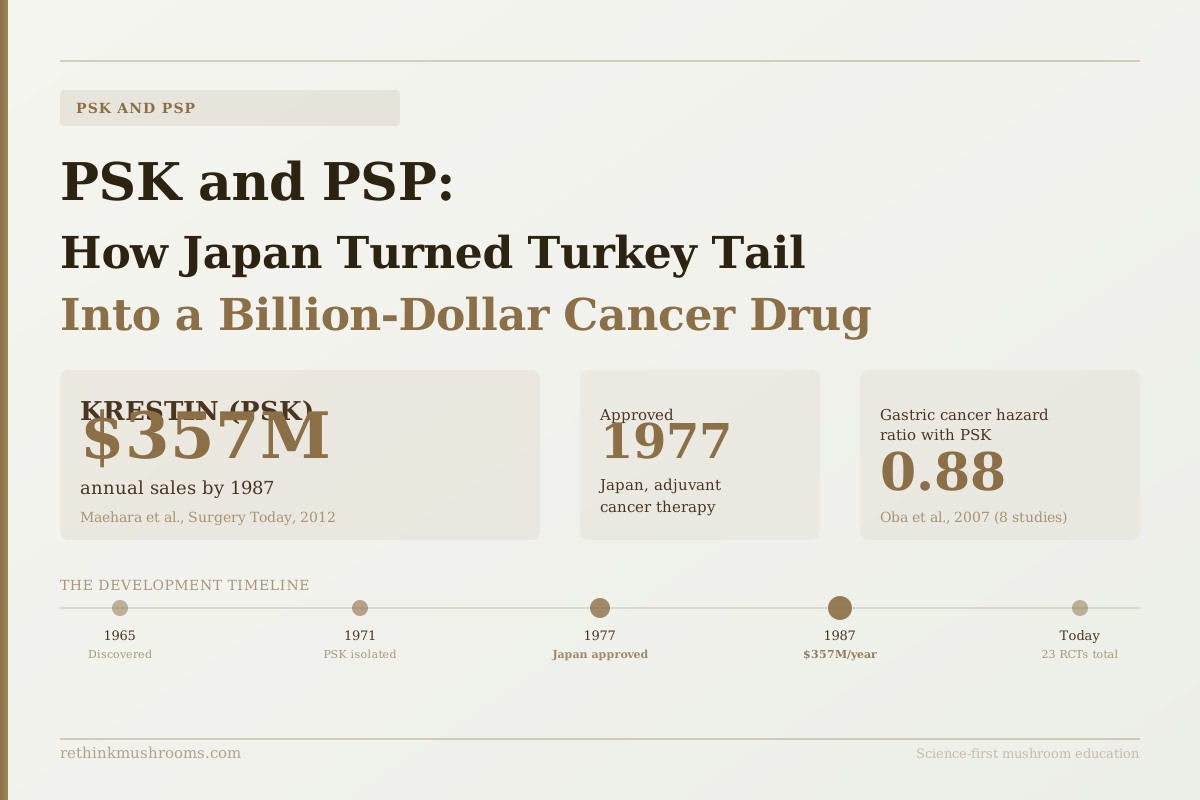
$357M/year by 1987
KRESTIN (PSK), derived from turkey tail mushroom, became one of Japan's top-selling cancer treatments. It accounted for more than a quarter of Japan's entire national budget for anticancer drugs.
Maehara et al., Surgery Today, 2012
1977
year PSK was approved as an adjuvant cancer therapy in Japan
HR 0.88
hazard ratio for gastric cancer with PSK plus chemotherapy vs chemotherapy alone
23
randomized controlled trials conducted on PSK across GI cancers
Maehara et al., Surgery Today, 2012
 View as image ↗
In 1987, a drug made from a fungus that grows on dead and fallen trees had become one of Japan's top-selling cancer treatments. By that year, KRESTIN, the brand name for PSK (polysaccharide-K), was generating $357 million in annual sales and accounting for more than 25% of Japan's entire national budget for anticancer agents.[1]
That number is extraordinary by any standard. Japan had approved antidepressants, chemotherapy agents, and targeted therapies competing for that same budget. The fact that a mushroom-derived compound captured more than one quarter of it was not an accident of marketing. It was the result of a decade of clinical trials, a different regulatory philosophy, and an institutional will to build the evidence base that Western pharmaceutical companies never had an incentive to build.
This article tells the story of how PSK and its Chinese counterpart PSP got from laboratory fungus to mainstream oncology practice in two countries, why that story never replicated in the United States, and what the accumulated evidence actually shows about whether the investment was justified. For the broader context on beta-glucans and why mushroom-derived compounds work the way they do, see What Are Beta-Glucans? The Most Important Compound in Medicinal Mushrooms.
Key Takeaways
- PSK (polysaccharide-K), sold as KRESTIN, was approved as an adjuvant cancer therapy in Japan in 1977, extracted from the CM-101 strain of Trametes versicolor (turkey tail mushroom)[1]
- By 1987, KRESTIN had annual sales of $357 million and accounted for more than 25% of Japan's national budget for anticancer drugs (Maehara et al., Surgery Today, 2012)[1]
- A 2007 meta-analysis of 8 gastric cancer studies found PSK plus chemotherapy produced a hazard ratio of 0.88 versus chemotherapy alone, a 12% reduction in risk of death or recurrence (Oba et al., Cancer Immunol Immunother, 2007)[2]
- A 2017 network meta-analysis of 23 RCTs confirmed PSK's safety in GI cancer and found it reduced chemotherapy side effects including nausea and low white blood cell counts (Ma et al., Oncotarget, 2017)[4]
- PSP (polysaccharide-peptide), derived from the COV-1 strain of the same mushroom by Chinese researchers, followed a parallel development path and entered clinical practice in China around 1987[6]
- Neither PSK nor PSP has received FDA approval; western turkey tail supplements contain beta-glucans from whole mushroom powder, not pharmaceutical-grade PSK or PSP
What PSK Actually Is: A Prescription Drug, Not a Supplement
PSK is not what most people in Western countries have encountered under the name "turkey tail."
PSK is a purified protein-bound beta-glucan, extracted from a specific strain of Trametes versicolor called CM-101 using a proprietary process developed by Kureha Corporation in Japan. The compound is a water-soluble polysaccharide with proteins attached, manufactured under pharmaceutical-grade standards, tested for purity and potency, and administered at controlled doses in clinical settings alongside chemotherapy.[1]
Turkey tail supplements sold in Western health food stores are whole mushroom powder or hot-water extracts of the whole mushroom. They contain beta-glucans, but at concentrations, purities, and compositions that have never been shown to be equivalent to pharmaceutical PSK. The 23 randomized controlled trials that built PSK's evidence base were conducted with the pharmaceutical extract, not with retail supplements. That distinction matters when reading clinical data.
KRESTIN, the brand name under which PSK is sold in Japan, has been on the Japanese market continuously since 1977. Japanese oncologists prescribe it as an adjuvant alongside chemotherapy for gastric and colorectal cancers. It is an approved drug in Japan. In the United States, it is not a drug, not approved, and not available as a prescription.
$357 Million a Year by 1987: The Scale Nobody Mentions
The economic scale of PSK's adoption in Japan is the most compelling single data point in the turkey tail literature, and the one that almost no Western content ever includes.
When Maehara and colleagues published their authoritative historical and mechanistic review in Surgery Today in 2012, they documented that by 1987, KRESTIN had become one of Japan's top-selling anticancer drugs, with annual revenue of approximately $357 million and a market share exceeding 25% of Japan's total national expenditure on anticancer agents.[1]
To put that in context: Japan in 1987 had a fully functional modern oncology sector with chemotherapy drugs, radiation equipment, and surgical cancer care. The country was spending significant sums on cancer treatment. PSK's slice of that spending was not a niche. It was a mainstream clinical tool, prescribed by practicing oncologists in hospitals, reimbursed by Japan's national health insurance, and validated by decades of institutional research.
That commercial scale required and generated a clinical trial infrastructure. Japanese researchers, working within a regulatory framework that allowed approval of plant and mushroom derivatives with lower evidentiary bars than the US FDA required, built a body of evidence that eventually ran to dozens of randomized controlled trials. The $357 million annual revenue funded continued research. The continued research justified continued revenue.
What Two Meta-Analyses and 23 RCTs Found About Survival
The clinical evidence for PSK is not theoretical. It comes from actual patients, actual trials, and actual survival data.
The most important single number is the hazard ratio of 0.88 for gastric cancer. Oba and colleagues published a meta-analysis in Cancer Immunology Immunotherapy (2007) combining data from 8 studies of patients who had undergone curative resection of gastric cancer and received either adjuvant chemotherapy alone or chemotherapy plus PSK.[2] A hazard ratio of 0.88 means the PSK-plus-chemotherapy group had 12% lower risk of dying or experiencing disease recurrence compared to chemotherapy alone. That is a meaningful effect for an adjuvant therapy added on top of standard care.
For colorectal cancer, Sakamoto and colleagues published a separate meta-analysis in the same journal in 2006, combining data from centrally randomized controlled trials of PSK in patients with curative resections of colorectal cancer.[3] The finding: moderately better 5-year disease-free survival in patients receiving PSK plus adjuvant chemotherapy compared to chemotherapy alone. This represented the highest-quality colorectal cancer evidence base available for any immunochemotherapy adjuvant of this type at the time.
Ma and colleagues then synthesized the entire literature in a network meta-analysis published in Oncotarget (2017), pulling together data from 23 randomized controlled trials of PSK across gastrointestinal cancers.[4] Beyond confirming survival benefit, Ma and colleagues found that PSK actively reduced the toxic side effects of chemotherapy, specifically nausea and vomiting and leukopenia (abnormally low white blood cell counts), in GI cancer patients. This meant PSK was not just adding a modest survival benefit on top of chemotherapy; it was also helping patients tolerate the chemotherapy better.
Twenty-three randomized controlled trials. That is a substantial evidentiary investment. Most natural compounds have never been tested in even a fraction of that number of controlled trials.
For deeper context on what PSK is doing mechanistically to achieve these effects, see How PSK Works: Mechanisms of Anti-Cancer Action.
China Built the Same Thing: PSP Takes a Parallel Route
While Japanese researchers were building the PSK evidence base, Chinese researchers were working with the same mushroom and arriving at a closely related compound through a different path.
PSP (polysaccharide-peptide) is extracted from the COV-1 strain of Trametes versicolor, a different strain from the CM-101 used to produce PSK. The structural difference is subtle: both compounds are protein-bound beta-glucans, but PSP contains a smaller peptide fragment while PSK contains a larger protein component. Functionally, both activate immune cells to fight cancer, but the specific cell types they preferentially target appear to differ.[6]
PSP entered clinical practice in China around 1987, roughly a decade after PSK had become established in Japan. The development followed the same pattern: state-sponsored institutional research, clinical trials within the Chinese healthcare system, and approval for use in cancer patients. He and colleagues published a focused 2022 review in Biomedicines specifically examining the evidence for PSP in colorectal cancer, synthesizing both preclinical and clinical evidence for PSP's mechanisms and efficacy in that cancer type.[7]
The parallel development in two countries, with two different strains, two different pharmaceutical products, and two separate clinical trial programs, is significant. It means the evidence for the underlying mushroom's anti-cancer potential was independently replicated at an institutional level in two of the world's major healthcare systems. Japan and China did not coordinate their turkey tail research programs. They each found the same mushroom and built the same infrastructure around it independently.
For a direct comparison of how PSK and PSP differ structurally and what each compound targets, see PSP vs. PSK: Comparing Turkey Tail's Two Major Compounds.
Why Western Oncology Never Adopted Either Compound
The question Western readers always want answered is: if this is real, why isn't it available here?
The answer is economic and regulatory, not scientific.
When PSK was approved in Japan in the late 1970s, Japan's regulatory framework for plant- and mushroom-derived medicines operated differently from the US FDA's drug approval process. Japan could approve a natural extract with good safety data and moderate clinical evidence. The FDA requires two large Phase 3 clinical trials conducted in US patients, demonstrating superiority or non-inferiority to an existing treatment, before approving a new drug. That process costs hundreds of millions of dollars and takes a decade or more.
For a pharmaceutical company to spend that money, it needs to hold a patent on the compound it's developing, so it can recoup the investment through exclusive sales. PSK is a natural compound. It cannot be patented. Any company that ran the FDA clinical trials would be funding a drug that its competitors could immediately manufacture and sell. No pharmaceutical company has a business reason to file an IND, run the trials, and submit the NDA for a compound they cannot own.
Sun and colleagues noted this dynamic directly in their 2012 Current Medicinal Chemistry review, titled "Polysaccharide-K (PSK) in Cancer: Old Story, New Possibilities?": PSK's clinical evidence is substantial, its mechanisms are increasingly understood, and Western scientists have been aware of the Japanese data for decades.[5] The barrier is not scientific credibility. It is the absence of an economic actor willing to spend the money to get a natural compound through the FDA's approval process without the ability to recoup that investment.
The same logic applies to PSP in China. Within China's healthcare system, PSP is used clinically. Outside China, there is no mechanism to bring it to Western pharmacy shelves as a prescription drug.
What Western Researchers Found When They Finally Looked at 50 Years of Data
Scientific attention to PSK in Western literature has grown steadily since the early 2010s, as the Japanese and Chinese clinical evidence became too large to ignore.
Sun and colleagues' 2012 review argued explicitly that PSK deserves reconsideration in Western oncology, particularly in the context of modern combination therapies where adding an immune-activating agent to targeted cancer treatment could produce synergistic effects that didn't exist when the original Japanese trials were designed.[5]
By 2020, Habtemariam published one of the most comprehensive reviews of turkey tail polysaccharide evidence in Biomedicines, examining both PSK and PSP at the level of in vitro studies, animal models, and clinical trials.[6] The review covered mechanisms of direct cancer cell killing (induction of programmed cell death, arrest of the cancer cell's reproductive cycle), immune activation pathways, and oral bioavailability evidence showing the compounds survive digestion and reach systemic circulation. The conclusion was consistent with 50 years of Japanese and Chinese data: the evidence is real, the mechanisms are understood, and the question of adoption is a regulatory and economic one, not a scientific one.
The PSK story is not a story of a supplement that might work. It is the story of a drug that works in a specific clinical context, backed by one of the larger bodies of evidence for any natural compound in oncology, that happens to be inaccessible to Western patients because of an economic structure that has no incentive to run the trials needed for approval.
For context on another mushroom-derived compound that followed a similar institutional development path in Japan, see Lentinan as an Approved Drug: 35 Years of Japanese Oncology Experience. For a broader comparison of how different mushroom bioactive classes work, see Cordycepin (3-Deoxyadenosine): The Multi-Target Mushroom Drug.
The Bottom Line
PSK (KRESTIN) is a pharmaceutical-grade protein-bound beta-glucan extracted from the CM-101 strain of turkey tail mushroom, approved as an adjuvant cancer therapy in Japan in 1977 and generating $357 million in annual sales by 1987. The clinical evidence behind that commercial scale is substantial: a 2007 meta-analysis found a hazard ratio of 0.88 for gastric cancer, and a 2017 network meta-analysis of 23 RCTs confirmed both efficacy and safety. China developed a parallel compound (PSP) from the same mushroom through a separate institutional program. Neither compound has reached Western markets as a prescription drug, not because the science is insufficient, but because the economic incentives to pursue FDA approval for an unpatentable natural compound do not exist within the current pharmaceutical industry structure.
Frequently Asked Questions
Sources & References
- 1RTHM-00475·Maehara, Yoshihiko et al. (2012). “Biological mechanism and clinical effect of protein-bound polysaccharide K (KRESTIN(®)): review of development and future perspectives..” Surgery today.Study breakdown →PubMed →↩
- 2RTHM-00226·Oba, Koji et al. (2007). “Efficacy of adjuvant immunochemotherapy with polysaccharide K for patients with curative resections of gastric cancer..” Cancer immunology.Study breakdown →PubMed →↩
- 3RTHM-00200·Sakamoto, Junichi et al. (2006). “Efficacy of adjuvant immunochemotherapy with polysaccharide K for patients with curatively resected colorectal cancer: a meta-analysis of centrally randomized controlled clinical trials..” Cancer immunology.Study breakdown →PubMed →↩
- 4RTHM-00895·Ma, Yan et al. (2017). “Can polysaccharide K improve therapeutic efficacy and safety in gastrointestinal cancer? a systematic review and network meta-analysis..” Oncotarget.Study breakdown →PubMed →↩
- 5RTHM-00489·Sun, C et al. (2012). “Polysaccharide-K (PSK) in cancer--old story, new possibilities?.” Current medicinal chemistry.Study breakdown →PubMed →↩
- 6RTHM-01194·Habtemariam, Solomon (2020). “Trametes versicolor (Synn. Coriolus versicolor) Polysaccharides in Cancer Therapy: Targets and Efficacy..” Biomedicines.Study breakdown →PubMed →↩
- 7RTHM-01535·He, Zhicheng et al. (2022). “Polysaccharide-Peptide from Trametes versicolor: The Potential Medicine for Colorectal Cancer Treatment..” Biomedicines.Study breakdown →PubMed →↩