Reishi (Ganoderma lucidum)
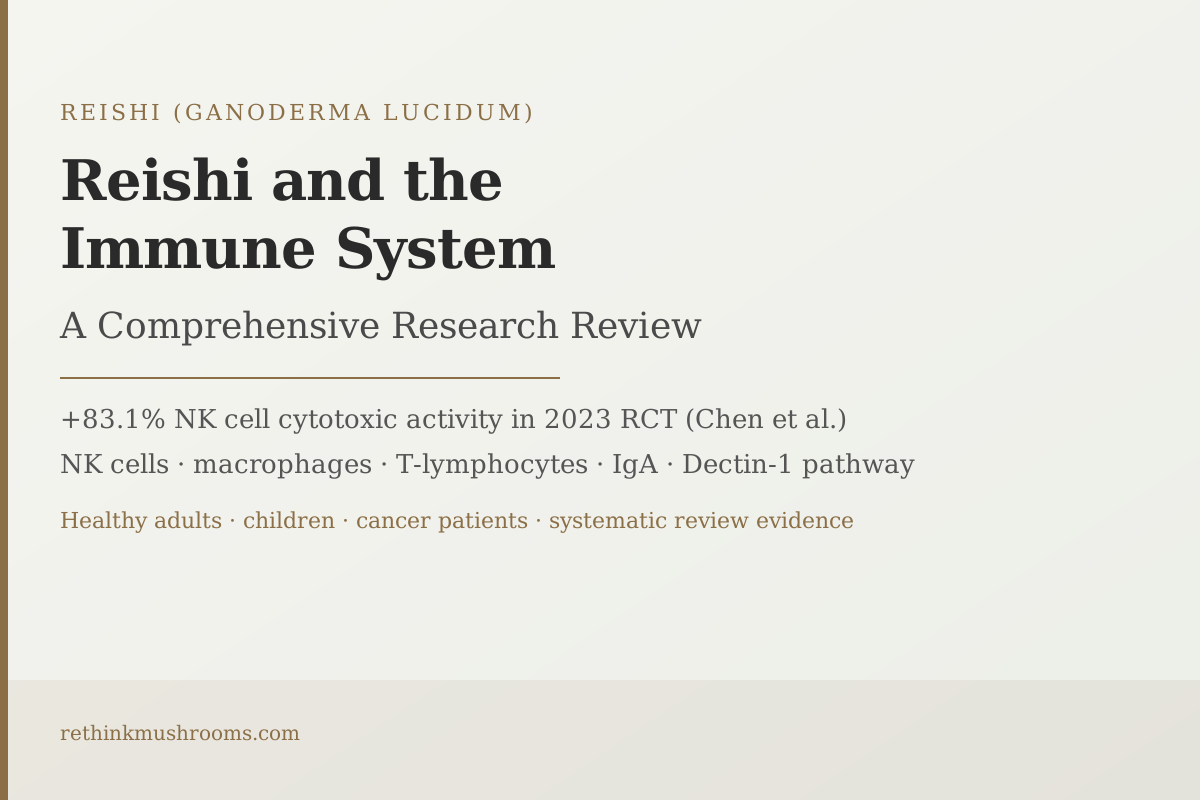
83.1% NK cell activity increase
A 2023 randomized controlled trial in healthy adult volunteers found reishi beta-glucan supplementation increased NK cell cytotoxic activity by 83.1% and NK cell count by 19.5% after 12 weeks versus placebo.
Chen et al., Foods, 2023
+10% IgA
serum immunoglobulin A improvement in the same Chen 2023 RCT, alongside significant CD3+, CD4+, and CD8+ T-lymphocyte increases
Dectin-1 + TLR2/4
the primary receptor pathway through which reishi beta-glucans activate macrophages and NK cells in the innate immune system (Lin 2005, Wang 2019)
Stimulate + Modulate
reishi's polysaccharides activate immune cells while its triterpenes suppress excessive inflammation via NF-κB inhibition: two complementary effects from one mushroom (Wang 2019)
Chen et al., Foods, 2023
 View as image ↗
Reishi mushroom's most studied effect is on the immune system, and unlike many health claims made about medicinal mushrooms, the mechanistic picture here is genuinely specific. It's not "generally supports immunity." It's a measurable increase in the activity of identifiable immune cell populations through a known receptor pathway.
The clearest human evidence: a 2023 randomized controlled trial in healthy adult volunteers found that reishi beta-glucan supplementation produced an 83.1% increase in NK cell cytotoxic activity versus placebo after 12 weeks.[1] NK cells (natural killer cells) are one of the body's primary defenses against virally infected cells and emerging tumor cells. That's not a vague wellness endpoint.
This article covers the full research picture on reishi immune system research: which cells are affected, how the mechanism works at the receptor level, what the clinical trials have found across healthy and immunocompromised populations, and what the dual stimulating-and-modulating nature of reishi's immune effects means. For the broader context of what reishi is and does, the complete guide to reishi mushroom provides that foundation.
Key Takeaways
- A 2023 RCT in healthy adults found reishi beta-glucan supplementation produced +83.1% NK cell cytotoxic activity, +19.5% NK cell count, +10% serum IgA, and significant improvements in CD3+, CD4+, and CD8+ T-lymphocyte levels versus placebo over 12 weeks (Chen et al.)
- Reishi polysaccharides (beta-glucans) bind to Dectin-1, TLR2, TLR4, and complement receptor 3 (CR3) on macrophages and NK cells, triggering intracellular signaling that activates both innate and adaptive immune responses (Lin 2005, Wang 2019)
- Reishi has two distinct immune mechanisms: beta-glucans stimulate immune cell activation, while triterpenes suppress excessive inflammation via NF-κB inhibition. This dual action means reishi can both boost deficient immune responses and moderate excessive ones
- A systematic review of RCTs for fungal beta-glucans found consistent improvements in immune cell counts, NK cell activity, and infection outcomes across populations, with strongest effects in immunocompromised and elderly subjects (Vlassopoulou 2021)
- Clinical evidence extends to vulnerable populations: a 2005 trial in advanced lung cancer patients found reishi polysaccharides significantly improved NK cell counts and CD4/CD8 ratios versus control (Gao 2005)
- A 2018 RCT in Colombian children found that yogurt enriched with reishi beta-glucans for 12 weeks produced significantly higher CD8+ T-lymphocyte and NK cell counts versus placebo, demonstrating immune effects from a food matrix (Henao 2018)
What Immune Cells Reishi Actually Affects
The question "does reishi boost the immune system?" implies a monolithic immune system that can be uniformly boosted. The actual picture is more specific and more interesting.
Wang and Lin (2019) published a comprehensive review of Ganoderma's immunomodulatory effects and proposed mechanisms.[2] The immune cells affected by reishi compounds include:
Macrophages: the first-responder immune cells that engulf pathogens and signal other immune cells. Reishi polysaccharides activate macrophages, increasing their phagocytic activity and cytokine production.
Natural killer (NK) cells: specialized lymphocytes that destroy infected and cancerous cells without needing prior exposure to a specific pathogen. This is the cell type showing the 83.1% cytotoxic activity increase in the 2023 RCT.
Dendritic cells: antigen-presenting cells that link the innate immune system (fast, non-specific) to the adaptive immune system (slow, specific). Reishi polysaccharides activate dendritic cells, prompting them to present antigens to T cells and trigger learned immune responses.
T-lymphocytes: the backbone of adaptive immunity. Reishi supplementation has been shown to increase CD3+, CD4+ (helper T cells), and CD8+ (cytotoxic T cells) populations, as well as improve the CD4/CD8 ratio, a marker of immune balance.
B-lymphocytes: the cells that produce antibodies. The 2023 Chen RCT showed a 10% increase in serum IgA, an antibody class primarily responsible for mucosal immunity (the immune layer protecting the gut and respiratory tract).
This is not a single-pathway effect. Reishi influences multiple cell types in both major branches of immunity. Lin's 2005 foundational mechanistic paper established the distinct molecular pathways for polysaccharide-mediated innate activation and triterpene-mediated adaptive modulation.[3]
How the Mechanism Works: Dectin-1, TLR2/4, and the Signaling Cascade
The receptor-level mechanism explains why reishi beta-glucans specifically activate immune cells.
Beta-glucans from Ganoderma (β-1,3;β-1,6-D-glucans) bind to pattern recognition receptors on the surface of macrophages and NK cells. The primary receptors are Dectin-1, Toll-like receptors 2 and 4 (TLR2 and TLR4), and complement receptor 3 (CR3).[3] These receptors exist on macrophages and other immune cells as part of the innate immune system's pattern-recognition apparatus, designed to detect structural features of microbial cell walls.
When beta-glucans bind to Dectin-1, they trigger an intracellular signaling cascade through the CARD9/Syk pathway. This activates NF-κB (a master regulator of inflammatory and immune gene expression), triggering cytokine production and increasing the cell's activity level. The activated macrophage becomes more effective at phagocytosis (physically engulfing pathogens), more effective at producing signaling molecules that recruit other immune cells, and better at presenting antigens to T cells.
The triterpene compounds in reishi operate on the same NF-κB pathway but in the opposite direction: they suppress excessive NF-κB activation, reducing inflammatory cytokine production.[2] This is why reishi can both stimulate immune responses (via polysaccharides) and moderate immune excess (via triterpenes). The compound classes work in opposite directions on the same target, creating what Wang and Lin describe as a balanced immune response.
For a detailed comparison of how these two compound classes differ in their effects across health applications, how reishi triterpenes differ from polysaccharides in mechanism covers that specifically. For the broader mushroom immunology context, how mushrooms prime innate immunity places reishi within the wider fungal immune literature.
The 2023 RCT: Concrete Numbers from Healthy Adults
The Chen et al. (2023) trial is the most relevant human immune evidence for healthy individuals considering reishi supplementation.[1] Most earlier clinical immune data came from cancer patients or other immunocompromised groups. Chen's RCT in healthy adult volunteers fills the gap.
The trial tested β-1,3;β-1,6-D-glucan derived specifically from Ganoderma lucidum against placebo. After 12 weeks, the reishi group showed:
- NK cell count: +19.5% versus placebo
- NK cell cytotoxic activity: +83.1% versus placebo
- Serum IgA: +10.0% versus placebo
- CD3+ total T-lymphocytes: significant increase
- CD4+ helper T cells: significant increase
- CD8+ cytotoxic T cells: significant increase
- CD4/CD8 ratio: significant improvement
These are not animal model data. They are measured outcomes in human volunteers taking a standardized reishi beta-glucan supplement. The 83.1% cytotoxic activity increase for NK cells is particularly notable because cytotoxic activity, not just cell count, is what determines how effective NK cells are at eliminating threats.
Evidence in Vulnerable Populations: Children and Cancer Patients
Clinical immune evidence for reishi extends across population types. The pattern is consistent: reishi polysaccharides improve immune cell counts and activity, with stronger effects in populations where immune function is suppressed.
Henao and colleagues (2018) conducted a randomized controlled trial in 60 children from Medellin, Colombia, over 12 weeks.[6] Children consumed yogurt enriched with reishi beta-glucans or plain yogurt. The reishi group showed significantly higher CD8+ T-lymphocyte counts and NK cell counts versus placebo. The finding that the active molecule works through a food matrix (not just an isolated supplement) is relevant: it reinforces that the beta-glucan structure is the active agent, not something unique to supplement formulations.
Gao and colleagues (2005) enrolled advanced lung cancer patients in a clinical trial of water-soluble reishi polysaccharides.[8] This population has severely compromised immune function from both cancer and chemotherapy. The reishi polysaccharide group showed significantly improved NK cell counts, improved CD4/CD8 ratios, and overall immune function improvements versus control. For a population where immune restoration is clinically meaningful, this represents direct therapeutic evidence.
Neuwirthová and colleagues (2020) reviewed the clinical evidence for reishi and turkey tail (Trametes versicolor) in cancer patients.[7] The review documents NK cell restoration, CD4+ T-cell improvement, and tumor-specific immune response enhancement across multiple clinical investigations. For a comprehensive look at reishi's role in cancer supportive care, Ganoderma lucidum as a cancer adjunct covers that evidence directly.
The Systematic Review Level: What Meta-Evidence Shows
Vlassopoulou and colleagues (2021) conducted a systematic review specifically focused on randomized controlled trials of fungal beta-glucans.[4] Reishi was among the species included. The review's conclusions across the available RCT evidence: fungal beta-glucans consistently showed improvements in immune cell counts, NK cell activity, and infection outcomes across diverse populations. The strongest effects appeared in immunocompromised and elderly subjects.
This systematic-level evidence provides context for interpreting the individual trials. Reishi's immune effects are not isolated findings; they replicate across species, populations, and measurement approaches within the fungal beta-glucan literature.
A 2023 systematic review by Zhao and colleagues specifically covering Ganoderma lucidum spore preparations confirmed immune modulation as well-documented pharmacological activity.[9] Spore extracts are particularly concentrated in both polysaccharides and triterpenes relative to whole mushroom powder, which may explain their documented efficacy in multiple studies.
The Dual Mechanism: Stimulation and Modulation
Guggenheim and colleagues (2014) positioned Ganoderma in an integrative oncology review covering five major immune-modulating mushrooms.[5] Their assessment: Ganoderma has the most comprehensive immune profile of the five species reviewed, covering macrophage activation, NK cell stimulation, T-cell regulation, and anti-tumor immune effects in combination.
The dual mechanism is what distinguishes reishi from simpler immune stimulants. Most supplements sold for immune support work via a single pathway: either pro-inflammatory stimulation, or anti-inflammatory suppression. Reishi does both simultaneously via different compound classes.
This bidirectionality has clinical relevance. In immunodeficiency (cancer patients, elderly, post-illness recovery), the beta-glucan-mediated stimulation is the primary beneficial effect. In conditions involving excessive immune activation (inflammation-driven conditions, allergic responses), the triterpene-mediated NF-κB suppression is the relevant pathway. A mushroom that can both enhance deficient immune responses and moderate excessive ones is mechanistically suited to a wider range of immune contexts than a single-direction immunostimulant.
For the clinical evidence on colds and flu prevention, where this dual mechanism is relevant for both prevention (NK cell activation) and symptom severity (inflammation modulation), can reishi help prevent colds and flu covers that specific evidence. For the innate and adaptive immune distinction in more mechanistic depth, how reishi modulates innate and adaptive immunity examines those pathways at the cell biology level. For the beta-glucan activation story specifically, reishi beta-glucans and immune cell activation goes further into the Dectin-1 receptor biology.
The Bottom Line
Reishi polysaccharides (beta-glucans) activate macrophages, NK cells, dendritic cells, and T/B lymphocytes via Dectin-1 and TLR receptors, while triterpenes simultaneously moderate excessive immune activation via NF-κB inhibition. A 2023 RCT in healthy adults produced an 83.1% increase in NK cell cytotoxic activity. Clinical evidence extends to children, elderly subjects, and cancer patients. The bidirectional mechanism (stimulation of deficient immune function and moderation of excessive activation) is the feature that distinguishes reishi from simpler immunostimulants.
Frequently Asked Questions
Sources & References
- 1. Source details for this reference are not yet available.
- 2. Source details for this reference are not yet available.
- 3. Source details for this reference are not yet available.
- 4. Source details for this reference are not yet available.
- 5. Source details for this reference are not yet available.
- 6. Source details for this reference are not yet available.
- 7. Source details for this reference are not yet available.
- 8. Source details for this reference are not yet available.
- 9. Source details for this reference are not yet available.