Schizophyllum commune (Split Gill)
Dectin-1: the receptor that makes SPG specifically target dendritic cells
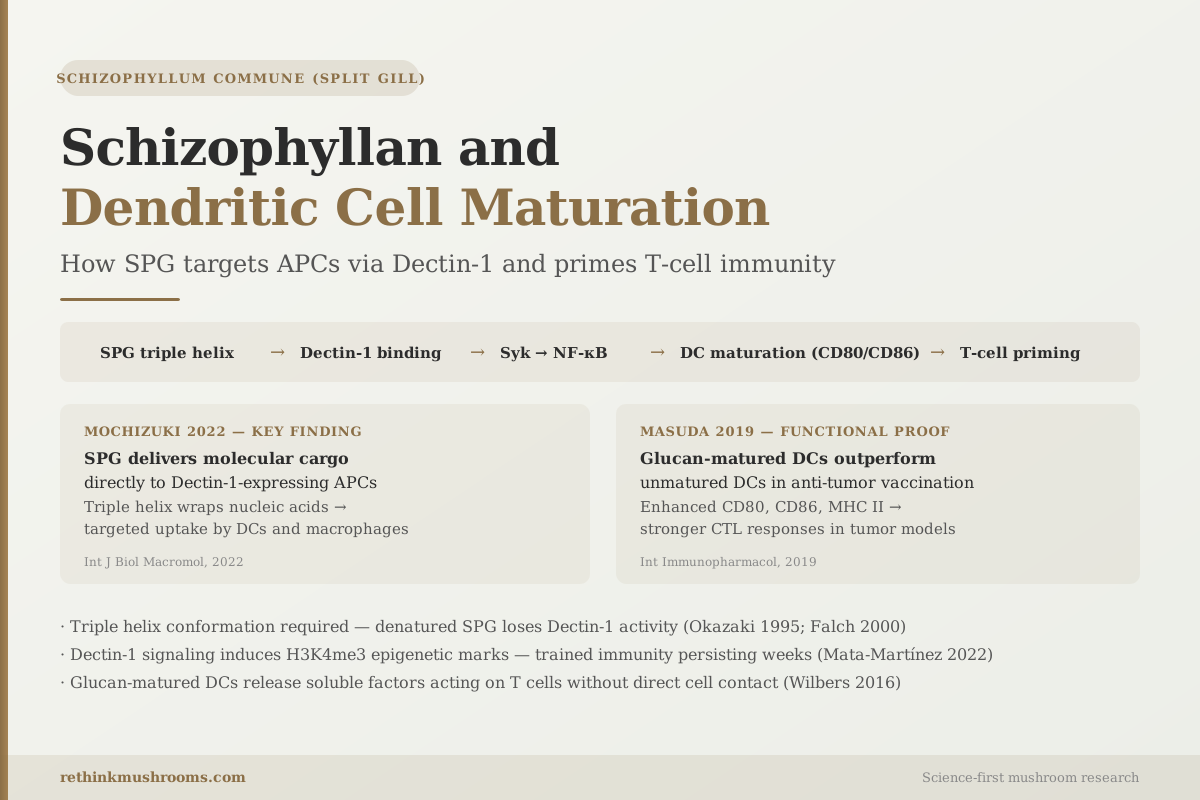
Schizophyllan's triple-helix structure is recognized by Dectin-1 on dendritic cells, triggering a maturation cascade that bridges innate detection and adaptive T-cell immunity. A 2022 study showed SPG delivers molecular cargo directly to these cells.
Mochizuki et al., Int J Biol Macromol, 2022; Ansari et al., Carbohydr Polym, 2025
Triple-helix structure required
denaturing the glucan irreversibly reduces its cytokine-stimulating activity (Falch 2000)
Mochizuki 2022
SPG wraps nucleic acids and delivers them directly to Dectin-1-expressing APCs
Glucan-matured DCs
produce stronger anti-tumor T-cell responses than unmatured DCs (Masuda 2019)
Mochizuki et al., Int J Biol Macromol, 2022; Ansari et al., Carbohydr Polym, 2025
 View as image ↗
Dendritic cells are the immune system's bridge between a detected threat and a targeted response. When they encounter a pathogen or tumor antigen, they mature, upregulate surface markers that activate T cells, and direct the adaptive immune response toward that specific target. Without dendritic cell maturation, even the presence of a foreign antigen doesn't reliably produce an effective immune response.
Schizophyllan (SPG), the beta-glucan produced by the split gill mushroom Schizophyllum commune, is recognized by a receptor on dendritic cells called Dectin-1. The recognition triggers dendritic cell maturation. In a 2022 study, researchers showed that SPG can even deliver molecular cargo specifically to Dectin-1-expressing antigen-presenting cells including dendritic cells, suggesting a more specific DC-targeting mechanism than most mushroom immune compounds demonstrate.[1]
This article covers what the research shows about SPG and dendritic cell maturation. It sits within the Schizophyllum commune pillar and connects to related articles on SPG's immune system effects, macrophage activation by SPG, and SPG as a biological response modifier.
Key Takeaways
- Schizophyllan binds Dectin-1 receptors on dendritic cells, triggering a signaling cascade (Syk kinase → CARD9 → NF-κB) that drives DC maturation with upregulated CD80, CD86, and MHC II surface markers
- The triple-helix conformation is structurally required for full immunological activity; denaturing the helix irreversibly reduces a beta-glucan's cytokine-stimulating activity, and the reduction is not restored even when the structure is re-annealed (Falch et al., 2000)
- A 2022 study found that SPG wrapped around oligonucleotide sequences is specifically taken up by Dectin-1-expressing antigen-presenting cells including dendritic cells, demonstrating targeted molecular delivery (Mochizuki et al., 2022)
- Mushroom glucan-matured dendritic cells showed enhanced expression of co-stimulatory markers and produced stronger anti-tumor T-cell responses when used in DC vaccination protocols (Masuda et al., 2019)
- Glucan stimulation of DCs produces soluble immunomodulatory factors that act on T cells without requiring direct DC-T cell contact, amplifying the immune-activating effect beyond cells the DC directly interacts with (Wilbers et al., 2016)
- A 2022 review establishes Dectin-1 as crucial for beta-glucan-induced trained immunity — a long-term, epigenetically encoded reprogramming of innate immune cells (in the broader literature, marked by H3K4me3 histone modifications) that leaves the cells primed to respond more vigorously to later challenges (Mata-Martinez et al., 2022)
What Dendritic Cells Actually Do, and Why Activating Them Matters
Dendritic cells are sometimes called the generals of the adaptive immune system. They are not the soldiers that kill tumors or clear infections; they are the cells that identify what the threat is and direct the immune response toward it. Understanding their role is essential for understanding why SPG's mechanism matters.
Dendritic cells in their immature form are found throughout peripheral tissues. They are equipped with pattern recognition receptors, including Dectin-1, that detect molecular patterns associated with pathogens and abnormal cells. When an immature dendritic cell encounters one of these patterns, it begins maturing: it processes the antigen, migrates to lymph nodes, and upregulates a set of surface proteins called co-stimulatory molecules (CD80 and CD86) and major histocompatibility complex class II (MHC II) molecules.
These surface proteins are what allow the dendritic cell to activate T cells. When a T cell encounters a mature dendritic cell displaying a specific antigen on MHC II with co-stimulatory signals present, the T cell is activated, proliferates, and differentiates into cytotoxic T cells that can kill target cells bearing that antigen, or helper T cells that coordinate the broader immune response.
Without dendritic cell maturation, this activation chain breaks. Immature dendritic cells encountering T cells without the proper co-stimulatory signals can actually induce T-cell tolerance or anergy rather than activation, producing immune suppression rather than immune activation. This is one of the mechanisms tumors exploit to evade immunity: suppressing DC maturation in the tumor microenvironment prevents effective T-cell activation against tumor antigens.
Compounds that specifically promote dendritic cell maturation therefore have strategic value. They don't kill cancer cells directly. They mature the cells that train the immune system to recognize and respond to cancer.[2]
Why Schizophyllan Specifically Targets Dendritic Cells via Dectin-1
Not all immune-stimulating compounds interact with dendritic cells through the same receptor or with the same specificity. SPG's interaction with DCs occurs through Dectin-1, a C-type lectin pattern recognition receptor expressed on macrophages, neutrophils, dendritic cells, and some lymphocytes.
A 2007 crystallographic study resolved several structures of the Dectin-1 receptor, including one with a natural beta-glucan trapped in the crystal lattice, and showed that Dectin-1 forms higher-order complexes with beta-glucans.[3] The receptor binds beta-1,3-glucan through its C-type lectin-like carbohydrate recognition domain. The functional importance of the triple-helix conformation, however, is shown most clearly not by the receptor structure alone but by what happens when the glucan's higher-order structure is destroyed.
That structure-dependence was established experimentally by Falch and colleagues in 2000. Studying scleroglucan, schizophyllan, and lentinan — comb-like branched (1→3)-beta-D-glucans — they found that cytokine-stimulating activity depended on molecular weight and higher-order structure, and that denaturing the linear triple helices with NaOH caused an irreversible reduction in cytokine-inducing activity. Critically, the activity was not restored even after the denatured samples were re-annealed back to structures that looked identical to the starting material under electron microscopy.[10] This is why SPG's intact triple-helix conformation is functionally important, and it carries a practical warning: manufacturing and extraction processes that denature the glucan structure can produce immunologically weakened products that cannot simply be "re-folded" back to potency.
The SPG-Dectin-1 relationship matters on dendritic cells specifically because DCs are among the antigen-presenting cells that express Dectin-1, the major receptor for beta-glucans. SPG's intact, triple-helical molecular structure is recognized by this receptor, which is the basis for SPG being developed as a delivery vehicle that targets compounds specifically to antigen-presenting cells — the property the 2022 Mochizuki study put to use.
For a detailed account of how the same Dectin-1 pathway operates in macrophages, the article on SPG and macrophage activation: how it primes immunity covers that parallel story.
The Mochizuki 2022 Discovery: SPG Delivers Molecular Cargo Directly to APCs
A 2022 study by Mochizuki and colleagues represented the most mechanistically specific evidence yet for SPG's interaction with antigen-presenting cells including dendritic cells.[1]
The researchers demonstrated that SPG, because of its triple-helix structure, can wrap around single-stranded nucleic acid sequences such as oligonucleotides through hydrogen bonding. The SPG strand and the nucleic acid sequence form a triple-helix complex together. This complex retains SPG's Dectin-1 binding capacity while carrying the nucleic acid as a passenger.
When these SPG-nucleic acid complexes were introduced to cells, they were specifically taken up by Dectin-1-expressing antigen-presenting cells, including both macrophages and dendritic cells. Cells without Dectin-1 did not take up the complexes at comparable levels. This demonstrates targeted delivery: SPG does not just broadly activate immune cells, it delivers its payload specifically to the cells that express its receptor.
The clinical significance of this finding is in the context of immunotherapy and vaccine adjuvants. SPG acts as a delivery vehicle that ensures molecules reach the specific antigen-presenting cells that need to receive them. A compound or antigen delivered via SPG arrives in dendritic cells, where it can be processed and presented to T cells, rather than being diluted across non-specific cell types.
This study is the most direct experimental evidence for SPG's mechanism of interaction with dendritic cells published to date, and it has received essentially no attention in consumer health media. The 2025 Ansari review, the most current comprehensive SPG synthesis, discusses this delivery platform as one of the most promising emerging applications of schizophyllan.[9]
Mochizuki, Miyamoto & Sakurai (2022) · Drug Metabolism and Pharmacokinetics
- Population
- In vitro Dectin-1 binding (quartz crystal microbalance) plus in vivo mouse models
- Intervention
- SPG complexed with oligonucleotides (antisense, siRNA, or CpG-ODN) via triple-helix hydrogen bonding
- Comparator
- Free oligonucleotide / cells lacking Dectin-1
- Finding
- An SPG–oligonucleotide complex was recognized by recombinant Dectin-1; an SPG-delivered antisense ODN against TNF-alpha protected mice from LPS-induced hepatitis at a very low dose, and a CpG-ODN/SPG complex plus antigen induced potent antigen-specific immune responses.
preliminary Mechanistic and preclinical (in vitro binding and mouse models); no human trials of the SPG delivery platform yet.
Mochizuki et al., Drug Metab Pharmacokinet, 2022 (PMID 34896749)
Glucan-Matured Dendritic Cells Produce Stronger Anti-Tumor T-Cell Responses
The functional consequence of dendritic cell maturation by glucans is not just a change in surface markers. It changes the dendritic cell's ability to activate anti-tumor T cells.
A 2019 study by Masuda and colleagues tested this directly using maitake mushroom alpha-glucan to mature dendritic cells ex vivo, then used those matured DCs in a DC vaccination protocol in tumor-bearing mice.[6] Glucan-matured DCs showed significantly higher expression of CD80, CD86, and MHC II compared to unmatured DCs. When these glucan-matured DCs were used in vaccination, they produced substantially stronger anti-tumor cytotoxic T-cell responses than vaccinations with unmatured DCs.
This is the functional proof that glucan-mediated DC maturation has consequences beyond laboratory markers: matured DCs are more effective at training anti-tumor T cells. The Masuda study used a different mushroom glucan than SPG, but the mechanism is shared. SPG and maitake glucan both bind Dectin-1 on DCs; the downstream maturation and enhanced APC function is a consequence of Dectin-1 activation rather than a species-specific effect.
A parallel study by Wilbers and colleagues added another dimension: dendritic cells stimulated by mushroom glucans release soluble immunomodulatory factors that act on T cells even without direct cell-to-cell contact.[7] The matured DC's influence extends beyond its immediate neighborhood through secreted cytokines and chemokines. This amplifies the immune-activating effect: a single SPG-activated DC can influence T-cell behavior across a radius larger than its direct contacts would allow.
For the broader context on how mushroom beta-glucans epigenetically reprogram immune cells, the article on how beta-glucans epigenetically reprogram immune cells covers the histone modification and trained immunity angle that applies across glucan types.
The DC Maturation Cascade: From Dectin-1 Binding to T-Cell Priming
The molecular journey from SPG binding to Dectin-1 to a mature DC capable of activating T cells involves a well-defined signaling cascade that has been detailed in multiple review studies.
When SPG binds Dectin-1 on a dendritic cell surface, the receptor's intracellular tail activates Syk kinase. Syk initiates a signaling complex involving CARD9, Bcl10, and MALT1, which activates NF-κB and MAPK pathways.[4] NF-κB activation drives transcription of pro-inflammatory cytokines (IL-6, IL-12, IL-23) and upregulation of the co-stimulatory molecules CD80 and CD86.
The resulting cytokine profile matters for T-cell polarization. IL-12 drives Th1 polarization (cell-mediated immunity, cytotoxic T-cell activation). IL-23 supports Th17 differentiation. Both of these phenotypes are associated with effective anti-tumor and anti-pathogen immunity. The DC that SPG matures is primed to direct adaptive immunity toward a type 1, cell-mediated response.[5]
The DC maturation stages that SPG drives:
- Immature DC: low surface expression of CD80, CD86, MHC II; high capacity for antigen uptake
- SPG-stimulated DC: Dectin-1 activation initiates maturation; antigen uptake decreases as presentation machinery upregulates
- Mature DC: high CD80, CD86, MHC II; IL-12 and IL-23 production; migration toward lymphoid tissue; ready for T-cell activation
Each stage is functionally important. SPG accelerates the transition from immature to mature DC, which is the rate-limiting step in many anti-tumor immune responses. For a broader look at how this Dectin-1 cascade interacts with the split gill mushroom's cancer immunity applications, the article on split gill and dendritic cell maturation: cancer immunity covers the oncology applications.
Trained Immunity in Dendritic Cells: An Epigenetic Dimension
The most recent research on Dectin-1 signaling has added a new layer to the SPG-DC interaction: trained immunity.
Trained immunity refers to the epigenetic reprogramming of innate immune cells, including dendritic cells, that occurs after an initial stimulus. Rather than reverting to their baseline state after the stimulus clears, trained cells maintain an enhanced responsiveness to future challenges. This is a form of immunological memory that exists in innate cells, separate from the antigen-specific memory of adaptive immunity.
A 2022 review by Mata-Martinez and colleagues specifically updated the understanding of Dectin-1 signaling in the context of trained immunity, concluding that this long-term memory of innate immune cells can be triggered by beta-glucans and that Dectin-1 is crucial for its initiation.[8] The mechanism the trained-immunity literature attributes to beta-glucan involves epigenetic modifications at the chromatin level — notably H3K4me3 histone marks at the promoters of inflammatory genes — that increase the accessibility of those promoters so the cell responds more vigorously to future stimulation. The reprogramming persists well beyond the initial glucan exposure rather than resetting to baseline once the stimulus clears.
The trained immunity mechanism means SPG's effect on dendritic cells is not purely transient. A DC that has been stimulated by SPG carries a lasting epigenetic state that makes it more capable of responding to future antigens and activating T cells more effectively. For mushroom-based immune research, this is a significant finding: it suggests that periodic SPG exposure could maintain dendritic cells in a state of heightened functional readiness rather than requiring constant SPG presence.
For the companion article covering how beta-glucans activate macrophages (with a similar trained immunity angle), the article on how medicinal mushrooms activate macrophages covers parallel mechanisms.
The Bottom Line
Schizophyllan activates dendritic cells through Dectin-1 receptors, triggering a maturation cascade (Syk → CARD9 → NF-κB) that upregulates CD80, CD86, and MHC II and drives IL-12 and IL-23 production. The triple-helix conformation of SPG is structurally required for this activity; denatured glucan loses immunological potency. A 2022 study demonstrated SPG can deliver molecular cargo directly to Dectin-1-expressing APCs including dendritic cells. Glucan-matured DCs produce stronger anti-tumor T-cell responses in DC vaccination protocols, and their stimulating effects extend to neighboring T cells through secreted factors. A 2022 update on Dectin-1 signaling documented that beta-glucan stimulation induces lasting epigenetic reprogramming of DCs through H3K4me3 histone modification.
Frequently Asked Questions
Sources & References
- 1RTHM-01586·Mochizuki, Shinichi et al. (2022). “Oligonucleotide delivery to antigen presenting cells by using schizophyllan..” Drug metabolism and pharmacokinetics.Study breakdown →PubMed →↩
- 2RTHM-00154·Goodridge, Helen S et al. (2009). “Beta-glucan recognition by the innate immune system..” Immunological reviews.Study breakdown →PubMed →↩
- 3RTHM-00111·Brown, James et al. (2007). “Structure of the fungal beta-glucan-binding immune receptor dectin-1: implications for function..” Protein science : a publication of the Protein Society.Study breakdown →PubMed →↩
- 4RTHM-00244·Batbayar, Sainkhuu et al. (2012). “Immunomodulation of Fungal β-Glucan in Host Defense Signaling by Dectin-1..” Biomolecules & therapeutics.Study breakdown →PubMed →↩
- 5RTHM-00333·Lee, Dong Hee et al. (2014). “Innate immunity induced by fungal β-glucans via dectin-1 signaling pathway..” International journal of medicinal mushrooms.Study breakdown →PubMed →↩
- 6RTHM-01106·Masuda, Yuki et al. (2019). “Maturation of dendritic cells by maitake α-glucan enhances anti-cancer effect of dendritic cell vaccination..” International immunopharmacology.Study breakdown →PubMed →↩
- 7RTHM-00839·Wilbers, Ruud H P et al. (2016). “Physical Interaction of T Cells with Dendritic Cells Is Not Required for the Immunomodulatory Effects of the Edible Mushroom Agaricus subrufescens..” Frontiers in immunology.Study breakdown →PubMed →↩
- 8RTHM-01584·Mata-Martínez, Pablo et al. (2022). “Dectin-1 Signaling Update: New Perspectives for Trained Immunity..” Frontiers in immunology.Study breakdown →PubMed →↩
- 9RTHM-02051·Ansari, Elham et al. (2025). “Research progress on production and biomedical applications of Schizophyllan as a tailor-made polysaccharide: A review..” Carbohydrate polymers.Study breakdown →PubMed →↩
- 10RTHM-00032·Falch, B H et al. (2000). “The cytokine stimulating activity of (1-->3)-beta-D-glucans is dependent on the triple helix conformation..” Carbohydrate research.Study breakdown →PubMed →↩