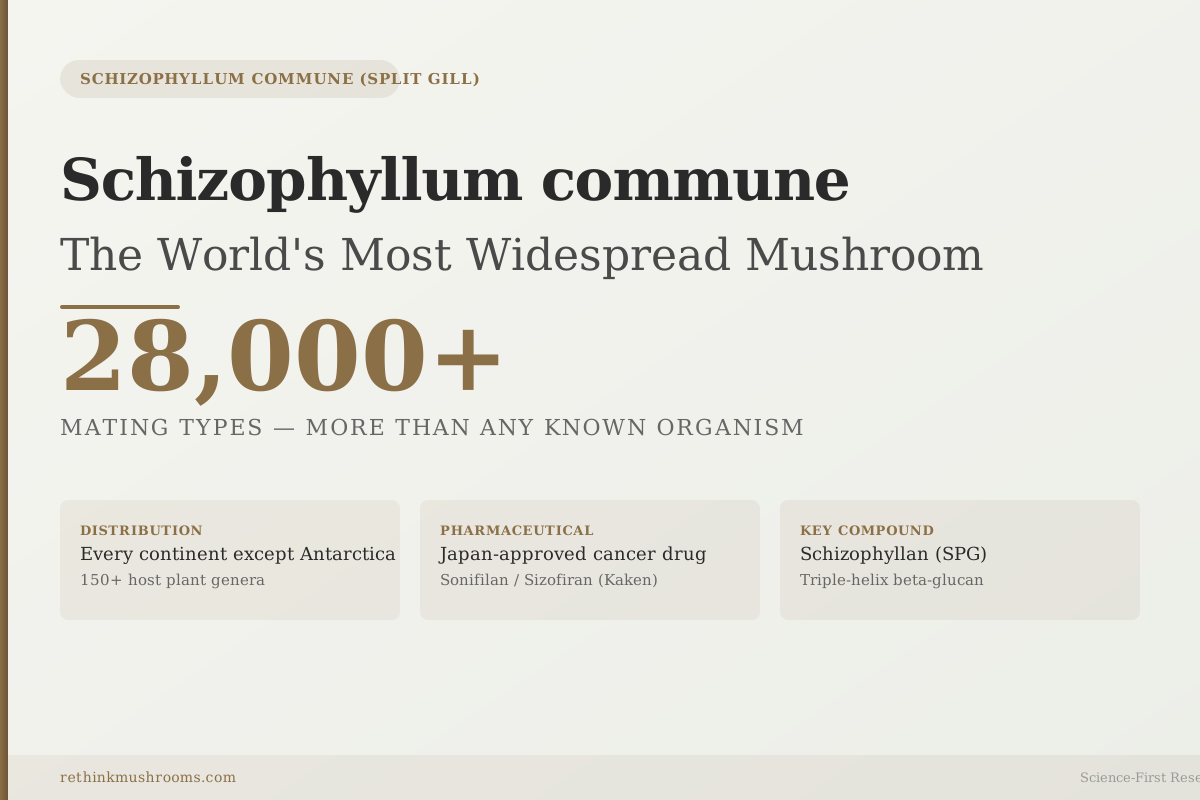
Schizophyllum commune (Split Gill)
28,000+ mating types
Schizophyllum commune holds the biological record for mating diversity and produces schizophyllan, a compound approved as a cancer adjuvant drug in Japan.
Ansari et al., Carbohydrate Polymers, 2025
Every continent
except Antarctica
Japan-approved
cancer immunotherapy drug
150+ plant genera
grows on almost any dead wood
Ansari et al., Carbohydrate Polymers, 2025
 View as image ↗
Schizophyllum commune, commonly called the split gill mushroom, is arguably the world's most widely distributed fungus. It grows on dead wood on every continent except Antarctica, on over 150 genera of host plants. It is remarkable for two reasons: biologically, it has more than 28,000 distinct mating types, more than any known organism; medically, it produces a compound called schizophyllan that is an approved anti-cancer drug in Japan.[1]
Most people have never heard of it. Most mushroom supplement sites have never written about it. The biologists who study its genetics are usually not the same people who follow its pharmaceutical development, and neither group talks to the foragers who identify it on weekend walks.
This article covers both sides: the biology that makes S. commune a genuine scientific marvel, and the clinical evidence that makes it medically significant. They are equally surprising.
Key Takeaways
- Schizophyllum commune holds the biological record for mating diversity: over 28,000 genetically distinct sexual identities, meaning any individual can mate with roughly 99% of all others it encounters
- It grows on dead wood on every continent except Antarctica, on over 150 plant genera, sustained by white rot enzymes and a split-gill survival mechanism that prevents desiccation
- The mushroom produces schizophyllan (SPG), a polysaccharide that forms a rigid triple helix in water; a 2000 study by Bohn and BeMiller established that this triple-helix structure is required for its immune-activating properties
- A 326-patient randomized controlled trial (Fujimoto et al., Surgery Today, 1984) found a statistically significant 5-year survival advantage for Stage III gastric cancer patients treated with schizophyllan plus chemotherapy vs. chemotherapy alone (p=0.0105)
- Schizophyllan is approved in Japan as a cancer adjuvant immunotherapy under the brand names Sonifilan and Sizofiran; it is not approved by the FDA or EMA
- In people with severely compromised immune systems, S. commune can cause opportunistic infections — a risk entirely separate from the pharmaceutical extract
28,000 Mating Types: The Number That Makes Geneticists Stop and Stare
Most organisms that reproduce sexually have two mating types. Some algae and fungi have a handful. Schizophyllum commune has more than 28,000 — the highest count of any known organism on Earth.
To understand what that number means, start with what a mating type actually is. In fungi, mating types are genetic identities that determine which individuals can reproduce together. The rule is simple: two individuals can only mate if their types are different at the relevant genetic locations. This biological gate ensures outbreeding and prevents genetically identical individuals from reproducing with each other.
S. commune has two mating loci — designated A and B. Each locus contains multiple independently segregating subloci: the A locus has Aα and Aβ; the B locus has Bα and Bβ. Each sublocus exists in many versions (alleles). The Aα sublocus has around 32 distinct alleles. Aβ has around 48. Each B sublocus has comparable numbers. When you multiply the possible combinations across all four subloci, you reach a theoretical ceiling of more than 28,000 distinct mating-type identities across the species.
The practical result is that any individual S. commune can mate with roughly 99% of all other individuals it encounters. This is as close to the theoretical maximum for outbreeding as any biological system known.
John Raper at Harvard recognized the research potential of this system in the late 1940s. He spent two decades building a research program around S. commune, mapping the genetics of sexual compatibility in detail that no other organism could provide. The body of work he and his students published from the 1950s through the 1970s established S. commune as a foundational model organism in transmission genetics — not for any single experiment, but for providing an unusually tractable window into how organisms encode sexual identity in their genomes.[1]
The 28,000 figure gets cited as a curiosity. But the underlying biology is an elegant solution to a real problem. A fungal species dispersed by wind spores across six continents cannot afford a mating system that rejects most potential partners on the basis of genetic similarity. A system that approves 99% of all pairings solves the problem completely — every new territory colonized by a single spore has near-certain reproductive potential the moment a second spore arrives.
Why Schizophyllum commune Grows on Every Continent: Three Biological Answers
Geographic distribution this wide requires more than just good spore dispersal. Most fungal species have narrow habitat ranges. S. commune is genuinely global — documented in tropical rainforests, temperate woodlands, Mediterranean scrublands, subtropical forests, and suburban gardens across five continents, with occurrences recorded on most other land masses.
Three mechanisms work together to make this possible.
White rot enzymes. Schizophyllum commune is a white rot fungus. It produces enzymes that break down lignin, the tough polymer that gives wood its structural rigidity. Most wood-decaying organisms can only digest cellulose — the softer structural sugar in wood — and stop at lignin. White rot fungi go further, secreting peroxidases and laccases that attack lignin directly. This gives S. commune access to dead wood that other organisms cannot colonize, dramatically expanding its potential habitat across virtually any tree species on Earth.
The split-gill survival mechanism. The mushroom's gills — the ribbed structures on its underside that bear the spores — split lengthwise and curl inward when the surrounding air is dry. This physically protects the spore-bearing surface from desiccation. When humidity rises, the gills reopen and sporulation resumes. This is the origin of the common name "split gill." Very few multicellular fungi can fully desiccate and recover without cellular damage. This mechanism allows S. commune to survive dry seasons, variable climates, and conditions that would kill most other fruiting fungi.
Spore biology. S. commune produces small, lightweight spores in large quantities. They are carried by wind, water, insects, and animals across geographic barriers that would stop most organisms. Spore viability is sufficient for long-distance dispersal. A species that can colonize almost any dead wood, survive desiccation, and broadcast spores globally faces no barrier to establishment anywhere wood decomposes — which is everywhere except Antarctica, where temperatures prevent wood formation entirely.
For a deeper look at the molecular biology driving this global reach, including the enzymatic genetics of lignin degradation and the cellular basis of the split-gill mechanism, see The Biology of Schizophyllum commune: Why It Grows Everywhere.
Schizophyllan: The Compound That Only Works as a Triple Helix
Inside the cells of Schizophyllum commune is a long-chain sugar molecule called schizophyllan, abbreviated SPG. It belongs to a class of molecules called polysaccharides — long chains of sugar units linked together. The specific way those units connect, and the three-dimensional shape the chain forms in water, determines whether the molecule does anything useful in the human body.[1]
Schizophyllan is a beta-glucan. That means it is a chain of glucose units connected through a particular type of chemical bond — a β-(1→3) linkage — with small branches attached at every third unit via β-(1→6) bonds. In plain terms: glucose chains connected backbone-to-backbone, with small offshoots at regular intervals. When dissolved in water, three of these chains wrap around each other spontaneously to form a triple helix — a braided, rope-like structure with substantial rigidity.
That triple helix is not a structural curiosity. It is the pharmacological mechanism.
Bohn and BeMiller established this in a 2000 study published in Carbohydrate Polymers.[2] They demonstrated that the triple-helix conformation is required for schizophyllan's cytokine-stimulating activity — its ability to trigger immune cells to produce signaling proteins that activate anti-tumor responses. Denature the triple helix to a single chain by heating or dissolving in certain solvents, and most of the immune-activating effect disappears.
The shape of the molecule is the mechanism. Schizophyllan is not a generic immune stimulant that works in any form. It works in one specific three-dimensional configuration, and preserving that configuration is essential for effective pharmaceutical preparations.
This structural specificity also explains why schizophyllan is pharmacologically distinct from other beta-glucans. Oat beta-glucan forms linear chains without triple-helix structure — it is effective for cholesterol management via bile acid binding, but does not activate immune cells the same way. Yeast beta-glucan has branching but lacks the rigid triple helix. Lentinan from shiitake mushroom is structurally more similar to schizophyllan and carries some clinical trial evidence, but a different and smaller evidence base than SPG. The structural differences between these compounds correspond to measurable differences in receptor binding and clinical outcomes.
For a detailed structural comparison of schizophyllan against other beta-glucans and an explanation of how it activates specific immune receptors including Dectin-1, see Schizophyllan (SPG): The Most-Studied Beta-Glucan You've Never Heard Of.
The Japan-Approved Cancer Drug That Most of the Western World Has Never Heard Of
The pharmaceutical story of schizophyllan is one of the stranger gaps in modern natural product medicine. The evidence base is substantial. The clinical trials were rigorous. The regulatory approval was real. Almost nobody outside Japan knows it exists.
Japanese researchers began investigating schizophyllan's immune effects in the 1960s, following animal studies showing that certain fungal polysaccharide extracts slowed tumor growth. By the late 1970s, pharmaceutical-grade schizophyllan had been purified and standardized. A clinical trial program began in earnest.
The most rigorous early test was a 1984 randomized controlled trial led by Fujimoto and colleagues. They enrolled 326 patients with resectable gastric cancer across multiple Japanese institutions and randomized them to either chemotherapy alone or chemotherapy plus schizophyllan injections as an adjuvant immunotherapy.[3] The primary outcome was five-year survival. For Stage III patients — those with the most locally advanced disease in the trial — the schizophyllan arm showed a statistically significant survival advantage, with a p-value of 0.0105. This was a landmark result: a natural product-derived compound demonstrating an outcome-level survival benefit in a randomized design with over 300 patients.
The trial program continued. A second gastric cancer trial with 386 patients confirmed the Stage III survival finding. A multi-center trial across 52 Japanese institutions enrolled 220 patients with Stage II-III cervical cancer and found that schizophyllan combined with radiation therapy significantly extended time to recurrence and improved five-year survival compared to radiation alone. A 2021 systematic review by Brown and Gordon, published in Frontiers in Oncology, examined the full evidence base for fungal beta-glucans as cancer adjuvants and confirmed that schizophyllan sits among the most rigorously tested compounds in the category, with a clinical trial program that exceeds most natural products and many approved pharmaceuticals in terms of patient enrollment and trial design quality.[4]
By the early 1990s, the accumulated evidence supported regulatory approval in Japan. Schizophyllan was classified as a biological response modifier — a drug that works by stimulating or modifying immune responses rather than directly attacking cancer cells. It is manufactured by Kaken Pharmaceutical under two brand names: Sonifilan (for cervical cancer indication) and Sizofiran (for gastric cancer indication). The drug is administered by injection, not taken orally.
For the complete trial-by-trial breakdown — including Stage-specific survival data and comparisons against current standards — see Schizophyllan (SPG): The Mushroom Compound Used as a Drug in Japan. For the narrative history of how this compound moved from laboratory to pharmacy, see Split Gill Mushroom: From Common Fungus to Pharmaceutical Agent.
Therapeutic on One Side, Pathogenic on the Other
Here is the part of the S. commune story that most mushroom sites skip entirely.
The same species that produces an approved cancer drug can, in specific circumstances, cause infection. In people with normal immune function, encountering S. commune spores in outdoor environments causes no harm. The fungus cannot establish itself in healthy tissue. Immune defenses clear it routinely.
But in people with severely compromised immune systems — organ transplant recipients on anti-rejection drugs, patients receiving chemotherapy that suppresses white blood cell production, people with advanced hematological malignancies — S. commune has been documented causing opportunistic infections. These include sinusitis (sinus cavity infection), pneumonia, and in rare cases brain abscesses following spore inhalation. The condition is sometimes classified under the umbrella term hyalohyphomycosis.
This dual nature is less contradictory than it appears. The therapeutic application involves a purified, pharmaceutical-grade polysaccharide extract given by injection under clinical supervision to cancer patients who still retain functional immune capacity. The schizophyllan in this context is stimulating the immune cells that are still present to work more effectively.
The pathogenic risk involves the living organism — its spores establishing growth in tissue where the immune system is too suppressed to mount a defense. These are different biological entities affecting different patient populations through different mechanisms. Understanding both is part of having an accurate picture of this species.
What Researchers Are Building With Schizophyllan in 2025
The oncology trials that supported Japan's drug approval are decades old. Schizophyllan research has since expanded into entirely different application areas.
The most active current direction is drug delivery. When schizophyllan is dissolved in dimethyl sulfoxide — a common laboratory solvent — the triple helix unwinds into a single-chain form called s-SPG. This single-chain form can wrap around DNA and RNA molecules, forming stable complexes that protect genetic material from degradation inside the body. This makes s-SPG a candidate vehicle for gene delivery and RNA therapeutics: carrying genetic payloads into cells without the toxicity problems associated with many synthetic carriers.[1]
A 2025 review by Ansari and colleagues in Carbohydrate Polymers described schizophyllan as a "tailor-made polysaccharide" with active research across multiple fronts: nanoparticle drug delivery systems, wound-healing hydrogels (the triple helix forms stable gels that support tissue scaffolding), tissue engineering scaffolds, and ongoing cancer immunotherapy development. The review examined production optimization methods and commercial scale-up pathways — a sign that researchers treat schizophyllan as a platform material with multiple application tracks, not a single-purpose compound.
These applications are largely preclinical or in early clinical investigation. They represent the next generation of research built on the foundational pharmacology documented in Japan over the past four decades.
For details on the nanotechnology and gene delivery research, see Schizophyllan Drug Delivery Systems: Nanotechnology Applications.
Why the West Has Never Heard of an Approved Cancer Drug
The gap between schizophyllan's evidence base and Western awareness of it is one of the stranger facts in pharmacology.
The trials were conducted primarily in Japanese hospitals. Many were published in Japanese-language journals, or in English-language journals with limited circulation in the 1980s and 1990s. The drug was approved by Japanese regulators on the evidence generated in Japan, and it was never submitted to the FDA or EMA.
The reason is economics, not evidence. Schizophyllan is off-patent. Running the clinical trial program required for FDA approval — designed to current standards, conducted in Western patient populations, costing hundreds of millions of dollars — would need to be funded by a company with no patent protection on the resulting approval. Any competitor could immediately manufacture generic versions once approval was granted. The incentive to invest simply does not exist.
This regulatory dead-end is not unique to schizophyllan. Many effective compounds approved in one jurisdiction never reach others because the economics of re-approval do not work. The evidence exists. The trials were real. The patients were real. The survival data is real. It is invisible to anyone reading English-language mushroom sites primarily because of the economics of pharmaceutical regulation, not because the evidence is weak.
The Bottom Line
Schizophyllum commune is the world's most widely distributed terrestrial fungus, found on every continent except Antarctica and on over 150 plant genera. Its biology is remarkable for two independent reasons: more than 28,000 distinct mating types — the highest count of any known organism — and the production of schizophyllan, a triple-helix polysaccharide with documented immune-activating properties. That compound has been tested in multiple large randomized controlled trials, including a 326-patient gastric cancer RCT showing a significant survival benefit at Stage III (p=0.0105), and is approved as a cancer adjuvant drug in Japan. Its near-complete absence from Western pharmacopoeias reflects patent economics, not evidence quality.
Frequently Asked Questions
Sources & References
- 1. Source details for this reference are not yet available.
- 2. Source details for this reference are not yet available.
- 3. Source details for this reference are not yet available.
- 4. Source details for this reference are not yet available.