Schizophyllum commune
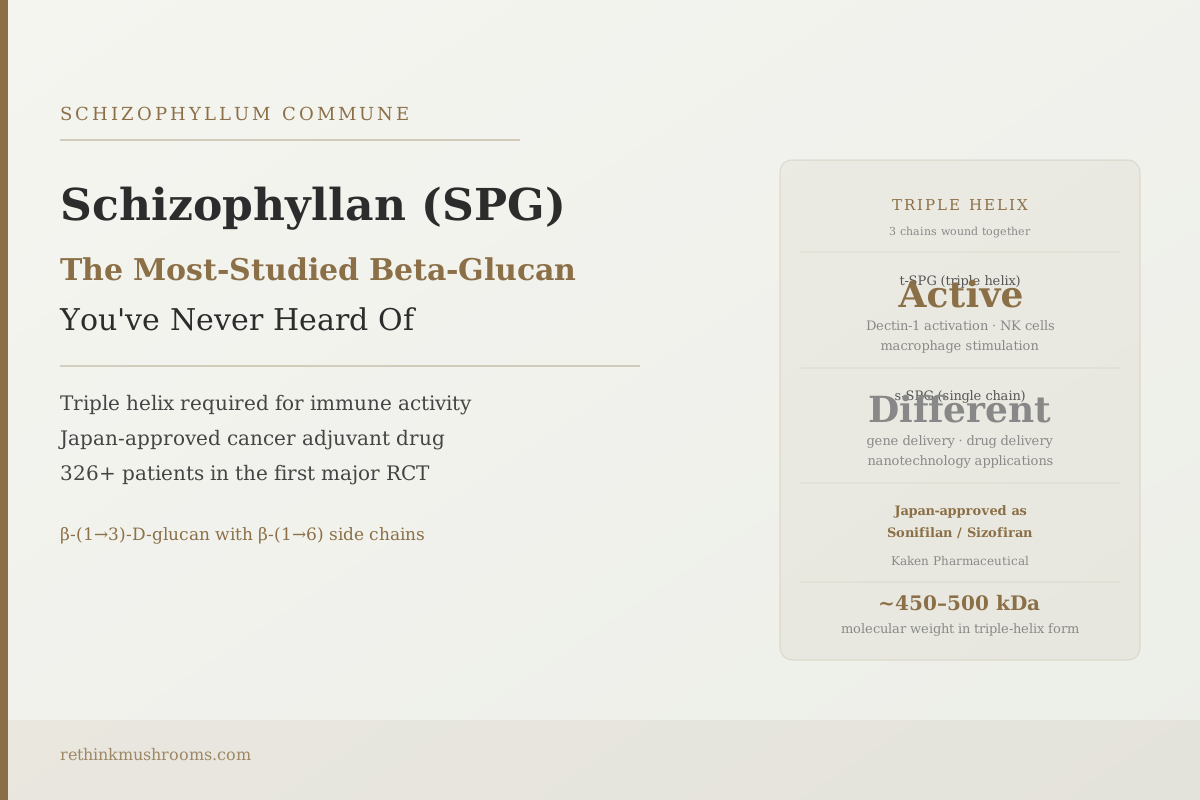
326 gastric cancer patients in schizophyllan's first major RCT
Schizophyllan (SPG) is a beta-glucan that is one of the few mushroom-derived compounds with a genuine randomized cancer-trial record — and an approved cancer-adjuvant pharmaceutical in Japan. It is also almost completely unknown in Western consumer markets.
Fujimoto et al., Jpn J Surg, 1984
Triple helix required
the triple-helix molecular form is not optional — denature schizophyllan to a single chain and its immune-activating activity largely disappears
Japan-approved drug
schizophyllan (Sonifilan/Sizofiran) is approved in Japan as a cancer adjuvant pharmaceutical, not just a supplement ingredient
s-SPG application
the single-chain form is used in nanotechnology for drug delivery — an entirely different application from the immunotherapy use
Fujimoto et al., Jpn J Surg, 1984
 View as image ↗
Beta-glucans have become a common feature of mushroom supplement marketing. If you follow functional mushroom content, you've likely seen claims about "high beta-glucan content" on lion's mane, turkey tail, chaga, and reishi products. One of the beta-glucans doing the most rigorous clinical work in this category — a compound with an actual randomized-trial record and a drug approval behind it — is one you've almost certainly never heard of: schizophyllan (SPG), from the split gill mushroom Schizophyllum commune.
This compound is not found in Western supplement markets. It is approved as a prescription cancer drug in Japan, has been tested in randomized controlled trials enrolling hundreds of patients, and works through a structural feature — a rigid triple helix — that most beta-glucan content has never mentioned.
For background on Schizophyllum commune itself and what makes it biologically remarkable, see the overview of Schizophyllum commune.
Key Takeaways
- Schizophyllan is a β-(1→3)-D-glucan with β-(1→6) side chains produced by Schizophyllum commune; in water, three chains coil together into a rigid triple helix (t-SPG) with a molecular weight of approximately 450–500 kDa[1]
- The triple helix is not cosmetic: the triple-helix conformation is required for schizophyllan's immune-activating activity — denature it to a single chain and most of that activity disappears, a structure-function relationship documented across the schizophyllan literature[1]
- The β-(1→6) branching pattern contributes to macrophage recognition and activation; the specific branched geometry, not just the glucose backbone, shapes how immune receptors engage the molecule
- Schizophyllan activates immune cells through Dectin-1 and complement receptors on macrophages and natural killer cells — the same receptor family that recognizes fungal cell wall components as a threat signal[2]
- The clinical record includes several small-to-moderate randomized controlled trials in gastric and cervical cancer from the 1980s–1990s; a 2021 systematic review (Steimbach et al.) placed fungal beta-glucans including schizophyllan among the studied cancer adjuvants, while noting the evidence is limited by trial size, age, and stage- or subgroup-confined benefits[7]
- The single-chain form (s-SPG, produced by dissolving in DMSO) is used for drug delivery and gene delivery applications — an entirely different therapeutic application from the triple-helix immunotherapy form[1]
What Schizophyllan Actually Is: Starting With the Structure
Schizophyllan is a polysaccharide — a long chain of sugar molecules — produced and secreted by Schizophyllum commune during growth. Its molecular backbone is formed by glucose molecules connected at the 1 and 3 positions (β-(1→3) linkages), making it a beta-glucan. Every third glucose along this backbone carries a single glucose side branch at the 1 and 6 positions.
This is the molecular specification. What makes it interesting is what happens to this structure in water.
In aqueous solution, three schizophyllan chains spontaneously coil together into a rigid triple helix — technically designated t-SPG (triple helix schizophyllan). Think of three ropes twisted together, each contributing structure to a configuration that is stiffer and more stable than any single rope alone. The resulting triple helix has a molecular weight of approximately 450–500 kilodaltons (a measure of molecular size) and a distinctive rod-like rigidity.
This structure is not merely a physical property. It is the pharmacological active form.
Ansari and colleagues published a comprehensive 2025 review of schizophyllan production and biomedical applications in Carbohydrate Polymers, covering decades of research into this compound's properties and uses.[1] The review confirms that schizophyllan's cancer immunotherapy applications, drug delivery applications, and wound healing research all depend on understanding this structural chemistry — and that the triple helix is the form responsible for immune activation.
The Finding That Changes How You Think About Beta-Glucan Quality
One of the most consequential facts about schizophyllan is one with real implications for how you evaluate any beta-glucan product: the triple-helix conformation is required for its immune-activating activity.[1]
When schizophyllan is denatured into a single chain — s-SPG, produced by dissolving it in dimethyl sulfoxide (DMSO) — it loses most of its immunostimulatory effect. When the single chains are allowed to re-associate back into a triple helix, immune activity is restored. The glucose backbone is identical in both states. The β-(1→6) side chains are identical. The molecular weight is identical. But the spatial arrangement of those chains relative to each other determines whether the compound can activate immune cells.
To make the implication concrete: the same molecule, in two different conformational states, has dramatically different immunological effects. The chemistry hasn't changed — only the fold has.
This matters beyond schizophyllan specifically. It is a demonstration of a general principle in beta-glucan pharmacology: structural integrity determines biological activity. A beta-glucan supplement that has undergone harsh extraction, excessive heating, or processing conditions that disrupt molecular conformation may contain the right chemical constituents while lacking the structural form those constituents need to be active.
One Molecule, Two Jobs
The Same Glucan, Folded Two Ways — Only One Activates the Immune System
- How it’s made
- Dissolved in water — three chains coil into a rigid rod (~450–500 kDa)
- What it does
- Engages Dectin-1 and complement receptors; activates macrophages, NK cells and dendritic cells
- Used as
- The immunotherapy / cancer-adjuvant form
- How it’s made
- Dissolved in DMSO — the triple helix denatures into one flexible chain
- What it does
- Loses most immune-activating activity; instead binds complementary DNA/RNA sequences
- Used as
- The drug- and gene-delivery form
The glucose backbone and the β-(1→6) side branches are identical in both forms. Only the three-dimensional arrangement of the chains changes — and that alone decides whether the molecule activates immune cells or carries genetic cargo.
Source: Ansari et al. (2025), Carbohydrate Polymers — review of schizophyllan structure, conformation and biomedical applications.
Why the Branching Pattern Matters
Beyond the triple helix, schizophyllan's side-chain architecture contributes to how immune cells recognize it. The β-(1→6) branching pattern — one branch per three backbone glucose units, at the 1,6 position — is part of what makes schizophyllan an effective ligand for the immune receptors described below.
Macrophages are immune cells that serve two functions: direct elimination of foreign material and infection, and coordination of broader immune responses by releasing signaling molecules called cytokines. Branched β-(1→3)/β-(1→6) glucans like schizophyllan engage macrophages far more effectively than unbranched linear beta-glucans. The predominant form in oat beta-glucan, for example, is largely linear and shows minimal macrophage activation through this pathway (though oat beta-glucan has distinct cholesterol-lowering effects through a different mechanism entirely).[1]
This is why schizophyllan's specific architecture is pharmacologically relevant, not just biochemically interesting: both the triple-helix fold and the branched side chains shape its interaction with the immune system.
How Schizophyllan Activates the Immune System: The Receptor Biology
The immune system recognizes beta-glucans primarily through two receptor families on the surface of immune cells: Dectin-1 and complement receptors.[2]
Dectin-1 is the primary pattern-recognition receptor for fungal beta-glucans. It is expressed on macrophages, dendritic cells (immune cells that coordinate adaptive immune responses), and neutrophils (first-responder immune cells). When Dectin-1 binds to a beta-glucan with the appropriate structure, it triggers an intracellular signaling cascade that activates the cell and promotes anti-tumor and anti-microbial activity.
Complement receptors (specifically CR3, also known as Mac-1) are expressed on natural killer cells — innate immune cells that directly kill cancer cells and virus-infected cells — as well as on macrophages and neutrophils. Beta-glucan binding to complement receptors primes these cells for enhanced cytotoxicity against tumor targets.
Schizophyllan's triple-helix structure provides a rigid, repetitive surface that engages Dectin-1 effectively, and the β-(1→6) branches contribute to this recognition. The downstream effects documented across the schizophyllan research program include: enhanced macrophage phagocytic activity, increased natural killer cell cytotoxicity, dendritic cell maturation and increased antigen-presenting capacity, and promotion of Th1-type immune responses (the immune response profile associated with anti-tumor immunity, as opposed to Th2 responses associated with allergy). For a deeper exploration of these anti-tumor immune mechanisms, see how schizophyllan enhances anti-tumor immunity.
Schizophyllan vs. the Beta-Glucans You've Actually Heard Of
The table below compares schizophyllan's key properties to the beta-glucans most commonly discussed in health content and supplement marketing:
| Beta-Glucan | Source | Structure | Key Feature | Primary Studied Use | Evidence Level |
|---|---|---|---|---|---|
| Schizophyllan (SPG) | Schizophyllum commune | β-(1→3) backbone, β-(1→6) branches, triple helix | Rigidity of triple helix; pharmaceutical drug | Cancer adjuvant immunotherapy | Several RCTs; Japan-approved |
| Lentinan | Shiitake (Lentinula edodes) | β-(1→3) backbone, β-(1→6) branches | Similar structure to SPG | Cancer adjuvant; Japan-approved | Multiple RCTs |
| PSK (Krestin) | Turkey tail (Trametes versicolor) | β-(1→4) backbone, different side chains | Protein-bound; patent-protected | Cancer adjuvant immunotherapy | Multiple meta-analyses; thousands of patients |
| Yeast beta-glucan | Baker's yeast (Saccharomyces) | β-(1→3) backbone, β-(1→6) branches | Particulate form; lower MW | Immune support | Moderate clinical evidence |
| Oat beta-glucan | Oat bran | Mixed β-(1→3) / β-(1→4) linkages (linear) | Linear chain; soluble fiber | Cholesterol reduction | Extensive; FDA-authorized claim |
Schizophyllan and lentinan are structurally the most similar — both are branched β-(1→3) glucans — and both have Japan drug approval for cancer adjuvant use. The difference is that lentinan (marketed as Lentinan, Ajinomoto) has been more extensively researched and has more Japanese clinical infrastructure behind it, while schizophyllan remains almost entirely unknown in Western health discourse.
Oat beta-glucan is mechanistically separate. It works primarily through bile acid binding in the gut (which reduces cholesterol reabsorption), not through the Dectin-1/complement receptor pathway that drives schizophyllan's immune effects. They are called beta-glucans because they share structural similarities, but their health applications and mechanisms are largely distinct.
The Clinical Evidence: What the Trials Actually Show
A 2021 systematic review of fungal beta-glucans as cancer adjuvants (Steimbach et al., Clinical Nutrition) surveyed the randomized trial evidence for schizophyllan alongside lentinan, PSK, and related compounds.[7] The honest reading of that record is cautiously positive: schizophyllan has a genuine randomized-trial history — unusual for a mushroom-derived compound — but one built from small-to-moderate, mostly decades-old trials, with benefits typically confined to specific cancer stages or subgroups, and none replicated in a modern Phase III trial.
The foundational trial is Fujimoto 1984, a randomized controlled trial in 326 patients with resectable gastric cancer.[3] Patients received either adjuvant SPG immunochemotherapy or chemotherapy alone. The result is more nuanced than schizophyllan's reputation suggests: overall 3-year survival did not differ between the SPG and control groups. Among the 100 Stage III patients (where cancer had spread to regional lymph nodes) there was a survival trend favoring the SPG group, but it did not reach statistical significance (p=0.0811). It was a large, well-conducted trial for its era — but its primary endpoint was negative, and the promising signal was a subgroup trend rather than a definitive result.
The evidence that followed is similarly mixed-but-real. A second gastric-cancer RCT (Fujimoto 1991, n=386) again found no overall survival benefit across all randomized patients, but within the 264 who underwent curative resection, SPG administration was an independent favorable prognostic factor in multivariate analysis (p=0.011).[4] In cervical cancer, Okamura 1986 (n=220, SPG plus radiotherapy) found significantly longer survival and time to recurrence in Stage II patients, with no significant difference in Stage III.[5] A larger cervical-cancer study across 52 Japanese institutions (Noda 1992; 315 enrolled, 292 analyzed) reported a higher complete-response rate with SPG (Stage III: 77.9% vs 61.2%) and faster recovery of lymphocyte counts after radiotherapy — though it measured tumor response and immune recovery rather than overall survival.[6]
Read together, the picture is real but modest: a cluster of randomized trials, each showing a benefit in a particular stage or subgroup, adding up to enough evidence for Japanese drug approval but not to the kind of unambiguous, replicated survival benefit that would move a compound into first-line Western oncology. That schizophyllan cleared Japan's pharmaceutical bar at all — where the overwhelming majority of mushroom compounds never even reach a randomized trial — is itself the remarkable part of the story.
Not medical advice. This article summarizes research on schizophyllan. Schizophyllan is not an approved treatment outside its specific Japanese pharmaceutical indication, and nothing here should be read as guidance to use it — or any supplement — to treat cancer or any other condition. Cancer treatment decisions should be made only in consultation with a qualified physician.
For the complete clinical trial review including all the cancer indication data, see schizophyllan and cancer: research on an approved anti-cancer drug. For the full drug approval story, see schizophyllan: the mushroom compound used as a drug in Japan.
The Single-Chain Form: When You Want to Break the Triple Helix
The triple helix form (t-SPG) is the immunotherapy form. But schizophyllan has a second research application that depends on breaking that triple helix: the single-chain form (s-SPG).
When schizophyllan is dissolved in dimethyl sulfoxide (DMSO) under specific conditions, the triple helix denatures into a single flexible polymer chain. This form retains the glucose backbone but loses the rigid helical structure — and with it, most of the immune-activating activity documented for t-SPG.
What s-SPG gains instead is structural flexibility and a specific molecular geometry that can bind to complementary nucleic acid sequences (DNA and RNA) through hydrogen bonds. This property makes s-SPG useful as a carrier for oligonucleotides (short genetic sequences) — a nanotechnology application for gene delivery. When s-SPG wraps around a target oligonucleotide, it forms a stable complex that can protect the genetic cargo from degradation and be delivered into cells.
The Ansari 2025 review documents this application among schizophyllan's expanding biomedical uses, alongside drug delivery vehicles and wound healing applications.[1] For readers interested in this forward-looking direction, see schizophyllan drug delivery systems: nanotechnology applications.
The two forms — t-SPG for immune activation and s-SPG for drug delivery — illustrate how a single natural compound can have multiple, mechanistically unrelated pharmaceutical applications depending on how its structure is manipulated.
Why Schizophyllan Isn't in Your Supplement Cabinet
Schizophyllan is not available in consumer supplement markets in the United States or Europe. This is not because the evidence is uniformly weak — as documented above, it has a randomized-trial record that most marketed supplements lack. It is because the path from clinical evidence to market availability requires either regulatory approval (complex, expensive, country-specific) or supplement regulatory frameworks that allow health claims based on general ingredient status.
In Japan, schizophyllan went through the pharmaceutical approval process and emerged as Sonifilan (Sizofiran), manufactured by Kaken Pharmaceutical. In the US, no equivalent approval has been pursued. The compound is not GRAS (generally recognized as safe) listed as a food ingredient with established health claims, and no pharmaceutical company has invested in the FDA approval pathway for this indication.
The result: one of the most extensively trialed mushroom-derived beta-glucans is unknown in the market that most consumes beta-glucan supplement products.
The Bottom Line
Schizophyllan (SPG), produced by Schizophyllum commune, is a β-(1→3)-D-glucan with β-(1→6) branches that forms a rigid triple helix in water. That triple-helix conformation is required for its immune-activating activity — the denatured single-chain form loses most of its cytokine-stimulating capacity. Schizophyllan activates macrophages and NK cells through Dectin-1 and complement receptors, with the β-(1→6) branching contributing to macrophage recognition. It has been tested in several small-to-moderate randomized controlled trials as a cancer adjuvant — with benefits generally confined to specific stages or subgroups rather than overall survival — and is approved in Japan as a pharmaceutical (Sonifilan/Sizofiran), while remaining unknown in Western supplement markets. The single-chain form (s-SPG) has entirely separate applications in nanotechnology and drug delivery.
Frequently Asked Questions
Sources & References
- 1RTHM-02051·Ansari, Elham et al. (2025). “Research progress on production and biomedical applications of Schizophyllan as a tailor-made polysaccharide: A review..” Carbohydrate polymers.Study breakdown →PubMed →↩
- 2RTHM-00154·Goodridge, Helen S et al. (2009). “Beta-glucan recognition by the innate immune system..” Immunological reviews.Study breakdown →PubMed →↩
- 3RTHM-00014·Fujimoto, S et al. (1984). “Clinical evaluation of schizophyllan adjuvant immunochemotherapy for patients with resectable gastric cancer--a randomized controlled trial..” The Japanese journal of surgery.Study breakdown →PubMed →↩
- 4RTHM-00029·Fujimoto, S et al. (1991). “Clinical outcome of postoperative adjuvant immunochemotherapy with sizofiran for patients with resectable gastric cancer: a randomised controlled study..” European journal of cancer (Oxford.Study breakdown →PubMed →↩
- 5RTHM-00019·Okamura, K et al. (1986). “Clinical evaluation of schizophyllan combined with irradiation in patients with cervical cancer. A randomized controlled study..” Cancer.Study breakdown →PubMed →↩
- 6RTHM-00030·Noda, K et al. (1992). “Clinical effect of sizofiran combined with irradiation in cervical cancer patients: a randomized controlled study. Cooperative Study Group on SPG for Gynecological Cancer..” Japanese journal of clinical oncology.Study breakdown →PubMed →↩
- 7RTHM-00719·Steimbach, Laiza et al. (2021). “Fungal beta-glucans as adjuvants for treating cancer patients - A systematic review of clinical trials..” Clinical nutrition (Edinburgh.Study breakdown →PubMed →↩