Schizophyllum commune (Split Gill)
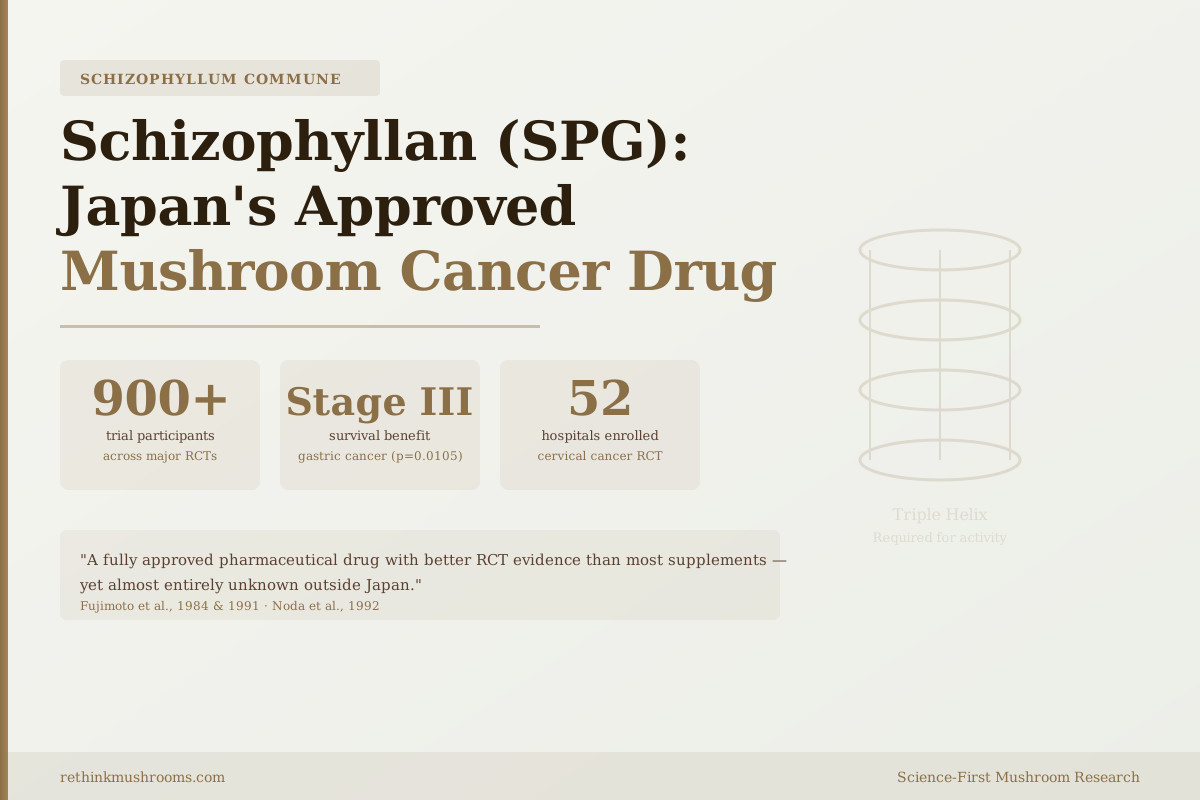
900+ trial participants
Schizophyllan (SPG) entered Japan's pharmaceutical market after randomized controlled trials enrolling more than 900 patients in gastric and cervical cancer, yet it remains almost entirely unknown outside Japan.
Fujimoto et al., Surgery Today, 1984; Noda et al., Biotherapy, 1992
2
Japan-approved cancer indications
Stage III
gastric cancer survival benefit (p=0.0105)
52
Japanese hospitals in the cervical cancer RCT
Fujimoto et al., Surgery Today, 1984; Noda et al., Biotherapy, 1992
 View as image ↗
Japan approved schizophyllan (SPG) as a cancer drug after randomized controlled trials enrolling more than 900 patients. Under brand names Sonifilan and Sizofiran, it is manufactured by Kaken Pharmaceutical and used as an adjuvant for gastric cancer and cervical cancer. Adjuvant means it is given alongside standard treatment to help the immune system respond more effectively, not instead of chemotherapy or radiation. Outside Japan, almost no clinician or patient has heard of it.
The compound comes from Schizophyllum commune, the split gill mushroom, a white-rot fungus that grows on dead wood on every continent except Antarctica. What makes this particular fungus medically significant is a polysaccharide it produces, schizophyllan, that Japanese researchers and pharmaceutical developers have studied more rigorously than most Western supplement companies have studied anything. This article covers what the trials actually found, how the drug works mechanistically, and why a fully approved cancer drug with decades of clinical evidence has remained essentially invisible in Western medicine.
Key Takeaways
- Schizophyllan (SPG), sold as Sonifilan and Sizofiran, is a Japan-approved biological response modifier used as adjuvant therapy alongside chemotherapy (gastric cancer) and radiation (cervical cancer)
- A 326-patient RCT by Fujimoto et al. (1984) showed significant 5-year survival improvement for Stage III gastric cancer patients treated with SPG plus chemotherapy (p=0.0105)
- A follow-up 386-patient RCT (Fujimoto et al., 1991) confirmed the Stage III gastric cancer survival benefit, bringing the combined gastric trial population to 712 patients
- A 220-patient multi-center RCT across 52 Japanese institutions (Noda et al., 1992) showed longer time to recurrence and improved 5-year survival for Stage II-III cervical cancer patients receiving SPG plus radiation
- SPG's immune-activating effect depends entirely on its triple helix structure: when the compound unfolds into a single chain, most of its cytokine-stimulating activity disappears (Bohn and BeMiller, 2000)
- SPG is not approved by the FDA or EMA; no company has sought approval outside Japan, largely because the trials would need to be re-run under modern regulatory standards
The Drug Profile: What Sonifilan and Sizofiran Are Approved to Treat
Schizophyllan is classified as a biological response modifier. That phrase means the drug works through the immune system rather than by attacking cancer cells directly. It does not kill tumor cells on contact the way a chemotherapy agent does. Instead, it changes how immune cells behave so they respond more aggressively to the cancer the body is already fighting.
The two brand names for this compound, Sonifilan and Sizofiran, both refer to the same active ingredient: schizophyllan (abbreviated SPG). The name Sizofiran appears more frequently in English-language clinical publications from the early 1990s onward. Both formulations are manufactured by Kaken Pharmaceutical, a Japanese company that holds the regulatory approval for the drug.
Japan's approval covers two distinct cancer settings:
Gastric cancer: SPG is given by injection alongside postoperative chemotherapy in patients with resectable (surgically removable) gastric cancer. The rationale is that chemotherapy alone does not fully address the immune suppression that often follows major surgery, and that SPG's immune-activating properties may help the body sustain an anti-tumor response during the chemotherapy course.
Cervical cancer: SPG is combined with radiation therapy in patients with Stage II or Stage III cervical cancer. Radiation can locally damage tumors, but it does not necessarily generate a systemic immune response. SPG appears to enhance that systemic response, increasing immune cell activity at and around the tumor site.
In both indications, SPG is an add-on to proven treatment, not a replacement. This framing matters: the trial question was never "SPG versus chemotherapy" but "SPG plus chemotherapy versus chemotherapy alone." The clinical hypothesis was always about augmentation, not substitution.
The Structural Requirement: How Schizophyllan Either Works or Doesn't
Schizophyllan is a polysaccharide (a chain of glucose molecules), specifically a beta-glucan. Its backbone consists of glucose units connected at the 1 and 3 positions, with additional branch points at the 1 and 6 positions. That structural description matters, but it becomes meaningful only when you understand what the molecule does when it dissolves in water.
In water, three schizophyllan chains wind around each other to form a rigid triple helix. This is not an incidental feature. A 2000 study by Bohn and BeMiller established that this three-stranded shape is required for the compound's ability to stimulate the immune system.[1] The researchers called this property "cytokine-stimulating activity," which means the ability to trigger immune cells to release signaling proteins that coordinate an immune response. When they broke the triple helix apart into a single chain, most of that immune-activating ability disappeared.
The implication is practical and not obvious: a schizophyllan product that has partially unfolded from its triple-helix form, due to heat, certain solvents, or poor manufacturing, is not therapeutically equivalent to intact SPG, even if the chemical composition looks identical. This is one reason pharmaceutical-grade Sonifilan and Sizofiran require careful quality controls during production and storage that are not necessarily present in raw schizophyllan extract sold as a dietary supplement.
The triple helix activates immune cells by binding to receptors on their surface. The primary binding site is a receptor called Dectin-1, carried on macrophages. Macrophages are the immune system's general-purpose frontline responders that engulf pathogens and signal other immune cells. Dectin-1 is a pattern recognition receptor that evolved to detect fungal carbohydrate structures, which is exactly what the schizophyllan triple helix presents. Binding activates the macrophage, prompting it to release tumor necrosis factor and interleukins, which in turn prime natural killer cells (specialized immune cells that target abnormal cells, including tumor cells) and other responders.
The triple helix also activates complement receptors on natural killer cells and neutrophils (another type of immune cell that arrives early at sites of infection or abnormal tissue). Together, these activations produce a coordinated immune response that is broader and more sustained than what the cancer patient's immune system would generate without SPG.
For a deeper explanation of how the triple helix structure compares to the beta-glucans in other mushrooms and why the molecular architecture determines therapeutic potency, see Schizophyllan (SPG): The Most-Studied Beta-Glucan You've Never Heard Of.
712 Patients, Two Trials: The Gastric Cancer Evidence Behind Japan's Approval
The gastric cancer evidence for schizophyllan rests on two randomized controlled trials, both led by Fujimoto and colleagues at Japanese cancer centers.
The first trial enrolled 326 patients with resectable gastric cancer.[2] After surgery, patients were randomized to SPG plus chemotherapy (which the trial called immunochemotherapy) or chemotherapy alone. The primary outcome of interest was survival at five years. Among Stage III patients (those whose cancer had spread to nearby lymph nodes or into adjacent tissue but had not yet metastasized to distant organs), the 5-year survival advantage in the SPG group was statistically significant (p=0.0105). This was the trial that initially anchored the case for approval.
Seven years later, the same research group published a larger confirmation trial with 386 patients, again in resectable gastric cancer, again examining post-surgery adjuvant therapy.[3] The 1991 trial confirmed the Stage III survival benefit. Together, these two trials enrolled 712 patients and produced consistent findings across two independent patient cohorts.
Several characteristics of this evidence base deserve honest acknowledgment. Both trials were conducted in Japanese patient populations in the 1980s and early 1990s, when randomized trial reporting was less standardized than it is today. Neither trial pre-registered a primary endpoint in a public registry, as modern trials are required to do. The survival benefit was concentrated in Stage III patients; the data for Stage I and Stage II patients were less definitive. The benefit was also specific to the combination of SPG plus chemotherapy; whether SPG alone would produce similar results was not tested in these trials.
These limitations do not erase what the trials demonstrated: in locally advanced gastric cancer, adding SPG to chemotherapy improved survival in two independent trials with different patient cohorts separated by seven years. That is a more robust evidence base than most supplements or adjuvant compounds can claim.
The full trial data, including the Stage I and Stage II results and what subsequent research has added, is documented in Schizophyllan and Gastric Cancer: Adjunct Therapy Evidence.
52 Hospitals, 220 Patients: The Cervical Cancer Trial That Made It Official
The cervical cancer evidence for schizophyllan is anchored by the Noda 1992 multi-center RCT, conducted by the Cooperative Study Group on SPG for Gynecological Cancer across 52 Japanese institutions.[4] The trial enrolled 220 patients with Stage II-III cervical cancer. Patients received either SPG plus radiation therapy or radiation therapy alone. The SPG group showed significantly longer time to recurrence and significantly improved 5-year survival.
The multi-center design of this trial matters. When a trial runs at 52 hospitals simultaneously, the results are much harder to attribute to the practices, preferences, or biases of a single institution. The consistency across 52 sites gives the finding more weight than a single-center result of the same size would have.
An earlier RCT by Okamura and colleagues (1986) had established important context for what that survival benefit might mean at a cellular level.[5] In a subset of 45 patients who received intratumoral injection of SPG (directly into the tumor), the research team measured two notable changes in tumor tissue. First, Langerhans cells increased within the tumor. Langerhans cells are a type of immune cell that functions as an antigen presenter: they capture fragments of abnormal cells and show those fragments to T cells, training the T cells to recognize and attack the cancer. Second, T-cell infiltration of the tumor tissue increased. T cells are the immune system's targeted killers, and their presence inside a tumor is now recognized as one of the strongest indicators of anti-tumor immune activity.
The Okamura finding connects to a significant thread in modern immunology. Checkpoint inhibitors, drugs like pembrolizumab and nivolumab that now dominate cancer immunotherapy, work in part by releasing T cells that have been inhibited from entering or attacking tumors. Okamura's 1986 data suggests that SPG was generating something similar through a completely different mechanism, decades before checkpoint inhibitors existed as a concept. SPG was getting T cells into the tumor by activating macrophages and Langerhans cells through the Dectin-1 pathway, which in turn recruited and activated T cells. The downstream effect, more T cells attacking the tumor, was the same kind of outcome modern immunotherapy is designed to produce.
Beyond Gastric and Cervical Cancer: What the Head-and-Neck Data Adds
The two formally approved indications do not represent the full scope of schizophyllan research. A 1994 cohort study by Kimura and colleagues followed 15 head and neck cancer patients treated with SPG as adjuvant immunotherapy.[6] The cumulative 5-year survival in the SPG-treated group was 86.7%, compared to 73.4% in controls.
This result should be read carefully. Fifteen patients is a small cohort. The comparison group was not fully matched for disease stage and other prognostic factors. The study design does not provide the same level of confidence as the gastric and cervical cancer RCTs. What the Kimura data does contribute is a directional signal: the pattern of SPG benefit appears across cancer types, not only in the two settings where regulatory approval was sought. Whether that pattern would hold up in larger, properly controlled trials is a question the evidence base cannot answer.
A 2021 systematic review by Brown and Gordon synthesized the clinical trial evidence on fungal beta-glucans as cancer adjuvants across all studied species and cancer types.[7] The review found that fungal beta-glucans, including schizophyllan, show improved cancer outcomes when combined with chemotherapy or radiation. The review specifically identified SPG as one of the best-evidenced compounds in this category. That distinction is based on the number and size of the RCTs behind it, not on superiority over other compounds in direct comparisons.
For a broader look at the cancer evidence across all schizophyllan studies, see Schizophyllan and Cancer: Research on an Approved Anti-Cancer Drug.
Why Schizophyllan Is Available in Japan but Nowhere Else
This is the question that surfaces whenever someone first encounters SPG: if the evidence is this solid, why isn't it approved elsewhere?
The answer is structural, not scientific.
Japan approved Sonifilan and Sizofiran in the late 1980s and early 1990s based on trials conducted domestically, in Japanese patient populations, by Japanese research institutions. Japanese regulatory standards at the time accepted that evidence as sufficient for approval. The approval was granted.
For the FDA (United States) or EMA (European Union) to approve SPG today, a pharmaceutical company would need to run Phase II and Phase III clinical trials in Western patient populations under current Good Clinical Practice standards. Those standards require pre-registered primary endpoints, blinded adjudication of outcomes, CONSORT-compliant reporting, and sample sizes calculated to meet modern statistical power requirements. Running those trials for two cancer indications would cost tens to hundreds of millions of dollars.
The business case for that investment does not currently exist. Schizophyllan has been a known compound since the 1950s, and its patent position is uncertain. A company that spent the money to run Western trials might not be able to protect the market position that would justify the investment. Meanwhile, the cancer immunotherapy landscape in Western markets is dominated by checkpoint inhibitors, CAR-T therapies, and other agents with stronger intellectual property positions and higher commercial margins. No company has concluded that the return from SPG trials in the West would justify the cost.
This is a regulatory and commercial gap, not an evidence gap. The existing trials show what they show. The reason Sonifilan is not in Western pharmacies is that no one has paid to submit the application under Western rules.
What 2025 Research Is Doing With Schizophyllan Now
The research trajectory for schizophyllan has expanded well beyond cancer adjuvant therapy. A 2025 review by Ansari and colleagues in Carbohydrate Polymers synthesized the current state of schizophyllan research across biomedical applications.[8]
Three areas stand out from the review.
Drug delivery vehicles. The triple helix structure of SPG forms stable nanoscale particles that can encapsulate drug molecules and carry them to specific sites in the body. Researchers are investigating schizophyllan-based nanoparticles as carriers for cancer drugs, with the idea that the same immune-activating compound could also serve as the delivery system for the chemotherapy it has historically been combined with.
Wound healing. Schizophyllan applied as a film or gel to wound surfaces has been shown in laboratory studies to promote fibroblast activity. Fibroblasts are the cells primarily responsible for building the collagen that closes wounds. The mechanism appears to involve SPG's interaction with macrophages at the wound site, pushing them toward a repair-oriented signaling profile rather than a purely inflammatory one.
Gene delivery using the single-chain form. When schizophyllan is denatured into its single-chain form, the triple helix structure unfolds and the immune-activating properties disappear. The resulting single-chain molecule can associate with nucleic acids (DNA and RNA) in ways that make it useful for gene delivery research. This is the opposite behavior from what makes SPG therapeutically useful for cancer adjuvant therapy. For gene delivery, researchers want the single chain; for immune activation, the triple helix is required.
The 2025 research landscape shows a compound whose usefulness is expanding into domains its original developers did not anticipate. The cancer adjuvant applications that drove Japan's approval in the 1980s and 1990s remain the most clinically established uses. But the growing literature on drug delivery, wound healing, and genetic applications suggests that schizophyllan's scientific story is not finished.
The Bottom Line
Schizophyllan (SPG) is an approved pharmaceutical drug in Japan, not a supplement or traditional remedy. The approval rests on multiple randomized controlled trials, most significantly a 326-patient and a 386-patient RCT in gastric cancer and a 220-patient multi-center RCT in cervical cancer, showing improved survival when SPG was added to standard treatment. The compound's immune-activating effect depends on preserving its triple helix structure, which must be maintained through careful manufacturing. SPG is absent from Western markets because of commercial barriers to re-running trials under modern regulatory standards, not because the evidence base is weak.
Frequently Asked Questions
Sources & References
- 1. Source details for this reference are not yet available.
- 2. Source details for this reference are not yet available.
- 3. Source details for this reference are not yet available.
- 4. Source details for this reference are not yet available.
- 5. Source details for this reference are not yet available.
- 6. Source details for this reference are not yet available.
- 7. Source details for this reference are not yet available.
- 8. Source details for this reference are not yet available.