Schizophyllum commune (Split Gill)
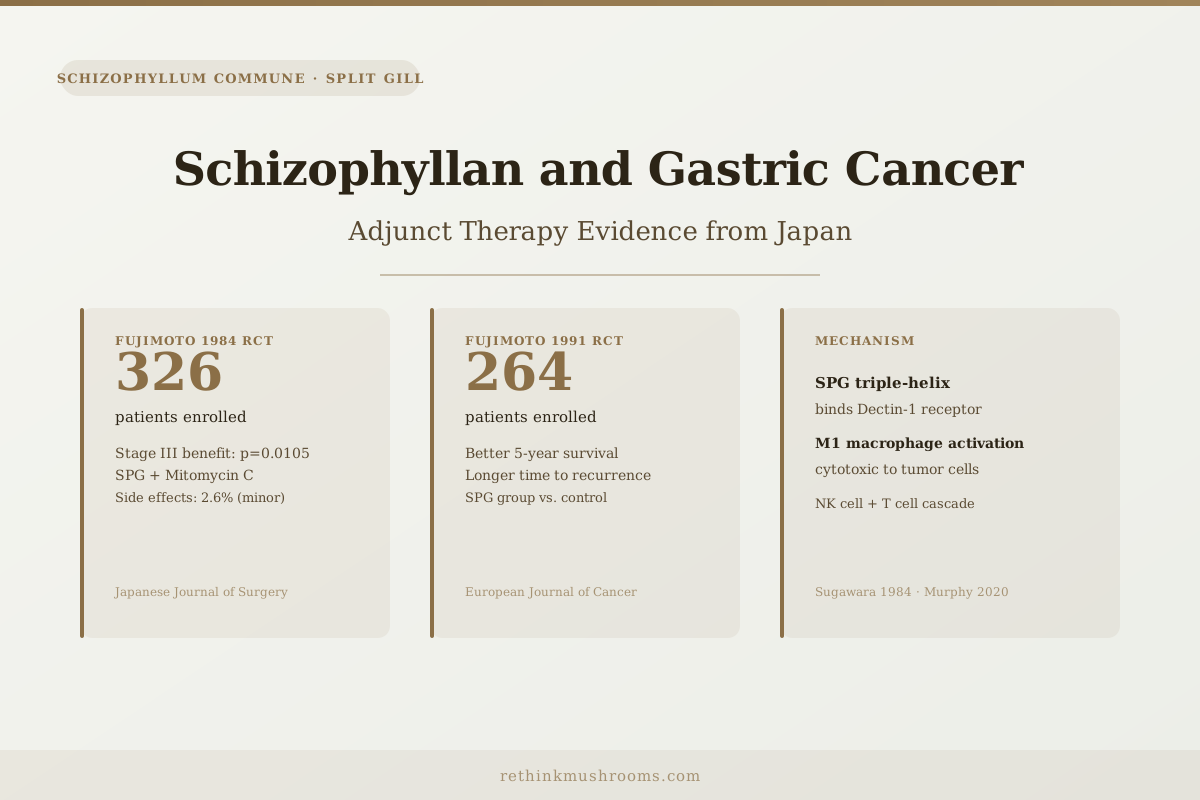
326 patients
Fujimoto et al.'s 1984 RCT enrolled 326 patients with resectable gastric cancer; SPG combined with Mitomycin C showed significantly better 5-year survival in Stage III patients (p=0.0105), with minor side effects in only 2.6% of participants.
Fujimoto et al., Japanese Journal of Surgery, 1984
264 patients
in Fujimoto 1991 (European Journal of Cancer) confirmatory RCT, SPG group had longer 5-year survival
p=0.0105
Stage III gastric cancer 5-year survival advantage in the 1984 RCT
2.6%
minor side effect rate in the 326-patient gastric cancer RCT (Fujimoto 1984)
Fujimoto et al., Japanese Journal of Surgery, 1984
 View as image ↗
Schizophyllan has two randomized controlled trials for gastric cancer, published in major oncology journals, that most English-language health content has never cited. The trials are old (from 1984 and 1991), but the data is real, the patient numbers are substantial, and the Stage III survival benefit in the larger trial reached statistical significance.
What schizophyllan is, briefly: a (1→3)-β-D-glucan polysaccharide produced by the common split gill mushroom (Schizophyllum commune), approved in Japan as a prescription anti-cancer drug under the trade names Sonifilan and Sizofiran. It is given by intramuscular injection in clinical practice (not orally) and used as an adjuvant alongside chemotherapy or radiotherapy. This article focuses specifically on the gastric cancer evidence. For the full cancer overview, see schizophyllan and cancer: research on an approved anti-cancer drug. For the pillar introduction to the mushroom itself, see what is Schizophyllum commune.
Key Takeaways
- Fujimoto et al. (1991) published a 264-patient RCT in European Journal of Cancer showing that sizofiran (SPG) added to post-surgical care improved 5-year survival probability and prolonged time to recurrence vs. control in resectable gastric cancer[1]
- Fujimoto et al. (1984) published an earlier 326-patient RCT in which SPG combined with Mitomycin C chemotherapy showed significantly better 5-year survival in Stage III gastric cancer patients (p=0.0105); side effects were minor in 2.6% of patients[2]
- Sugawara et al. (1984) established the mechanism: SPG directly activates macrophages, which become cytotoxic against tumor cells; SPG is a macrophage stimulant rather than a lymphocyte mitogen; activated macrophages release cytokines that amplify NK cell and T cell activity[3]
- Murphy et al. (2020) clarified the receptor pathway: triple-helix beta-glucans bind Dectin-1 and CR3 receptors on macrophages, triggering M1 polarization and cytokine release; the triple-helix conformation is required for this activity[4]
- Steimbach et al. (2021) systematic review of all clinical trials using fungal beta-glucans as cancer adjuvants found consistent evidence of improved survival with adjuvant use, particularly in gastrointestinal cancers; identified oral bioavailability as the primary limitation for SPG versus PSK[5]
- The gastric cancer RCT data is 30-40 years old with no recent Phase III replication; all trials used intramuscular injection, not oral supplementation; supplement forms of SPG may have substantially different bioavailability than the clinical drug
What Schizophyllan Is and Why Japan Used It for Gastric Cancer
Gastric cancer is the third most common cause of cancer death worldwide and has historically had high incidence in Japan. The post-surgical recurrence problem is similar to colorectal cancer: curative resection removes visible tumor, but microscopic residual disease causes recurrence in a significant fraction of patients. The Japanese oncology research of the 1970s and 1980s explored immune adjuvants as tools to activate the immune system's ability to clear this residual microscopic disease.
Schizophyllan entered this research because of its macrophage-activating properties. SPG is a large-molecule polysaccharide (molecular weight 100,000-200,000 Da) that folds into a distinctive triple-helix structure (three polysaccharide chains wound around each other). This shape is recognized by pattern recognition receptors on macrophages as a foreign signal, triggering immune activation without causing inflammation in the way a pathogen would.
The experimental design across all SPG gastric cancer trials followed the same adjuvant logic used in PSK (reishi) and lentinan (shiitake) research: give patients standard post-surgical chemotherapy, with or without SPG, and track recurrence and survival at five years. The question is whether adding SPG to standard treatment improves outcomes.
The 1991 Fujimoto Trial: 264 Patients, European Journal of Cancer
Fujimoto and colleagues published their 1991 sizofiran gastric cancer trial in the European Journal of Cancer, giving it broader international visibility than the 1984 predecessor.[1]
The study enrolled 264 patients with resectable gastric cancer at Japanese institutions. After curative resection, patients were randomized to receive either standard post-surgical care or SPG added to that care. The primary outcomes were five-year survival probability and time to recurrence.
Results: the SPG group showed a better probability of five-year survival and a longer median time to recurrence compared to controls. The European Journal of Cancer is a peer-reviewed oncology journal with international readership; publication there represents external validation of the findings beyond the Japanese research community.
The population was curatively resected patients (those for whom surgery had removed all visible cancer). This is the adjuvant context: SPG's role was not to treat visible tumor but to prevent its return in patients who appeared disease-free after surgery.
The 1984 Fujimoto Trial: The Stage III Breakthrough Data
The earlier Fujimoto trial, published in Japanese Journal of Surgery in 1984, was the larger and more statistically informative of the two gastric cancer studies.[2]
326 patients with resectable gastric cancer were enrolled. SPG was combined with Mitomycin C, a chemotherapy agent commonly used in Japanese gastric cancer treatment protocols of that era. The control group received Mitomycin C alone.
The key finding: Stage III patients in the SPG group had significantly better five-year survival than Stage III controls (p=0.0105). Stage III gastric cancer indicates tumor involvement of nearby lymph nodes but not distant metastasis; it is a stage where curative surgery is possible but recurrence risk is high.
The safety finding is also notable: minor side effects were observed in only 2.6% of patients. For an adjuvant treatment added on top of active chemotherapy, a 2.6% minor adverse event rate is favorable.
The 1984 trial's Stage III specificity is meaningful. Not all stages showed equivalent benefit: the statistically significant finding was concentrated in Stage III, where residual microscopic lymph node involvement likely creates the immune environment where macrophage activation by SPG has the most impact. Stage II (lymph-node-negative) showed a favorable trend but the effect was smaller and less precisely estimated.
Why Stage III Showed the Strongest Benefit
The Stage III specificity is not arbitrary. It reflects the biology of how SPG works and where immune adjuvants are most useful.
Stage III gastric cancer patients after curative resection have had their primary tumor removed but have documented lymph node involvement. Lymph nodes are the staging posts of the immune system and are also where metastatic gastric cancer often begins to spread. Residual microscopic cancer cells in partially treated lymph nodes are the source of many recurrences.
SPG's mechanism centers on macrophage activation. Macrophages circulate through lymphatic tissue and patrol for foreign cells. An SPG-activated macrophage (more aggressive, more cytotoxic, releasing tumor-targeting cytokines) is particularly relevant in the lymph node environment where residual microscopic disease is concentrated in Stage III patients. Stage II patients (lymph-node-negative) have less of this specific immune surveillance task; Stage IV patients have distant metastatic disease beyond what macrophage activation in locoregional lymphatics can address.
Mechanism: Macrophage Activation as the Primary Event
Sugawara and colleagues' 1984 study established the foundational cellular mechanism.[3]
SPG directly activates macrophages. When SPG-treated macrophages were tested against both genetically matched (syngeneic) and mismatched (allogeneic) tumor cells, they showed cytotoxic activity against both. This means SPG-activated macrophages can attack tumor cells regardless of whether those cells have the specific surface markers the macrophage has learned to recognize as "self" or "foreign."
The mechanism operates through innate immunity rather than adaptive immunity. Lymphocytes (T cells and B cells) are the adaptive immune cells that recognize specific antigens and mount targeted responses. SPG was not mitogenic to lymphocytes; it did not stimulate T or B cell proliferation. Its primary action was on macrophages, part of the innate immune system that responds to general patterns rather than specific learned antigens.
This is clinically significant for cancer adjuvant use: adaptive immune responses require time to develop and are specific to antigens the immune system has already encountered. Macrophage activation via SPG is faster and antigen-independent, potentially useful against cancer cells whose surface markers may have mutated away from recognized antigens.
The Receptor Pathway: How Macrophages Detect SPG
Murphy and colleagues' 2020 review clarified the molecular pathway by which macrophages respond to triple-helix beta-glucans.[4]
Macrophages carry three surface receptors that recognize beta-glucan structures: Dectin-1 (the primary receptor), Complement Receptor 3 (CR3), and TLR4. When SPG's triple-helix binds Dectin-1 on the macrophage surface, it triggers a signaling cascade that:
Polarizes the macrophage toward the M1 phenotype. M1 macrophages are the "aggressive" type that produce pro-inflammatory cytokines (IL-1, IL-6, TNF-alpha) and are directly cytotoxic to pathogens and tumor cells.
Releases interferon-gamma, IL-12, and TNF-alpha, which in turn activate natural killer (NK) cells and cytotoxic T lymphocytes. This creates a downstream adaptive immune amplification: the macrophage fires the signal, and the NK cells and T cells carry out targeted killing of tumor cells.
The triple-helix conformation is essential for this receptor binding. Murphy 2020 confirmed what earlier structural studies established: a denatured SPG molecule (unfolded from triple-helix to single strand, which can happen with excessive heat or alkaline conditions) loses its receptor-binding activity and therefore its immunostimulatory effect. This is why preparation and storage conditions matter for SPG products.
What the Systematic Review Shows
Steimbach and colleagues' 2021 systematic review analyzed all available clinical trials of fungal beta-glucans as cancer adjuvants, including SPG, lentinan (from shiitake), and PSK (from reishi).[5]
The review found consistent evidence of improved survival when fungal beta-glucan adjuvants were added to standard cancer treatment, particularly for gastrointestinal cancers. This pattern held across the three compounds and across different chemotherapy regimens.
The Steimbach review also identified the key practical limitation of SPG compared to PSK: oral bioavailability. PSK from reishi (trametes versicolor) is orally active at standard supplement doses, meaning supplement consumers can access the clinical dose range. SPG and lentinan, by contrast, are macromolecules whose large size and triple-helix structure limit intestinal absorption. The clinical trials that showed benefit used intramuscular injection. Whether oral SPG supplements produce meaningful systemic exposure is not established. For a direct comparison of SPG and lentinan in this context, see schizophyllan vs. lentinan: comparing mushroom cancer drugs. For lentinan's gastric cancer-specific evidence, see lentinan clinical trials in gastric cancer: results and outcomes.
What the Evidence Cannot Tell Us
Five limitations define the boundaries of what the gastric cancer RCT data can support:
Age of the data. Both trials were conducted in the 1980s using surgical and chemotherapy protocols of that era. Modern gastric cancer surgery (laparoscopic, robotic), chemotherapy combinations (FLOT, XELOX with HER2 targeting), and staging tools are substantially different. Whether SPG produces the same relative benefit on top of modern treatment is not known.
No recent Phase III replication. A treatment would typically require recent, large-scale Phase III data to be considered for adoption in Western oncology. SPG has never been studied in a modern Phase III trial outside Japan. This absence is the primary reason it remains unknown in Western medicine.
Intramuscular injection form. All clinical trial benefit was demonstrated with IM-injected SPG. Oral SPG supplements are available commercially but their bioavailability compared to the injected clinical form is not established. The large molecular size of SPG reduces passive gut absorption compared to smaller molecules.
Comparison to modern immunotherapy. The 1980s trials compared SPG to chemotherapy alone. Today, checkpoint inhibitors (nivolumab, pembrolizumab) and other immunotherapy agents are part of standard gastric cancer care in many countries. How SPG would perform alongside these modern immunotherapies is unknown.
Stage specificity. The significant survival benefit was concentrated in Stage III. Stage II showed a trend but not statistical significance. The evidence is not equally strong across all gastric cancer staging.
For how SPG compares to the other approved Japanese mushroom cancer drugs, see polysaccharide-based anti-cancer drugs from mushrooms. For the immune mechanism in more depth, see how schizophyllan enhances anti-tumor immunity. For the cervical cancer evidence, where SPG's results were similarly compelling, see SPG for cervical cancer: clinical trial results from Japan.
The Bottom Line
Schizophyllan has two Japanese randomized controlled trials for gastric cancer: a 326-patient 1984 study showing significant Stage III 5-year survival benefit (p=0.0105) combined with Mitomycin C, and a 264-patient 1991 confirmatory study in European Journal of Cancer. The mechanism is macrophage activation via Dectin-1 receptor binding of the triple-helix SPG molecule. The Steimbach 2021 systematic review confirms consistent survival benefit for fungal beta-glucan adjuvants in GI cancers. Key limitations: data is 30-40 years old, no modern Phase III replication, and clinical trials used intramuscular injection not oral supplementation.
Frequently Asked Questions
Sources & References
- 1RTHM-00029·Fujimoto, S et al. (1991). “Clinical outcome of postoperative adjuvant immunochemotherapy with sizofiran for patients with resectable gastric cancer: a randomised controlled study..” European journal of cancer (Oxford.Study breakdown →PubMed →↩
- 2RTHM-00014·Fujimoto, S et al. (1984). “Clinical evaluation of schizophyllan adjuvant immunochemotherapy for patients with resectable gastric cancer--a randomized controlled trial..” The Japanese journal of surgery.Study breakdown →PubMed →↩
- 3RTHM-00015·Sugawara, I et al. (1984). “Schizophyllan (SPG)-treated macrophages and anti-tumor activities against syngeneic and allogeneic tumor cells. I. Characteristics of SPG-treated macrophages..” Cancer immunology.Study breakdown →PubMed →↩
- 4RTHM-00639·Murphy, Emma J et al. (2020). “β-Glucan Metabolic and Immunomodulatory Properties and Potential for Clinical Application..” Journal of fungi (Basel.Study breakdown →PubMed →↩
- 5RTHM-00719·Steimbach, Laiza et al. (2021). “Fungal beta-glucans as adjuvants for treating cancer patients - A systematic review of clinical trials..” Clinical nutrition (Edinburgh.Study breakdown →PubMed →↩