Schizophyllum commune (Split Gill)
220 patients
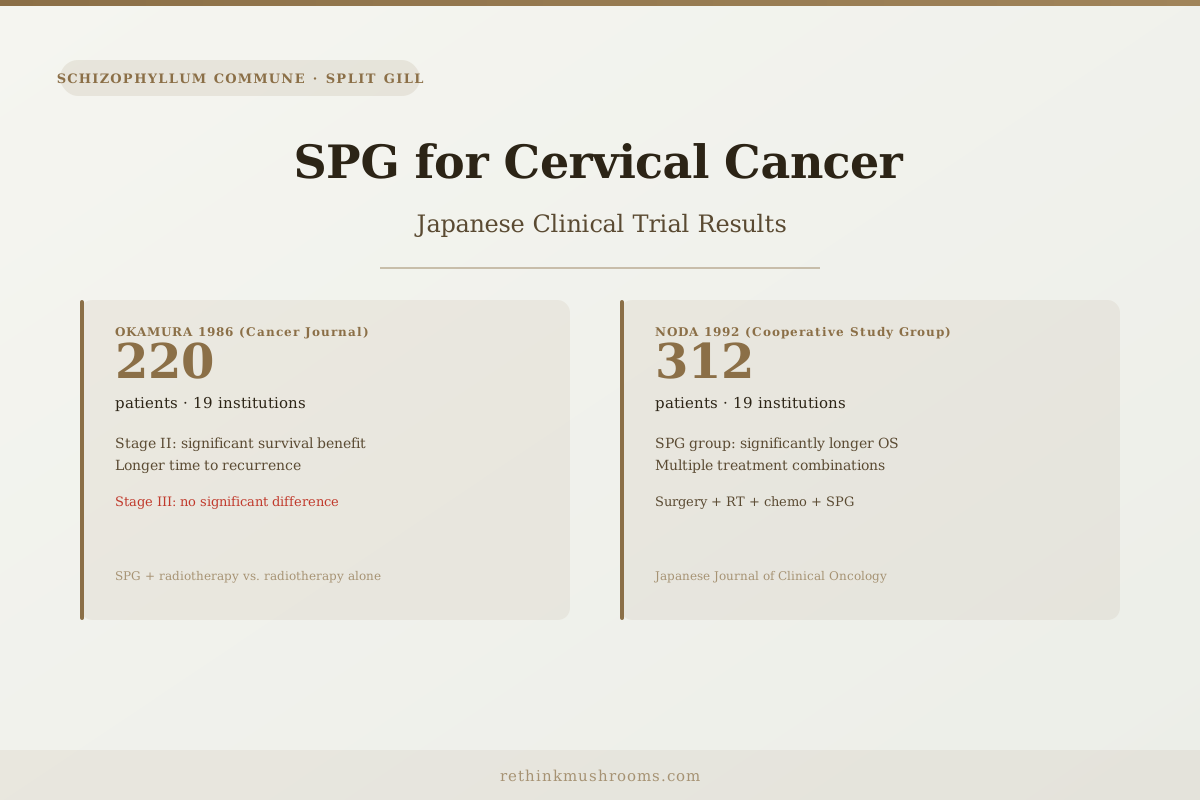
Okamura et al. published a 220-patient randomized controlled trial in Cancer journal (1986) showing schizophyllan plus radiotherapy significantly improved survival and time to recurrence in Stage II cervical cancer patients versus radiotherapy alone.
Okamura et al., Cancer, 1986
Stage II only
Stage II cervical cancer showed significant benefit; Stage III did not in the 1986 RCT
312 patients
enrolled in the 1992 confirmatory study across 19 Japanese institutions (Noda et al.)
19 institutions
participated in the Noda 1992 collaborative RCT, reducing single-site bias
Okamura et al., Cancer, 1986
 View as image ↗
Schizophyllan (SPG) has the strongest evidence base for cervical cancer of the three approved Japanese mushroom anti-cancer drugs. Two randomized controlled trials, published in major oncology journals, show consistent improvement in survival outcomes when SPG was added to standard radiotherapy. The first enrolled 220 patients and was published in Cancer. The second enrolled 312 patients across 19 institutions.
The finding is not universal across all cervical cancer stages. Stage II showed significant benefit in both studies. Stage III did not show a significant survival difference in the larger trial. That staging specificity tells a story about how SPG works, and it's the part that almost no English-language health content has ever explained.
This is a cluster article in the Schizophyllan and Cancer series. For the full overview of SPG's cancer evidence across all indications, see schizophyllan and cancer: Japan's approved anti-cancer drug. For the pillar introduction to the mushroom, see what is Schizophyllum commune.
Key Takeaways
- Okamura et al. (1986) published a 220-patient RCT in Cancer (19 Japanese institutions): Stage II cervical cancer patients receiving SPG plus radiotherapy had significantly longer survival and longer time to recurrence vs. radiotherapy alone; Stage III showed no significant difference[1]
- Noda et al. (1992) published the larger collaborative follow-up (312 patients, Cooperative Study Group on SPG for Gynecological Cancer): patients treated with SPG survived significantly longer overall across combinations of surgery, radiotherapy, and chemotherapy[2]
- Stage II cervical cancer (locally advanced, no lymph node spread) showed significant benefit; Stage III (regional lymph node involvement) did not; this staging specificity reflects the biology of where SPG's macrophage-activation mechanism is most effective
- Sugawara et al. (1984) established the mechanism: SPG-activated macrophages become directly cytotoxic against tumor cells via innate immune activation, explaining why SPG enhances the anti-tumor effect of radiotherapy without adding significant toxicity[3]
- Steimbach et al. (2021) systematic review confirmed consistent survival benefit for fungal beta-glucan adjuvants including SPG across gastrointestinal and gynecological cancers[4]
- All trials used intramuscular injection, not oral SPG; the clinical drug form delivers SPG directly into circulation at defined therapeutic concentrations
What the 1986 Okamura Trial Found: Results and Limits
The landmark SPG cervical cancer study was published by Okamura and colleagues in 1986 in Cancer, one of the most widely read oncology journals internationally.[1]
The trial enrolled 220 patients with Stage II and Stage III cervical cancer at 19 Japanese institutions. Patients received radiotherapy either alone or combined with schizophyllan by intramuscular injection. The primary outcomes were survival and time to first recurrence.
The results split clearly by stage:
Stage II patients in the SPG group had significantly longer overall survival and significantly longer time to recurrence compared to Stage II controls receiving radiotherapy alone. Both endpoints reached statistical significance.
Stage III patients showed no significant survival difference between the SPG and control groups.
Publishing this staging distinction honestly is what sets rigorous science apart from advocacy. A research publication or health article could easily report that "SPG improved outcomes in cervical cancer" and not be technically wrong, since Stage II patients did show benefit. But a reader making decisions about their own care needs to know the result was stage-specific.
The 19-institution design substantially reduces the risk that the result reflects local practice patterns or patient selection at a single hospital. When 19 sites across Japan show the same pattern in the same direction, the signal carries more weight than a single-institution study.
The 1992 Noda Collaborative Study: 312 Patients, 19 Institutions
Noda and colleagues (1992) published the larger follow-up in Japanese Journal of Clinical Oncology, under the Cooperative Study Group on SPG for Gynecological Cancer.[2]
312 patients received various combinations of surgery, radiotherapy, fluorouracil chemotherapy, and SPG. The SPG-treated patients survived significantly longer overall. The multi-institution design (also 19 institutions) and the larger patient number provide more statistical power to detect survival differences than the 1986 study could achieve.
The Noda 1992 study used a more complex treatment design; patients were randomized across several treatment combinations rather than a simple two-arm comparison. This design provides information about how SPG interacts with different treatment backbones (surgery alone, radiation alone, chemotherapy + radiation) but also makes direct comparison to the 1986 data more complicated.
Together, the two trials constitute a replication pattern: the same finding (SPG improves survival in cervical cancer treatment) from two independent Japanese study groups with a combined enrollment of 532 patients.
Why Stage II Shows Benefit and Stage III Does Not
The staging pattern is not random. It reflects the biology of where SPG's mechanism is most useful.
Cervical cancer staging at the time of these trials used FIGO (International Federation of Gynecology and Obstetrics) staging:
Stage II: The tumor has spread beyond the cervix into the upper vagina or surrounding parametrial tissue, but regional lymph nodes are not involved. The cancer is locally advanced but has not established a lymphatic metastatic route.
Stage III: The tumor has spread to the lower vagina or pelvic wall, and regional lymph nodes are typically involved.
SPG works by activating macrophages, which patrol and reside in lymphatic tissue and the tumor microenvironment. In Stage II cervical cancer, the locoregional tumor environment is the primary disease site. SPG-activated macrophages, becoming directly cytotoxic and releasing tumor-targeting cytokines, can operate against the primary tumor and any microscopic residual disease in the immediate field after radiation.
In Stage III cervical cancer, regional lymph node involvement means the disease has established a systemic dissemination route. SPG-activated macrophages in the locoregional environment are less able to address tumor cells that have already established themselves in distant lymph nodes or are in transit through lymphatic channels. The immune activation that helps Stage II disease cannot reach Stage III disease effectively.
This is the same pattern seen in the gastric cancer data: Stage III (lymph node positive) showed the strongest benefit in gastric cancer, while Stage III (lymph node and distant disease) showed less benefit in cervical cancer. The difference is that gastric Stage III still represents resectable locoregional disease, while cervical Stage III represents more established lymphatic involvement.
The Mechanism: How SPG Enhances Radiation's Effect
Sugawara and colleagues (1984) established the foundational mechanism: SPG directly activates macrophages, which become cytotoxic against tumor cells.[3]
In the context of radiotherapy for cervical cancer, this mechanism explains the combination's synergy. Radiation kills tumor cells by damaging their DNA. However, radiation does not sterilize every cancer cell in the field: some survive with sublethal DNA damage and can regenerate the tumor. Radiation also creates a local inflammatory environment.
SPG-activated macrophages are recruited to inflamed tissue. In the post-radiation environment, activated macrophages can target the tumor cells that survived radiation with sublethal damage, phagocytizing them and releasing cytokines (including TNF-alpha and interferon-gamma) that signal NK cells and cytotoxic T lymphocytes to join the anti-tumor response.
This combination logic explains why SPG was studied as an adjuvant alongside radiation rather than as a standalone treatment. Radiation does the primary cell-killing. SPG's macrophage activation targets the survivors.
The Systematic Review Context
Steimbach and colleagues' 2021 systematic review of all clinical trials of fungal beta-glucan cancer adjuvants provides the broadest context for interpreting the SPG cervical cancer data.[4]
The review found consistent survival benefits for fungal beta-glucan adjuvants across cancer types, with the evidence base including SPG, lentinan, and PSK. For gynecological cancers specifically, SPG has the most dedicated RCT evidence; the Okamura and Noda trials have no equivalent among the other beta-glucan drugs for this indication.
Among the three approved Japanese mushroom cancer drugs, SPG has the strongest cervical cancer-specific evidence. Lentinan's clinical evidence base is concentrated in gastric cancer. PSK's evidence spans colorectal and gastric cancer. SPG is the only one with two dedicated cervical cancer RCTs in the published literature. For a direct comparison of the three drugs, see schizophyllan vs. lentinan: comparing mushroom cancer drugs.
Turkey tail (PSK) also has cervical cancer-adjacent research through HPV-related applications. For that comparison, see Turkey Tail and cervical dysplasia: from HPV clearance to prevention.
What the Evidence Cannot Tell Us
The Okamura and Noda trials are the most specific cervical cancer evidence available for any mushroom-derived compound. They also have limitations that define what questions remain unanswered.
Staging system differences. The FIGO staging system has been revised since these 1980s trials. Current staging classifications differ in meaningful ways from those used by Okamura and Noda. The specific patient populations enrolled may not map exactly to current staging categories.
Treatment protocol evolution. Concurrent chemoradiation (cisplatin-based) has replaced radiation alone as the standard of care for locally advanced cervical cancer since these trials were conducted. Whether SPG produces the same relative benefit alongside cisplatin-based chemoradiation is not known.
No replication outside Japan. Both trials were conducted exclusively in Japanese institutions with Japanese patient populations. International replication in different populations and with modern treatment protocols has not been attempted.
Injection only. The clinical benefit was achieved with intramuscular SPG injection. Oral SPG supplement forms have not been studied in cervical cancer patients. The current status of schizophyllan research, including emerging applications beyond oncology, is covered in Ansari et al. (2025).[5]
The Bottom Line
Schizophyllan has two randomized controlled trials in cervical cancer: Okamura 1986 (220 patients, published in Cancer) and Noda 1992 (312 patients, 19 institutions). Both showed significant improvement in survival outcomes when SPG was added to standard radiotherapy. The benefit was concentrated in Stage II cervical cancer; Stage III showed no significant survival difference in the larger trial. The mechanism involves SPG-activated macrophages targeting radiation-surviving tumor cells. All trials used intramuscular injection; oral supplement bioavailability is not established for this indication.
Frequently Asked Questions
Sources & References
- 1RTHM-00019·Okamura, K et al. (1986). “Clinical evaluation of schizophyllan combined with irradiation in patients with cervical cancer. A randomized controlled study..” Cancer.Study breakdown →PubMed →↩
- 2RTHM-00030·Noda, K et al. (1992). “Clinical effect of sizofiran combined with irradiation in cervical cancer patients: a randomized controlled study. Cooperative Study Group on SPG for Gynecological Cancer..” Japanese journal of clinical oncology.Study breakdown →PubMed →↩
- 3RTHM-00015·Sugawara, I et al. (1984). “Schizophyllan (SPG)-treated macrophages and anti-tumor activities against syngeneic and allogeneic tumor cells. I. Characteristics of SPG-treated macrophages..” Cancer immunology.Study breakdown →PubMed →↩
- 4RTHM-00719·Steimbach, Laiza et al. (2021). “Fungal beta-glucans as adjuvants for treating cancer patients - A systematic review of clinical trials..” Clinical nutrition (Edinburgh.Study breakdown →PubMed →↩
- 5RTHM-02051·Ansari, Elham et al. (2025). “Research progress on production and biomedical applications of Schizophyllan as a tailor-made polysaccharide: A review..” Carbohydrate polymers.Study breakdown →PubMed →↩