Schizophyllum commune (Split Gill)
3 cancer types
Schizophyllan has randomized controlled trial evidence across gastric cancer, cervical cancer, and head and neck cancer, making it the only mushroom-derived compound with RCT data spanning three distinct oncology indications.
Ansari et al., Carbohydrate Polymers, 2025
Japan only
schizophyllan is an approved prescription cancer drug in Japan, not FDA- or EMA-approved
IM injection
all clinical trials used intramuscular injection; oral supplement bioavailability is not established
1980s
Japan approved schizophyllan as a prescription adjuvant cancer treatment in the 1980s
Ansari et al., Carbohydrate Polymers, 2025
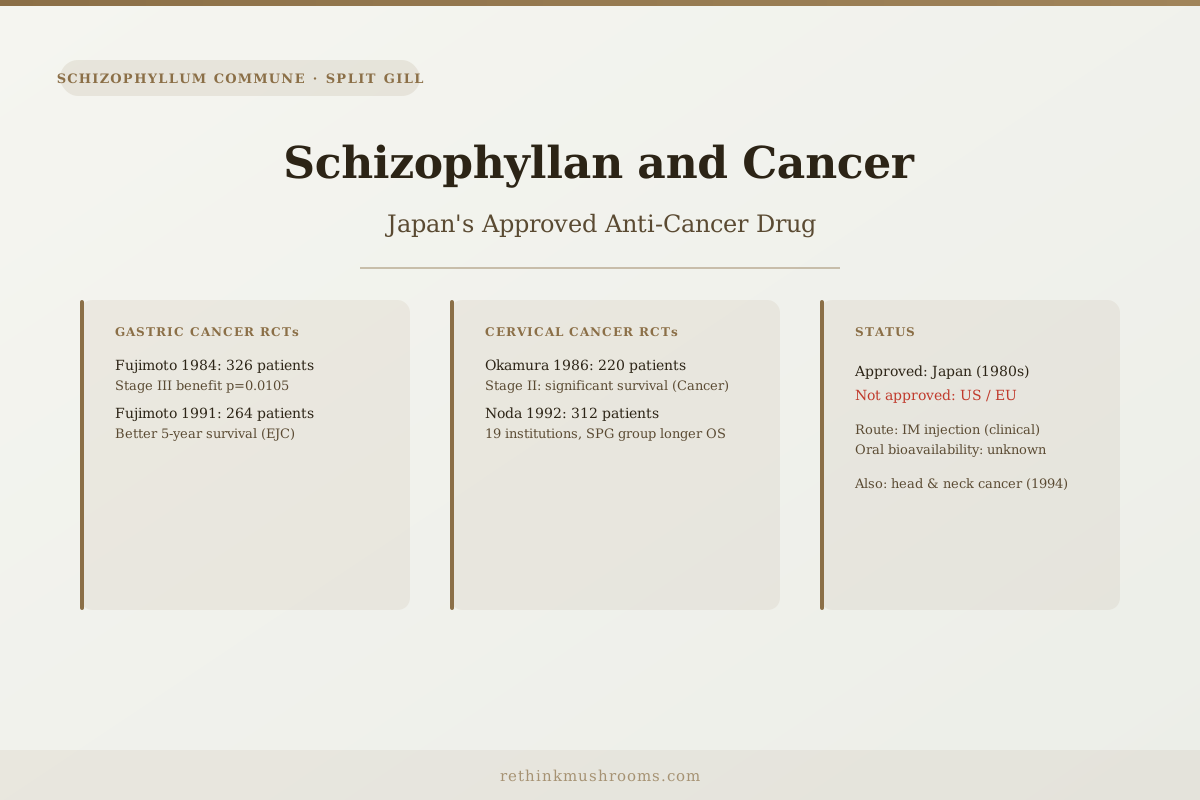 View as image ↗
Japan has three approved mushroom-derived anti-cancer drugs: PSK from turkey tail (Trametes versicolor), lentinan from shiitake (Lentinus edodes), and schizophyllan from split gill mushroom (Schizophyllum commune). PSK is the best-known outside Japan, largely because it is orally active and available as a supplement. Lentinan has attracted recent attention through Chinese clinical research. Schizophyllan (SPG) is the least-covered in English-language content, and it has randomized controlled trial data across the widest range of cancers of the three.
SPG has randomized controlled trial evidence in gastric cancer, cervical cancer, and head and neck cancer, published across Japanese and European oncology journals from the 1980s through the 1990s. It is an approved prescription drug in Japan under the trade names Sonifilan and Sizofiran. It is not approved by the FDA, EMA, or any Western regulatory authority. This article is the overview of that evidence, and it is careful to state what each trial actually found rather than the rounded-up version that circulates online. For the pillar introduction to the mushroom itself, see what is Schizophyllum commune.
Key Takeaways
- Ansari et al. (2025) published the most current comprehensive review of schizophyllan, documenting its structure (triple-helix (1→3)-β-D-glucan backbone with (1→6) side chains every 3rd residue), clinical applications, and emerging pharmaceutical uses[1]
- Two gastric cancer RCTs give a mixed-but-real signal: Fujimoto 1984 (326 patients) found no overall survival benefit and only a non-significant Stage III trend (p=0.0811); Fujimoto 1991 (386 randomized) found better 5-year survival in the 264 curatively resected patients, where SPG was an independent prognostic factor (p=0.011, European Journal of Cancer)[3][4]
- The strongest cervical result is Okamura 1986 (220 patients, published in Cancer): Stage II patients on SPG plus radiotherapy had significantly longer survival; Stage III showed no significant difference[5]
- Noda 1992 (315 enrolled / 292 analyzed across 52 institutes) reported a significantly higher complete-response rate with SPG (Stage III: 77.9% vs 61.2%) and faster immune recovery — a tumor-response and immune endpoint, not a demonstrated overall-survival benefit[6]
- Steimbach et al. (2021) systematically reviewed 16 fungal beta-glucan cancer trials (1650 patients) and found the compounds safe and well-tolerated, most often reducing treatment-induced immune depression, but flagged heterogeneous methods and mixed results on hard outcomes rather than a clean survival benefit[2]
- Miura et al. (2000) demonstrated that high doses of sonifilan (SPG) failed to produce antitumor activity in preclinical models; dose-dependent immunomodulatory activity has an effective window, and more is not better[8]
- All clinical trial evidence used intramuscular injection; oral supplement forms of SPG may have substantially different bioavailability from the pharmaceutical drug form
The Trial Record, At a Glance
Every Schizophyllan Cancer Trial — What It Actually Showed
Trial
What it showed
Caveat
Fujimoto 1984[3]
Gastric · RCT, n=326 · Jpn J Surg
Stage III (n=100) showed a survival trend favoring SPG (p=0.0811)
Overall 3-year survival no different; the trend was not statistically significant
Fujimoto 1991[4]
Gastric · RCT, n=386 · Eur J Cancer
In the 264 curatively resected: better 5-yr survival; SPG an independent prognostic factor (p=0.011)
No survival benefit across all 386 randomized — only the curative subgroup
Okamura 1986[5]
Cervical · RCT, n=220 · Cancer
Stage II: significantly longer survival and time to recurrence with SPG + radiotherapy
Stage III: no significant survival difference
Noda 1992[6]
Cervical · RCT, 315 enrolled / 292 analyzed, 52 institutes · Jpn J Clin Oncol
Higher complete-response rate (Stage III 77.9% vs 61.2%); faster immune recovery
Reported tumor response and recovery, not an overall-survival benefit
Kimura 1994[7]
Head & neck · n=15
5-year survival 86.7% (SPG) vs 73.4% (control); faster immune recovery
Only 15 patients and no significance test reported — a pilot signal
Read together, the record is real but modest: five small-to-moderate trials from 1984–1994, each with a benefit confined to a specific stage or subgroup, and none replicated in a modern Phase III trial. The cleanest positive signal is Stage II cervical cancer (Okamura 1986).
Sources: Fujimoto et al. (1984) [ref 3]; Fujimoto et al. (1991) [ref 4]; Okamura et al. (1986) [ref 5]; Noda et al. (1992) [ref 6]; Kimura et al. (1994) [ref 7]. Figures quoted from each study’s primary report.
What Schizophyllan Is: Structure, Source, and Trade Names
Schizophyllan (also called SPG, Sonifilan, or Sizofiran) is a polysaccharide produced during the growth of Schizophyllum commune in fermentation culture. The active compound is extracted from the culture broth, not from the mushroom fruiting body itself.
The structure is specific: a (1→3)-β-D-glucan backbone with (1→6) glucose side chains at every third residue. This branching pattern creates a polysaccharide that folds into a distinctive triple-helix conformation (three polysaccharide chains wound around each other in a stable helical structure). The triple-helix is essential for SPG's immune-activating properties; denatured single-strand forms lose biological activity.[1]
The molecular weight of pharmaceutical SPG is typically 100,000 to 200,000 daltons. This large molecular size creates the central practical limitation for supplement users: intestinal absorption of large polysaccharides is limited, and the intramuscular injection used in clinical trials delivers SPG directly into the bloodstream, bypassing the gut entirely.
Trade names and pharmaceutical forms: Sonifilan is the trade name used in Japanese oncology practice. Sizofiran (also spelled sizofilan) appears in several of the RCT publications. Both names refer to the same compound at pharmaceutical grade. Commercial supplement products using the name "schizophyllan" or "SPG" may vary substantially in molecular weight, purity, and cracking method compared to the clinical drug.
Approved in Japan, Unknown in the West: The Regulatory Story
Japan approved schizophyllan as a prescription adjuvant cancer treatment in the 1980s, on the basis of the gastric and cervical cancer RCT data generated in that decade. It entered Japanese oncology practice alongside lentinan (approved for gastric cancer) and PSK (approved for gastric and colorectal cancer).
Outside Japan, SPG never progressed through regulatory approval. The reasons are partly practical (the RCTs were conducted in Japan using Japanese patient populations and published primarily in Japanese journals) and partly commercial (the pharmaceutical development was Japan-specific). No Phase III trial conforming to modern FDA or EMA trial design standards has been completed.
The result is a compound with genuine randomized controlled trial evidence that is essentially invisible to Western oncology. A patient in the United States asking an oncologist about schizophyllan would almost certainly receive a blank response, despite two gastric cancer RCTs and two cervical cancer RCTs in the peer-reviewed literature.
The Steimbach 2021 systematic review, published in Clinical Nutrition, is the closest thing to a Western-accessible evidence synthesis: it reviewed 16 clinical trials of fungal beta-glucan cancer adjuvants (1650 patients total) and concluded the compounds are safe and well-tolerated, most often reducing the immune depression caused by chemotherapy and radiotherapy. It stopped short of a clean survival conclusion, explicitly noting that heterogeneous methods and some null results made the overall picture controversial.[2]
The Gastric Cancer Evidence: Two Japanese RCTs
The gastric cancer evidence is the foundation of SPG's approval history, and it is also where the online version of the story tends to overstate the result. The trials are real, but their findings are specific and partly mixed.
Fujimoto et al. (1984) enrolled 326 patients with resectable gastric cancer and gave adjuvant SPG by intramuscular injection alongside standard chemotherapy after surgery, or chemotherapy alone.[3] Overall three-year survival did not differ between the SPG and control groups. The one hint of benefit was in the 100 Stage III patients, whose survival was enhanced at p=0.0811 in the SPG group — a trend in the right direction, but not statistically significant at the conventional threshold. Stages I, II, and IV showed little difference. This is a genuinely honest starting point: the foundational trial was, by its own primary analysis, a near-miss rather than a clear win.
Fujimoto et al. (1991) is the stronger of the two. It randomized 386 gastric cancer patients and reported in the European Journal of Cancer.[4] Across all 386, overall five-year survival did not differ. But in the 264 patients who had a curative resection (no visible tumor remaining after surgery), the SPG group had better five-year survival and longer time to recurrence, and in multivariate analysis SPG administration was an independent prognostic factor (p=0.011), alongside nodal involvement, age, and tumor size. In other words, the benefit was real but confined to the subgroup with the least residual disease.
Read together, the gastric data point in a consistent direction — SPG helps most when the tumor burden is lowest — but neither trial delivered an across-the-board survival benefit, and the strongest result is a subgroup finding. For more on the gastric cancer data specifically, see schizophyllan and gastric cancer: adjunct therapy evidence.
The Cervical Cancer Evidence: Two Studies, Stage II as the Signal
The cervical cancer evidence for SPG is the cleanest in its published literature, and Stage II cervical cancer is the indication where SPG has the most defensible data.
Okamura et al. (1986) · Cancer
- Population
- 220 patients with Stage II or III cervical cancer receiving radiotherapy
- Intervention
- Radiotherapy plus schizophyllan (SPG) by intramuscular injection
- Comparator
- Radiotherapy alone
- Finding
- Stage II patients on SPG had significantly longer 48-month survival and longer time to recurrence. Stage III patients showed no significant survival difference.
positive The benefit is confined to Stage II. This trial does not support a Stage III survival claim, and its scope is a single tumor stage in one cancer type.
Okamura et al., Cancer, 1986 (PMID 2941141)
Okamura et al. (1986) published a 220-patient RCT in Cancer, one of the most visible oncology journals in the world.[5] The study enrolled Stage II and Stage III cervical cancer patients treated with irradiation. Patients received radiotherapy with or without SPG by intramuscular injection. Stage II patients in the SPG group had significantly longer 48-month survival and significantly longer time to recurrence. Stage III patients did not show a significant survival difference.
This staging specificity matters. Stage II cervical cancer is locally advanced but has not spread to distant sites; Stage III involves more extensive regional spread. The pattern mirrors the gastric cancer data: SPG's benefit concentrates in the stage where the immune system still has the most capacity to act against a limited disease burden.
Noda et al. (1992) was the larger collaborative follow-up: a randomized controlled study across 52 institutes, with 315 patients enrolled and 292 included in the analysis after exclusions.[6] Patients received radiotherapy with or without SPG (given intramuscularly, 40 mg once and 20 mg twice weekly). The headline result was a higher complete-response rate in the SPG group — 91.0% vs 79.1% in Stage II, and a significantly higher 77.9% vs 61.2% in Stage III — together with significantly faster recovery of the lymphocyte counts suppressed by radiotherapy. It is important to be precise here: Noda 1992 demonstrated better tumor response and immune recovery, not a documented overall-survival benefit. The 52-institute design substantially reduces the risk that the result reflects a single-site anomaly.
Publication in Cancer (1986) and the Japanese Journal of Clinical Oncology (1992) puts this evidence in a different category from unpublished or gray-literature data. These are peer-reviewed findings from major oncology journals that have simply not been synthesized in English-language consumer health content. For a dedicated analysis of the cervical cancer data, see SPG for cervical cancer: clinical trial results from Japan.
Head and Neck Cancer: A Small Pilot Signal
Kimura and colleagues (1994) reported the use of sizofilan (SPG) as an immunotherapy adjuvant in head and neck cancer.[7] The study is small — only 15 patients — and its numbers should be read as a pilot signal rather than robust evidence: cumulative five-year survival was 86.7% in the SPG group versus 73.4% in controls, and the SPG group recovered cellular immunity more quickly after radiation, chemotherapy, and surgery. No statistical significance test for the survival difference is reported, which is unsurprising given the tiny sample.
Head and neck cancers share some features with cervical cancer — squamous epithelium, HPV involvement in a subset, and regional lymph node status as the key staging determinant — so it is biologically plausible that SPG's macrophage-activating mechanism would operate similarly. But the honest summary is that this is a 15-patient pilot that extends the indication list without adding statistical weight.
- Cell studiescompleted
Macrophage activation via Dectin-1, cytokine induction, and the triple-helix requirement documented in vitro
- Animal modelscompleted
Antitumor activity in rodent tumor models; the dose-window/overdose-failure effect shown by Miura 2000
- Randomized controlled trialscompleted
Five small-to-moderate RCTs (1984–1994), largest n=326; benefits confined to specific stages or subgroups
- Modern Phase III / Western replicationmissing
No contemporary Phase III trial with current chemotherapy regimens or non-Japanese populations
- Pooled meta-analysismissing
The 2021 systematic review is qualitative; heterogeneity prevented a pooled survival meta-analysis
Schizophyllan reached randomized controlled trials decades ago, but the evidence has not advanced since: no modern Phase III trial and no pooled survival meta-analysis exist. The RCTs are small-to-moderate, 30–40 years old, and used the injectable drug — not an oral supplement.
Steimbach et al., Clinical Nutrition, 2021; Ansari et al., Carbohydrate Polymers, 2025
The Systematic Review: Where SPG Stands Among Mushroom Cancer Drugs
The Steimbach 2021 systematic review is the single most useful context piece for understanding SPG's place in the broader mushroom oncology literature.[2] It screened over 1,000 records and analyzed 16 clinical trials — 1,650 patients across nine cancer types — using fungal beta-glucans as cancer adjuvants, covering SPG, lentinan, and yeast-derived glucans.
The review's actual conclusions are more measured than the way SPG is often described online. It found that beta-glucan administration is safe and well-tolerated, and that most trials showed reduced treatment-induced immune depression and faster recovery of white-blood-cell counts when a beta-glucan was given alongside chemotherapy or radiotherapy. But it also noted that some trials found no statistical difference between beta-glucan and control groups, and that the large diversity in study methods and the incomplete reporting prevented a rigorous pooled analysis. The fair reading is: consistent immune-supportive effects and a good safety profile, but genuinely mixed and under-powered evidence on hard outcomes like survival.
Within that landscape, PSK is the most supplement-accessible because it is orally active, while lentinan and SPG require injection for their demonstrated clinical effects. For readers comparing SPG to lentinan specifically, the two compounds have similar mechanisms (triple-helix beta-glucan, macrophage activation via Dectin-1) and similar clinical evidence strength from Japanese RCTs, but different indication emphases: lentinan has more extensive recent Chinese gastric cancer data, while SPG has its cleanest signal in Stage II cervical cancer. For a direct comparison, see schizophyllan vs. lentinan: comparing mushroom cancer drugs. For context on lentinan and chemotherapy, see lentinan and chemotherapy: synergistic effects on survival.
The Dose Problem: Why More SPG Is Not Better
Miura and colleagues (2000) published a finding that belongs in any honest account of SPG's pharmacology: high doses of sonifilan failed to produce antitumor activity in preclinical models.[8]
The dose-response relationship for SPG is not linear. At appropriate doses, SPG primes macrophages and downstream antitumor immune activity. At high doses, that effect is lost: the study found that an overdose significantly reduced tumor necrosis factor (TNF-α) production and macrophage adherence, the very responses SPG is meant to augment. This inverse behavior at high concentrations is one reason clinical trials used specific dose protocols rather than escalating the dose.
The practical implication for supplement users: taking higher doses of schizophyllan supplements does not produce proportionally stronger immune activation, and preclinical data suggest it could be counterproductive. Dose standardization in the clinical trials was not accidental; it reflects the pharmacological window within which SPG produces its effects.
Supplements vs. the Clinical Drug: The Administration Gap
The single most important practical point about schizophyllan for anyone interested in it as a supplement: all of the clinical trial evidence used intramuscular injection, not oral administration.
Safety & Scope
ModerateOral supplements are not the drug that was tested
Concern
Every schizophyllan cancer trial used the pharmaceutical injectable form (intramuscular SPG). Oral supplements sold as 'schizophyllan' or 'SPG' have not been shown to reach the bloodstream concentrations those trials required, and no trial has tested an oral form for cancer. Reported side effects in the trials themselves were low but real — for example, roughly 5% of patients in Noda 1992.
What the research says
Schizophyllan is an approved prescription drug only in Japan, given by injection under oncologist supervision as an add-on to standard therapy — never as a standalone cancer treatment. It is not FDA- or EMA-approved, and it cannot legally be marketed for any cancer indication in the US.
Particularly relevant for: Anyone considering schizophyllan supplements in the context of cancer
What to do
Treat this article as educational information, not medical advice. Cancer treatment decisions belong with a qualified oncologist, and no supplement should replace or delay conventional care.
Noda et al., 1992 (PMID 1573785); Steimbach et al., Clinical Nutrition, 2021; Japanese Ministry of Health approval status
SPG is a large polysaccharide, and large polysaccharides are absorbed poorly through the intestinal epithelium. The IM injection route delivers SPG directly into circulation, where it reaches macrophages in blood and lymphoid tissue at therapeutic concentration. Oral administration of the same mass of SPG results in substantially lower systemic exposure, with most of the molecule degraded or passing through the gut unabsorbed.
Whether oral SPG supplements produce systemic concentrations within the effective immunomodulatory window has not been established by pharmacokinetic study. The Steimbach 2021 review identified this oral bioavailability limitation as the primary practical disadvantage of SPG compared to PSK, which is demonstrably active by mouth.
This does not mean oral SPG has no biological activity; gut-resident immune cells (macrophages in Peyer's patches, for example) may be activated by locally present SPG even without systemic absorption. But the specific results documented in the RCTs cannot be attributed to oral SPG without evidence that oral dosing achieves comparable macrophage activation.
Current Research Status
The Ansari 2025 review in Carbohydrate Polymers is the most current comprehensive synthesis of schizophyllan research, published four decades after the initial Japanese clinical trials.[1]
The current research directions extend well beyond cancer immunotherapy: SPG is being studied as a drug delivery scaffold (its triple-helix structure can form complexes with nucleic acids and other biomolecules), as a platform for targeted therapy, and as a material for controlled-release pharmaceutical systems.
For the cancer immunotherapy application specifically, the evidence base has not grown substantially since the 1990s. No modern Phase III trial has replicated the Japanese RCT data in a Western population or with contemporary chemotherapy regimens. The compound remains approved only in Japan, used primarily by oncologists familiar with the historical trial data.
The Ansari 2025 review frames SPG as a "tailor-made polysaccharide" with pharmaceutical modification potential. The future direction is less about re-running the 1980s RCTs and more about engineering SPG derivatives for targeted delivery and combination with modern immunotherapy. Whether that research reaches clinical application will determine whether SPG eventually earns a place in Western oncology.
The Bottom Line
Schizophyllan is an approved Japanese prescription anti-cancer drug with randomized controlled trial evidence in gastric cancer (two RCTs; the clearest benefit is in curatively resected patients in Fujimoto 1991, where SPG was an independent prognostic factor, p=0.011), cervical cancer (two RCTs; a significant Stage II survival benefit in Okamura 1986, n=220, and higher complete-response rates in Noda 1992, 292 analyzed), and a 15-patient head and neck pilot. The Steimbach 2021 systematic review (16 trials, 1,650 patients) found fungal beta-glucans safe and immune-supportive but reported mixed results on hard outcomes. Critical limitations: all trials used intramuscular injection, not oral supplements; the data is 30–40 years old; no modern Phase III trial exists; and high-dose SPG paradoxically loses efficacy (Miura 2000). SPG is not FDA-approved and is available in Western markets only as an unregulated supplement.
Frequently Asked Questions
Sources & References
- 1RTHM-02051·Ansari, Elham et al. (2025). “Research progress on production and biomedical applications of Schizophyllan as a tailor-made polysaccharide: A review..” Carbohydrate polymers.Study breakdown →PubMed →↩
- 2RTHM-00719·Steimbach, Laiza et al. (2021). “Fungal beta-glucans as adjuvants for treating cancer patients - A systematic review of clinical trials..” Clinical nutrition (Edinburgh.Study breakdown →PubMed →↩
- 3RTHM-00014·Fujimoto, S et al. (1984). “Clinical evaluation of schizophyllan adjuvant immunochemotherapy for patients with resectable gastric cancer--a randomized controlled trial..” The Japanese journal of surgery.Study breakdown →PubMed →↩
- 4RTHM-00029·Fujimoto, S et al. (1991). “Clinical outcome of postoperative adjuvant immunochemotherapy with sizofiran for patients with resectable gastric cancer: a randomised controlled study..” European journal of cancer (Oxford.Study breakdown →PubMed →↩
- 5RTHM-00019·Okamura, K et al. (1986). “Clinical evaluation of schizophyllan combined with irradiation in patients with cervical cancer. A randomized controlled study..” Cancer.Study breakdown →PubMed →↩
- 6RTHM-00030·Noda, K et al. (1992). “Clinical effect of sizofiran combined with irradiation in cervical cancer patients: a randomized controlled study. Cooperative Study Group on SPG for Gynecological Cancer..” Japanese journal of clinical oncology.Study breakdown →PubMed →↩
- 7RTHM-00037·Kimura, Y et al. (1994). “Clinical evaluation of sizofilan as assistant immunotherapy in treatment of head and neck cancer..” Acta oto-laryngologica. Supplementum.Study breakdown →PubMed →↩
- 8RTHM-00072·Miura, T et al. (2000). “Failure in antitumor activity by overdose of an immunomodulating beta-glucan preparation, sonifilan..” Biological & pharmaceutical bulletin.Study breakdown →PubMed →↩