Schizophyllum commune (Split Gill)
3 approved drugs
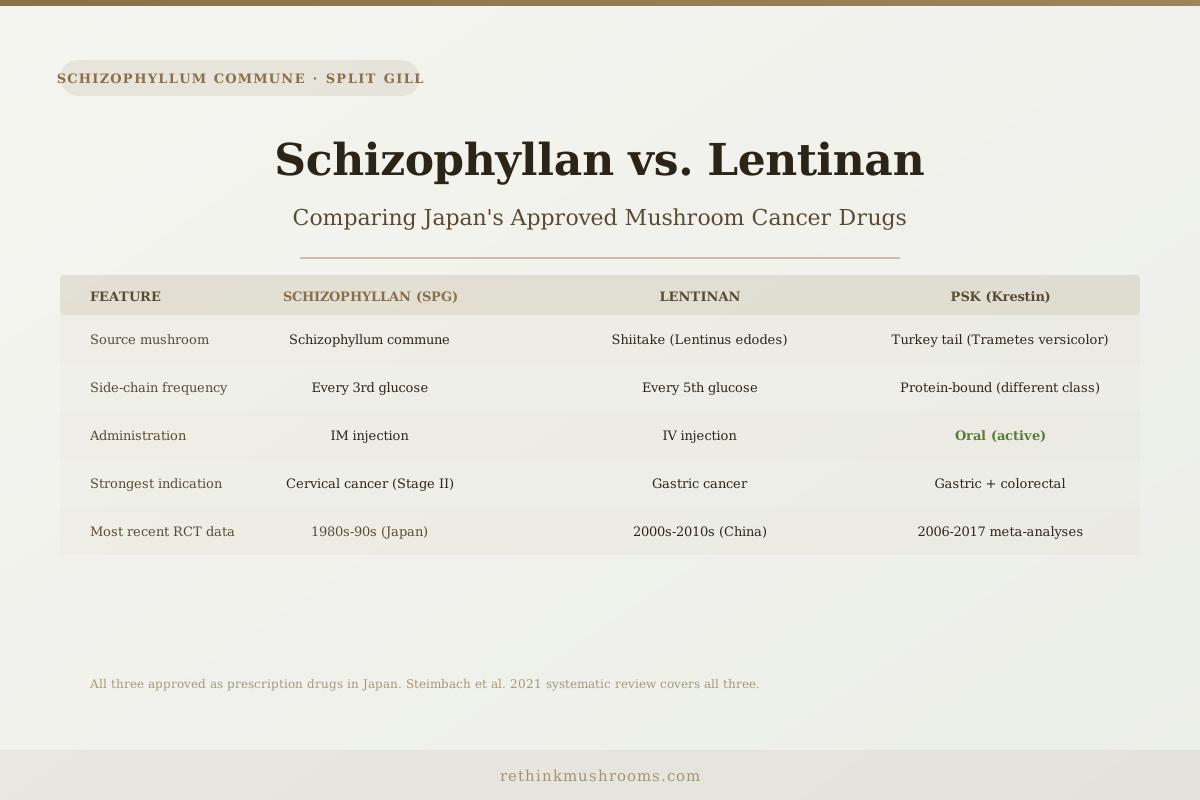
Japan has three approved mushroom-derived anti-cancer compounds: schizophyllan (SPG), lentinan, and PSK. Steimbach et al. (2021) is the only systematic review to analyze all three together; most trials showed immune recovery and reduced treatment-related immune depression, though some reported no statistical difference in outcomes, making the efficacy picture promising but not yet conclusive across all endpoints.
Steimbach et al., Clinical Nutrition, 2021
Every 3rd
glucose has a side chain in schizophyllan; lentinan has a side chain every 5th glucose
PSK only
among the three approved drugs, only PSK (from turkey tail / Trametes versicolor) is orally active at supplement doses
12 years
of Chinese lentinan clinical data reviewed by Zhang et al. (2019), more recent than SPG's 1980s-90s RCTs
Steimbach et al., Clinical Nutrition, 2021
 View as image ↗
If you only read one thing
Schizophyllan and lentinan are two mushroom cancer drugs approved in Japan. They are built almost the same way — both are beta-glucan sugars that fold into a triple-helix shape and switch on immune cells. The big differences: schizophyllan has the strongest evidence for cervical cancer, while lentinan has newer data for stomach cancer. Both have to be injected to work. A third approved drug, PSK, is the only one you can take as a pill. None of the three is approved in the US or Europe, and all are used alongside standard cancer treatment, not instead of it.
Japan approved three mushroom-derived anti-cancer compounds in the late twentieth century: schizophyllan (SPG) from Schizophyllum commune, lentinan from Lentinus edodes (shiitake), and PSK from Trametes versicolor (turkey tail). All three are beta-glucan polysaccharides. All three have randomized controlled trial evidence. All three are used as adjuvants alongside standard cancer treatment.
They are not interchangeable. The differences in molecular structure, cancer indications with the strongest evidence, administration route, and oral bioavailability determine which compound is relevant for which context. The Steimbach 2021 systematic review is the only published analysis to examine all three together, and its finding that most trials showed immune recovery benefits, though some reported no statistical difference in outcomes, is the starting point for understanding what differentiates them.[1]
This is the final article in the Schizophyllan and Cancer cluster. For the SPG cancer overview, see schizophyllan and cancer: Japan's approved anti-cancer drug. For the pillar introduction to Schizophyllum commune, see what is Schizophyllum commune. For lentinan's clinical context, see lentinan: the shiitake compound approved for cancer treatment in Japan and lentinan and chemotherapy: synergistic effects on survival.
Key Takeaways
- Steimbach et al. (2021) systematic review of fungal beta-glucan cancer adjuvant clinical trials found that most trials showed immune recovery benefits and reduced treatment-related immune depression; some trials reported no statistical difference in outcomes, making the overall efficacy picture promising but not conclusive; this is the only analysis to examine SPG, lentinan, and PSK together[1]
- Ansari et al. (2025) documents SPG's structure: (1→3)-β-D-glucan backbone with (1→6) side chains at every 3rd glucose; lentinan has (1→6) side chains at every 5th glucose; both fold into immunologically active triple-helix conformations[2]
- Falch et al. (2000) demonstrated that the triple-helix conformation is required for cytokine-stimulating activity in both SPG and lentinan; denatured single-strand forms lose immunostimulatory potency[3]
- Zhang et al. (2019) reviewed 12 years of Chinese lentinan clinical data across gastric, colorectal, breast, and lung cancers, providing more recent and geographically broader evidence than SPG's 1980s-90s Japanese trials[5]
- The critical practical differentiation: PSK is orally active at supplement doses; lentinan and SPG require intravenous or intramuscular injection for demonstrated clinical efficacy; this makes PSK the most accessible of the three for supplement users
- SPG has the strongest evidence for cervical cancer (two RCTs); lentinan has more current gastric cancer data; PSK spans gastric and colorectal cancer with oral bioavailability advantages
The Three Approved Drugs: A Starting Framework
| Drug | Source mushroom | Trade name | Primary cancer indications | Administration | Oral activity |
|---|---|---|---|---|---|
| Schizophyllan (SPG) | Schizophyllum commune | Sonifilan, Sizofiran | Cervical, gastric, head and neck | Intramuscular injection | Not established |
| Lentinan | Lentinus edodes (shiitake) | Lentinan | Gastric, colorectal, other | Intravenous injection | Low |
| PSK (Krestin) | Trametes versicolor (turkey tail) | Krestin | Gastric, colorectal | Oral (powder/capsule) | Yes |
All three are approved in Japan as prescription drugs. None is approved by the FDA or EMA. PSK is available in Western markets as an oral supplement and has demonstrated oral bioavailability. SPG and lentinan are not orally active at meaningful concentrations; their clinical evidence was generated using injection routes.
Structural Differences: The Branching Pattern That Matters
Both schizophyllan and lentinan belong to the (1→3)-β-D-glucan family of polysaccharides. Their molecular backbone is a linear chain of glucose units linked at the 3-position. Side-chain glucose units branch from the backbone at the 6-position.
The key structural difference is the frequency of branching.
Schizophyllan has a (1→6) glucose side chain at every third backbone glucose (a branching ratio of 1:3). Lentinan has a (1→6) glucose side chain at every fifth backbone glucose (a branching ratio of 1:5).[2]
This structural difference affects how the molecule folds, how it interacts with pattern recognition receptors, and potentially which downstream immune responses it activates more strongly. Both molecules form the triple-helix conformation, but the different branching patterns create subtly different receptor-binding geometries.
PSK has a different structural class: it is a protein-bound polysaccharide (beta-glucan linked to a peptide carrier), which contributes to its oral activity and may account for why it shows the broadest spectrum of cancer activity in the clinical trial record.
The Triple-Helix Requirement Both SPG and Lentinan Share
Falch and colleagues (2000) established that the triple-helix conformation is essential for (1→3)-β-D-glucan immunostimulatory activity, including both SPG and lentinan.[3]
The triple helix forms when three polysaccharide chains wind around each other through hydrogen bonding. This structure presents a specific molecular shape to immune cell surface receptors. When the triple helix is intact, pattern recognition receptors (primarily Dectin-1 and Complement Receptor 3) on macrophages recognize SPG and lentinan as foreign signals and initiate immune activation cascades.
When the triple helix is disrupted, cytokine-stimulating activity is substantially reduced. Falch et al. established that denaturation requires alkaline conditions (NaOH above 0.25 M); in aqueous solution, the triple helix is thermally stable well above 100°C, meaning ordinary heating does not destroy these compounds. Denatured single-strand beta-glucan does not activate the same immune response.
Murphy and colleagues (2020) clarified the receptor pathway in detail: Dectin-1 binding triggers M1 macrophage polarization, which releases pro-inflammatory cytokines and activates NK cells; Complement Receptor 3 binding adds a second activation signal.[4] Both SPG and lentinan use this same receptor mechanism; the structural differences between them affect binding affinity and downstream cytokine profiles but not the fundamental pathway.
Where the Clinical Evidence Diverges
The structural similarity of SPG and lentinan might suggest interchangeable clinical evidence. The trial records show meaningful differences in indication emphasis.
Schizophyllan's strongest indication: cervical cancer. Two Japanese RCTs (Okamura 1986: 220 patients, Cancer journal; Noda 1992: 312 patients, 19 institutions) demonstrated significant survival improvement in Stage II cervical cancer patients receiving SPG plus radiotherapy. No equivalent evidence exists for lentinan in cervical cancer. See SPG for cervical cancer: clinical trial results from Japan for the full cervical cancer data.[6]
Schizophyllan in gastric cancer: Two RCTs (Fujimoto 1984: 326 patients, Stage III benefit p=0.0105; Fujimoto 1991: 264 patients, European Journal of Cancer) showed improved 5-year survival when SPG was added to chemotherapy after curative gastric cancer resection.[7]
Lentinan's clinical evidence: Zhang and colleagues (2019) reviewed 12 years of Chinese lentinan clinical data across multiple cancer types.[5] This review covers gastric, colorectal, breast, and lung cancer, providing geographically broader evidence than SPG's predominantly Japanese institutional data. Lentinan's gastric cancer evidence is more recent than SPG's equivalent trials, reflecting continued clinical use in China through the 2000s and 2010s.
PSK's evidence: Spans gastric and colorectal cancer with the strongest meta-analytic foundation (Sakamoto 2006 for colorectal, Oba 2007 for gastric), both of which are centrally randomized trials analyzed in formal meta-analyses. PSK also benefits from being the most recently studied of the three in both Western and Asian settings.
- Cell & Lab Studiescompleted
Receptor binding (Dectin-1, CR3) and triple-helix requirement established for SPG and lentinan
- Animal Studiescompleted
Antitumor activity in rodent models across all three compounds
- Case Reports & Early Seriescompleted
Japanese clinical use beginning in the late 1970s-80s
- Small Human Trialscompleted
Early single-institution RCTs (e.g., Okamura 1986: 220 patients; Fujimoto 1984: 326 patients)
- Large Randomized Trialscompleted
Multi-institution RCTs (e.g., Noda 1992: 312 patients across 19 institutions)
- Meta-Analyses & Systematic Reviewscurrent
PSK meta-analyses (Sakamoto 2006, Oba 2007); Zhang 2019 lentinan review; Steimbach 2021 systematic review of all three
Unlike most mushroom compounds, these three reached the top of the evidence ladder decades ago — they are approved prescription drugs in Japan with randomized trial and meta-analytic support. The caveats: the SPG trials are largely from the 1980s-90s, the data is concentrated in Japan and China, and none of the three holds FDA or EMA approval.
Aggregate of Steimbach 2021, Zhang 2019, and the cited SPG/PSK randomized trials
The Administration Gap: Why This Matters for Supplement Users
The most consequential practical difference between the three drugs is oral bioavailability.
PSK is orally active. The clinical trials that established PSK's efficacy used oral powder or capsule formulations. Western consumers can access PSK through turkey tail mushroom supplements at doses within the range of clinical trial evidence.
Lentinan and SPG both require injection for demonstrated clinical effect. Lentinan is administered intravenously in Japanese and Chinese oncology practice. SPG is given by intramuscular injection. Both bypass the gut entirely, delivering the compound directly into circulation.
The Steimbach 2021 review identified this oral bioavailability difference as the primary practical advantage of PSK over the other two compounds for supplement users.[1] SPG and lentinan are large polysaccharides with molecular weights of 100,000 to several hundred thousand daltons. Passive intestinal absorption of molecules this size is limited. Whether oral SPG or lentinan supplements achieve systemic concentrations within the immunomodulatory window established by injection trials has not been demonstrated by pharmacokinetic study.
This does not mean oral SPG or lentinan supplements have no activity. Macrophages in gut-associated lymphoid tissue (Peyer's patches, lamina propria) may be activated by locally present polysaccharide even without systemic absorption. But the specific survival benefits documented in the injection trials cannot be attributed to oral supplementation without direct evidence.
Which Drug for Which Context?
An honest summary of where the evidence points:
For supplement users seeking oral immune support: PSK is the most appropriate choice. Oral activity is established, the evidence base is the most extensive, and it spans the widest range of cancer types with consistent meta-analytic support. For the PSK evidence, see polysaccharide-based anti-cancer drugs from mushrooms.
For cervical cancer-specific research context: SPG has the only dedicated RCT evidence for this indication among mushroom-derived compounds. For the mechanism and staging details, see how schizophyllan enhances anti-tumor immunity.
For most current gastrointestinal cancer data: Lentinan has more recent Chinese clinical evidence extending into the 2000s and 2010s. Researchers looking at gastric cancer specifically should weigh SPG's 1980s RCTs against lentinan's more contemporaneous data.
For combination potential with modern immunotherapy: None of the three has been studied alongside checkpoint inhibitors (PD-1/PD-L1 blockers, CTLA-4 blockers) in properly designed clinical trials. The mechanism rationale for combination exists: macrophage activation via these beta-glucans could complement T cell-focused checkpoint inhibition. The evidence does not yet exist.
Can You Combine SPG and Lentinan?
No clinical trial has tested SPG and lentinan in combination. The question is pharmacologically interesting: both activate macrophages via Dectin-1, potentially through additive or saturable receptor binding. Whether combining two Dectin-1 agonists produces additive benefit, diminishing returns (through receptor saturation), or interference (through competition for the same binding site) is not established.
The dose-dependency caution documented for SPG (Miura 2000: high doses fail to produce antitumor activity) applies generally to immune adjuvants. More receptor activation is not always more benefit; immune systems operate in windows where activation is useful and outside which exhaustion or overactivation reduces efficacy. Combining two macrophage activators without pharmacokinetic and pharmacodynamic data is speculative.
The Bottom Line
Schizophyllan and lentinan share triple-helix (1→3)-β-D-glucan structure and macrophage activation via Dectin-1, but differ in branching frequency, cancer indication emphasis, and recency of clinical data. SPG has the strongest cervical cancer evidence (two RCTs, Stage II benefit). Lentinan has more recent gastric cancer clinical data from China. PSK is the most supplement-accessible of the three via oral bioavailability. The Steimbach 2021 systematic review found that most trials showed immune recovery benefits across all three fungal beta-glucan adjuvants, though some studies reported no statistical difference in outcomes; the evidence is promising but heterogeneous. The practical choice for supplement users is PSK; SPG and lentinan require injection for clinically demonstrated effects.
Frequently Asked Questions
Sources & References
- 1RTHM-00719·Steimbach, Laiza et al. (2021). “Fungal beta-glucans as adjuvants for treating cancer patients - A systematic review of clinical trials..” Clinical nutrition (Edinburgh.Study breakdown →PubMed →↩
- 2RTHM-02051·Ansari, Elham et al. (2025). “Research progress on production and biomedical applications of Schizophyllan as a tailor-made polysaccharide: A review..” Carbohydrate polymers.Study breakdown →PubMed →↩
- 3RTHM-00032·Falch, B H et al. (2000). “The cytokine stimulating activity of (1-->3)-beta-D-glucans is dependent on the triple helix conformation..” Carbohydrate research.Study breakdown →PubMed →↩
- 4RTHM-00639·Murphy, Emma J et al. (2020). “β-Glucan Metabolic and Immunomodulatory Properties and Potential for Clinical Application..” Journal of fungi (Basel.Study breakdown →PubMed →↩
- 5RTHM-01153·Zhang, Meng et al. (2019). “Mushroom polysaccharide lentinan for treating different types of cancers: A review of 12 years clinical studies in China..” Progress in molecular biology and translational science.Study breakdown →PubMed →↩
- 6RTHM-00019·Okamura, K et al. (1986). “Clinical evaluation of schizophyllan combined with irradiation in patients with cervical cancer. A randomized controlled study..” Cancer.Study breakdown →PubMed →↩
- 7RTHM-00014·Fujimoto, S et al. (1984). “Clinical evaluation of schizophyllan adjuvant immunochemotherapy for patients with resectable gastric cancer--a randomized controlled trial..” The Japanese journal of surgery.Study breakdown →PubMed →↩