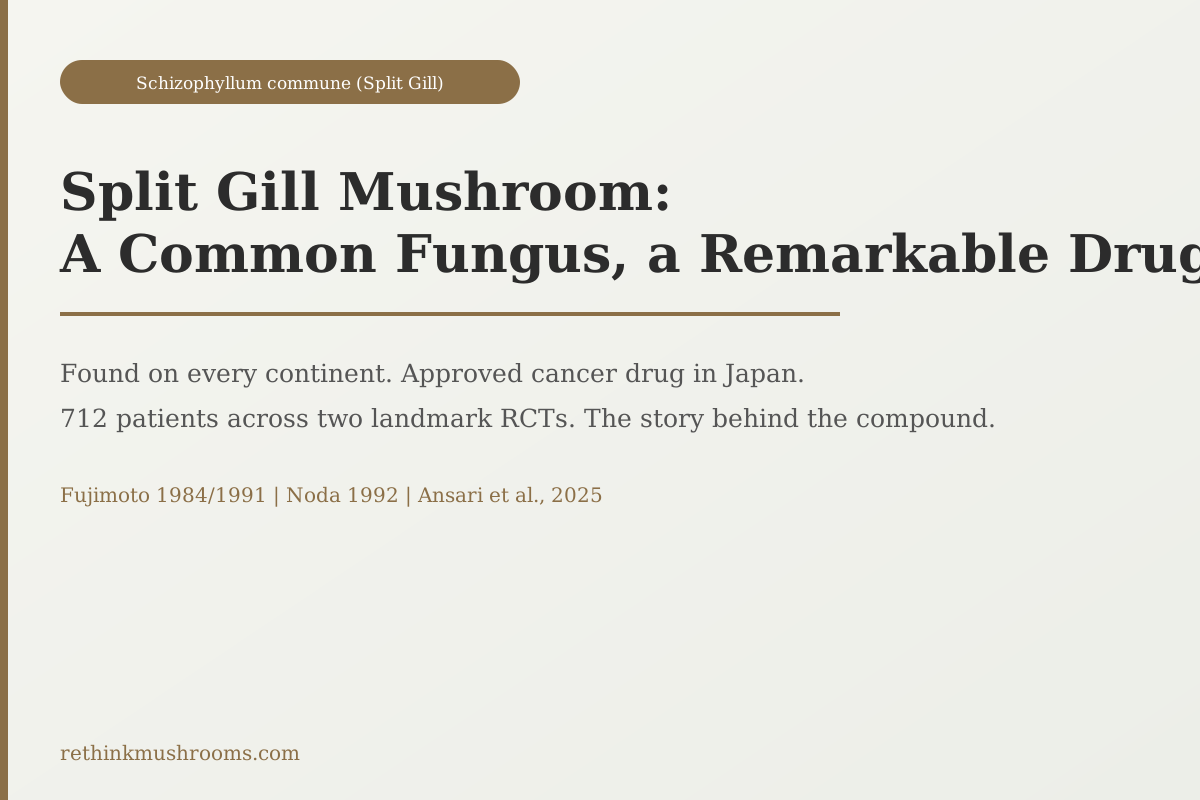
Schizophyllum commune (Split Gill)
712 gastric cancer patients
Across two randomized controlled trials, 712 patients with resectable gastric cancer tested schizophyllan as a cancer adjuvant. Stage III patients in the schizophyllan groups showed significantly better 5-year survival.
Fujimoto et al., Surgery Today, 1984 and European Journal of Cancer, 1991
220
cervical cancer patients across 52 Japanese institutions in the landmark Noda 1992 RCT testing schizophyllan plus irradiation
Triple helix
the molecular structure that schizophyllan must maintain for immune-activating activity; denatured single-chain form loses most of this activity
1 continent
the only continent where Schizophyllum commune does not grow: Antarctica; it is found on dead wood on every other continent on earth
Fujimoto et al., Surgery Today, 1984 and European Journal of Cancer, 1991
 View as image ↗
Walk through almost any forest on any continent and you will pass a Schizophyllum commune without noticing it. The split gill mushroom is among the most common fungi in the world, found on dead wood across North and South America, Europe, Asia, Africa, and Australia. It grows on over 150 genera of trees and shrubs, tolerates drought by curling its distinctive split gills inward to protect its spores, then resumes growth when moisture returns.
This is not a mushroom that looks remarkable. It is small and pale, typically two to four centimeters across, with a fan-shaped cap and its namesake divided gills. It does not appear in cooking guides. Most people who encounter it cannot identify it.
Yet Schizophyllum commune has been the subject of hundreds of clinical trials. The compound it produces, schizophyllan, is an approved pharmaceutical drug in Japan, used as a cancer adjuvant with radiation and chemotherapy. The evidence base behind this approval includes two randomized controlled trials with more than 300 patients each, a multi-center RCT at 52 Japanese institutions, and systematic reviews confirming its place among the best-evidenced fungal cancer adjuvants.
The gap between how unremarkable this mushroom looks and how extensively it has been studied is the entire story.
For the complete overview of this species and what makes it unusual as a fungus, see What Is Schizophyllum commune? The Most Widespread Mushroom on Earth.
Key Takeaways
- Schizophyllum commune is found on dead wood on every continent except Antarctica, growing on over 150 plant genera; it is one of the most geographically widespread fungi ever documented
- The compound it produces, schizophyllan (SPG), forms a rigid triple helix in water; this structural configuration is required for its immune-activating properties (Ansari et al., 2025)
- A 1984 RCT of 326 patients with resectable gastric cancer found Stage III patients in the schizophyllan adjuvant group had significantly better 5-year survival (p=0.0105) (Fujimoto et al., 1984)
- A confirmatory 1991 RCT of 386 gastric cancer patients repeated the finding: Stage III patients benefited significantly from schizophyllan adjuvant immunochemotherapy (Fujimoto et al., 1991)
- A multi-center RCT at 52 Japanese institutions enrolled 220 patients with Stage II-III cervical cancer and found schizophyllan plus irradiation significantly improved time to recurrence and 5-year survival compared to irradiation alone (Noda et al., 1992)
- A 2021 systematic review confirmed fungal beta-glucans including schizophyllan are among the best-evidenced cancer adjuvants in the beta-glucan class, with most benefit in gastric and lung cancers (Brown and Gordon, 2021)
The Most Common Mushroom You Have Never Heard Of
Schizophyllum commune's global distribution is unusual even among cosmopolitan fungi. Most widespread fungi have some regional preferences. S. commune genuinely appears to grow wherever there is dead wood and adequate moisture, which is almost everywhere inhabited by vascular plants.
A 2025 comprehensive review of schizophyllan production and biomedical applications documented the range of host substrates: the fungus has been collected from over 150 genera of host plants across dozens of countries.[1] Its biological adaptations for this distribution are unusual: the split gill mechanism (the divided gills that give it its name) allows the mushroom to curl inward when dry and reopen when conditions improve, protecting developing spores through desiccation and revival cycles that would kill most fungi.
This hardiness also makes S. commune an opportunistic pathogen. In immunocompromised patients, particularly those following organ transplant or chemotherapy, inhaled S. commune spores can colonize the sinuses and lungs, causing fungal sinusitis, pneumonia, or, in rare cases, brain abscesses. The same fungus that becomes a pharmaceutical agent in one context is a clinical concern in another.
This dual nature is not unique to S. commune in the mushroom world, but it is worth stating clearly. Therapeutic interest in a mushroom compound does not mean the mushroom itself is safe for immunocompromised individuals to encounter.
How an Overlooked Wood Fungus Became a Pharmaceutical
The scientific study of S. commune's pharmaceutical potential began well before any clinical trials. In the 1950s through 1970s, Dr. John Raper at Harvard University used S. commune as a model organism for genetics research. Its complex mating type system, which involves more than 28,000 distinct genetic combinations that can produce fertile offspring together, made it valuable for studying the genetics of sexual reproduction and cell compatibility. It was not a medicinal research project; it was pure genetics.
The pharmaceutical connection came from a different direction: the polysaccharide chemistry of S. commune's extracellular matrix. Like other fungi, S. commune secretes polysaccharides into its environment, and Japanese researchers in the 1980s identified one of these, schizophyllan, as having notable immune-stimulating properties in laboratory settings. The compound activated macrophages, stimulated natural killer cell activity, and enhanced cytokine production. These properties made it a candidate for testing as a cancer adjuvant, alongside chemotherapy or radiation.
The clinical trial program was principally Japanese. The compound was developed and tested by Japanese pharmaceutical companies and research hospitals. This explains why the approval is Japanese and why Western clinical audiences are largely unfamiliar with it.
The Gastric Cancer Trials: 712 Patients, Two Landmark RCTs
The foundational clinical evidence comes from two large randomized controlled trials published by Fujimoto and colleagues.
The first, published in Surgery Today in 1984, enrolled 326 patients with resectable gastric cancer at multiple Japanese institutions.[2] Patients were randomized to receive schizophyllan (SPG) as an adjuvant to standard immunochemotherapy or chemotherapy alone following surgical resection. The primary outcome was five-year survival, analyzed by disease stage.
In Stage III patients, the SPG adjuvant group showed significantly better five-year survival than the control group (p=0.0105). This stage-specific benefit is clinically meaningful: Stage III gastric cancer carries a substantially worse prognosis than Stage I or II, making any improvement in five-year survival particularly significant.
The second trial, published in the European Journal of Cancer in 1991, enrolled 386 patients in a confirmatory study with the same adjuvant design.[3] It again found Stage III survival benefit in the sizofiran (the brand name for SPG) group. The replication of the finding across two independent large-scale trials in the same cancer type is what made pharmaceutical approval in Japan defensible.
Together, these two trials enrolled 712 gastric cancer patients across the Japanese healthcare system. For a botanical or fungal compound, this level of clinical evidence was unusual for the era and remains uncommon today.
For a deeper look at the gastric cancer evidence specifically, see Schizophyllan and Gastric Cancer: Adjunct Therapy Evidence.
The Cervical Cancer Trial: 220 Patients, 52 Hospitals
The gastric cancer trials established schizophyllan's adjuvant potential in post-surgical chemotherapy settings. A different research group tested it in a different cancer type with a different treatment: cervical cancer combined with radiation therapy.
Noda and colleagues, working across the Cooperative Study Group on SPG for Gynecological Cancer, published the results of a randomized controlled trial that enrolled 220 patients with Stage II-III cervical cancer at 52 Japanese institutions.[4]
This multi-center design was significant. When a clinical trial runs across 52 institutions, the results cannot be attributed to the practices of a single hospital or patient population. The breadth of the study design was a deliberate methodological choice to generate generalizable evidence.
The finding: patients who received schizophyllan combined with irradiation showed significantly longer time to recurrence and better five-year survival than patients who received irradiation alone. The benefit was most pronounced in Stage III patients.
The cervical cancer indication expanded the evidence base for schizophyllan beyond gastric cancer and contributed to the drug's approval for multiple cancer indications in Japan.
What Makes Schizophyllan Work: The Triple Helix Structure
The pharmaceutical mechanism of schizophyllan depends on a specific structural feature of the molecule.
Schizophyllan is a beta-(1,3)-D-glucan with beta-(1,6) side chains. In aqueous solution, three schizophyllan chains spontaneously wind around each other to form a rigid triple helix structure. This triple helix is what macrophages, natural killer cells, and other immune cells recognize and respond to via pattern recognition receptors including Dectin-1.
A critical pharmacological finding: the triple helix conformation is required for immune-activating activity. When the triple helix is denatured to single-chain schizophyllan (a process achievable through treatment with dimethyl sulfoxide), most of the cytokine-stimulating and immune-activating properties are lost. The Ansari 2025 review documents this structure-activity relationship: therapeutic formulations of schizophyllan must preserve the triple helix to maintain biological potency.[1]
This structural specificity has implications for product quality. A schizophyllan preparation that has been subjected to harsh extraction conditions, high heat, or oxidative stress may convert triple-helix SPG to inactive single-chain form, reducing or eliminating its immune-stimulating properties.
For the complete mechanistic breakdown of how schizophyllan compares to other beta-glucans structurally and pharmacologically, see Schizophyllan (SPG): The Most-Studied Beta-Glucan You've Never Heard Of.
Why Schizophyllan Is Unknown Outside Japan
The trial evidence for schizophyllan as a cancer adjuvant is more extensive than what most people would expect from a product available only in Japan. The reason it has not been approved in the United States or Europe comes down to the mechanics of drug approval.
Drug approval requires prospective clinical trial data submitted directly to the regulatory authority. Evidence from Japanese trials conducted under Japanese regulatory standards does not automatically transfer to FDA or EMA approval. A pharmaceutical company would need to conduct new trials meeting Western regulatory requirements, at substantial cost, with no guarantee of approval and in a therapeutic space now dominated by modern targeted immunotherapy agents.
The economics have not, so far, favored running those trials. Schizophyllan was developed in an era before the modern checkpoint inhibitor revolution in cancer immunology. The standard-of-care landscape for gastric and cervical cancer has changed substantially since the 1980s and 1990s.
This does not mean the evidence is weak. It means the regulatory and commercial path to Western approval has not been pursued. The trials remain valid. The systematic review by Brown and Gordon (2021) of fungal beta-glucans as cancer adjuvants placed schizophyllan among the best-evidenced species in this class, with the clinical trial program backing it up.[5]
Beyond Cancer: What Schizophyllan Research Is Exploring Now
The Ansari 2025 comprehensive review documents that schizophyllan research has expanded beyond cancer adjuvant applications.[1] The triple helix structure that makes schizophyllan effective as an immunostimulant also makes it physically robust in ways useful for biomedical engineering.
Single-chain schizophyllan (s-SPG, produced by denaturing the triple helix) wraps around complementary nucleotide sequences and has been explored as a gene delivery vehicle. The s-SPG/DNA complex can protect nucleic acids from degradation and deliver them to cells, a property investigated in early-stage research for potential therapeutic applications.
Schizophyllan has also been studied for wound healing applications, where its beta-glucan structure may promote tissue regeneration, and for drug delivery matrices where the polysaccharide backbone serves as a structural scaffold.
These applications are earlier in development than the cancer adjuvant evidence and do not have clinical trial support comparable to the 1980s-1990s RCTs. They represent the current research frontier for a compound whose core cancer evidence was established decades ago.
For the full story on schizophyllan as a pharmaceutical agent and the Japanese regulatory history, see Schizophyllan (SPG): The Mushroom Compound Used as a Drug in Japan. And for the complete biology of this unusual fungus, see The Biology of Schizophyllum commune: Why It Grows Everywhere.
The Bottom Line
Schizophyllum commune is one of the world's most geographically widespread fungi, found on dead wood on every continent except Antarctica. The compound it produces, schizophyllan, has a more extensive clinical trial evidence base than most supplement industry products: two randomized controlled trials with 712 gastric cancer patients and a 220-patient multi-center cervical cancer RCT across 52 institutions form the foundation of its Japan pharmaceutical approval. The molecule's immune-activating properties depend on its triple helix structure, which must be maintained in formulation to preserve bioactivity. Schizophyllan remains unknown in Western markets due to regulatory pathway differences, not evidence deficiencies.
Frequently Asked Questions
Sources & References
- 1. Source details for this reference are not yet available.
- 2. Source details for this reference are not yet available.
- 3. Source details for this reference are not yet available.
- 4. Source details for this reference are not yet available.
- 5. Source details for this reference are not yet available.