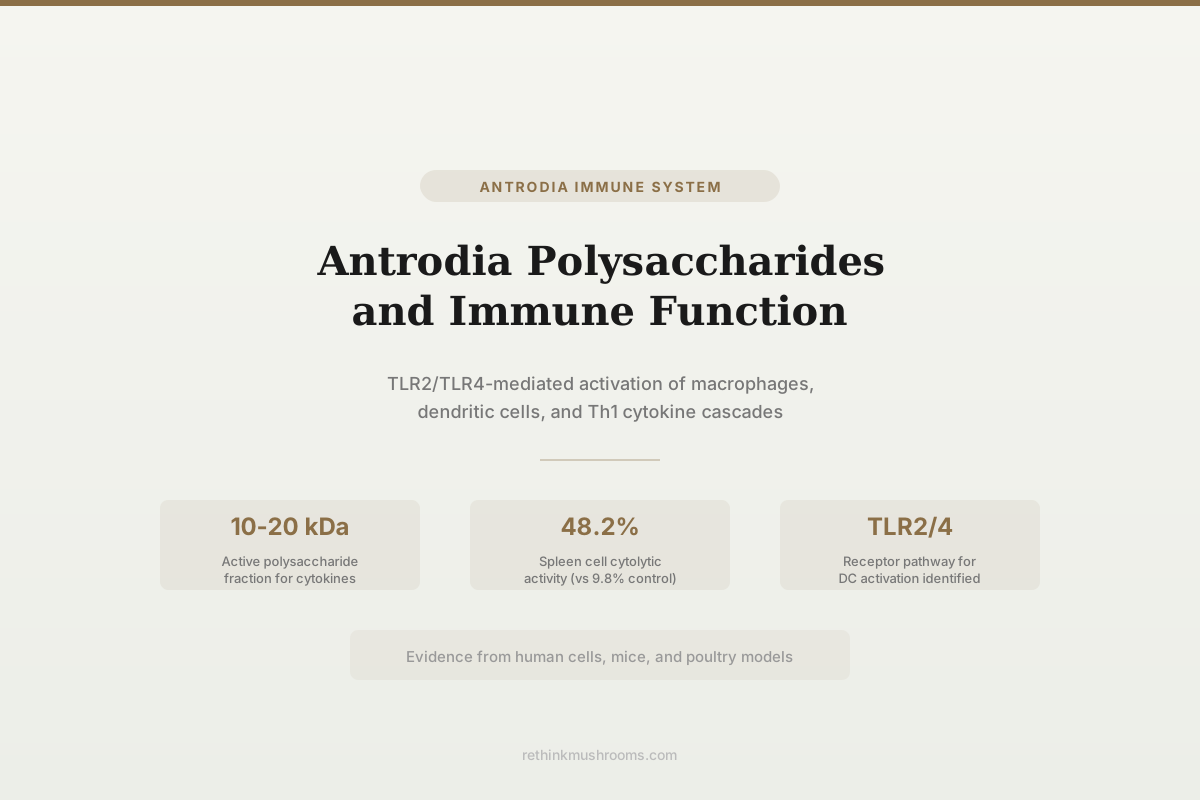
Antrodia Immune System
10-20 kDa active fraction
The immunomodulatory effect of Antrodia camphorata mycelia is mainly attributed to polysaccharides in the 10-20 kDa molecular weight range plus adenosine.
Kuo et al., J. Ethnopharmacology, 2008
TLR2/TLR4
receptor-mediated immune activation
48.2%
spleen cell cytolytic activity (vs 9.8%)
8 Studies
on Antrodia polysaccharide immunity
Kuo et al., J. Ethnopharmacology, 2008
 View as image ↗
Polysaccharides are the primary immune-active compounds in most medicinal mushrooms, and Antrodia camphorata is no exception. These complex sugar polymers engage pattern recognition receptors on immune cells, triggering signaling cascades that enhance macrophage phagocytosis, dendritic cell maturation, natural killer cell activity, and cytokine production. What distinguishes Antrodia's polysaccharide evidence from the general mushroom immunology literature is the identification of specific molecular weight fractions, defined receptor pathways (TLR2 and TLR4), and documented effects across multiple immune cell types. For the broader picture of Antrodia immunity including non-polysaccharide compounds, see the overview on Antrodia and the immune system.
Eight studies spanning 2004 to 2022 characterize how Antrodia polysaccharides interact with the immune system. The evidence comes from human blood cell cultures, mouse models, and one poultry study. The consistent finding is that Antrodia polysaccharides shift immune balance toward Th1 dominance: increased IFN-gamma, IL-12, and TNF-alpha with enhanced cellular immunity. This profile is associated with stronger antiviral, antibacterial, and antitumor immune responses. For how these polysaccharides contribute to NK cell activation specifically, the companion article covers that evidence.
Key Takeaways
- The 10-20 kDa polysaccharide fraction from Antrodia mycelia drove the strongest TNF-alpha and IL-6 induction in human peripheral blood cultures, with adenosine as a co-active component (Kuo et al., 2008)
- Antrodia polysaccharides increased spleen cell cytolytic activity from 9.8% to 48.2% after intraperitoneal administration in sarcoma-bearing mice, with two-fold higher splenic cell proliferation (Liu et al., 2004)
- Oral Antrodia polysaccharides for 6 weeks increased splenic dendritic cells, macrophages, CD8alpha+ expression, and the CD4+/CD8+ ratio in BALB/c mice (Chen et al., 2008)
- High-molecular-weight polysaccharides (>100 kDa) activated dendritic cells through TLR2/TLR4 and NF-kappaB/MAPK pathways, enhancing antigen presentation (Lin et al., 2015)
- Antrodia polysaccharide fractions modulated dendritic cell function to suppress Th2 responses and reduce airway inflammation in an asthma mouse model (Liu et al., 2010)
- Polysaccharide extracts enhanced immune responses in specific pathogen-free chickens, demonstrating activity across species (Song et al., 2014)
Identifying the Active Polysaccharide Fraction
Not all Antrodia polysaccharides are equally immunoactive. Kuo et al. (2008) systematically fractionated hot water extracts from submerged-cultured Antrodia and tested each fraction for immune-stimulating activity in human peripheral blood cultures.[1]
The mycelia fraction (Fr. M II) and culture filtrate fractions (Fr. E II and Fr. E III) showed the strongest TNF-alpha and IL-6 induction. At 20 microg/mL, these fractions enhanced phagocytosis in human polymorphonuclear neutrophils and monocytes. CD11b expression, an early marker of neutrophil activation, was upregulated in a dose-dependent manner.
Gel permeation chromatography and HPLC analysis revealed that the immunomodulatory effect of mycelia is mainly attributed to polysaccharides in the 10-20 kDa molecular weight range, plus adenosine as a co-active compound.[1] This molecular weight identification is important because it allows researchers to standardize preparations and because the 10-20 kDa range is distinct from the high-molecular-weight beta-glucans (>100 kDa) that dominate other mushroom immunology studies.
The adenosine co-component is noteworthy. Adenosine is a known immunomodulator that acts through four G protein-coupled receptors (A1, A2A, A2B, A3) on immune cells. Its presence alongside polysaccharides suggests Antrodia's immune effects involve dual receptor engagement: pattern recognition receptors for the polysaccharides and adenosine receptors for the nucleoside component.
Antitumor Immunity Through Spleen Cell Activation
Liu et al. (2004) provided the most striking quantitative evidence for Antrodia polysaccharide immune enhancement using a sarcoma 180 mouse model.[2] A purified polysaccharide fraction (AC-PS) from mycelia was tested for both direct cytotoxicity and immune-mediated antitumor effects.
AC-PS showed no direct cytotoxicity to human leukemic U937 cells even at 200 microg/mL. This ruled out direct tumor killing and confirmed the immune-mediated mechanism. When mononuclear cells were pre-treated with AC-PS, their conditioned medium inhibited U937 proliferation by 55.3%, demonstrating that AC-PS activates immune cells to produce tumor-suppressive factors.
The in vivo numbers were compelling. Administered intraperitoneally and orally at 100 and 200 mg/kg, AC-PS suppressed sarcoma tumor growth by 69.1% and 58.8%, respectively. Spleen cell proliferation doubled compared to controls. Cytolytic activity of spleen cells increased from 9.8% in control mice to 34.2% after oral treatment and 48.2% after intraperitoneal treatment. Serum IL-12 levels increased with treatment.[2]
The IL-12 elevation is mechanistically central. IL-12 is produced primarily by dendritic cells and macrophages and acts as the primary activator of NK cells and CD8+ cytotoxic T cells. It also drives naive T helper cells toward Th1 differentiation. The cascade from polysaccharide exposure to IL-12 production to enhanced cellular immunity represents a coherent immunological pathway for antitumor defense.
The distinction between direct cytotoxicity and immune-mediated antitumor activity is critical for understanding how mushroom polysaccharides work. Unlike chemotherapy drugs that kill cancer cells directly (and damage healthy cells in the process), polysaccharides like AC-PS work by activating the patient's own immune system to recognize and destroy tumor cells. This immune-mediated mechanism explains why polysaccharides show no toxicity to normal cells in culture but still produce measurable tumor suppression in whole-animal models. The clinical implication, tested in some countries with other mushroom polysaccharides (PSK from Trametes versicolor, lentinan from shiitake), is as an adjunct to standard cancer treatment rather than a standalone therapy.
Dendritic Cell Maturation and Antigen Presentation
Dendritic cells (DCs) are the master regulators of adaptive immunity, bridging innate immune recognition to T cell responses. Two studies specifically examined how Antrodia polysaccharides affect DC function.
Chen et al. (2008) administered Antrodia polysaccharides orally to BALB/c mice for 2, 4, and 6 weeks and measured changes in splenic immune cell populations.[3] After 6 weeks, the number of splenic dendritic cells and macrophages increased. Surface expression of CD8alpha+ and MHC class II (I-A/I-E) on dendritic cells rose, indicating enhanced antigen-presenting capacity. The CD4+/CD8+ ratio among splenocytes was augmented, and B cell numbers increased. High levels of IFN-gamma and TNF-alpha mRNA were detected at all three timepoints.
This study also demonstrated functional immune protection: polysaccharide-treated mice showed inhibited Schistosoma mansoni infection, providing evidence that the immune enhancement translates to actual pathogen resistance.[3]
Lin et al. (2015) identified the specific receptor pathway. High-molecular-weight polysaccharides (>100 kDa) purified from Antrodia activated dendritic cells through TLR2 and TLR4 receptors, triggering NF-kappaB and MAPK signaling cascades.[4] The activated DCs showed enhanced expression of MHC class II, CD80, and CD86 co-stimulatory molecules, all required for effective T cell priming. When used as vaccine adjuvants with DNA vaccines, these polysaccharides enhanced antigen-specific immune responses.
The TLR2/TLR4 pathway identification connects Antrodia polysaccharides to the broader beta-glucan immunology literature. Beta-glucans from other fungi primarily activate Dectin-1, while Antrodia's high-MW polysaccharides appear to work through TLR2/TLR4, suggesting structural differences in the polysaccharide composition. Antrodia polysaccharides include galactomannans and beta-D-glucans with distinct branching patterns that may determine receptor specificity.
Structure–Activity · Two Active Fractions
Two Molecular-Weight Fractions, Two Immune Pathways
Antrodia’s immune activity does not trace to a single molecule. A small fraction drives innate effector cytokines in human blood, while a large fraction matures dendritic cells through pattern-recognition receptors. Whole extracts contain both.
- System
- Human peripheral blood cells
- Immune arm
- Innate effector activation
- Pathway
- Neutrophil & monocyte priming
- Strongest TNF-α & IL-6 induction
- Enhanced phagocytosis at 20 µg/mL
- CD11b up-regulated dose-dependently
Kuo et al., 2008 [ref 1] · RTHM-00263
- System
- Dendritic cells (mouse)
- Immune arm
- Adaptive priming via APC maturation
- Pathway
- TLR2 / TLR4 → NF-κB / MAPK
- DC maturation: ↑ MHC II, CD80, CD86
- Antigen-specific T-cell & Th1 priming
- Boosted a HER-2/neu DNA vaccine
Lin et al., 2015 [ref 4] · RTHM-00715
Both fractions converge on a Th1-dominant response, but they were tested in different systems (human blood vs. mouse dendritic cells) and no study has separated their contributions within a single whole-extract preparation — a core reason dosing is not yet standardized.
Immune Regulation: Enhancement Without Overactivation
Not all immune enhancement is beneficial. Uncontrolled immune activation causes autoimmune disease and allergic inflammation. Liu et al. (2010) demonstrated that Antrodia polysaccharides can regulate immune responses bidirectionally depending on context.[5]
In an ovalbumin-induced asthma mouse model, purified polysaccharide fraction GF2 modulated dendritic cell function in a way that suppressed allergic (Th2) responses. GF2-treated DCs showed enhanced IL-10 and IL-12 production. Higher GF2 doses reduced OVA-specific IgG1 and IgE (Th2 markers) while lower doses enhanced OVA-specific IgG2a (Th1 marker). GF2 administration dose-dependently inhibited airway hyperresponsiveness, eosinophilia, and Th2 cytokine production.[5]
This immune-regulatory capacity is distinct from simple immune stimulation. The simultaneous enhancement of IL-12 (pro-Th1) and IL-10 (anti-inflammatory) suggests a balanced immune response rather than blanket activation. This profile is consistent with "trained immunity" concepts where innate immune cells develop enhanced responsiveness to pathogens while maintaining tolerance to self-antigens.
Anti-Inflammatory Polysaccharide Activity
Wu et al. (2007) revealed that different polysaccharide extraction methods yield functionally different compounds.[6] The alkaline extraction fraction (AC-2) inhibited LPS-induced nitric oxide production and suppressed iNOS, IL-6, IL-10, MCP-5, and RANTES expression in macrophages dose-dependently. This anti-inflammatory activity appears opposite to the immune-stimulating effects of hot water-extracted polysaccharides.
Yang et al. (2022) clarified this apparent contradiction using a liver injury model.[7] Antrodia polysaccharide improved inflammatory responses in liver injury through the ROS/TLR4/NF-kappaB signaling pathway, reducing excessive inflammation while maintaining immune surveillance. The dual capacity to enhance immune defense in immunocompromised states while dampening pathological inflammation likely depends on the existing immune context and the specific polysaccharide fraction used.
Cross-Species Validation
Song et al. (2014) extended the immune evidence beyond rodents by testing Antrodia polysaccharide extracts in specific pathogen-free chickens.[8] Polysaccharide administration enhanced immune responses in poultry, demonstrating that Antrodia's immunomodulatory effects are not species-specific. This cross-species activity is consistent with the TLR-mediated mechanism, as TLR2 and TLR4 are conserved across vertebrates.
The veterinary application also has practical implications. If Antrodia polysaccharides enhance immune function in poultry and livestock, they could serve as alternatives to antibiotic growth promoters, addressing the growing concern about antimicrobial resistance in agricultural settings. Several countries have already approved mushroom-derived beta-glucans as feed additives for immune support in livestock. Antrodia polysaccharides, with their demonstrated TLR-mediated activity conserved across species, could join this category if cost-effective cultivation methods make large-scale production feasible.
Cross-species conservation of the immune response also strengthens the mechanistic argument. TLR2 and TLR4 evolved as ancient pattern recognition systems that detect microbial cell wall components. The fact that Antrodia polysaccharides activate these same receptors in human blood cells, mouse splenocytes, and chicken immune cells suggests the interaction is with a conserved binding site rather than a species-specific quirk. For broader context on how Antrodia may support immune recovery in compromised immune states, the cluster sibling covers that evidence.
Limitations
No human immune trials with purified polysaccharides. The Kuo et al. (2008) study used human peripheral blood cells in culture, but no trial has administered Antrodia polysaccharides to humans and measured immune outcomes in vivo.
Molecular weight fractions vary between studies. Kuo identified the 10-20 kDa range as most active for cytokine induction, while Lin found >100 kDa polysaccharides drove DC activation. Different fractions may activate different immune pathways, and whole extracts contain both.
Extraction method determines the product. Hot water extraction, alkaline extraction, and ethanol precipitation all yield different polysaccharide fractions with different (sometimes opposite) immune effects. Commercial products rarely specify extraction parameters at the level of detail used in published research.
Oral bioavailability of polysaccharides is poorly characterized. Large polysaccharide molecules are not absorbed intact from the gastrointestinal tract. Their immune effects after oral administration likely involve gut-associated lymphoid tissue (GALT) interaction, Peyer's patch sampling, or gut microbiota-mediated metabolism. The specific route from oral intake to systemic immune effects has not been mapped for Antrodia polysaccharides.
Dose standardization is absent. Studies used polysaccharide concentrations ranging from 20 microg/mL in cell culture to 200 mg/kg in mouse models, with different extraction methods, molecular weight fractions, and administration routes. No dose-finding study has established the minimum effective dose for any specific immune endpoint, and the optimal dose for one effect (e.g., cytokine induction) may differ from another (e.g., DC maturation).
The Bottom Line
Antrodia camphorata polysaccharides enhance immune function through defined receptor pathways (TLR2/TLR4) that activate dendritic cells, macrophages, and NK cells while promoting Th1-dominant cytokine profiles (IL-12, IFN-gamma, TNF-alpha). The 10-20 kDa fraction drives cytokine induction in human blood cells, while >100 kDa fractions activate dendritic cell maturation. In tumor-bearing mice, polysaccharides increased spleen cell cytolytic activity nearly five-fold. Different extraction methods produce polysaccharides with either immune-stimulating or anti-inflammatory effects, suggesting context-dependent regulation. All in vivo evidence is from rodent and poultry models.
Frequently Asked Questions
Sources & References
- 1RTHM-00140·Kuo, Mei-Chun et al. (2008). “Immunomodulatory effect of Antrodia camphorata mycelia and culture filtrate..” Journal of ethnopharmacology.Study breakdown →PubMed →↩
- 2RTHM-00074·Liu, Jun-Jen et al. (2004). “Antitumor effects of the partially purified polysaccharides from Antrodia camphorata and the mechanism of its action..” Toxicology and applied pharmacology.Study breakdown →PubMed →↩
- 3RTHM-00129·Chen, Yu-Jen et al. (2008). “Polysaccharides from Antrodia camphorata mycelia extracts possess immunomodulatory activity and inhibits infection of Schistosoma mansoni..” International immunopharmacology.Study breakdown →PubMed →↩
- 4RTHM-00391·Lin, Chi-Chen et al. (2015). “The adjuvant effects of high-molecule-weight polysaccharides purified from Antrodia cinnamomea on dendritic cell function and DNA vaccines..” PloS one.Study breakdown →PubMed →↩
- 5RTHM-00192·Liu, Ko-Jiunn et al. (2010). “Administration of polysaccharides from Antrodia camphorata modulates dendritic cell function and alleviates allergen-induced T helper type 2 responses in a mouse model of asthma..” Immunology.Study breakdown →PubMed →↩
- 6RTHM-00124·Wu, Yen-ying et al. (2007). “Modulation of inflammation-related genes of polysaccharides fractionated from mycelia of medicinal basidiomycete Antrodia camphorata..” Acta pharmacologica Sinica.Study breakdown →PubMed →↩
- 7RTHM-00804·Yang, Yi et al. (2022). “Antrodia camphorata polysaccharide improves inflammatory response in liver injury via the ROS/TLR4/NF-κB signal..” Journal of cellular and molecular medicine.Study breakdown →PubMed →↩
- 8RTHM-00349·Song, Ai-Rong et al. (2014). “Immunomodulatory effect of polysaccharides extracted from the medicinal mushroom Antrodia camphorata (higher Basidiomycetes) in specific pathogen-free chickens..” International journal of medicinal mushrooms.Study breakdown →PubMed →↩