Antrodia Immune System
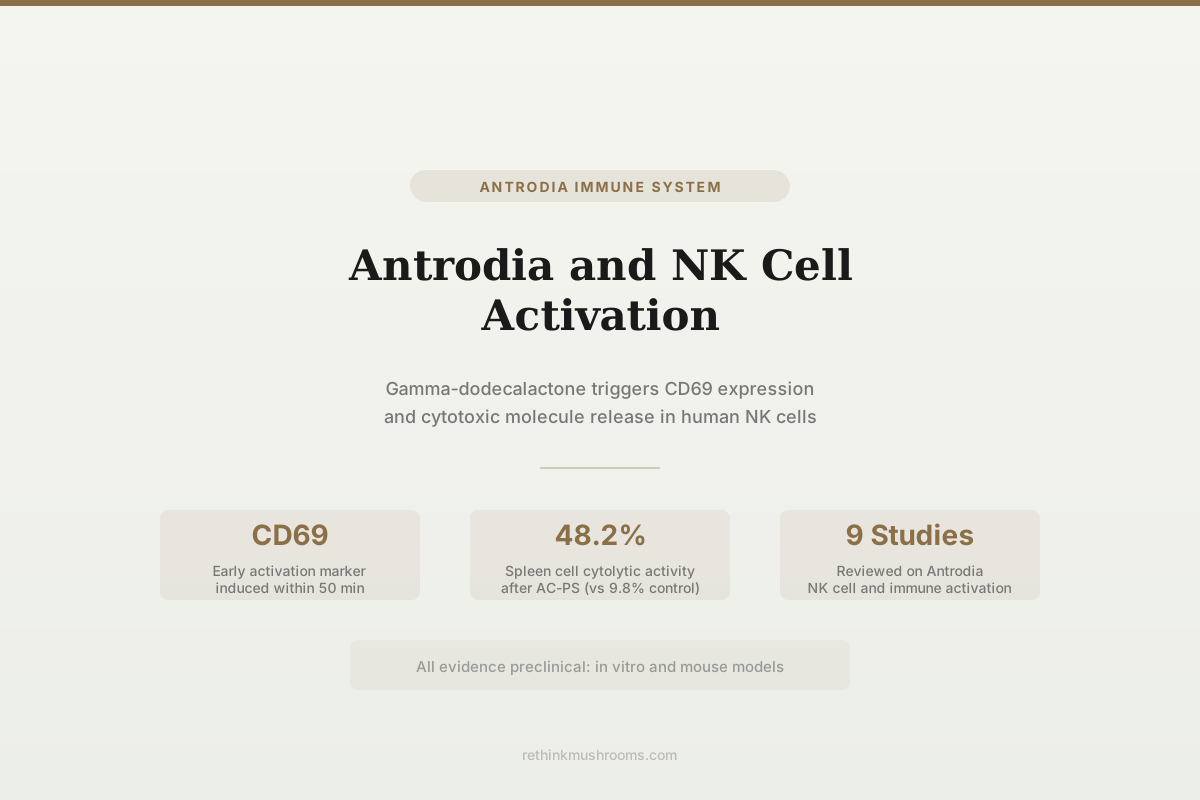
CD69 activation
A volatile lactone from Antrodia camphorata triggers NK cells to express the early activation marker CD69 within 50 minutes in vitro.
Chen et al., Bioorganic & Medicinal Chemistry, 2010
γ-Dodecalactone
direct NK activator identified
48.2%
spleen cell cytolytic activity after AC-PS
9 Studies
reviewed on Antrodia immune activation
Chen et al., Bioorganic & Medicinal Chemistry, 2010
 View as image ↗
Natural killer cells destroy virus-infected and cancerous cells without prior sensitization, making them a frontline defense in innate immunity. A 2010 study isolated a volatile compound called gamma-dodecalactone from the culture medium of Antrodia camphorata and demonstrated it could activate human NK cells to express CD69 and release cytotoxic molecules within minutes.[1] This finding opened a line of research connecting Antrodia's bioactive compounds to one of the immune system's most critical cell populations. For a broader overview of how Antrodia modulates immunity across multiple pathways, see the full guide on Antrodia and the immune system.
The evidence spans volatile lactones, polysaccharide fractions, and whole-extract preparations tested in human cell cultures and mouse models. Most studies come from Taiwanese research groups, reflecting Antrodia's status as an endemic species found only on the inner heartwood of Cinnamomum kanehirae in Taiwan. All current evidence is preclinical. No human clinical trials have tested Antrodia specifically for NK cell outcomes.
Key Takeaways
- Gamma-dodecalactone from Antrodia activated human NK cells to express CD69 within 50 minutes and its metabolite (R)-(+)-4-hydroxydodecanoic acid activated NK cells within 10 minutes (Chen et al., 2010)
- NK cells treated with gamma-dodecalactone secreted FasL, granzyme B, TNF-alpha, and IFN-gamma, all markers of cytotoxic killing capacity (Chen et al., 2010)
- Antrodia polysaccharides increased spleen cell cytolytic activity from 9.8% in controls to 48.2% after intraperitoneal administration in sarcoma-bearing mice (Liu et al., 2004)
- Taiwanofungus camphoratus capsules enhanced NK cell cytolytic activity and increased IL-2 and IFN-gamma levels in BALB/c mice over 6 weeks (Lin et al., 2019)
- Oral Antrodia polysaccharide administration for 6 weeks increased splenic dendritic cells, macrophages, and the CD4+/CD8+ ratio in mice (Chen et al., 2008)
- Only the (R)-(+) enantiomer of 4-hydroxydodecanoic acid activates NK cells; the (S)-(-) form is inactive, demonstrating stereospecific immune recognition (Chen et al., 2010)
What NK Cells Do and Why Activation Matters
Natural killer cells are large granular lymphocytes that patrol the body for abnormal cells. Unlike T cells, NK cells do not require antigen presentation through major histocompatibility complex (MHC) molecules to identify targets. They recognize stressed cells through a balance of activating and inhibitory receptors on their surface.
When NK cells activate, they undergo several measurable changes. CD69 appears on the cell surface as an early activation marker, typically within minutes to hours. The cells then release cytotoxic granules containing perforin (which punches holes in target cell membranes) and granzymes (which trigger apoptosis inside the target). Activated NK cells also secrete cytokines, primarily IFN-gamma and TNF-alpha, that recruit and activate other immune cells.
NK cell activity varies between individuals and declines with age, chronic stress, and certain diseases. Compounds that reliably enhance NK cell activation in controlled settings attract research interest because of the central role these cells play in immune surveillance. The question with Antrodia is whether its compounds can meaningfully activate NK cells and through what mechanisms.
Gamma-Dodecalactone: A Direct NK Cell Activator
The most specific evidence for Antrodia's effect on NK cells comes from Chen et al. (2010), who isolated gamma-dodecalactone (gamma-DDL) from the volatile fraction of Antrodia camphorata culture medium.[1]
Gamma-DDL is a 12-carbon lactone, a cyclic ester with a characteristic peach-like aroma. Using cytomic screening on human peripheral blood NK cells, the researchers found that gamma-DDL induced CD69 expression within 50 minutes of exposure. CD69 is the earliest inducible cell surface glycoprotein during lymphocyte activation.
Beyond surface marker expression, gamma-DDL-treated NK cells secreted four key molecules:
- FasL (Fas ligand): triggers apoptosis in target cells expressing the Fas receptor
- Granzyme B: a serine protease that enters target cells and activates caspase-dependent cell death
- TNF-alpha: a pro-inflammatory cytokine that amplifies immune responses
- IFN-gamma: a Th1 cytokine critical for macrophage activation and antitumor immunity
The study revealed a stereospecific mechanism. Inside NK cells, gamma-DDL converts to 4-hydroxydodecanoic acid (its acyclic isomer) in a time-dependent process. Synthetic (R,S)-4-hydroxydodecanoic acid activated NK cells to express CD69 mRNA within 10 minutes, faster than gamma-DDL itself. When the researchers separated the two enantiomers, only (R)-(+)-4-hydroxydodecanoic acid activated NK cells. The (S)-(-) enantiomer had no effect.[1]
This chirality requirement is biologically meaningful. It suggests gamma-DDL's metabolite interacts with a specific receptor or signaling protein on or inside NK cells, not through a nonspecific membrane perturbation. The identity of that receptor remains unknown.
How Antrodia Polysaccharides Boost Immune Cell Activity
While gamma-DDL acts directly on NK cells, Antrodia's polysaccharide fractions appear to enhance NK function indirectly by activating the broader immune network. For a deeper look at how these sugar-based polymers work, see Antrodia polysaccharides and immune enhancement.
Fungal polysaccharides, particularly beta-glucans, engage pattern recognition receptors on immune cells. Dectin-1 and Toll-like receptors on macrophages and dendritic cells recognize these carbohydrate structures as foreign, triggering signaling cascades that upregulate cytokine production and phagocytic activity. Antrodia polysaccharides appear to work through this general mechanism, though the specific receptor binding profile has not been fully characterized.
Liu et al. (2004) purified a polysaccharide fraction (AC-PS) from Antrodia camphorata mycelia and tested it in sarcoma 180-bearing mice.[2] AC-PS alone showed no direct cytotoxicity to human leukemic U937 cells even at 200 microg/ml. However, when mononuclear cells were pre-treated with AC-PS, the conditioned medium from those cells inhibited U937 proliferation by 55.3%. This indirect mechanism, where polysaccharides prime immune cells to produce tumor-suppressive factors, is consistent with how beta-glucans from other medicinal mushrooms operate.
In the mouse model, the immune parameters were striking. Spontaneous proliferation of spleen cells after AC-PS administration was two-fold higher than controls. Cytolytic activity of spleen cells increased from 9.8% in control mice to 34.2% after oral treatment and 48.2% after intraperitoneal treatment. Serum IL-12 levels increased with AC-PS treatment.[2] Since IL-12 is a primary driver of NK cell activation and IFN-gamma production, this cytokine shift suggests AC-PS promotes a Th1-dominant immune state favorable to NK cell function.
Kuo et al. (2008) identified the active molecular weight range. Testing different fractions of hot water extracts from submerged-cultured Antrodia, they found the 10-20 kDa polysaccharide fraction and adenosine drove the strongest TNF-alpha and IL-6 induction in diluted human peripheral blood cultures.[3] These fractions enhanced phagocytosis in human polymorphonuclear neutrophils and monocytes and upregulated CD11b expression (an early marker of neutrophil activation) in a dose-dependent manner.
The IFN-Gamma and IL-12 Signaling Axis
Multiple Antrodia studies converge on the IFN-gamma/IL-12 axis, which is the primary cytokine pathway for NK cell activation and sustained function.
Chen et al. (2008) administered Antrodia polysaccharides orally to BALB/c mice for 2, 4, and 6 weeks.[4] High levels of IFN-gamma and TNF-alpha mRNA were detected at all three timepoints. After 6 weeks, the number of splenic dendritic cells and macrophages increased, surface expression of CD8alpha+ and MHC class II (I-A/I-E) on dendritic cells rose, and the CD4+/CD8+ ratio among splenocytes was augmented. This is relevant to NK cell function because dendritic cells are a primary source of IL-12, which in turn activates NK cells to produce more IFN-gamma, creating a positive feedback loop.
The two 2018 Taiwanofungus studies provided direct evidence of enhanced NK cytolytic activity. Lin et al. (2019) treated female BALB/c mice with a capsule formulation containing fruiting body extract and solid-state-cultivated mycelia for 6 weeks.[5] The treatment increased IL-2 and IFN-gamma levels while decreasing IL-4, IL-5, and TNF-alpha, shifting the immune profile toward Th1 dominance. NK cell activity and macrophage phagocytosis both increased.
Chen et al. (2018) confirmed these findings independently using male BALB/c mice. Their solid-state cultivated powder enhanced splenic immune cell proliferation, macrophage phagocytic activity, and NK cell cytolytic activity over 6 weeks of oral administration.[6] Levels of IL-2, TNF-alpha, IFN-gamma, and GM-CSF all increased. This study also examined antigen-specific responses using ovalbumin immunization, finding increased OVA-specific IgG and IgM, suggesting Antrodia enhances both innate and adaptive immunity simultaneously.
The convergence of these findings across research groups, mouse strains, and preparation methods strengthens the case that Antrodia genuinely shifts immune balance toward Th1 dominance and enhanced NK cell function. The IL-12/IFN-gamma axis appears central: polysaccharides activate antigen-presenting cells, which produce IL-12, which activates NK cells, which produce IFN-gamma, which further activates macrophages. This positive feedback loop may explain why relatively modest doses of Antrodia extracts produce measurable immune shifts in mouse models.
Antrodia's Broader Immune Network Effects
NK cells do not operate in isolation. Their activation state depends on signals from dendritic cells, macrophages, and the cytokine environment. Antrodia appears to influence this entire network. The relationship between Antrodia and gamma-delta T cells, another innate-like lymphocyte population, adds a further dimension to this picture.
Liu et al. (2010) demonstrated that purified Antrodia polysaccharide fractions (GF2) modulated dendritic cell function in the context of allergen-induced asthma in mice.[7] In the presence of GF2, LPS-activated dendritic cells showed upregulated MHC class II and co-stimulatory molecule expression, along with enhanced IL-10 and IL-12 production. The IL-12 component is directly relevant to NK cells. However, the IL-10 increase introduces complexity: IL-10 generally suppresses inflammatory responses, and its concurrent elevation with IL-12 suggests Antrodia polysaccharides may promote a regulated immune activation rather than unbridled inflammation.
Wu et al. (2007) examined how different polysaccharide fractions from Antrodia mycelia affected LPS-induced gene expression in mouse macrophages.[8] The alkaline extraction fraction (AC-2) inhibited LPS-induced nitric oxide production and suppressed iNOS, IL-6, IL-10, MCP-5, and RANTES expression in a dose-dependent manner. This anti-inflammatory polysaccharide activity appears distinct from the pro-inflammatory immune-activating effects seen with other fractions, indicating that different extraction methods yield functionally different compounds.
This duality matters for understanding NK cell effects. Some Antrodia fractions activate immune cells and promote NK function. Others dampen inflammatory signaling. The specific extraction method, molecular weight fraction, and preparation type determine which effect dominates. Research on how Antrodia's anti-inflammatory triterpenoids interact with its immune-activating polysaccharides remains limited.
Comparing Antrodia with Other NK-Activating Mushrooms
Antrodia is not the only mushroom studied for NK cell effects. Kimura et al. (2004) showed that sodium pyroglutamate isolated from Agaricus blazei increased NK cell infiltration into tumors in Lewis lung carcinoma-bearing mice while also inhibiting tumor growth and metastasis.[9] Ganoderma lucidum (reishi), Lentinus edodes (shiitake), and Trametes versicolor (turkey tail) all have published NK cell data.
What distinguishes the Antrodia evidence is the gamma-dodecalactone finding. While most mushroom NK cell studies focus on polysaccharide-mediated, indirect activation through cytokine cascades, the Chen et al. (2010) study identified a small volatile molecule with direct, stereospecific NK cell activating properties.[1] This mechanism is unusual among characterized mushroom compounds.
The polysaccharide-mediated pathway, on the other hand, is common across medicinal mushrooms and likely operates through pattern recognition receptors like Dectin-1 and Toll-like receptors. Antrodia's polysaccharide effects on NK cells appear broadly similar to those of other beta-glucan-containing fungi, though the specific molecular weight range (10-20 kDa per Kuo et al.) and the co-presence of adenosine may create a distinct activation profile.[3]
Direct comparison studies between mushroom species using standardized NK cell assays are rare. Claims that one mushroom is "better" than another for NK cell activation cannot be supported by existing data. The field lacks standardized protocols for measuring mushroom-derived NK cell activation, making cross-study comparisons unreliable even when the same assay types are used. Cell sources, incubation times, extract concentrations, and endpoint measurements all vary between research groups.
Evidence Gaps and What the Research Cannot Tell Us
Every study reviewed here has limitations that constrain interpretation.
All human cell data is in vitro. The gamma-dodecalactone study used isolated human NK cells in culture. Concentrations that activate NK cells in a dish may not be achievable through oral consumption of Antrodia products. No pharmacokinetic data exists for gamma-DDL in humans.
All whole-animal data uses mice. Mouse immune systems differ from human immune systems in NK cell receptor repertoire, cytokine signaling, and baseline immune tone. The BALB/c mouse strain used in most studies has a known Th2 bias, which may exaggerate the apparent Th1-shifting effects of Antrodia compounds.
No human clinical trials exist for Antrodia and NK cells specifically. While some Taiwanese clinical studies have examined Antrodia for liver function and cancer adjunctive therapy, none have measured NK cell activation as a primary endpoint.
Dose-response relationships are incomplete. The Lin et al. (2019) study tested three doses (172.2, 344.4, and 861.0 mg/kg), showing dose-dependent effects, but optimal dosing for NK cell activation versus other immune outcomes has not been established.
Preparation type matters enormously. Fruiting body extracts, submerged culture mycelia, solid-state cultivated mycelia, hot water extracts, and ethanol extracts all contain different compounds at different ratios. Results from one preparation cannot be extrapolated to another.
The gamma-DDL receptor is unknown. The stereospecific activation pattern strongly suggests a receptor-mediated mechanism, but the actual molecular target has not been identified. Until it is, the signaling pathway from gamma-DDL exposure to CD69 expression remains a black box.
For broader context on Antrodia's potential role in cancer-related immune function, see the comprehensive review of Antrodia and cancer research. For how Antrodia may support immune recovery in post-illness contexts, that evidence base is also developing.
The Bottom Line
Antrodia camphorata contains at least two distinct classes of NK cell-relevant compounds: gamma-dodecalactone, a volatile lactone that directly activates human NK cells through a stereospecific mechanism, and polysaccharide fractions that enhance NK function indirectly through IL-12/IFN-gamma signaling and dendritic cell activation. Mouse studies consistently show enhanced NK cytolytic activity, increased Th1 cytokines, and greater splenic immune cell proliferation. All evidence is preclinical, and no human trials have measured NK cell activation as a primary endpoint.
Frequently Asked Questions
Sources & References
- 1RTHM-00175·Chen, Chia-Jung et al. (2010). “Structure and functions of gamma-dodecalactone isolated from Antrodia camphorata for NK cell activation..” Bioorganic & medicinal chemistry.Study breakdown →PubMed →↩
- 2RTHM-00074·Liu, Jun-Jen et al. (2004). “Antitumor effects of the partially purified polysaccharides from Antrodia camphorata and the mechanism of its action..” Toxicology and applied pharmacology.Study breakdown →PubMed →↩
- 3RTHM-00140·Kuo, Mei-Chun et al. (2008). “Immunomodulatory effect of Antrodia camphorata mycelia and culture filtrate..” Journal of ethnopharmacology.Study breakdown →PubMed →↩
- 4RTHM-00129·Chen, Yu-Jen et al. (2008). “Polysaccharides from Antrodia camphorata mycelia extracts possess immunomodulatory activity and inhibits infection of Schistosoma mansoni..” International immunopharmacology.Study breakdown →PubMed →↩
- 5RTHM-00572·Lin, Liang-Hung et al. (2019). “Immunomodulatory Effects of Fruiting Body Extract and Solid-State-Cultivated Mycelia of Taiwanofungus camphoratus..” Nutrients.Study breakdown →PubMed →↩
- 6RTHM-00504·Chen, Yun-Yu et al. (2018). “Effects of Taiwanofungus camphoratus on non-specific and specific immune activities in mice..” Mycology.Study breakdown →PubMed →↩
- 7RTHM-00192·Liu, Ko-Jiunn et al. (2010). “Administration of polysaccharides from Antrodia camphorata modulates dendritic cell function and alleviates allergen-induced T helper type 2 responses in a mouse model of asthma..” Immunology.Study breakdown →PubMed →↩
- 8RTHM-00124·Wu, Yen-ying et al. (2007). “Modulation of inflammation-related genes of polysaccharides fractionated from mycelia of medicinal basidiomycete Antrodia camphorata..” Acta pharmacologica Sinica.Study breakdown →PubMed →↩
- 9RTHM-00073·Kimura, Yoshiyuki et al. (2004). “Isolation of an anti-angiogenic substance from Agaricus blazei Murill: its antitumor and antimetastatic actions..” Cancer science.Study breakdown →PubMed →↩