Antrodia and Immunity
IFN-gamma production
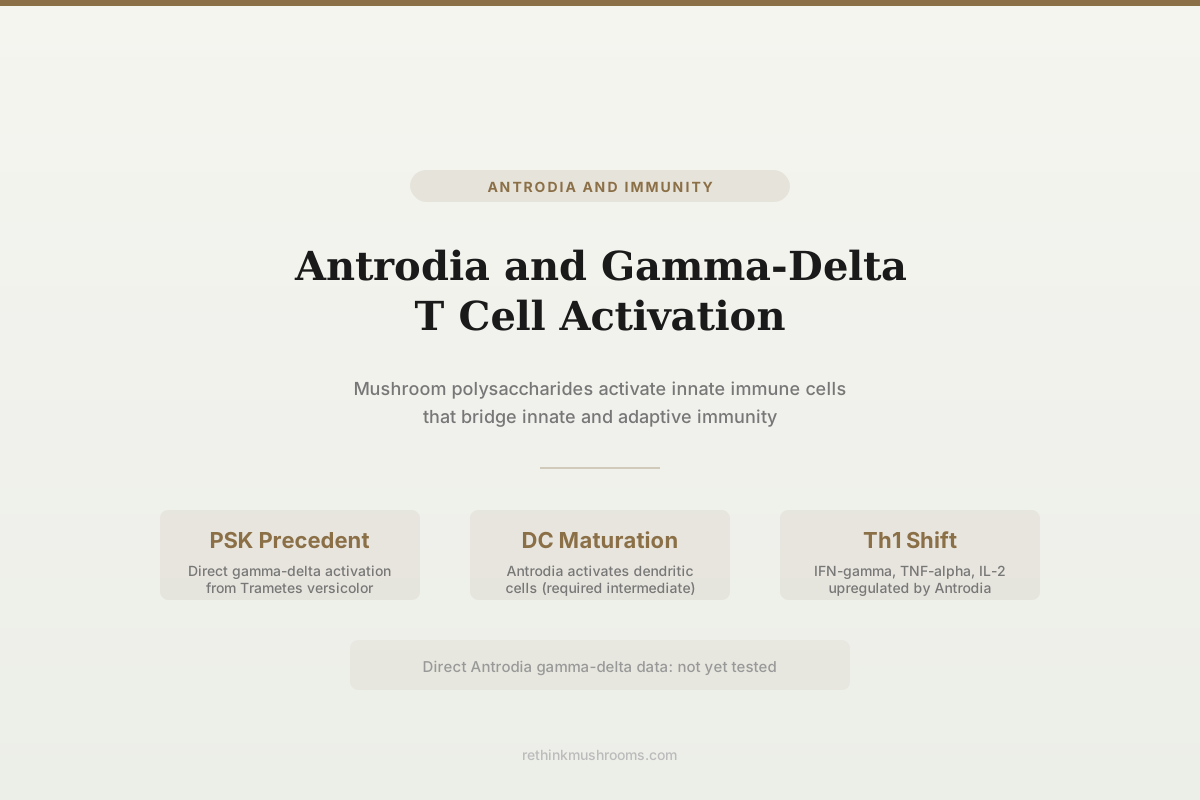
Gamma-delta T cells produced IFN-gamma after treatment with the mushroom polysaccharide PSK, with upregulated CD25, CD69, and CD107a expression markers indicating full activation.
Inatsuka et al., Cancer Immunol Immunother, 2013
Gamma-delta T cells
bridge innate and adaptive immunity
PSK precedent
Trametes versicolor polysaccharide activates them
Indirect link
Antrodia-specific gamma-delta data is limited
Inatsuka et al., Cancer Immunol Immunother, 2013
 View as image ↗
Gamma-delta T cells occupy a unique position in the immune system: they bridge innate and adaptive immunity, recognize stressed cells without requiring classical antigen presentation, and are found concentrated in epithelial tissues where they serve as a first line of defense. Mushroom polysaccharides activate these cells. Polysaccharide K (PSK) from Trametes versicolor directly stimulated gamma-delta T cells to produce IFN-gamma and upregulate activation markers CD25, CD69, and CD107a in preclinical cancer models.[1] Antrodia camphorata produces structurally related polysaccharides with broad immunomodulatory activity across NK cells, CD4+ T cells, dendritic cells, and macrophages, but direct Antrodia-specific gamma-delta T cell data is limited.
This article maps the connection between established mushroom polysaccharide immunology, Antrodia's documented immune effects, and the specific question of gamma-delta T cell activation. For a broader overview of Antrodia's full immune system effects, see the companion review.
Key Takeaways
- PSK from Trametes versicolor activated gamma-delta T cells to produce IFN-gamma, TNF-alpha, and granzyme B, with activation requiring direct cell-to-cell contact with dendritic cells (Inatsuka et al., 2013)
- Antrodia camphorata polysaccharides increased Th1 cytokines IFN-gamma, IL-2, and TNF-alpha in mouse splenocytes after oral administration, shifting the immune response toward cell-mediated immunity (Cheng et al., 2008)
- Gamma-dodecalactone from Antrodia camphorata activated NK cells to express CD69 and secrete FasL, granzyme B, TNF-alpha, and IFN-gamma through a direct stimulatory mechanism (Chen et al., 2010)
- An immunomodulatory protein from Antrodia camphorata activated macrophages via TLR2-dependent NF-kappaB signaling and induced M1 polarization (Sheu et al., 2009)
- Antrodia camphorata enhanced dendritic cell maturation and Th1-activating cytokine production sufficient to boost antitumor DNA vaccine efficacy in a HER-2/neu mouse model (Huang et al., 2010)
- No published study has directly measured gamma-delta T cell activation by Antrodia camphorata polysaccharides or extracts
What gamma-delta T cells are and why they matter
Gamma-delta T cells make up 1 to 10 percent of circulating T cells in human blood but are concentrated at much higher proportions in epithelial tissues: skin, gut mucosa, and the respiratory tract. Unlike conventional alpha-beta T cells that require MHC-presented peptide antigens, gamma-delta T cells recognize phosphoantigens, stress-induced ligands (MIC-A, MIC-B), and certain lipid antigens directly. This means they can detect and respond to cellular stress, infection, and malignant transformation without the weeks-long delay of adaptive immune priming.
In cancer immunology, gamma-delta T cells are gaining attention for three reasons. First, they kill tumor cells through perforin-granzyme and Fas-FasL pathways without requiring prior sensitization. Second, they produce large amounts of IFN-gamma and TNF-alpha, which activate other immune cells and create an antitumor microenvironment. Third, they are not restricted by MHC, meaning they can recognize tumor cells that have downregulated MHC expression to escape conventional T cell killing.
The question for mushroom immunology is whether polysaccharides and other fungal compounds can activate gamma-delta T cells the way they activate NK cells and macrophages. The PSK evidence says yes. The Antrodia-specific evidence is indirect.
PSK: the precedent for mushroom polysaccharide gamma-delta activation
The most direct evidence that mushroom polysaccharides activate gamma-delta T cells comes from Inatsuka et al. (2013), who studied PSK (polysaccharide K, also called krestin) from Trametes versicolor (turkey tail mushroom). PSK is the most clinically validated mushroom immunotherapy, approved in Japan as an adjunct cancer treatment since the 1970s.[1]
In mouse splenocyte cultures, PSK activated gamma-delta T cells to produce IFN-gamma and upregulate three activation markers: CD25 (IL-2 receptor alpha, indicating proliferative readiness), CD69 (early activation), and CD107a (degranulation marker, indicating cytotoxic activity). The gamma-delta T cells also produced TNF-alpha and granzyme B after PSK stimulation.[1]
The activation required direct cell-to-cell contact between gamma-delta T cells and dendritic cells (DCs). When gamma-delta T cells were separated from DCs by a transwell membrane, activation did not occur. This means PSK did not directly stimulate gamma-delta T cells; rather, it activated DCs, which then activated gamma-delta T cells through contact-dependent signaling.[1]
This DC-dependent mechanism is critical for evaluating Antrodia's potential. If gamma-delta T cell activation requires DC maturation as an intermediate step, then any mushroom polysaccharide that matures dendritic cells could theoretically activate gamma-delta T cells downstream. Antrodia camphorata polysaccharides have been shown to modulate dendritic cell function.
Antrodia and dendritic cells: the mechanistic link
Liu et al. (2010) demonstrated that Antrodia camphorata polysaccharides modulated dendritic cell function in a mouse asthma model. The polysaccharides enhanced DC activation and shifted the immune response from Th2-dominant (allergic) toward Th1-dominant (cell-mediated). This included increased production of IL-12 and IFN-alpha, both Th1-activating cytokines released by mature DCs.[2]
Huang et al. (2010) extended this to cancer immunology. Antrodia camphorata enhanced the antitumor efficacy of a HER-2/neu DNA vaccine in mice by acting as an immunomodulating adjuvant. The mechanism involved enhanced DC activation and increased production of Th1-activating cytokines (IL-12 and IFN-alpha) in draining lymph nodes, which stimulated T cell proliferation and IFN-gamma production.[3]
The logical chain is: Antrodia polysaccharides mature DCs. Mature DCs activate gamma-delta T cells (shown with PSK). Therefore, Antrodia polysaccharides may activate gamma-delta T cells through DC maturation. This is a reasonable hypothesis, not a demonstrated fact. The PSK study used a specific polysaccharide from a different mushroom species. Antrodia's polysaccharides have different structural features (molecular weight, branching pattern, side chain composition), and structural differences affect receptor binding and immune activation profiles. For Antrodia's effects on NK cell activation specifically, see the dedicated review.
Antrodia's broader Th1 immune shift
Multiple studies document Antrodia camphorata's ability to shift the immune response toward Th1-type cell-mediated immunity, the same arm of the immune system that gamma-delta T cells support.
Cheng et al. (2008) used a T1/T2 doubly transgenic mouse model to study Antrodia camphorata polysaccharide effects on immune balance. Oral administration of Antrodia polysaccharides increased Th1 cytokines (IFN-gamma, IL-2, TNF-alpha) in splenocytes and increased the proportion of CD4+ Th1 cells. The polysaccharides also protected against Schistosoma mansoni infection, consistent with enhanced cell-mediated immunity.[4]
Chen et al. (2008) confirmed these results using a different preparation. Polysaccharides from Antrodia camphorata mycelia extracts showed immunomodulatory activity and inhibited Schistosoma mansoni infection in mice. The 10 to 20 kDa polysaccharide fraction and adenosine were identified as the primary immunoactive components.[5]
The consistent Th1 shift across studies is relevant because gamma-delta T cells are Th1-associated effectors. They produce the same cytokine profile (IFN-gamma, TNF-alpha) that Antrodia polysaccharides upregulate. An environment enriched in Th1 cytokines also promotes gamma-delta T cell expansion and activation. The relationship may be bidirectional: Antrodia polysaccharides create a Th1 cytokine milieu that supports gamma-delta T cell function, and activated gamma-delta T cells produce more Th1 cytokines that reinforce the shift.
NK cell activation: a parallel innate lymphocyte story
Gamma-delta T cells and NK cells share several functional similarities. Both kill target cells through perforin-granzyme and Fas-FasL pathways. Both produce IFN-gamma. Both are activated by stress ligands rather than classical MHC-peptide complexes. Compounds that activate NK cells frequently also activate gamma-delta T cells.
Chen et al. (2010) identified gamma-dodecalactone from Antrodia camphorata as an NK cell activator. This volatile compound activated human NK cells to express CD69 (the same early activation marker upregulated on gamma-delta T cells by PSK) and stimulated secretion of FasL, granzyme B, TNF-alpha, and IFN-gamma.[6]
The NK cell activation profile produced by gamma-dodecalactone closely mirrors the gamma-delta T cell activation profile produced by PSK: same activation markers, same effector molecules, same cytokines. Whether gamma-dodecalactone also activates gamma-delta T cells has not been tested. Given the shared biology between NK and gamma-delta T cells, and the overlapping activation signatures, this is a plausible but unconfirmed extension.
Macrophage and TLR2 signaling: another activation pathway
Sheu et al. (2009) purified a novel immunomodulatory protein (ACA) from Antrodia camphorata that activated macrophages through TLR2-dependent NF-kappaB signaling. ACA induced M1 polarization (pro-inflammatory, antitumor phenotype) in murine macrophages, with increased production of TNF-alpha, IL-1beta, and IL-12.[7]
TLR2 signaling is relevant to gamma-delta T cell biology because gamma-delta T cells express TLR2 and can be directly activated through TLR2 ligation. If ACA binds TLR2 on macrophages, it may also bind TLR2 on gamma-delta T cells. This is speculative; the study tested macrophages only.
Kuo et al. (2008) provided a broader view of Antrodia's immunomodulatory effects, showing that mycelia and culture filtrate enhanced phagocytosis in neutrophils and monocytes and upregulated CD11b expression dose-dependently. The immunostimulatory activity spanned multiple innate immune cell types.[8]
Song et al. (2014) demonstrated immunomodulatory effects in a veterinary context, showing that Antrodia camphorata polysaccharides enhanced immune function in specific pathogen-free chickens, confirming the immunostimulatory effects extend beyond rodent models.[9] For how Antrodia polysaccharides enhance immunity broadly, see the polysaccharide-focused review.
The evidence gap: what has not been tested
No published study has directly measured gamma-delta T cell activation by Antrodia camphorata polysaccharides, extracts, or isolated compounds. The connection presented in this article is built on three pillars of indirect evidence:
- PSK from Trametes versicolor activates gamma-delta T cells through dendritic cell intermediaries (directly demonstrated).
- Antrodia camphorata polysaccharides mature and activate dendritic cells (directly demonstrated).
- Antrodia produces a Th1 cytokine environment and activates NK cells through pathways shared with gamma-delta T cell biology (directly demonstrated for NK cells, hypothesized for gamma-delta T cells).
Each pillar is supported by peer-reviewed research. The logical inference connecting them is reasonable. But inference is not data. The specific experiment, exposing gamma-delta T cells to Antrodia polysaccharides and measuring activation markers (CD25, CD69, CD107a) and cytokine production (IFN-gamma, TNF-alpha), has not been performed.
This gap matters because mushroom polysaccharides are structurally diverse. PSK is a protein-bound polysaccharide with specific structural features. Antrodia polysaccharides have different molecular weights, branching patterns, and protein conjugation. These structural differences could mean different receptor binding affinities and different downstream immune cell activation profiles. The fact that both activate dendritic cells does not guarantee both activate gamma-delta T cells to the same degree or through the same mechanism.
The research opportunity is clear and technically straightforward. Antrodia polysaccharide preparations could be tested against isolated gamma-delta T cells or in splenocyte cultures using the same methodology Inatsuka et al. (2013) used for PSK. Until this experiment is done, the gamma-delta T cell connection for Antrodia specifically remains a hypothesis with strong mechanistic rationale. For how Antrodia may support post-illness immune recovery, see the clinical applications review.
The Bottom Line
Mushroom polysaccharides activate gamma-delta T cells in preclinical cancer models, with PSK from Trametes versicolor providing the strongest direct evidence. Antrodia camphorata polysaccharides activate dendritic cells, shift immunity toward Th1, and stimulate NK cells through pathways that overlap with gamma-delta T cell biology. No study has directly tested Antrodia's effects on gamma-delta T cells. The mechanistic rationale is strong; the direct evidence is absent.
Frequently Asked Questions
Sources & References
- 1RTHM-00291·Inatsuka, Carol et al. (2013). “Gamma delta T cells are activated by polysaccharide K (PSK) and contribute to the anti-tumor effect of PSK..” Cancer immunology.Study breakdown →PubMed →↩
- 2RTHM-00192·Liu, Ko-Jiunn et al. (2010). “Administration of polysaccharides from Antrodia camphorata modulates dendritic cell function and alleviates allergen-induced T helper type 2 responses in a mouse model of asthma..” Immunology.Study breakdown →PubMed →↩
- 3RTHM-00185·Huang, Chia-Hsin et al. (2010). “Promoting effect of Antrodia camphorata as an immunomodulating adjuvant on the antitumor efficacy of HER-2/neu DNA vaccine..” Cancer immunology.Study breakdown →PubMed →↩
- 4RTHM-00130·Cheng, Po-Ching et al. (2008). “In vivo immunomodulatory effects of Antrodia camphorata polysaccharides in a T1/T2 doubly transgenic mouse model for inhibiting infection of Schistosoma mansoni..” Toxicology and applied pharmacology.Study breakdown →PubMed →↩
- 5RTHM-00129·Chen, Yu-Jen et al. (2008). “Polysaccharides from Antrodia camphorata mycelia extracts possess immunomodulatory activity and inhibits infection of Schistosoma mansoni..” International immunopharmacology.Study breakdown →PubMed →↩
- 6RTHM-00175·Chen, Chia-Jung et al. (2010). “Structure and functions of gamma-dodecalactone isolated from Antrodia camphorata for NK cell activation..” Bioorganic & medicinal chemistry.Study breakdown →PubMed →↩
- 7RTHM-00170·Sheu, Fuu et al. (2009). “Purification, cloning, and functional characterization of a novel immunomodulatory protein from Antrodia camphorata (bitter mushroom) that exhibits TLR2-dependent NF-κB activation and M1 polarization within murine macrophages..” Journal of agricultural and food chemistry.Study breakdown →PubMed →↩
- 8RTHM-00140·Kuo, Mei-Chun et al. (2008). “Immunomodulatory effect of Antrodia camphorata mycelia and culture filtrate..” Journal of ethnopharmacology.Study breakdown →PubMed →↩
- 9RTHM-00349·Song, Ai-Rong et al. (2014). “Immunomodulatory effect of polysaccharides extracted from the medicinal mushroom Antrodia camphorata (higher Basidiomycetes) in specific pathogen-free chickens..” International journal of medicinal mushrooms.Study breakdown →PubMed →↩