Antrodia and Immunity
Th1 immune shift
Oral Antrodia camphorata polysaccharides induced Th1 cytokine expression (IFN-gamma, IL-2, TNF-alpha) in mouse splenocytes, shifting the immune balance toward cell-mediated immunity.
Cheng et al., Toxicol Appl Pharmacol, 2008
5 immune cell types
macrophages, DCs, NK, T cells, neutrophils
TLR2 + TLR4
toll-like receptors required for activation
0 human trials
all animal and cell culture models
Cheng et al., Toxicol Appl Pharmacol, 2008
 View as image ↗
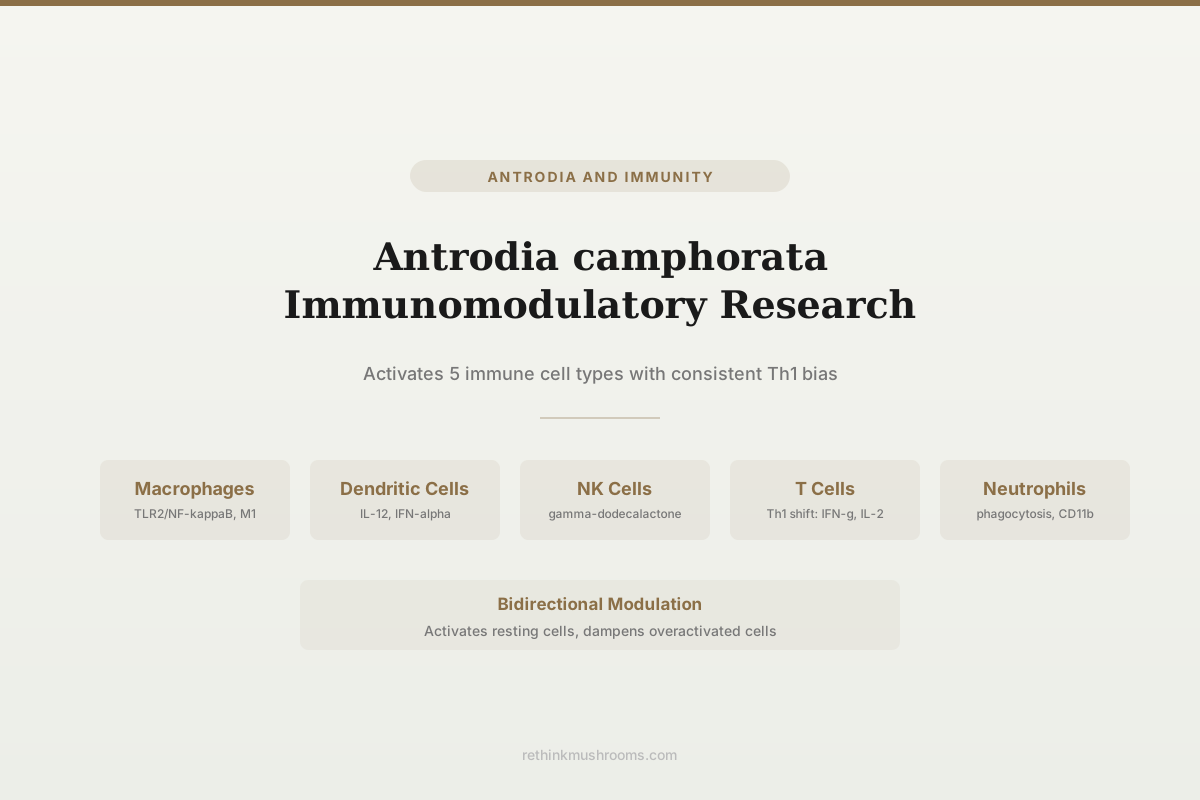
Antrodia camphorata activates nearly every major arm of the immune system in preclinical studies. Its polysaccharides mature dendritic cells, activate macrophages through TLR2, stimulate NK cell cytotoxicity, shift T helper responses toward Th1, and enhance neutrophil phagocytosis. A novel immunomodulatory protein (ACA) triggers NF-kappaB signaling through a TLR2-dependent mechanism. A volatile compound, gamma-dodecalactone, directly activates human NK cells. The consistent theme across all studies is immunostimulation biased toward cell-mediated (Th1) rather than humoral (Th2) immunity.[1][2]
No human immunomodulation studies have been published. All evidence comes from mouse models, chicken models, and cell culture experiments. This article maps Antrodia's effects across each immune cell type. For the specific question of gamma-delta T cell activation, see the dedicated article. For how Antrodia's immune effects may support post-illness recovery, see the clinical applications review.
Key Takeaways
- Oral Antrodia camphorata polysaccharides induced Th1 cytokines (IFN-gamma, IL-2, TNF-alpha) and increased CD4+ T cell and B cell proportions in spleens of transgenic mice (Cheng et al., 2008)
- A novel immunomodulatory protein (ACA) from Antrodia camphorata activated macrophages through TLR2-dependent NF-kappaB signaling and induced M1 polarization (Sheu et al., 2009)
- Gamma-dodecalactone from Antrodia camphorata activated human NK cells to express CD69 and secrete FasL, granzyme B, TNF-alpha, and IFN-gamma (Chen et al., 2010)
- Antrodia camphorata polysaccharides modulated dendritic cell function, enhanced IL-12 and IFN-alpha production, and shifted allergen-induced Th2 responses toward Th1 in an asthma model (Liu et al., 2010)
- Antrodia mycelia and culture filtrate enhanced phagocytosis in neutrophils and monocytes with dose-dependent CD11b upregulation (Kuo et al., 2008)
- Antrodia camphorata polysaccharides enhanced immune parameters in specific pathogen-free chickens, extending immunomodulatory evidence beyond rodent models (Song et al., 2014)
The Th1/Th2 paradigm: why the direction of immune shift matters
The immune system operates on a balance between Th1 responses (cell-mediated: fighting intracellular pathogens, killing infected/malignant cells) and Th2 responses (humoral: antibody production, anti-parasitic immunity, allergic responses). An immune modulator that randomly activates everything is not therapeutically useful. One that selectively strengthens Th1 responses while leaving Th2 responses unchanged, or even suppressing them, has defined applications: antitumor immunotherapy, antiviral defense, and correction of Th2-dominant allergic conditions.
Antrodia camphorata consistently demonstrates Th1-selective immunomodulation across multiple studies and immune cell types. This pattern determines its potential applications: cancer immunoadjuvancy (where Th1 immunity kills tumor cells), antiviral defense (where Th1 immunity controls intracellular pathogens), and allergic disease (where rebalancing away from Th2 reduces allergic inflammation).
T helper cells: direct Th1 induction
Cheng et al. (2008) provided the foundational T cell study using a T1/T2 doubly transgenic mouse model designed to track Th1 and Th2 responses simultaneously. Oral administration of Antrodia camphorata polysaccharides for 2 and 4 weeks induced Th1 cytokine mRNA expression (IFN-gamma, IL-2, TNF-alpha) in splenocytes. The proportion of CD4+ T cells and B cells within the spleen increased. Critically, Th2 cytokines were not elevated, confirming the directional specificity of the immune shift.[1]
The polysaccharides also protected against Schistosoma mansoni infection. S. mansoni is a helminth parasite that evades immunity partly by driving host Th2 responses (which produce antibodies but not cell-mediated killing). By shifting the balance toward Th1, Antrodia polysaccharides countered the parasite's immune evasion strategy.[1]
Chen et al. (2008) confirmed these results using a different Antrodia preparation. The 10 to 20 kDa polysaccharide fraction and adenosine from Antrodia camphorata mycelia showed the strongest immunomodulatory activity. The size-fractionation is valuable because it narrows down which components drive the immune effects, enabling future standardization.[3]
Dendritic cells: gatekeepers of adaptive immunity
Dendritic cells (DCs) are the bridge between innate detection and adaptive immune activation. They capture antigens, process them, and present them to T cells along with co-stimulatory signals that determine whether the T cell response will be Th1 or Th2. Antrodia polysaccharides influence this decision point.
Liu et al. (2010) demonstrated that Antrodia camphorata polysaccharides modulated DC function in a mouse asthma model. The polysaccharides enhanced DC maturation, increased production of Th1-polarizing cytokines (IL-12, IFN-alpha), and shifted allergen-induced T helper responses from Th2 toward Th1. In the asthma model, this meant reduced airway inflammation and decreased Th2 cytokines (IL-4, IL-5, IL-13) that drive eosinophilic airway inflammation.[4]
Huang et al. (2010) showed that this DC maturation effect has practical antitumor application. Antrodia camphorata enhanced the antitumor efficacy of a HER-2/neu DNA vaccine by acting as an immunomodulating adjuvant. In draining lymph nodes, DC activation increased and Th1-activating cytokine production rose sufficiently to stimulate T cell proliferation and IFN-gamma production. The vaccine alone produced modest immune responses; the vaccine plus Antrodia produced significantly stronger antitumor immunity.[5]
The adjuvant finding is translational. Vaccine adjuvants are a validated pharmaceutical category. If Antrodia polysaccharides can boost vaccine responses in humans the way they do in mice, there would be a clear clinical application, not just for cancer vaccines but potentially for infectious disease vaccines where Th1 responses determine efficacy (tuberculosis, certain viral vaccines). For deeper analysis of Antrodia polysaccharide immune mechanisms, see the compound-focused article.
Macrophages: TLR2-dependent activation and M1 polarization
Sheu et al. (2009) purified a novel immunomodulatory protein (ACA) from Antrodia camphorata and characterized its mechanism at the receptor level. ACA activated macrophages through TLR2-dependent NF-kappaB signaling. It did not activate through TLR4 (the lipopolysaccharide receptor), confirming specific receptor engagement rather than endotoxin contamination.[2]
ACA induced M1 polarization in murine macrophages. M1 macrophages produce TNF-alpha, IL-1beta, IL-12, and reactive oxygen species. They are pro-inflammatory, antimicrobial, and antitumor. The alternative, M2 macrophages, are anti-inflammatory and tissue-remodeling. In the tumor microenvironment, M2-polarized tumor-associated macrophages promote tumor growth. M1 polarization is the desirable direction for anticancer immunity.[2]
Hseu et al. (2005) demonstrated that Antrodia camphorata also has anti-inflammatory capacity, inhibiting iNOS, COX-2, and pro-inflammatory cytokine production through NF-kappaB suppression in activated macrophages. This appears paradoxical: one study shows NF-kappaB activation (Sheu), another shows NF-kappaB suppression (Hseu).[6]
The resolution is context-dependent. Sheu used an immunomodulatory protein (ACA) on resting macrophages, activating them. Hseu used a different extract on LPS-activated macrophages, suppressing overactivation. Antrodia appears to modulate macrophages bidirectionally: activating quiescent macrophages toward M1 and dampening excessively activated macrophages. This bidirectional modulation is the hallmark of an immunomodulator rather than a simple immunostimulant.
NK cells: direct activation by gamma-dodecalactone
Chen et al. (2010) identified gamma-dodecalactone as an NK cell activator from Antrodia camphorata. This volatile compound activated human NK cells (not mouse cells) to express CD69, secrete FasL and granzyme B (cytotoxic effector molecules), and produce TNF-alpha and IFN-gamma.[7]
The use of human NK cells is notable because most Antrodia immune studies use mouse models. Gamma-dodecalactone activated human cells directly, without requiring intermediate cell activation (unlike the dendritic cell-dependent gamma-delta T cell activation discussed in the gamma-delta T cell article). For a dedicated review of Antrodia and NK cell activation, including functional implications for cancer immunosurveillance, see the companion article.
Innate immune cells: neutrophils and monocytes
Kuo et al. (2008) provided the broadest survey of Antrodia's innate immune effects. Antrodia camphorata mycelia and culture filtrate enhanced phagocytosis in human polymorphonuclear neutrophils and monocytes. CD11b expression, an integrin that mediates cell adhesion and phagocytosis, was upregulated dose-dependently. The immunostimulatory activity was attributed primarily to the 10 to 20 kDa polysaccharide fraction and adenosine.[8]
Cross-species validation: chickens
Song et al. (2014) tested Antrodia camphorata polysaccharides in specific pathogen-free (SPF) chickens, providing the only non-rodent animal validation. The polysaccharides enhanced immune parameters, confirming that the immunomodulatory effects are not restricted to mouse physiology.[9]
Cross-species activity strengthens the case that Antrodia immunomodulation is genuine and not an artifact of a particular model system. However, chicken immune systems differ from human immune systems in several important ways (different TLR repertoire, different lymphocyte populations), so chicken data is not directly predictive of human responses.
The missing piece: human immunomodulation data
Antrodia camphorata's immunomodulatory evidence spans five immune cell types, at least three signaling pathways, two animal species, and multiple preparation methods. The consistency is the strongest argument for genuine biological activity. The gap is human data.
What would a human immunomodulation study look like? Blood would be drawn before and during Antrodia supplementation. NK cell cytotoxicity, monocyte phagocytic activity, T cell proliferation responses, and cytokine profiles (IFN-gamma, IL-4, IL-10, TNF-alpha) would be measured. This type of study is feasible, inexpensive compared to clinical trials, and would answer the fundamental question: do the immunomodulatory effects seen in mouse splenocytes and chicken blood also occur in human peripheral blood after oral Antrodia supplementation?
Until this study exists, Antrodia's immunomodulatory profile remains preclinical. The pharmacokinetic question, whether orally consumed Antrodia polysaccharides survive digestion, reach the gut-associated lymphoid tissue, and produce systemic immune effects, is answered indirectly by the oral dosing mouse studies (where systemic immune changes were documented after oral administration) but not answered for human physiology.
The Bottom Line
Antrodia camphorata polysaccharides and protein components activate macrophages (TLR2/NF-kappaB), mature dendritic cells (IL-12/IFN-alpha), stimulate NK cells (gamma-dodecalactone), shift T helper balance toward Th1, and enhance neutrophil phagocytosis in preclinical models. The consistent Th1 bias makes Antrodia relevant for antitumor immunity, vaccine adjuvancy, and antiviral defense. Bidirectional macrophage modulation distinguishes it from simple immunostimulants. No human immunomodulation studies have been published.
Frequently Asked Questions
Sources & References
- 1RTHM-00130·Cheng, Po-Ching et al. (2008). “In vivo immunomodulatory effects of Antrodia camphorata polysaccharides in a T1/T2 doubly transgenic mouse model for inhibiting infection of Schistosoma mansoni..” Toxicology and applied pharmacology.Study breakdown →PubMed →↩
- 2RTHM-00170·Sheu, Fuu et al. (2009). “Purification, cloning, and functional characterization of a novel immunomodulatory protein from Antrodia camphorata (bitter mushroom) that exhibits TLR2-dependent NF-κB activation and M1 polarization within murine macrophages..” Journal of agricultural and food chemistry.Study breakdown →PubMed →↩
- 3RTHM-00129·Chen, Yu-Jen et al. (2008). “Polysaccharides from Antrodia camphorata mycelia extracts possess immunomodulatory activity and inhibits infection of Schistosoma mansoni..” International immunopharmacology.Study breakdown →PubMed →↩
- 4RTHM-00192·Liu, Ko-Jiunn et al. (2010). “Administration of polysaccharides from Antrodia camphorata modulates dendritic cell function and alleviates allergen-induced T helper type 2 responses in a mouse model of asthma..” Immunology.Study breakdown →PubMed →↩
- 5RTHM-00185·Huang, Chia-Hsin et al. (2010). “Promoting effect of Antrodia camphorata as an immunomodulating adjuvant on the antitumor efficacy of HER-2/neu DNA vaccine..” Cancer immunology.Study breakdown →PubMed →↩
- 6RTHM-00079·Hseu, You-Cheng et al. (2005). “Anti-inflammatory potential of Antrodia Camphorata through inhibition of iNOS, COX-2 and cytokines via the NF-kappaB pathway..” International immunopharmacology.Study breakdown →PubMed →↩
- 7RTHM-00175·Chen, Chia-Jung et al. (2010). “Structure and functions of gamma-dodecalactone isolated from Antrodia camphorata for NK cell activation..” Bioorganic & medicinal chemistry.Study breakdown →PubMed →↩
- 8RTHM-00140·Kuo, Mei-Chun et al. (2008). “Immunomodulatory effect of Antrodia camphorata mycelia and culture filtrate..” Journal of ethnopharmacology.Study breakdown →PubMed →↩
- 9RTHM-00349·Song, Ai-Rong et al. (2014). “Immunomodulatory effect of polysaccharides extracted from the medicinal mushroom Antrodia camphorata (higher Basidiomycetes) in specific pathogen-free chickens..” International journal of medicinal mushrooms.Study breakdown →PubMed →↩