Antrodia and Immunity
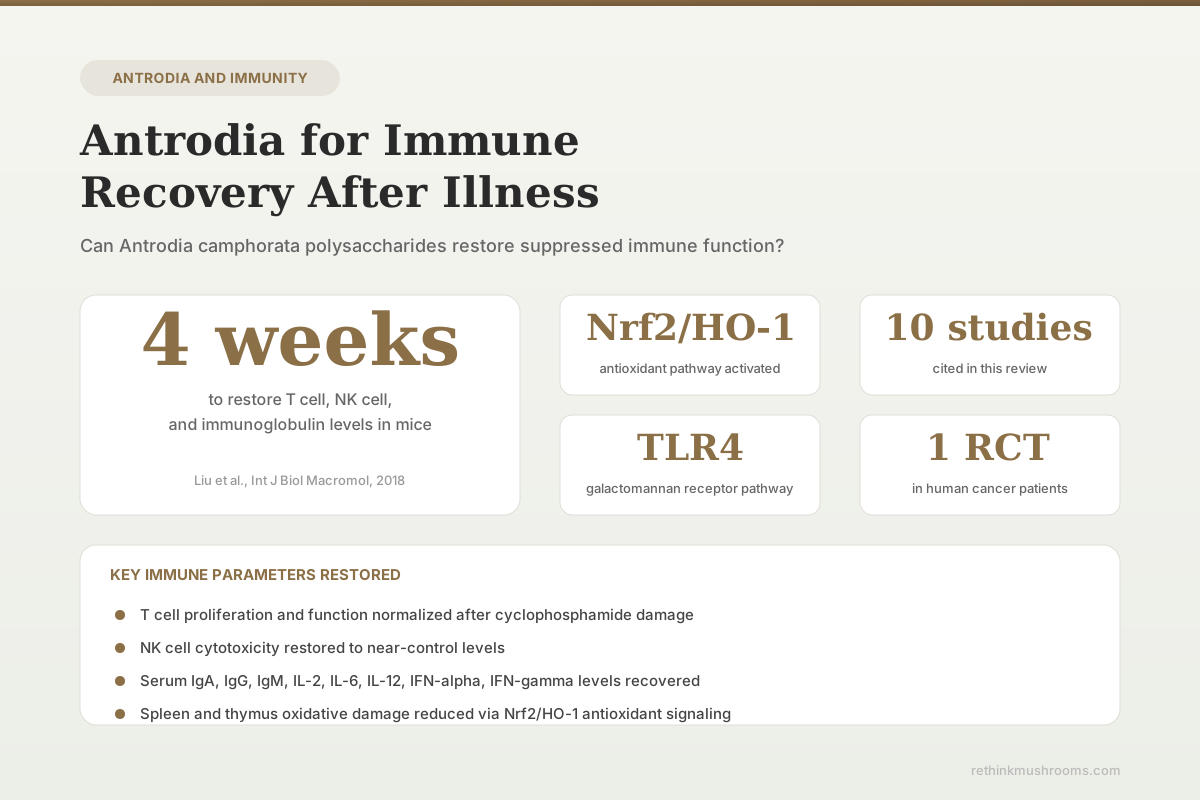
4 weeks to restore immune markers
Oral Antrodia cinnamomea polysaccharides reversed cyclophosphamide-induced immunosuppression in BALB/c mice within four weeks, restoring T cell function, NK cell cytotoxicity, and serum cytokine levels.
Liu et al., Int J Biol Macromol, 2018
IgA, IgG, IgM restored
serum immunoglobulins normalized
Nrf2/HO-1 pathway
antioxidant mechanism identified
0 human trials
all evidence from animal models
Liu et al., Int J Biol Macromol, 2018
 View as image ↗
Cyclophosphamide is one of the most immunosuppressive chemotherapy drugs in clinical use. It depletes T cells, suppresses NK cell activity, crashes immunoglobulin levels, and generates oxidative damage to immune organs. In a 2018 study, four weeks of oral Antrodia cinnamomea polysaccharide (ACPS) treatment reversed all of these effects in mice, restoring T cell function, NK cell cytotoxicity, and serum levels of IgA, IgG, and IgM.[1] That single study is the strongest direct evidence for Antrodia in immune recovery. The rest of the evidence is indirect: immunostimulatory effects in healthy animals, anti-sepsis effects, radiation protection for immune cells, and one small human trial in cancer patients.
For a broader view of Antrodia's immunomodulatory effects across all immune cell types, see the overview article. This article focuses specifically on what the research says about restoring immune function after it has been suppressed or damaged.
Key Takeaways
- Four weeks of oral Antrodia cinnamomea polysaccharides restored T cell function, NK cell cytotoxicity, and immunoglobulin levels (IgA, IgG, IgM) in cyclophosphamide-immunosuppressed mice (Liu et al., 2018)
- The immune recovery mechanism involved Nrf2/HO-1 antioxidant pathway activation in spleen and thymus tissue, reducing oxidative damage to immune organs (Liu et al., 2018)
- Antrodia camphorata polysaccharides decreased late-stage inflammatory mediator expression in septic mice, improving survival in a polymicrobial infection model (Meng et al., 2012)
- Antrodia cinnamomea extracts protected immune cells from radiation damage while simultaneously inhibiting cancer cell growth, showing selective radioprotection (Cheng et al., 2014)
- High-molecular-weight Antrodia polysaccharides enhanced dendritic cell maturation and boosted DNA vaccine efficacy in mice, suggesting vaccine adjuvant potential (Lin et al., 2015)
- A randomized controlled trial of Antrodia cinnamomea combined with chemotherapy in 37 advanced cancer patients showed lower mortality but no statistically significant survival benefit, alongside significantly lower platelet counts in the Antrodia group (p = 0.02) (Tsai et al., 2016)
Reversing chemotherapy-induced immunosuppression
The most directly relevant study for post-illness immune recovery is Liu et al. (2018), which used cyclophosphamide (CTX) to create a defined state of immunosuppression in BALB/c mice, then tested whether Antrodia cinnamomea polysaccharides (ACPS) could reverse it.[1]
CTX treatment produced predictable damage: body weight loss, decreased thymus and spleen indexes, reduced T cell proliferation, suppressed NK cell cytotoxicity, and depleted serum levels of IgA, IgG, IgM, IL-2, IL-6, IL-12, IFN-alpha, and IFN-gamma. Four weeks of oral ACPS treatment reversed all of these parameters. T cell function and NK cell cytotoxicity returned to levels approaching those of untreated controls.[1]
The mechanism involved the Nrf2/HO-1 antioxidant pathway. ACPS activated erythroid 2-related factor 2 (Nrf2) by downregulating Kelch-like ECH-associated protein 1 (Keap1), which led to increased expression of heme oxygenase-1 (HO-1), superoxide dismutase 2, and catalase in spleen and thymus tissue. This reduced reactive oxygen species and malondialdehyde levels in these immune organs.[1]
Direct Evidence · Animal Model
What Antrodia Restored After Chemotherapy Suppression
In the single most directly relevant study, cyclophosphamide (a strongly immunosuppressive chemotherapy drug) crashed a panel of immune and antioxidant markers in mice. Four weeks of oral Antrodia cinnamomea polysaccharide (ACPS) reversed each one toward untreated-control levels. This is direction of change in one mouse study — not a human-validated effect size.
T cell function
Cellular immunity
NK cell cytotoxicity
Cellular immunity
IgA / IgG / IgM (serum)
Antibodies
IL-2 / IL-6 / IL-12
Cytokines
IFN-α / IFN-γ
Cytokines
SOD / catalase / GPx
Antioxidant defense
Mechanism: ACPS activated the Nrf2/HO-1 antioxidant pathway in spleen and thymus, reducing oxidative damage to the organs where immune cells develop and are activated. Single strain (BALB/c), single immunosuppressant, not yet replicated.
Source: Liu et al., Int J Biol Macromol (2018) [ref 1] · RTHM-00979
The implication is that ACPS restored immune function partly by protecting the organs where immune cells develop and mature (thymus) and where they are activated (spleen) from oxidative damage. CTX generates substantial oxidative stress, and the antioxidant protection provided by ACPS may have created conditions for immune cell populations to repopulate these organs. This is a single study in one mouse strain with one immunosuppressant. It has not been replicated, and the dose translation to humans is undefined.
Immune recovery during active infection: the sepsis model
Sepsis represents the opposite end of the immune recovery problem. Instead of suppressed immunity, sepsis involves dysregulated hyperinflammation followed by immunoparalysis, a late-stage collapse of immune function that leaves patients vulnerable to secondary infections.
Meng et al. (2012) tested Antrodia camphorata polysaccharides in a cecal ligation and puncture (CLP) sepsis model in mice. They extracted polysaccharides from both mycelia and fruiting bodies and measured inflammatory mediator expression at the injury site and in circulation.[2]
Both mycelial and fruiting body polysaccharides decreased inflammatory mediator expression, with the most pronounced effects in late-stage sepsis. This timing is important because late-stage sepsis is when immunoparalysis sets in and when secondary infections become lethal. By modulating the inflammatory response without eliminating it entirely, the polysaccharides appeared to prevent the transition from hyperinflammation to immune collapse.[2]
The sepsis model is relevant to post-illness immune recovery because it addresses a scenario where the immune system is actively damaged by the disease process itself. The limitation is that CLP sepsis in mice does not perfectly model human sepsis, and the timing of polysaccharide administration (before versus after sepsis onset) matters considerably. Prophylactic immunomodulation and therapeutic immunomodulation are different problems.
Protecting immune cells from radiation damage
Cheng et al. (2014) investigated whether Antrodia cinnamomea extracts could protect immune cells from radiation while leaving cancer cells vulnerable. This dual-action question is central to any proposed adjunct use during cancer treatment.[3]
The results showed selective radioprotection: Antrodia extracts enhanced survival and function of immune cells exposed to radiation while simultaneously inhibiting cancer cell growth under the same radiation conditions. This selectivity, if it holds in vivo, would address one of the core challenges of using immunomodulators during cancer therapy. Agents that protect all cells equally, including tumor cells, are therapeutically useless. Agents that selectively protect immune cells while allowing or enhancing tumor cell killing have clear applications in radiation oncology supportive care.[3]
The study was conducted in cell culture. Selective radioprotection in vitro does not guarantee selective radioprotection in a living organism with complex pharmacokinetics and tissue distribution.
Baseline immunostimulation: building the foundation for recovery
Two studies from 2008 established that Antrodia camphorata polysaccharides stimulate immune responses in healthy (non-immunosuppressed) animals, providing the mechanistic foundation for why Antrodia might accelerate immune recovery.
Cheng et al. (2008) used a T1/T2 doubly transgenic mouse model to show that oral Antrodia polysaccharides induced Th1 cytokine expression (IFN-gamma, IL-2, TNF-alpha) after 2 to 4 weeks. After 6 weeks, the number of splenic dendritic cells and macrophages increased, and the CD4+/CD8+ ratio and B cell numbers were augmented. The immune shift was selectively Th1, not a non-specific activation of all immune pathways.[4]
Kuo et al. (2008) tested different fractions from hot water extracts of submerged-cultured Antrodia. The mycelia and culture filtrate enhanced phagocytosis in neutrophils and monocytes with dose-dependent upregulation of the adhesion molecule CD11b. The macrophage activation was characterized by TNF-alpha, IL-1beta, and IL-6 secretion and increased nitric oxide production.[5]
Chen et al. (2008) identified the active fraction: the 10 to 20 kDa polysaccharide fraction and adenosine from Antrodia mycelia showed the strongest immunomodulatory activity, providing a molecular weight target for future standardization efforts.[6]
These baseline studies are relevant to immune recovery because they identify the specific immune parameters Antrodia activates: Th1 cytokines, NK cell function, dendritic cell maturation, macrophage phagocytosis, and neutrophil activity. These are precisely the immune functions that decline during illness, chemotherapy, and aging. For a deeper look at how Antrodia activates gamma-delta T cells specifically, see the dedicated article.
Enhancing vaccine responses and dendritic cell function
Lin et al. (2015) purified high-molecular-weight polysaccharides from Antrodia cinnamomea and tested their effects on dendritic cell (DC) function and DNA vaccine efficacy. The polysaccharides promoted DC maturation, increased co-stimulatory molecule expression (CD40, CD80, CD86), and enhanced antigen presentation capacity.[7]
When used as an adjuvant alongside a DNA vaccine, the Antrodia polysaccharides boosted vaccine-specific immune responses. This is relevant to post-illness recovery because vaccine responses are often blunted in immunocompromised individuals. If Antrodia polysaccharides can enhance DC function, they might improve vaccination efficacy in people recovering from illness or immunosuppressive treatment.
Perera et al. (2018) identified the specific receptor pathway: a galactomannan polysaccharide from Antrodia cinnamomea stimulated TNF-alpha and IL-6 production in mouse macrophages and human dendritic cells through Toll-like receptor 4 (TLR4). TLR4 signaling is central to innate immune activation and connects to downstream adaptive immune responses.[8]
Huang et al. (2010) extended the vaccine adjuvant concept to tumor immunology. Using Antrodia camphorata as an immunomodulating adjuvant alongside a HER-2/neu DNA vaccine, the combination enhanced Th1-like cellular immune responses and suppressed tumor growth more effectively than the vaccine alone. Treated mice showed extended survival compared to vaccine-only controls.[9]
The only human trial: Antrodia with chemotherapy
Tsai et al. (2016) conducted the only published randomized controlled trial of Antrodia in immunocompromised humans. Thirty-seven advanced cancer patients receiving chemotherapy were randomly assigned to receive Antrodia cinnamomea extract (20 ml twice daily for 30 days) or placebo alongside their standard chemotherapy regimen.[10]
The Antrodia group showed lower mortality and longer mean overall survival than the placebo group, but neither difference reached statistical significance. The sample size was too small to detect anything but a very large effect. The study's primary contribution was safety data: Antrodia was generally well tolerated during concurrent chemotherapy.[10]
One concern emerged. Platelet counts were significantly lower in the Antrodia group than in the placebo group (p = 0.02). Thrombocytopenia (low platelets) is already a common and dangerous side effect of chemotherapy. An agent that worsens it raises safety questions for concurrent use during active chemotherapy, and the authors explicitly flagged this as a potential risk of the combination.[10]
Safety
ModeratePossible additive effect on low platelet counts during chemotherapy
Concern
In the only human trial, platelet counts were significantly lower in the Antrodia group than the placebo group (p = 0.02). Chemotherapy already causes thrombocytopenia, so an additive effect could increase bleeding risk.
What the research says
The trial authors flagged lowered platelets as a potential risk of combining Antrodia with chemotherapy. The finding comes from a single small (37-patient) study and has not been replicated, so its magnitude and clinical significance remain uncertain.
Particularly relevant for: People undergoing chemotherapy or otherwise at risk of low platelet counts
What to do
This is educational information, not medical advice. Anyone in cancer treatment should consult their oncologist before using Antrodia or any supplement.
Tsai et al., BMC Complement Altern Med, 2016
This trial does not demonstrate that Antrodia helps immune recovery in cancer patients. It demonstrates that concurrent use during chemotherapy does not produce obvious harm in a small sample and that a much larger trial would be needed to detect any survival benefit. For context on the bioactive compounds in Antrodia that drive these effects, see the dedicated article.
What the polysaccharide fraction actually does
Across all the immune recovery studies, polysaccharides are the primary active fraction. Antrodia contains multiple types of polysaccharides (beta-glucans, galactomannans, heteropolysaccharides), and their immune effects operate through defined receptor pathways: TLR2, TLR4, and Dectin-1 on innate immune cells.[8]
The galactomannan component activates through TLR4. High-molecular-weight polysaccharides enhance dendritic cell function. The 10 to 20 kDa fraction shows the strongest overall immunomodulatory activity. This molecular characterization matters for immune recovery applications because it suggests that specific, standardizable fractions, not crude whole extracts, drive the relevant effects. For more on how Antrodia's polysaccharides enhance immune function through specific pathways, see the dedicated review.
The triterpenoid fraction (antcins, zhankuic acids) drives Antrodia's anti-inflammatory and anticancer effects but contributes less to direct immunostimulation. Immune recovery likely requires the polysaccharide fraction specifically, though this has not been tested head-to-head in a recovery model. Understanding Antrodia's full compound profile and potential drug interactions is relevant for anyone interpreting this research.
Limitations of the immune recovery evidence
The distance between the available evidence and a clinical immune recovery application is substantial.
The strongest study (Liu et al., 2018) used a single mouse strain (BALB/c), a single immunosuppressant (cyclophosphamide), a single Antrodia preparation, and has not been replicated. The dose used in mice cannot be directly scaled to humans without pharmacokinetic bridging studies that do not exist.
The sepsis model (Meng et al., 2012) used prophylactic dosing, meaning the polysaccharides were administered before and during sepsis, not after immune collapse had already occurred. Whether Antrodia polysaccharides can rescue an already-collapsed immune system remains untested.
The human trial (Tsai et al., 2016) was underpowered, short-term (30 days), and did not measure immune recovery parameters directly. It measured survival and disease control, which are downstream outcomes influenced by many variables beyond immune function.
No study has tested Antrodia in post-viral immune recovery (the most common real-world application people search for), post-surgical immunosuppression, age-related immune decline, or immune reconstitution after bone marrow transplant. The traditional Taiwanese use for recovery from illness and exhaustion has no controlled clinical evidence behind it.
- Cell-culture studiescompleted
Selective radioprotection of immune cells and TLR4-mediated activation shown in vitro (Cheng et al., 2014; Perera et al., 2018)
- Animal studiescompleted
Reversal of cyclophosphamide-induced immunosuppression and sepsis-model modulation in mice (Liu et al., 2018; Meng et al., 2012)
- Case reportsmissing
None specific to immune recovery
- Small human trialcurrent
One 37-patient RCT alongside chemotherapy — safety data only, no significant survival benefit (Tsai et al., 2016)
- Large RCTmissing
No adequately powered trial exists
- Meta-analysismissing
Not possible without multiple human trials
The evidence sits almost entirely at the animal and cell-culture level. The single small human trial measured survival and safety, not immune-recovery endpoints, so no human study has directly demonstrated that Antrodia restores immune function after illness.
Liu et al., 2018; Meng et al., 2012; Cheng et al., 2014; Tsai et al., 2016; Perera et al., 2018
The Bottom Line
Antrodia camphorata polysaccharides show consistent immunostimulatory effects in animal models and cell culture: activating T cells, NK cells, macrophages, and dendritic cells through defined receptor pathways. One study demonstrated reversal of chemotherapy-induced immunosuppression in mice via Nrf2/HO-1 antioxidant signaling. A single small human trial showed no significant survival benefit when combined with chemotherapy but established basic safety data. The gap between these preclinical results and a validated immune recovery application in humans remains large.
Frequently Asked Questions
Sources & References
- 1RTHM-00521·Liu, Yange et al. (2018). “Ameliorative effects of Antrodia cinnamomea polysaccharides against cyclophosphamide-induced immunosuppression related to Nrf2/HO-1 signaling in BALB/c mice..” International journal of biological macromolecules.Study breakdown →PubMed →↩
- 2RTHM-00257·Meng, Ling-Min et al. (2012). “Polysaccharides from extracts of Antrodia camphorata mycelia and fruiting bodies modulate inflammatory mediator expression in mice with polymicrobial sepsis..” Nutrition (Burbank.Study breakdown →PubMed →↩
- 3RTHM-00314·Cheng, Po-Ching et al. (2014). “Radioprotective effects of Antrodia cinnamomea are enhanced on immune cells and inhibited on cancer cells..” International journal of radiation biology.Study breakdown →PubMed →↩
- 4RTHM-00130·Cheng, Po-Ching et al. (2008). “In vivo immunomodulatory effects of Antrodia camphorata polysaccharides in a T1/T2 doubly transgenic mouse model for inhibiting infection of Schistosoma mansoni..” Toxicology and applied pharmacology.Study breakdown →PubMed →↩
- 5RTHM-00140·Kuo, Mei-Chun et al. (2008). “Immunomodulatory effect of Antrodia camphorata mycelia and culture filtrate..” Journal of ethnopharmacology.Study breakdown →PubMed →↩
- 6RTHM-00129·Chen, Yu-Jen et al. (2008). “Polysaccharides from Antrodia camphorata mycelia extracts possess immunomodulatory activity and inhibits infection of Schistosoma mansoni..” International immunopharmacology.Study breakdown →PubMed →↩
- 7RTHM-00391·Lin, Chi-Chen et al. (2015). “The adjuvant effects of high-molecule-weight polysaccharides purified from Antrodia cinnamomea on dendritic cell function and DNA vaccines..” PloS one.Study breakdown →PubMed →↩
- 8RTHM-00524·Perera, Namal et al. (2018). “Antrodia cinnamomea Galactomannan Elicits Immuno-stimulatory Activity Through Toll-like Receptor 4..” International journal of biological sciences.Study breakdown →PubMed →↩
- 9RTHM-00185·Huang, Chia-Hsin et al. (2010). “Promoting effect of Antrodia camphorata as an immunomodulating adjuvant on the antitumor efficacy of HER-2/neu DNA vaccine..” Cancer immunology.Study breakdown →PubMed →↩
- 10RTHM-00453·Tsai, Ming-Yen et al. (2016). “A preliminary randomised controlled study of short-term Antrodia cinnamomea treatment combined with chemotherapy for patients with advanced cancer..” BMC complementary and alternative medicine.Study breakdown →PubMed →↩