Wood Ear and Antioxidants
93.0% hydroxyl radical scavenging
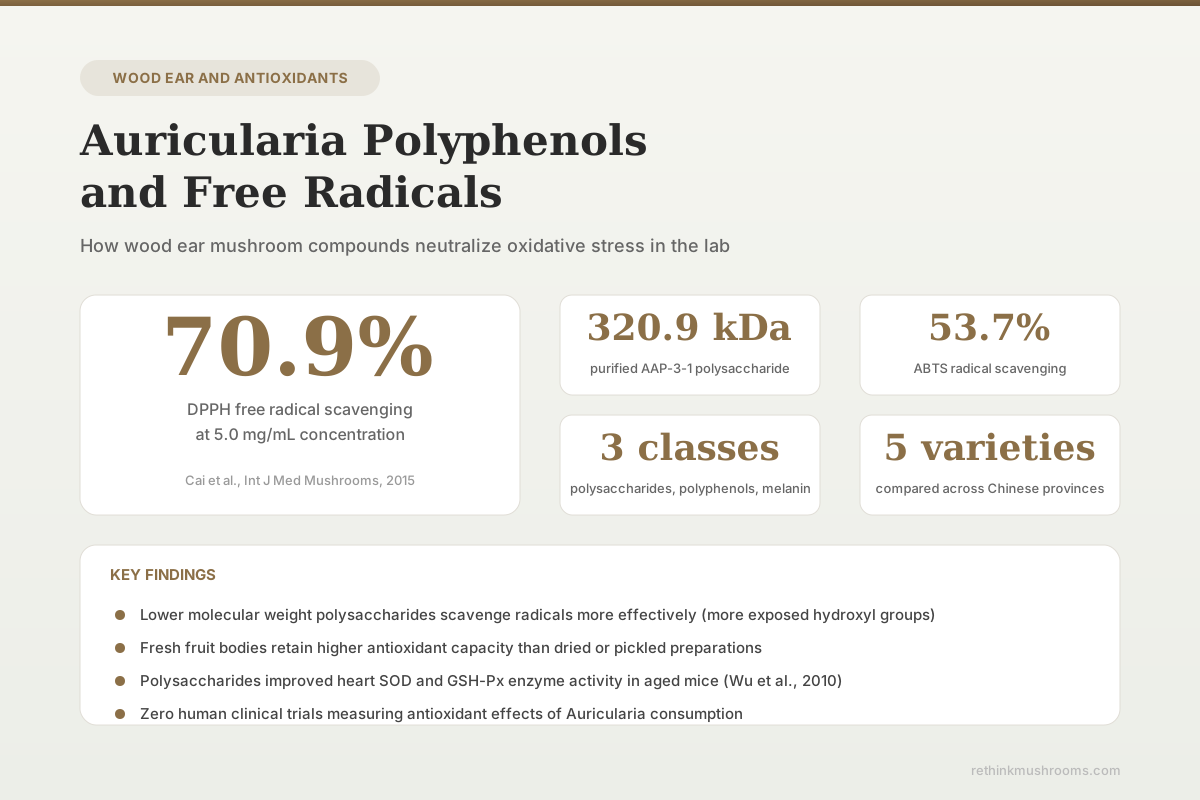
A purified Auricularia auricula polysaccharide fraction, AAP-3-1, scavenged 93.03% of hydroxyl radicals, 88.13% of superoxide anions, and 68.31% of DPPH radicals at 1.6 mg/mL — and reduced oxidative stress markers in liver cells.
Qian et al., Int J Biol Macromol, 2020
320.9 kDa
molecular weight of the purified AAP-3-1 fraction
2.87 mg/mL
DPPH EC50 of freeze-dried fruit body extract
0 human trials
all evidence is in vitro, nematode, or rodent
Qian et al., Int J Biol Macromol, 2020
 View as image ↗
Auricularia auricula, the wood ear mushroom, ranks among the world's most cultivated mushroom species and contains a complex mixture of polysaccharides, polyphenols, flavonoids, and melanin pigments that collectively scavenge free radicals through multiple chemical mechanisms. The strongest single result in the literature comes from a purified polysaccharide fraction: at 1.6 mg/mL, AAP-3-1 scavenged 93.03% of hydroxyl radicals, 88.13% of superoxide anions, and 68.31% of DPPH radicals.[2] But "antioxidant" covers distinct biochemical activities, and understanding which Auricularia compounds do what, at what concentrations, and through which mechanisms separates useful research from marketing claims.
This article maps the specific free radical scavenging evidence for Auricularia's polyphenols, polysaccharides, and melanin. For the role of wood ear melanin as an antioxidant, see the dedicated review. For how wood ear compares to other antioxidant mushrooms, see the comparison article.
Key Takeaways
- A purified polysaccharide fraction (AAP-3-1, 320.9 kDa, mannose and glucose at 1.4:1) scavenged 93.03% of hydroxyl radicals, 88.13% of superoxide anions, and 68.31% of DPPH radicals at 1.6 mg/mL, and reduced reactive oxygen species and malondialdehyde in liver cells (Qian et al., 2020)
- Crude hot-water-extracted polysaccharides showed significant radical scavenging, reducing power, and Fe2+ chelating ability, alongside antimicrobial activity against E. coli and S. aureus — the study reported these activities qualitatively, without scavenging percentages (Cai et al., 2015)
- Molecular weight influences activity in both directions: within A. auricula, the lowest-molecular-weight fraction (3.34 kDa) had the strongest antioxidant capability, while across four Auriculariales species, higher molecular weight correlated positively with scavenging (Heng et al., 2023; Su et al., 2020)
- Freeze-dried fruit body extract — not fresh — had the most potent DPPH activity, with an EC50 of 2.87 mg/mL, and FRAP values correlated positively with total phenolic content (R2 = 0.7668) (Kho et al., 2009)
- In C. elegans, Auricularia polysaccharides raised superoxide dismutase by 70.04% and catalase by 117.32% and lowered reactive oxygen species; the polysaccharide-richest variety came from Shanxi province at 53.02% (Xu et al., 2016)
- The only mammalian evidence: 40 days of polysaccharide administration improved blood and heart antioxidant enzyme activity and left ventricular function in aged mice (Wu et al., 2010)
- Zero human clinical trials have tested whether eating or supplementing wood ear changes any antioxidant marker in people
What "antioxidant" means in this context
Free radical scavenging is measured through standardized in vitro assays, each testing a different mechanism. DPPH (1,1-diphenyl-2-picrylhydrazyl) measures hydrogen atom transfer to a stable synthetic radical. ABTS (2,2'-azino-bis(3-ethylbenzothiazoline-6-sulfonic acid)) measures electron transfer capacity. FRAP (ferric reducing antioxidant power) measures metal ion reduction. Hydroxyl radical scavenging measures protection against the most reactive oxygen species in biological systems. Fe2+ chelating ability measures sequestration of catalytic metal ions that generate radicals via Fenton chemistry.
A compound that scores well on DPPH but poorly on metal chelation has a different antioxidant profile than one that chelates metals effectively but scavenges radicals weakly. Auricularia extracts have been tested across all these assays, and the results vary by fraction, extraction method, and molecular weight. The consistency of activity across multiple assay types strengthens the evidence; the variability between preparations complicates any simple characterization.
Assay Map
Six Tests, Six Different Questions
“Antioxidant activity” is not one measurement. Each assay uses a different artificial radical and a different chemical reaction, so a compound can excel on one and be unremarkable on another. Here is what each test asks, and where Auricularia’s cited results land.
Asks: Hydrogen atom transfer to a stable synthetic radical
Auricularia: 68.31% at 1.6 mg/mL (AAP-3-1)
EC50 2.87 mg/mL, freeze-dried fruit body extract · Qian 2020 [2]; Kho 2009 [6]
Asks: Protection against the most reactive oxygen species in biology
Auricularia: 93.03% at 1.6 mg/mL (AAP-3-1)
Highest single scavenging figure in the cited corpus · Qian 2020 [2]
Asks: Neutralization of the radical produced by normal respiration
Auricularia: 88.13% at 1.6 mg/mL (AAP-3-1)
Also positively correlated with MW across four species · Qian 2020 [2]; Su 2020 [5]
Asks: Electron transfer capacity
Auricularia: Concentration-dependent (melanin, polysaccharides)
Reported as a trend, not a single peak percentage · Shi 2023 [10]; Heng 2023 [4]
Asks: Metal ion reduction capacity
Auricularia: 5.22 µmol FeSO₄·7H₂O eq/g mycelium
Correlates with total phenolic content, R² = 0.7668 · Kho 2009 [6]
Asks: Locking up catalytic metal that drives Fenton chemistry
Auricularia: Significant ability, reported qualitatively
A prevention mechanism, not a scavenging one · Cai 2015 [1]; Heng 2023 [4]
Note the concentrations. The headline percentages come from 1.6 mg/mL of a purified fraction applied directly to a synthetic radical in solution — a chemistry result, with no established relationship to what reaches human tissue after eating wood ear.
Sources: Cai et al. (2015) [ref 1]; Qian et al. (2020) [ref 2]; Heng et al. (2023) [ref 4]; Su et al. (2020) [ref 5]; Kho et al. (2009) [ref 6]; Shi et al. (2023) [ref 10].
Polysaccharide fractions: the primary radical scavengers
Most Auricularia antioxidant research focuses on polysaccharides, which are the dominant bioactive fraction by mass.
Qian et al. (2020) isolated and purified a specific polysaccharide fraction, AAP-3-1, from A. auricula fruiting bodies using hot water extraction, ethanol precipitation, DEAE FF ion exchange chromatography, and Superdex 200 gel filtration. This heteropolysaccharide is composed mainly of mannose and glucose in a 1.4:1 molar ratio, with a molecular weight of 320.9 kDa. At 1.6 mg/mL, AAP-3-1 scavenged 88.13% of superoxide anions, 93.03% of hydroxyl radicals, and 68.31% of DPPH radicals, with activity increasing in a concentration-dependent manner.[2]
The same study went a step past the test tube. In HepG2 liver cells subjected to chemically induced oxidative stress, AAP-3-1 inhibited reactive oxygen species generation, decreased malondialdehyde content, and increased the activities of superoxide dismutase, glutathione peroxidase, and catalase. That combination matters mechanistically: it indicates AAP-3-1 works both by directly neutralizing radicals (non-enzymatic) and by raising the cell's own antioxidant enzyme defenses (enzymatic).[2]
Qian et al. (2020) · International Journal of Biological Macromolecules
- Population
- Cell-free radical assays plus HepG2 human liver cell line
- Intervention
- AAP-3-1, a purified 320.9 kDa mannose-glucose heteropolysaccharide, up to 1.6 mg/mL
- Finding
- 93.03% hydroxyl, 88.13% superoxide, and 68.31% DPPH radical scavenging at 1.6 mg/mL; in liver cells, reduced ROS and malondialdehyde while raising SOD, GSH-Px, and catalase activity.
positive Strong and well-characterized, but entirely in vitro — no animal or human dosing.
Qian et al., Int J Biol Macromol, 2020 [ref 2]
Cai et al. (2015) extracted crude polysaccharides from A. auricula-judae using hot water extraction and alcohol precipitation, optimizing to a 70 mL/g liquid-to-solid ratio at 90°C for 4 hours across 4 extractions, which yielded 6.89% crude polysaccharide at 76.12% purity. These crude polysaccharides showed significant antioxidant activity in radical scavenging, reducing power, and Fe2+ chelating assays. The study reported these activities qualitatively rather than as scavenging percentages. It also found antimicrobial activity against Escherichia coli and Staphylococcus aureus — inhibition zones of 5.55 ± 0.182 mm and 9.84 ± 0.076 mm respectively — with no activity against the other organisms tested.[1]
Zeng et al. (2012) used microwave-assisted extraction and found the extraction method itself shapes polysaccharide structure and activity. The resulting polysaccharide was a heteropolysaccharide of glucose, galactose, mannose, arabinose, and rhamnose at a molar ratio of 37.53:1:4.32:0.93:0.91, with a glucose backbone in (1→3) linkage and a molecular weight of 2.77 × 10⁴ Da (about 27.7 kDa). It was active against ABTS, DPPH, superoxide, and hydroxyl radicals and in lipid peroxidation and reducing power assays. The authors' conclusion is the one that matters for the next section: microwave extraction produced a low molecular weight polysaccharide with remarkable antioxidant capability.[3]
Molecular weight: a contradiction worth resolving
Heng et al. (2023) compared four Auricularia auricula polysaccharide fractions with viscosity-average molecular weights of 31.52, 11.82, 5.86, and 3.34 kDa. The lowest molecular weight fraction, AAP3 at 3.34 kDa, showed the strongest antioxidant capability across hydroxyl, ABTS, and DPPH scavenging and divalent iron chelation.[4]
Worth noting for context: this was not primarily an antioxidant paper. Its main subject was how these polysaccharides regulate calcium oxalate crystal growth and the resulting cytotoxicity toward HK-2 kidney cells — the antioxidant panel was one component of a kidney-stone investigation.[4]
The standard structural explanation for a low-molecular-weight advantage is that shorter chains have less interchain entanglement and a looser three-dimensional structure, exposing more free hydroxyl groups; since hydroxyl groups donate the hydrogen atoms that neutralize radicals, more exposed groups should mean more scavenging per unit mass. This is the accepted interpretation in polysaccharide chemistry rather than something Heng et al. demonstrated directly, and it should be read as a proposed mechanism.
Su et al. (2020) points the other way. Comparing polysaccharides from four Auriculariales species — A. cornea (ACP), A. auricula (AAP), A. polytricha (APP), and M. fungus (MFP) — they found molecular weight was significantly positively correlated with DPPH, superoxide anion, and hydroxyl radical scavenging. APP, from A. polytricha, had significantly higher total antioxidant capacity and significantly better DPPH and hydroxyl scavenging than the others. All four were mainly mannose and galactose and contained uronic acid and pyran ring structures. Total antioxidant capacity was significantly negatively correlated with fucose and galactose content, leading the authors to conclude those two sugars jointly determine total antioxidant capacity.[5]
So within one species, lower molecular weight wins; across species, higher molecular weight wins. Both can be true, because they are not the same comparison. Fractionating one polymer into smaller pieces changes chain length while holding sugar composition roughly constant — exposure of hydroxyl groups dominates. Comparing four species varies molecular weight and monosaccharide composition and branching simultaneously, and Su et al.'s own finding that fucose and galactose content drives total antioxidant capacity suggests composition, not chain length, is doing the work in that comparison. Zeng et al.'s low-molecular-weight, high-activity microwave extract sits comfortably with the intra-species reading.
Direction Split
Molecular Weight Points Both Ways
Two studies reach opposite conclusions about whether higher molecular weight means better radical scavenging. They are not contradicting each other — they are running different experiments.
Within one species
Lower molecular weight wins
Bar length = relative antioxidant capability. Fractionating a single polymer changes chain length while holding sugar composition roughly constant, so hydroxyl-group exposure dominates.
Heng et al. 2023 [ref 4]
Across four species
Higher molecular weight correlates with activity
APP (A. polytricha) — Highest total antioxidant capacity; best DPPH and hydroxyl scavenging
ACP (A. cornea) — Mannose and galactose backbone, uronic acid, pyran ring
AAP (A. auricula) — Same structural family, different proportions
MFP (M. fungus) — Same structural family, different proportions
Comparing species varies molecular weight, sugar composition, and branching at once. The same study found total antioxidant capacity was negatively correlated with fucose and galactose — composition, not chain length, doing the work.
Su et al. 2020 [ref 5]
Tie-breaker
A third study lands with the intra-species reading: microwave-assisted extraction produced a 2.77 × 10⁴ Da (about 27.7 kDa) polysaccharide that the authors described as having low molecular weight and remarkable antioxidant capability, active against ABTS, DPPH, superoxide, and hydroxyl radicals.
Zeng et al. 2012 [ref 3]
Practical read: molecular weight is not a potency grade. A supplement label advertising “high molecular weight polysaccharides” is not making a claim the antioxidant literature supports in either direction.
Sources: Zeng et al. (2012) [ref 3]; Heng et al. (2023) [ref 4]; Su et al. (2020) [ref 5].
Fact Check
Does 'higher molecular weight' mean a better wood ear extract?
The claim
“Higher molecular weight Auricularia polysaccharides are more potent antioxidants.”
Generalized from cross-species comparisons and supplement marketing that treats molecular weight as a potency grade.
What research shows
Context DependentDirection depends entirely on the comparison. Fractionating a single A. auricula polysaccharide, the 3.34 kDa fraction beat the 31.52 kDa fraction. Comparing four different Auriculariales species, higher molecular weight correlated with better scavenging.
Across species, sugar composition changes alongside molecular weight — and Su et al. found fucose and galactose content, not chain length, jointly determined total antioxidant capacity. Molecular weight alone is not a potency grade.
Heng et al. 2023 [ref 4]; Su et al. 2020 [ref 5]; Zeng et al. 2012 [ref 3]
Polyphenols and processing: the non-polysaccharide fraction
Auricularia's antioxidant activity is not entirely explained by polysaccharides. Phenolic compounds contribute independently, and processing method turns out to matter more than most summaries acknowledge.
Kho et al. (2009) measured antioxidant capacity of methanolic extracts from fresh, oven-dried, and freeze-dried A. auricula-judae fruit bodies and from mycelium, using DPPH scavenging and FRAP. The most potent DPPH activity came from the freeze-dried fruit body extract, with a 50% effective concentration of 2.87 mg/mL. The mycelium FRAP value was 5.22 micromol FeSO4·7H2O equivalents per gram. A positive correlation (R2 = 0.7668) between FRAP values and total phenolic content confirmed phenolics as a primary contributor to ferric reducing capacity. The authors' conclusion was that processing method affects antioxidant potential — not that fresh material is superior.[6]
Khaskheli et al. (2015) characterized polysaccharides from fresh A. auricula fruit bodies (AAPF) and from pickled product (AAPP). The two differed in composition: AAPF contained glucose, rhamnose, arabinose, mannose, and galactose at 16.74:1.0:1.18:1.0:1.0, while AAPP contained arabinose, mannose, galactose, and xylose at 15.59:1.52:4.76:1.0. Both fractions showed good antioxidant activity in vitro. AAPF performed significantly well across radical scavenging assays except DPPH — so the fresh-versus-pickled comparison is assay-dependent rather than a clean win for fresh.[7]
Taken together, Kho and Khaskheli support a narrower claim than "processing destroys antioxidants": preparation method changes which compounds survive and which assays register activity, and the direction is not consistently in favor of fresh material.
Variety and strain affect antioxidant potency
Xu et al. (2016) extracted polysaccharides from five varieties of A. auricula (AAP1 through AAP5) via alkali extraction with Sevag deproteinization. Material from Shanxi province had the highest polysaccharide content at 53.02%. Antioxidant capacity was assessed in vitro by DPPH, superoxide, and hydroxyl radical scavenging, metal chelation, and reducing power, and in vivo using the Caenorhabditis elegans nematode model.[8]
The strongest antioxidant activity belonged to AAP1 — composed of arabinose, xylose, 2-deoxy-D-glucose, mannose, glucose, and N-acetyl-D-glucosamine at 1:0.44:0.33:1.67:1:0.17. In C. elegans under oxidative stress, it scavenged free radicals, up-regulated superoxide dismutase by 70.04 ± 8.75% and catalase by 117.32 ± 8.06%, and reduced reactive oxygen species levels.[8]
Two details are frequently conflated in secondary coverage. The highest polysaccharide content came from Shanxi province; the strongest antioxidant activity came from AAP1. The study does not state that these are the same sample, and content and activity are separate measurements.
Khan et al. (2023) extended the variety question to strain level, screening 50 strains of Auricularia cornea for fruiting time, biological efficiency, polysaccharide content, minerals, and antioxidant activity. Crude polysaccharide content ranged widely — hybrid strain Ac18 at 15.2% and cultivated strain Ac33 at 15.6% led the field, while total polysaccharide in the fruiting body peaked in Ac1 and Ac33 at 216 and 200 mg/g. For radical scavenging, strains Ac33 and Ac24 significantly outperformed the rest on DPPH and ABTS respectively.[11]
The practical implication is that "Auricularia antioxidant activity" is not a species-level property. Which species, which strain, grown where, extracted how, at what molecular weight, tested with which assay — each variable moves the result, and a 50-strain spread within a single species is wider than most cross-species comparisons.
The mammalian evidence: one study
Wu et al. (2010) investigated whether Auricularia auricula polysaccharides could improve heart function in aged mice. GC-MS showed the polysaccharide was composed of glucose (72%), mannose (8%), xylose (10%), and fucose (10%), with FT-IR confirming characteristic polysaccharide bands. Aged mice were given the polysaccharides for 40 days.[9]
At baseline the aged mice showed significant declines (P<0.01) in immune and antioxidant activities and in left ventricular ejection fraction (EF) and fractional shortening (FS). After polysaccharide administration, all of those abnormal parameters — immune measures, antioxidant enzyme activities in blood and heart tissue, EF, and FS — were significantly ameliorated (P<0.01). The authors concluded that the polysaccharides improved heart function through antioxidant activity.[9]
The study reported antioxidant enzyme activity as a group rather than naming individual enzymes in its summary, so claims that it specifically raised SOD and glutathione peroxidase go beyond what the abstract supports. It remains a single study, in one aged-mouse model, and the leap to human cardiovascular benefit is substantial. For related vascular research on Auricularia, see the articles on thrombosis prevention and atherosclerosis prevention.
Melanin: Auricularia's third antioxidant system
Shi et al. (2023) isolated melanin from A. auricula fruit bodies using ultrasound-assisted alkaline cellulase to break the notoriously tough cell wall, reaching a 3.201 ± 0.018% yield, then raised it to 25.99 ± 2.36% using a choline chloride and urea deep eutectic solvent at a 1:2 ratio. X-ray photoelectron spectroscopy identified it as a typical eumelanin. The melanin showed concentration-dependent ABTS+ and hydroxyl radical scavenging, and at 0.5 mg/mL it significantly prolonged Caenorhabditis elegans survival under hydrogen peroxide and methyl viologen stress while raising glutathione levels and total superoxide dismutase and catalase activities (P < 0.05).[10]
Yin et al. (2022) extracted melanin from wild A. auricula using ultra-high-pressure-assisted extraction at 450 MPa, achieving a 7.9 ± 0.16% yield. Elemental analysis (48.51% C, 6.88% H, 5.26% N, 0.45% S, 38.90% O) suggested a DOPA-type melanin, and the pigment was stable to heat, light, and low concentrations of reducing and oxidizing agents. Notably, the authors described its free radical scavenging as "certain" — a deliberately modest characterization that sits well below Shi et al.'s stronger result.[12]
That gap between two melanin papers is itself informative: extraction method, wild versus cultivated source, and melanin subtype all shift the measured activity, and the more conservative report should not be dropped in favor of the more impressive one.
Melanin is structurally distinct from polysaccharides and polyphenols, scavenging radicals through an extended conjugated aromatic structure that can absorb and neutralize unpaired electrons. The result is that a crude Auricularia extract's total activity is the sum of at least three chemically independent antioxidant systems. For a detailed examination of wood ear melanin research, see the dedicated article.
What the evidence does and does not reach
Evidence Reach
Thick at the Bottom, Empty at the Top
Every antioxidant claim about wood ear traces to one of these levels. Bar width represents how much evidence exists at each — not how strong the effect is.
No trial has measured circulating antioxidant markers, oxidative DNA damage, or any clinical endpoint after Auricularia intake.
40 days of polysaccharide administration restored blood and heart antioxidant enzyme activity, ejection fraction, and fractional shortening (Wu 2010 [ref 9]).
SOD +70.04%, catalase +117.32%, ROS reduced (Xu 2016 [ref 8]); survival prolonged under H₂O₂ and methyl viologen stress at 0.5 mg/mL melanin (Shi 2023 [ref 10]).
AAP-3-1 lowered ROS and malondialdehyde while raising SOD, GSH-Px, and catalase under induced oxidative stress (Qian 2020 [ref 2]).
DPPH, ABTS, FRAP, hydroxyl, superoxide, and Fe²⁺ chelation across crude extracts, purified fractions, 50 strains, and two melanin preparations.
The shape of this ladder is the honest summary of the field: an unusually well-characterized chemistry layer, two nematode studies and one mouse study above it, and nothing in humans. A strong in vitro percentage is not a weak human result — it is a different kind of claim entirely.
Sources: Qian et al. (2020) [ref 2]; Xu et al. (2016) [ref 8]; Wu et al. (2010) [ref 9]; Shi et al. (2023) [ref 10]; plus cell-free assay data from refs 1, 3–7, 11, 12.
All DPPH, ABTS, FRAP, and hydroxyl radical scavenging data is generated in test tubes under controlled chemical conditions. These assays confirm that Auricularia compounds can transfer hydrogen atoms or electrons to synthetic radicals. They do not confirm that eating wood ear mushrooms reduces oxidative stress in the human body.
The translation gap includes oral bioavailability of polysaccharides, which are generally poorly absorbed intact; first-pass metabolism; tissue distribution; achievable concentrations at target sites; and interaction with endogenous antioxidant systems. The in vivo work sits at two levels. Xu et al. (2016) and Shi et al. (2023) both used C. elegans, a nematode roughly 1 mm long with no circulatory system — a legitimate oxidative-stress model, but a long way from mammalian physiology. Wu et al. (2010) is the single mammalian study, in aged mice, at doses that may not correspond to any realistic human dietary intake.
- Cell and cell-free assayscompleted
Extensive: DPPH, ABTS, FRAP, hydroxyl, superoxide, Fe2+ chelation across many fractions, plus HepG2 liver cells (Qian 2020).
- Animal modelscurrent
C. elegans (Xu 2016; Shi 2023) and one aged-mouse cardiac study (Wu 2010). No dose-ranging, no replication.
- Human case reportsmissing
None identified for antioxidant endpoints.
- Small human trialsmissing
No trial has measured antioxidant markers after Auricularia intake.
- Large randomized trialsmissing
None.
- Meta-analysismissing
Nothing to pool.
The in vitro layer is unusually thick and well characterized. Above it, the evidence thins to two nematode studies and a single mouse study, then stops entirely. No human data exists at any level.
Qian 2020 [ref 2]; Xu 2016 [ref 8]; Wu 2010 [ref 9]; Shi 2023 [ref 10]
Zero human clinical trials have measured whether Auricularia consumption changes circulating antioxidant markers, reduces oxidative DNA damage, or produces any clinically meaningful antioxidant effect.
Interpretation
ModerateIn vitro antioxidant results do not predict health effects
Concern
Scavenging percentages from DPPH or ABTS assays are routinely marketed as evidence that a mushroom 'fights free radicals' in the body. The assay concentrations used here (1.6 to 5 mg/mL in solution, applied directly to a synthetic radical) bear no defined relationship to what reaches human tissue after eating or supplementing wood ear.
What the research says
Treat these findings as chemistry, not physiology. The honest summary is that Auricularia contains multiple compound classes with demonstrable radical-scavenging chemistry, and that no one has tested whether this changes anything measurable in a person.
Particularly relevant for: Anyone evaluating wood ear or Auricularia extracts for antioxidant health claims
What to do
This article is research summary, not medical advice. Discuss supplements with a physician, particularly alongside anticoagulants — Auricularia's antiplatelet and anticoagulant activity is documented in a separate body of literature covered in our blood health articles.
Synthesis of refs 1-12; absence of human antioxidant trials verified across the cited corpus
The Bottom Line
Auricularia auricula contains at least three structurally distinct antioxidant compound classes: polysaccharides, polyphenols, and melanin. Polysaccharides are the best characterized, with a purified 320.9 kDa fraction scavenging 93.03% of hydroxyl radicals at 1.6 mg/mL and improving enzymatic defenses in liver cells. Molecular weight cuts both ways — lower is better within a species, higher correlates with activity across species, because composition changes alongside chain length. Processing matters, though not in the direction usually claimed: freeze-dried extract outperformed fresh on DPPH. Strain variation within a single species spans a wider range than most cross-species comparisons. Above the test tube, the evidence is two C. elegans studies and one aged-mouse study, and no human data exists at all.
Frequently Asked Questions
Sources & References
- 1RTHM-00364·Cai, Ming et al. (2015). “Extraction, Antimicrobial, and Antioxidant Activities of Crude Polysaccharides from the Wood Ear Medicinal Mushroom Auricularia auricula-judae (Higher Basidiomycetes)..” International journal of medicinal mushrooms.Study breakdown →PubMed →↩
- 2RTHM-00651·Qian, Lei et al. (2020). “Purification, characterization and in vitro antioxidant activity of a polysaccharide AAP-3-1 from Auricularia auricula..” International journal of biological macromolecules.Study breakdown →PubMed →↩
- 3RTHM-00275·Zeng, Wei-Cai et al. (2012). “Characterization of antioxidant polysaccharides from Auricularia auricular using microwave-assisted extraction..” Carbohydrate polymers.Study breakdown →PubMed →↩
- 4RTHM-00829·Heng, Bao-Li et al. (2023). “Antioxidant Activity of Auricularia auricula Polysaccharides with Different Molecular Weights and Cytotoxicity Difference of Polysaccharides Regulated CaOx to HK-2 Cells..” Bioinorganic chemistry and applications.Study breakdown →PubMed →↩
- 5RTHM-00657·Su, Yue et al. (2020). “Structural characterization and antioxidant activity of polysaccharide from four auriculariales..” Carbohydrate polymers.Study breakdown →PubMed →↩
- 6RTHM-00158·Kho, Y S et al. (2009). “Antioxidant capacity of fresh and processed fruit bodies and mycelium of Auricularia auricula-judae (Fr.) Quél..” Journal of medicinal food.Study breakdown →PubMed →↩
- 7RTHM-00379·Khaskheli, Shahzor Gul et al. (2015). “Characterization of Auricularia auricula polysaccharides and its antioxidant properties in fresh and pickled product..” International journal of biological macromolecules.Study breakdown →PubMed →↩
- 8RTHM-00457·Xu, Siqi et al. (2016). “Antioxidant activity in vitro and in vivo of the polysaccharides from different varieties of Auricularia auricula..” Food & function.Study breakdown →PubMed →↩
- 9RTHM-00201·Wu, Qin et al. (2010). “Chemical characterization of Auricularia auricula polysaccharides and its pharmacological effect on heart antioxidant enzyme activities and left ventricular function in aged mice..” International journal of biological macromolecules.Study breakdown →PubMed →↩
- 10RTHM-00851·Shi, Qianwen et al. (2023). “Isolation, Characterization, and Antioxidant Activity of Melanin from Auricularia auricula (Agaricomycetes)..” International journal of medicinal mushrooms.Study breakdown →PubMed →↩
- 11RTHM-00835·Khan, Asif Ali et al. (2023). “Characterization, antioxidant activity, and mineral profiling of Auricularia cornea mushroom strains..” Frontiers in nutrition.Study breakdown →PubMed →↩
- 12RTHM-00806·Yin, Chao-Min et al. (2022). “Physicochemical Properties and Antioxidant Activity of Natural Melanin Extracted from the Wild Wood Ear Mushroom, Auricularia auricula (Agaricomycetes)..” International journal of medicinal mushrooms.Study breakdown →PubMed →↩