Wood Ear and Cancer
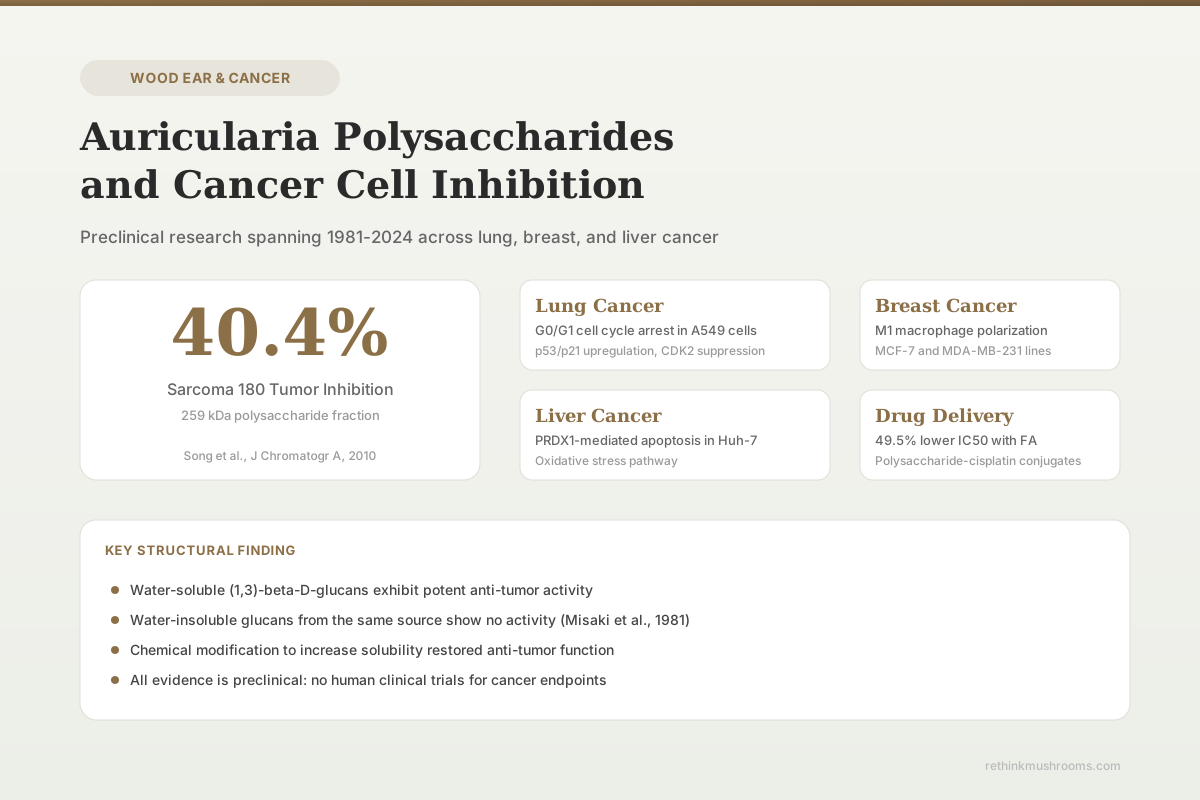
40.4% tumor inhibition
A purified polysaccharide fraction from Auricularia polytricha inhibited Sarcoma 180 tumor growth by 40.4% in mice, with activity linked to a specific 259 kDa molecular weight fraction.
Song et al., Journal of Chromatography A, 2010
1981-2024
research span
3 cancer types
lung, breast, liver
Beta-glucans
primary active structure
Song et al., Journal of Chromatography A, 2010
 View as image ↗
Auricularia mushrooms, commonly known as wood ear or black fungus, produce polysaccharides that have been tested against cancer cells in laboratory and animal models since 1981. The research spans three species (A. auricula-judae, A. polytricha, and A. auricula), multiple cancer types, and two distinct mechanisms: direct cytotoxicity against tumor cells and indirect anti-tumor effects through immune cell activation. None of this work has reached human clinical trials for cancer indications. What exists is a preclinical evidence base showing consistent anti-tumor activity across different Auricularia species and experimental systems, with enough mechanistic detail to understand how the polysaccharides work at a cellular level. For broader context on wood ear and cancer research beyond polysaccharides, see our comprehensive review.
Key Takeaways
- Auricularia polytricha polysaccharides inhibited lung cancer A549 cell proliferation in a concentration-dependent manner and arrested cell cycle at G0/G1 phase by upregulating p53 and p21 (Yu et al., 2014)
- A water-soluble (1,3)-beta-D-glucan from A. auricula-judae exhibited potent inhibition of Sarcoma 180 solid tumors in mice, while the water-insoluble form of the same glucan showed no activity (Misaki et al., 1981)
- Crude polysaccharides from A. polytricha polarized macrophages to the M1 anti-tumor phenotype and inhibited breast cancer cell invasion in MCF-7 and MDA-MB-231 lines (Nilkhet et al., 2024)
- A. auricula extract induced apoptosis in hepatocellular carcinoma Huh-7 cells through downregulation of peroxiredoxin 1, an antioxidant enzyme that protects cancer cells from oxidative damage (Kang et al., 2020)
- A purified 259 kDa polysaccharide fraction from A. polytricha inhibited Sarcoma 180 tumor growth by 40.4% in mice (Song et al., 2010)
- Auricularia polysaccharide-cisplatin complexes conjugated with folic acid showed 49.5% lower IC50 than unconjugated complexes against cervical cancer cells (Qiu et al., 2018)
The structural requirement: solubility determines anti-tumor activity
The earliest evidence that Auricularia polysaccharides could inhibit tumors came from Misaki et al. in 1981, who isolated two (1,3)-beta-D-glucans from the fruiting body of A. auricula-judae and tested them against implanted Sarcoma 180 solid tumors in mice.[1] The results revealed a critical structure-activity relationship: the water-soluble, branched glucan (glucan I) exhibited potent tumor inhibition, while the alkali-insoluble, branched glucan, which was the major polysaccharide constituent of the fruiting body, showed essentially no inhibitory activity.
When the researchers chemically modified the inactive glucan through periodate oxidation, borohydride reduction, and mild acid hydrolysis to increase its water solubility, the resulting derivative gained potent anti-tumor activity.[1] This finding established that for Auricularia glucans, the (1,3)-beta backbone provides the pharmacophore, but solubility in aqueous environments is the prerequisite for biological activity. The same structural principle has since been confirmed across other mushroom species. A 2024 review by Tang et al. noted that the molecular weight, branching degree, and triple-helix conformation of Auricularia polysaccharides all influence their bioactivity, with water-soluble fractions consistently outperforming insoluble ones.[2]
Song et al. (2010) separated crude Auricularia polytricha polysaccharides into three distinct fractions by molecular weight: 162 kDa (AAPS-1), 259 kDa (AAPS-2), and 483 kDa (AAPS-3).[3] Against Sarcoma 180 in mice, the 259 kDa fraction (AAPS-2) produced a 40.4% tumor inhibition rate. This molecular weight selectivity reinforces that not all polysaccharides from Auricularia are equally active; purification and characterization matter for identifying which fractions carry anti-tumor potential. For understanding how these polysaccharides relate to the broader role of Auricularia in tumor growth models, see our Sarcoma model review.
Lung cancer: cell cycle arrest and apoptosis in A549 cells
Yu et al. (2014) provided the most mechanistically detailed study of Auricularia polysaccharides against a specific human cancer cell line.[4] Auricularia polytricha polysaccharides (APPs) were tested against A549 human lung adenocarcinoma cells. APPs inhibited both proliferation and DNA synthesis in a concentration-dependent manner.
The mechanism involved cell cycle arrest at the G0/G1 phase. Western blotting showed APPs significantly increased expression of the CDK inhibitors p53 and p21, while decreasing expression of cyclin A, cyclin D, and CDK2. These are well-characterized regulators of cell cycle progression; by upregulating the brakes (p53, p21) and downregulating the accelerators (cyclins, CDKs), APPs effectively halted the proliferative machinery of lung cancer cells.[4]
Separately, Liu et al. (2021) identified a lectin protein from A. auricula that also inhibited lung cancer A549 cell proliferation with an IC50 of 28.19 micrograms/mL.[5] The lectin appeared to work through JUN, TLR4, and MYD88 signaling pathways and also altered pulmonary microbiota composition in the mouse model. This is a non-polysaccharide bioactive, but it demonstrates that Auricularia contains multiple compound classes with anti-cancer activity targeting the same organ system.
Both studies used in vitro cell culture systems and mouse models. The concentrations that produced effects in cell culture may not translate to achievable tissue concentrations in humans. No human data exists for Auricularia-based interventions in lung cancer. For dietary context on black fungus and cancer prevention, see our evidence review.
Breast cancer: immune-mediated tumor suppression
The most recent study in this field shifted the mechanistic focus from direct cytotoxicity to immune cell-mediated anti-tumor effects. Nilkhet et al. (2024) tested crude polysaccharides from A. polytricha on differentiated THP-1 macrophages and then evaluated the effect of those activated macrophages on breast cancer cells.[6]
Water extract and crude polysaccharides upregulated M1-related genes and stimulated production of pro-inflammatory cytokines (IL-6, IL-1beta, and TNF-alpha). When these M1-polarized macrophages were co-cultured with MCF-7 and MDA-MB-231 breast cancer cells, they inhibited cancer cell invasion and induced apoptosis.[6]
This matters because M2-type tumor-associated macrophages (TAMs) are known to promote tumor progression. Reversing macrophage polarization from the tumor-promoting M2 phenotype to the tumor-suppressing M1 phenotype represents a recognized strategy in cancer immunology. The finding that Auricularia polysaccharides can drive this polarization shift adds a mechanistic layer beyond simple direct cytotoxicity. Bao et al. (2020) had previously shown that purified A. auricula polysaccharides activated RAW264.7 macrophages, increasing phagocytosis and nitric oxide production, confirming the immunostimulatory capacity of these compounds.[7]
The limitation: this work used human cell lines in co-culture, not intact tumors in living organisms. Macrophage behavior in a simplified in vitro system differs from the complex tumor microenvironment where immunosuppressive signals from the tumor itself can override M1 polarization.
Hepatocellular carcinoma: oxidative stress and PRDX1
Kang et al. (2020) tested A. auricula extracts against five different cancer cell lines and found the most dramatic antiproliferative effect on Huh-7 hepatocellular carcinoma cells.[8] The mechanism involved downregulation of peroxiredoxin 1 (PRDX1), an antioxidant enzyme that cancer cells rely on to survive oxidative stress.
By reducing PRDX1 expression, A. auricula extracts increased intracellular reactive oxygen species (ROS) levels in cancer cells, triggering apoptosis. This is a selective vulnerability: cancer cells with elevated metabolic rates depend more heavily on antioxidant defense systems like PRDX1 than normal cells do.[8]
The study tested whole extracts rather than isolated polysaccharides, so attributing the effect specifically to the polysaccharide fraction requires caution. Auricularia extracts contain multiple bioactive classes including polysaccharides, melanin, lectins, and phenolic compounds. For additional research on Auricularia's effects on liver cancer specifically, we cover the broader evidence base in a separate article. The role of Auricularia in thrombosis prevention and gut microbiome modulation provides context for its wider biological activity profile.
Drug delivery: polysaccharide-cisplatin conjugates
Qiu et al. (2018) explored a different application: using Auricularia polysaccharides not as anti-cancer agents themselves, but as drug delivery vehicles.[9] They synthesized complexes of A. auricula-judae polysaccharides with cisplatin (a standard chemotherapy drug) and conjugated them with folic acid for tumor targeting.
The folic acid-conjugated polysaccharide-cisplatin complex (FA-AAP-CDDP) showed a 49.5% lower IC50 than the unconjugated complex in cell assays and a 2- to 11-fold higher cellular uptake rate. In vivo experiments in nude mice showed equivalent tumor-suppressing ability to free cisplatin but with targeted delivery characteristics.[9]
This line of research positions Auricularia polysaccharides as biocompatible carriers rather than standalone treatments. Polysaccharides offer advantages for drug delivery: they are naturally biodegradable, can be chemically modified, and Auricularia polysaccharides specifically have demonstrated hemocompatibility. The folic acid conjugation exploits the overexpression of folate receptors on many cancer cell surfaces, enabling selective targeting.
What the preclinical evidence does and does not show
The evidence for Auricularia polysaccharides against cancer cells is consistent in direction: across species (A. auricula-judae, A. polytricha, A. auricula), cancer types (lung, breast, liver, sarcoma, cervical), and experimental systems (cell culture, animal models), these polysaccharides show anti-tumor activity. The mechanisms are plausible and well-characterized at the molecular level.
What the evidence does not show:
No human data. Every study reviewed here used cell lines or animal models. The pharmacokinetics of orally consumed Auricularia polysaccharides in humans, including absorption, bioavailability, and tissue distribution, remain uncharacterized for cancer-relevant endpoints.
Dose translation is uncertain. Concentrations effective in cell culture (micrograms/mL applied directly to cancer cells) cannot be directly extrapolated to dietary or supplement doses. Polysaccharides undergo partial digestion in the gastrointestinal tract, and the fraction that reaches systemic circulation in bioactive form is unknown.
Extract variability. Studies used different Auricularia species, different extraction methods (hot water, alkali, ethanol), and different polysaccharide fractions. The 1981 Misaki study demonstrated that even within a single species, solubility differences between fractions determined whether activity was present or absent.[1] Commercial Auricularia products are rarely characterized to this level of specificity.
Animal model limitations. The Sarcoma 180 transplant model used in the earliest and several subsequent studies involves implanting tumor cells into mice and measuring growth inhibition. This model detects immunomodulatory anti-tumor effects but does not closely replicate human cancer development, progression, or treatment response.
No dose-response standardization. Each study used a different preparation, concentration range, and exposure time. Yu et al. (2014) demonstrated concentration-dependent effects in A549 cells, but the effective concentration range has not been replicated across laboratories or standardized into a reference dosing framework. Without reproducibility data, the reliability of any single study's concentration-effect relationship remains uncertain.
Species differences within Auricularia. A. polytricha, A. auricula-judae, and A. auricula are treated interchangeably in some reviews, but their polysaccharide profiles differ. The cancer types tested also vary by species, making cross-species comparisons difficult. Whether findings from A. polytricha polysaccharides in lung cancer cells apply to A. auricula-judae products remains untested.
The research trajectory from structural characterization (1981) through direct cytotoxicity studies (2010-2014) to immune-mediated mechanisms (2020-2024) reflects growing understanding of how these polysaccharides interact with both cancer cells and the immune system. The field has moved from asking "do they work?" to "how do they work?", which is a necessary step toward clinical translation that has not yet occurred.
The Bottom Line
Auricularia polysaccharides, particularly water-soluble (1,3)-beta-D-glucans, show consistent anti-tumor activity across in vitro and animal studies spanning four decades. The mechanisms include direct cancer cell cycle arrest (lung), immune cell polarization toward anti-tumor M1 macrophages (breast), pro-apoptotic oxidative stress via PRDX1 downregulation (liver), and Sarcoma 180 growth inhibition in mice. Polysaccharide-cisplatin conjugates demonstrate potential as targeted drug delivery vehicles. All evidence is preclinical; no human clinical trials for cancer endpoints have been conducted with Auricularia polysaccharides.
Frequently Asked Questions
Sources & References
- 1RTHM-00001·Misaki, A et al. (1981). “Studies on interrelation of structure and antitumor effects of polysaccharides: antitumor action of periodate-modified, branched (1 goes to 3)-beta-D-glucan of Auricularia auricula-judae, and other polysaccharides containing (1 goes to 3)-glycosidic linkages..” Carbohydrate research.Study breakdown →PubMed →↩
- 2RTHM-00913·Tang, Jun et al. (2024). “Structural properties, bioactivities, structure-activity relationships and bio-applications of polysaccharides from Auricularia auricula: A review..” International journal of biological macromolecules.Study breakdown →PubMed →↩
- 3RTHM-00198·Song, Guanglei et al. (2010). “Isolation of a polysaccharide with anticancer activity from Auricularia polytricha using high-speed countercurrent chromatography with an aqueous two-phase system..” Journal of chromatography. A.Study breakdown →PubMed →↩
- 4RTHM-00358·Yu, Jie et al. (2014). “Auricularia polytricha polysaccharides induce cell cycle arrest and apoptosis in human lung cancer A549 cells..” International journal of biological macromolecules.Study breakdown →PubMed →↩
- 5RTHM-00706·Liu, ZhenDong et al. (2021). “A New Lectin from Auricularia auricula Inhibited the Proliferation of Lung Cancer Cells and Improved Pulmonary Flora..” BioMed research international.Study breakdown →PubMed →↩
- 6RTHM-00897·Nilkhet, Sunita et al. (2024). “M1 macrophages polarized by crude polysaccharides isolated from Auricularia polytricha exhibit anti-tumor effect on human breast cancer cells..” Scientific reports.Study breakdown →PubMed →↩
- 7RTHM-00607·Bao, Zhijie et al. (2020). “Isolation, purification, characterization, and immunomodulatory effects of polysaccharide from Auricularia auricula on RAW264.7 macrophages..” Journal of food biochemistry.Study breakdown →PubMed →↩
- 8RTHM-00624·Kang, Mi Ae et al. (2020). “Auricularia auricula increases an apoptosis in human hepatocellular carcinoma cells via a regulation of the peroxiredoxin1..” Journal of food biochemistry.Study breakdown →PubMed →↩
- 9RTHM-00527·Qiu, Junqiang et al. (2018). “Auricularia auriculajudae polysaccharide-cisplatin complexes conjugated with folic acid as new tumor targeting agents..” International journal of biological macromolecules.Study breakdown →PubMed →↩