Wood Ear & Cancer Research
G0/G1 cell cycle arrest
Auricularia polytricha polysaccharides arrested human lung cancer A549 cells at the G0/G1 phase and activated caspase-mediated apoptosis in vitro and in nude mice.
Yu et al., Int J Biol Macromol, 2014
1981
first antitumor study on Auricularia
Sarcoma 180
tumor inhibited in early mouse models
0 Clinical
human cancer trials completed
Yu et al., Int J Biol Macromol, 2014
 View as image ↗
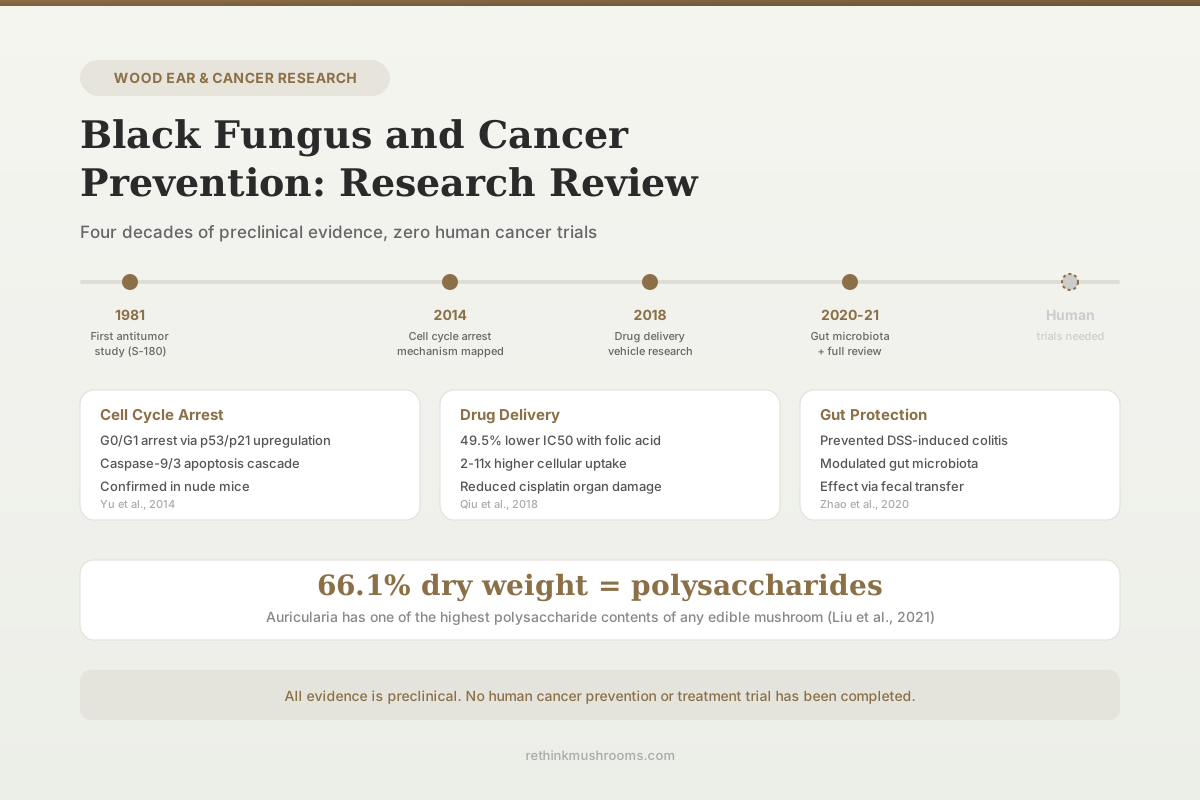
Black fungus (Auricularia auricula-judae), known as wood ear or tree ear mushroom, has been a staple in East Asian cuisine for centuries. It is one of the most consumed edible mushrooms in China, where it appears in soups, stir-fries, and salads. The question of whether this dietary exposure provides any cancer-preventive benefit has generated four decades of preclinical research, starting with Misaki et al. in 1981, who first demonstrated that a branched beta-glucan from Auricularia could inhibit Sarcoma 180 tumor growth in mice.[1]
Since then, Auricularia polysaccharides have shown antitumor activity across multiple cell lines and animal models. No human cancer prevention or treatment trial has been completed. The evidence is entirely preclinical, but it spans enough mechanistic territory to understand what these polysaccharides do at the cellular level and why that has not yet translated to clinical application. For a broader overview of antitumor research across Auricularia species, see wood ear and cancer: antitumor research review.
Key Takeaways
- A water-soluble branched beta-1,3-glucan from Auricularia auricula-judae inhibited Sarcoma 180 solid tumor growth in mice, while the alkali-insoluble form with excessive branching showed no activity (Misaki et al., 1981)
- Auricularia polytricha polysaccharides arrested A549 lung cancer cells at G0/G1 phase, upregulated p53 and p21, and activated caspase-9 and caspase-3 apoptosis both in vitro and in tumor-bearing nude mice (Yu et al., 2014)
- Auricularia polysaccharide-cisplatin complexes conjugated with folic acid showed 49.5% lower IC50 than unconjugated complexes and 2-11-fold higher cellular uptake in cervical cancer cells (Qiu et al., 2018)
- Auricularia polysaccharides prevented DSS-induced colitis in mice by modulating gut microbiota, with protective effects transmissible via fecal transfer (Zhao et al., 2020)
- A 2021 review identified polysaccharides comprising up to 66.1% of Auricularia dry weight, with antitumor, hypoglycemic, antioxidant, and immunomodulatory activities documented (Liu et al., 2021)
- Auricularia polysaccharides at 50-100 mg/kg reduced inflammation and insulin resistance in diabetic mice via AKT/AMPK pathway activation and gut microbiota modulation (Xu et al., 2021)
The 1981 Foundation: Structure Determines Activity
Misaki et al. (1981) established the structural basis for Auricularia's antitumor activity using beta-glucans isolated from the fruiting body. Two glucans were tested: a water-soluble, branched beta-1,3-glucan (glucan I) and an alkali-insoluble, heavily branched beta-1,3-glucan (glucan II).[1]
Glucan I showed potent inhibitory activity against implanted Sarcoma 180 solid tumor in mice. Glucan II showed essentially no activity. The difference came down to branching patterns: when glucan II was modified through controlled periodate oxidation to alter its branching structure, it gained potent antitumor activity. The attachment of polyhydroxy groups at O-6 positions on the beta-1,3-glucan backbone enhanced antitumor potency, while carboxymethyl group substitution did not.
This early work established a principle that applies across all mushroom beta-glucans: the beta-1,3-glucan backbone is necessary but not sufficient for antitumor activity. The specific branching pattern, solubility, and three-dimensional conformation determine whether a glucan activates immune cells or passes through the system inertly. For detailed analysis of how structure determines beta-glucan potency, see beta-glucan structure and immune potency.
Lung Cancer Cell Mechanisms
Yu et al. (2014) provided the most detailed mechanistic study of Auricularia polysaccharides against a specific cancer cell line. Using polysaccharides from Auricularia polytricha (a close relative of A. auricula-judae), they demonstrated concentration-dependent inhibition of A549 human lung cancer cell proliferation and DNA synthesis.[2]
The mechanism involved multiple converging pathways. The polysaccharides arrested cells at the G0/G1 phase of the cell cycle by upregulating the CDK inhibitors p53 and p21 while downregulating cyclin A, cyclin D, and CDK2. This stopped the cancer cells from progressing through the division cycle. Simultaneously, the polysaccharides triggered the mitochondrial apoptosis pathway: cytochrome c was released from mitochondria to cytosol, activating the caspase-9/caspase-3 cascade and cleaving PARP (poly ADP-ribose polymerase), the enzyme that normally repairs DNA damage.
The in vitro results were validated in BALB/c-nu nude mice bearing A549 tumors, confirming that the polysaccharides retained their growth-inhibitory effect in a living system, not just in isolated cells. For specific findings on how Auricularia polysaccharides interact with cancer cells, see Auricularia polysaccharides and cancer cell inhibition.
Drug Delivery: Polysaccharides as Carriers
Qiu et al. (2018) took a different approach: using Auricularia polysaccharides not as direct antitumor agents but as drug delivery vehicles for cisplatin, a standard chemotherapy agent. They synthesized Auricularia auriculajudae polysaccharide-cisplatin complexes (AAP-CDDP) and conjugated them with folic acid for tumor targeting.[3]
The folic acid-conjugated complex (FA-AAP-CDDP) showed 49.5% lower IC50 than the unconjugated complex and 2-11-fold higher uptake rates in cervical cancer cells. In nude mice, the targeted complex matched free cisplatin's ability to reduce subcutaneous tumor growth and lower serum tumor markers. Western blotting confirmed apoptosis induction through Bax, cytochrome c, and caspase-3 activation with Bcl-2 downregulation.
The advantage over free cisplatin was not greater tumor killing but reduced toxicity. Mice treated with FA-AAP-CDDP had higher organ weights (indicating less organ damage) and better antioxidant enzyme profiles (higher superoxide dismutase, catalase, glutathione peroxidase; lower malondialdehyde) compared to cisplatin alone. This suggests Auricularia polysaccharides may have value as biocompatible drug carriers that reduce chemotherapy side effects while maintaining efficacy.
Beyond Cancer: The Gut-Immune Connection
Several recent studies connect Auricularia's effects to gut microbiota modulation, which may be relevant to cancer prevention through indirect immune mechanisms.
Zhao et al. (2020) demonstrated that Auricularia polysaccharides prevented DSS-induced colitis in mice by reducing colon damage, mucosal inflammation, and intestinal barrier disruption. High-throughput sequencing revealed that the polysaccharides altered gut microbiota composition. The protective effect was transmissible via fecal transfer from treated to untreated mice, confirming that the microbiota changes themselves were sufficient to confer protection.[4]
This is relevant to cancer prevention because chronic intestinal inflammation is a recognized risk factor for colorectal cancer. Patients with inflammatory bowel disease have a 2-6 fold increased risk of colorectal cancer depending on disease duration and severity. If Auricularia polysaccharides reduce gut inflammation through microbiota modulation, they could theoretically reduce inflammation-associated cancer risk. This pathway is distinct from the direct cell cycle arrest and apoptosis mechanisms documented by Yu et al. (2014), suggesting Auricularia may affect cancer risk through at least two independent mechanisms: direct antitumor effects on malignant cells and indirect protection through inflammation reduction in pre-malignant tissue.
Xu et al. (2021) extended the gut microbiota findings to metabolic disease. Auricularia polysaccharides at 50-100 mg/kg reduced inflammation, liver injury, and insulin resistance in high-fat-diet/STZ-induced diabetic mice. The polysaccharides activated AKT and AMPK signaling pathways and increased gut microbiota diversity, elevating Lactobacillus and Bacteroides while decreasing Clostridium and Allobaculum abundance.[5] Metabolic syndrome and chronic inflammation are both linked to increased cancer risk, positioning Auricularia's metabolic effects as a potential indirect cancer prevention mechanism. For related research on how liver protection may connect to cancer prevention, see wood ear and liver cancer: preclinical findings.
The Complete Bioactive Profile
Liu et al. (2021) published a comprehensive review of Auricularia auricula-judae as a functional food, documenting the full range of bioactive compounds beyond polysaccharides. The fungus contains polysaccharides (up to 66.1% of dry weight), melanin, phenolic compounds, dietary fiber, and minerals. The review emphasized that current research has been "too unitary" in focusing on polysaccharides while other bioactives remain underexplored.[6]
Melanin from Auricularia has demonstrated antioxidant properties in several studies. Phenolic compounds contribute additional antioxidant capacity. The dietary fiber fraction, including chitin-glucan complexes, acts as a prebiotic for gut microbiota. Each of these compound classes could contribute to cancer prevention through different mechanisms: antioxidants reduce DNA damage from reactive oxygen species; prebiotics support immune-regulating gut bacteria; polysaccharides directly modulate immune cell activity.
For antitumor research in the Sarcoma 180 model specifically, see Auricularia polysaccharides and tumor growth inhibition in sarcoma models. For broader context on beta-glucan immune mechanisms across mushroom species, see beta-glucans and anti-tumor immunity: mechanisms explained.
Where the Dietary Evidence Stands
The phrase "dietary evidence for cancer prevention" implies epidemiological data showing that people who eat more black fungus have lower cancer rates. This evidence does not exist in any rigorous form. No prospective cohort study or case-control study has specifically examined Auricularia consumption and cancer incidence.
What exists is a chain of preclinical evidence: Auricularia polysaccharides inhibit cancer cell proliferation in vitro, reduce tumor growth in animal models, modulate immune function, reduce chronic inflammation, and improve gut microbiota composition. Each step in this chain has peer-reviewed support, but the chain has never been tested end-to-end in humans.
The gap between preclinical promise and clinical evidence is particularly wide here because Auricularia is consumed as food, not medicine. No pharmaceutical company has an incentive to fund clinical trials for a common edible mushroom. Academic research has focused on mechanistic studies in cell lines and animal models because these are fundable and publishable, but they cannot answer the fundamental question: does eating black fungus reduce cancer risk in humans?
Several broader epidemiological studies have examined mushroom consumption and cancer risk in general (not Auricularia specifically). A 2021 meta-analysis in Advances in Nutrition found that higher mushroom consumption was associated with lower cancer risk, particularly breast cancer, though the association was modest and most studies did not differentiate between mushroom species. Auricularia is consumed primarily in East Asian populations, and its contribution to overall mushroom intake in these cohorts is difficult to isolate from other commonly consumed species like shiitake, enoki, and oyster mushrooms.
The honest assessment: the preclinical pharmacology is compelling, the mechanistic pathways are well-characterized, and the safety profile is excellent (it is a widely consumed food). But "dietary cancer prevention" remains a hypothesis supported by laboratory evidence, not a conclusion validated by human data specific to Auricularia.
The Bottom Line
Auricularia auricula-judae polysaccharides have demonstrated antitumor activity in cell culture and animal models since 1981, working through cell cycle arrest, caspase-mediated apoptosis, immune modulation, and gut microbiota changes. No human cancer prevention trials exist. The evidence supports biological plausibility for cancer-preventive effects but cannot confirm them. The compound also shows promise as a biocompatible drug delivery vehicle for conventional chemotherapy.
Frequently Asked Questions
Sources & References
- 1RTHM-00001·Misaki, A et al. (1981). “Studies on interrelation of structure and antitumor effects of polysaccharides: antitumor action of periodate-modified, branched (1 goes to 3)-beta-D-glucan of Auricularia auricula-judae, and other polysaccharides containing (1 goes to 3)-glycosidic linkages..” Carbohydrate research.Study breakdown →PubMed →↩
- 2RTHM-00358·Yu, Jie et al. (2014). “Auricularia polytricha polysaccharides induce cell cycle arrest and apoptosis in human lung cancer A549 cells..” International journal of biological macromolecules.Study breakdown →PubMed →↩
- 3RTHM-00527·Qiu, Junqiang et al. (2018). “Auricularia auriculajudae polysaccharide-cisplatin complexes conjugated with folic acid as new tumor targeting agents..” International journal of biological macromolecules.Study breakdown →PubMed →↩
- 4RTHM-00667·Zhao, Di et al. (2020). “Polysaccharide isolated from Auricularia auricular-judae (Bull.) prevents dextran sulfate sodium-induced colitis in mice through modulating the composition of the gut microbiota..” Journal of food science.Study breakdown →PubMed →↩
- 5RTHM-00728·Xu, Nuo et al. (2021). “Auricularia auricula-judae (Bull.) polysaccharides improve type 2 diabetes in HFD/STZ-induced mice by regulating the AKT/AMPK signaling pathways and the gut microbiota..” Journal of food science.Study breakdown →PubMed →↩
- 6RTHM-00702·Liu, Enchao et al. (2021). “Review on Auricularia auricula-judae as a Functional Food: Growth, Chemical Composition, and Biological Activities..” Journal of agricultural and food chemistry.Study breakdown →PubMed →↩