Wood Ear and Cancer
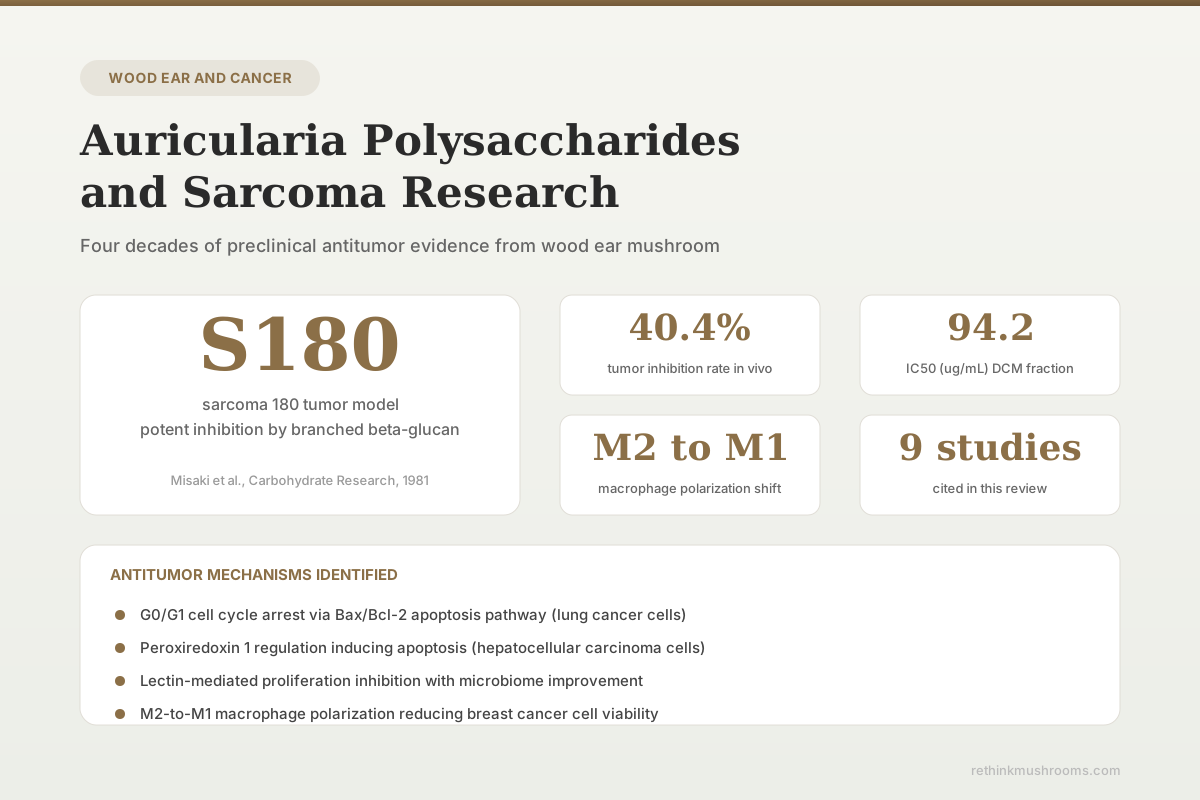
S180 tumor model
A branched (1-3)-beta-D-glucan from Auricularia auricula-judae exhibited potent inhibitory activity against implanted sarcoma 180 solid tumors in mice, one of the earliest demonstrations of mushroom antitumor polysaccharides.
Misaki et al., Carbohydr Res, 1981
40.4% inhibition
AAPS-2 fraction against S180 in vivo
IC50 94.2 ug/mL
DCM fraction against S180 cells
0 human trials
all mouse models and cell culture
Misaki et al., Carbohydr Res, 1981
 View as image ↗
The sarcoma 180 (S180) mouse model has been the standard first-pass screening tool for mushroom antitumor polysaccharides since the 1960s. When Misaki et al. implanted S180 solid tumors in mice in 1981, a branched (1-3)-beta-D-glucan isolated from Auricularia auricula-judae potently inhibited tumor growth, establishing wood ear mushroom as a species with antitumor polysaccharide activity.[1] Two years later, Ukai et al. confirmed antitumor activity from Auricularia species polysaccharides alongside compounds from Ganoderma, Cordyceps, and Dictyophora.[2]
Four decades of subsequent research has moved beyond the S180 model to identify specific mechanisms: cell cycle arrest, apoptosis induction through peroxiredoxin regulation, lectin-mediated proliferation inhibition, and macrophage polarization from tumor-promoting M2 to tumor-fighting M1 phenotype. This article tracks the sarcoma model evidence and the mechanistic studies that followed. For the broader view of wood ear and cancer research, see the overview article. For Auricularia's effects specifically on liver cancer, see the dedicated review.
Key Takeaways
- A branched (1-3)-beta-D-glucan from Auricularia auricula-judae potently inhibited sarcoma 180 tumor growth in mice; periodate modification that removed side chains reduced but did not eliminate activity (Misaki et al., 1981)
- The dichloromethane fraction of A. auricula-judae ethanol extract showed an IC50 of 94.2 ug/mL against sarcoma 180 cells in vitro, with dose-dependent activity from 0.01 to 0.3 mg/mL (Reza et al., 2011)
- A purified Auricularia polytricha polysaccharide (AAPS-2, 27 kDa) inhibited transplanted S180 sarcoma by 40.4% in mice (Song et al., 2010)
- Auricularia polytricha polysaccharides arrested A549 lung cancer cells at G0/G1 phase and induced apoptosis through upregulation of Bax and downregulation of Bcl-2 (Yu et al., 2014)
- A lectin purified from A. auricula inhibited lung cancer cell proliferation and improved pulmonary microbiome composition in tumor-bearing mice (Liu et al., 2021)
- Crude polysaccharides from A. polytricha polarized macrophages from M2 (tumor-promoting) to M1 (tumor-fighting) phenotype, reducing breast cancer cell viability (Nilkhet et al., 2024)
The foundational sarcoma 180 studies
Misaki et al. (1981) isolated two (1-3)-beta-D-glucans from A. auricula-judae fruiting bodies and tested their antitumor activity against implanted sarcoma 180 solid tumors in mice. The branched glucan (glucan I) showed potent tumor inhibition. To determine whether the branching structure mattered, they performed periodate modification to remove side chains. The modified glucan retained some activity but was less potent, demonstrating that the branched structure contributes to, but is not solely responsible for, antitumor effects.[1]
This structure-activity analysis was ahead of its time. Most contemporary mushroom antitumor studies simply reported tumor inhibition percentages. By systematically modifying the polysaccharide structure and retesting, Misaki's group established that the (1-3)-beta backbone is the minimum structural requirement for antitumor activity, while branching enhances it.
Ukai et al. (1983) expanded the comparison by testing polysaccharides from five mushroom genera including Auricularia, Ganoderma, Cordyceps, and Dictyophora against S180 tumors. Auricularia species polysaccharides demonstrated antitumor activity consistent with the (1-3)-beta-glucan structural motif shared across these taxonomically diverse species.[2]
Solvent fractionation: finding the most active components
Reza et al. (2011) moved beyond crude polysaccharides by fractionating A. auricula-judae 70% ethanol extract into five solvent fractions: ethanol, dichloromethane (DCM), ethyl acetate, butanol, and water. Each fraction was tested against P388D1 macrophage cells and sarcoma 180 cells at concentrations from 0.01 to 0.3 mg/mL.[3]
All fractions showed dose-dependent antitumor activity against both cell lines, but the DCM fraction was the most potent, with an IC50 of 94.2 ug/mL against S180 cells. The DCM fraction also showed the strongest activity against solid tumors in BALB/c mice in vivo. This matters because the DCM fraction captures medium-polarity compounds (terpenoids, steroids, some phenolics), not the water-soluble polysaccharides that dominate most Auricularia antitumor research.[3]
The implication is that Auricularia's antitumor activity is not exclusively polysaccharide-mediated. Non-polysaccharide compounds extracted by organic solvents contribute meaningfully. Most studies focus on the water-soluble polysaccharide fraction because it is the easiest to extract and characterize; the DCM fraction suggests additional active components remain underexplored.
Purified polysaccharide fractions in the sarcoma model
Song et al. (2010) used high-speed countercurrent chromatography (HSCCC) to separate Auricularia polytricha crude polysaccharides into three purified fractions: AAPS-1 (192 mg, 1010 kDa molecular weight), AAPS-2 (137 mg, 27 kDa), and AAPS-3 (98 mg, 5 kDa). When tested against transplanted S180 sarcoma in mice, AAPS-2 (the mid-range molecular weight fraction) inhibited tumor growth by 40.4%.[4]
The molecular weight of the active fraction (27 kDa) is notable. Very high molecular weight polysaccharides (1010 kDa, AAPS-1) and very low molecular weight fractions (5 kDa, AAPS-3) were less effective, suggesting an optimal molecular weight range for antitumor activity. This parallels findings in Auricularia antioxidant research, where polyphenol and polysaccharide radical scavenging also varies with molecular weight.
Beyond sarcoma: cell cycle arrest and apoptosis mechanisms
The S180 model demonstrates that tumors shrink but does not explain how. Subsequent studies used cancer cell lines to identify specific molecular mechanisms.
Yu et al. (2014) tested Auricularia polytricha polysaccharides (APPs) against A549 human lung cancer cells. APPs inhibited proliferation and DNA synthesis in a concentration-dependent manner. Flow cytometry revealed that APPs arrested cell cycle progression at the G0/G1 phase, preventing cancer cells from entering DNA replication (S phase). The mechanism involved upregulation of the pro-apoptotic protein Bax and downregulation of the anti-apoptotic protein Bcl-2, shifting the Bax/Bcl-2 ratio toward apoptosis.[5]
Kang et al. (2020) investigated A. auricula's effects on human hepatocellular carcinoma (HCC) cells. Using MTT assay and real-time cell electronic sensing, they confirmed antiproliferative effects. The mechanism involved regulation of peroxiredoxin 1 (Prdx1), an antioxidant enzyme that plays a dual role in cancer: it can protect cancer cells from oxidative damage, but its regulation can also trigger apoptosis. A. auricula extract increased apoptosis in HCC cells through Prdx1 modulation.[6]
Lectin-mediated antitumor activity: a non-polysaccharide pathway
Liu et al. (2021) isolated a novel lectin from A. auricula and tested its effects on lung cancer cells. Lectins are carbohydrate-binding proteins, structurally and functionally distinct from polysaccharides. The A. auricula lectin inhibited lung cancer cell proliferation in a dose-dependent manner.[7]
An unexpected finding emerged: in tumor-bearing mice, the lectin improved pulmonary flora composition. The connection between gut/pulmonary microbiome and cancer immunity is an active area of research, and this study suggests Auricularia compounds may influence tumor biology through microbiome modulation in addition to direct antiproliferative effects. For related research on Auricularia's gut microbiome effects, see the dedicated article.[7]
Macrophage polarization: immune-mediated antitumor effects
Nilkhet et al. (2024) provided the most mechanistically sophisticated study to date. Breast cancer progression correlates with infiltration of tumor-associated macrophages (TAMs) that adopt an M2 phenotype, suppressing immune responses and promoting tumor growth. In contrast, M1 macrophages display antitumor activity.[8]
Crude polysaccharides from A. polytricha polarized macrophages from the M2 to M1 phenotype. Conditioned media from these M1-polarized macrophages reduced breast cancer cell viability. This represents an indirect antitumor mechanism: the polysaccharides do not kill cancer cells directly but reprogram immune cells to do so. This immune-mediated mechanism may be more therapeutically relevant than direct cytotoxicity, because it activates the body's own tumor surveillance system rather than requiring drug concentrations at the tumor site.[8]
Drug delivery: polysaccharide-cisplatin conjugates
Qiu et al. (2018) explored a completely different application: using Auricularia polysaccharides as drug carriers. They created polysaccharide-cisplatin complexes conjugated with folic acid, producing targeted tumor delivery vehicles. Cancer cells overexpress folate receptors, so folic acid-conjugated complexes preferentially accumulate in tumor tissue.[9]
This approach uses Auricularia polysaccharides not for their intrinsic antitumor activity but as a biocompatible delivery platform for conventional chemotherapy drugs. It represents a fundamentally different research direction from the biological response modifier approach of the earlier studies.
Structure-activity relationships: what makes a polysaccharide antitumor
The cumulative evidence from S180 studies and cell culture work reveals a consistent set of structural features associated with antitumor activity in Auricularia polysaccharides.
The (1-3)-beta-D-glucan backbone is the minimum structural requirement. Misaki et al. (1981) demonstrated this by showing that even after periodate modification removed side chains, the glucan retained partial antitumor activity. The backbone alone triggers immune recognition through pattern recognition receptors on macrophages and dendritic cells, particularly Dectin-1, which specifically binds (1-3)-beta-glucan structures.[1]
Branching enhances activity. Side chains along the (1-3)-beta backbone increase water solubility, alter three-dimensional conformation, and expose additional binding sites for immune cell receptors. The degree and type of branching varies between extraction methods and Auricularia species, which partly explains why different research groups report different levels of antitumor activity from the same mushroom species.
Molecular weight matters but the optimal range depends on the mechanism. For direct radical scavenging (an indirect antitumor mechanism through reduced oxidative DNA damage), lower molecular weight fractions are more active. For immune-mediated antitumor effects through macrophage activation, mid-range molecular weights (around 27 kDa, as with Song's AAPS-2 fraction) appear optimal. Very high molecular weight polysaccharides may be too large for efficient cellular uptake and immune receptor engagement.
Monosaccharide composition adds another variable. Auricularia polysaccharides are heteropolysaccharides containing varying proportions of mannose, glucose, galactose, xylose, and rhamnose. Su et al. (2020) showed these proportions differ across Auriculariales species and correlate with different biological activities.[5] For how these same structural features influence Auricularia's antioxidant properties, see the polyphenol research article.
The distance from mice to medicine
Sarcoma 180 is a transplantable murine tumor line used since the 1950s for screening antitumor compounds. It grows rapidly, responds to many agents, and does not model the complexity of spontaneous human cancers. A compound that inhibits S180 in mice may or may not have any relevance to human cancer treatment.
The cell culture studies (A549 lung cancer, HCC cells, breast cancer cells) demonstrate mechanisms of action in isolated systems. Cell culture cannot model immune responses, pharmacokinetics, tumor heterogeneity, or drug resistance. The macrophage polarization study (Nilkhet et al., 2024) comes closest to clinical relevance by addressing the immune component of tumor biology, but it remains an in vitro demonstration.
No Auricularia compound has entered human clinical trials for cancer. No epidemiological studies have examined whether dietary Auricularia consumption correlates with reduced cancer incidence. The evidence supports biological plausibility for antitumor effects but does not support any claim about cancer prevention or treatment in humans. For how dietary evidence for black fungus and cancer prevention compares to the preclinical data, see the dedicated article.
The Bottom Line
Auricularia polysaccharides, particularly branched (1-3)-beta-D-glucans, inhibit sarcoma 180 tumor growth in mice, a finding replicated across multiple studies since 1981. Subsequent research identified specific mechanisms: G0/G1 cell cycle arrest, Bax/Bcl-2 apoptosis regulation, peroxiredoxin modulation, lectin-mediated proliferation inhibition, and M2-to-M1 macrophage polarization. Non-polysaccharide fractions (DCM-soluble compounds, lectins) also contribute antitumor activity. All evidence remains preclinical, with no human trials or epidemiological data.
Frequently Asked Questions
Sources & References
- 1RTHM-00001·Misaki, A et al. (1981). “Studies on interrelation of structure and antitumor effects of polysaccharides: antitumor action of periodate-modified, branched (1 goes to 3)-beta-D-glucan of Auricularia auricula-judae, and other polysaccharides containing (1 goes to 3)-glycosidic linkages..” Carbohydrate research.Study breakdown →PubMed →↩
- 2RTHM-00004·Ukai, S et al. (1983). “Polysaccharides in fungi. XIII. Antitumor activity of various polysaccharides isolated from Dictyophora indusiata, Ganoderma japonicum, Cordyceps cicadae, Auricularia auricula-judae, and Auricularia species..” Chemical & pharmaceutical bulletin.Study breakdown →PubMed →↩
- 3RTHM-00232·Reza, Ahsanur et al. (2011). “Comparative Antitumor Activity of Different Solvent Fractions from an Auricularia auricula-judae Ethanol Extract in P388D1 and Sarcoma 180 Cells..” Toxicological research.Study breakdown →PubMed →↩
- 4RTHM-00198·Song, Guanglei et al. (2010). “Isolation of a polysaccharide with anticancer activity from Auricularia polytricha using high-speed countercurrent chromatography with an aqueous two-phase system..” Journal of chromatography. A.Study breakdown →PubMed →↩
- 5RTHM-00358·Yu, Jie et al. (2014). “Auricularia polytricha polysaccharides induce cell cycle arrest and apoptosis in human lung cancer A549 cells..” International journal of biological macromolecules.Study breakdown →PubMed →↩
- 6RTHM-00624·Kang, Mi Ae et al. (2020). “Auricularia auricula increases an apoptosis in human hepatocellular carcinoma cells via a regulation of the peroxiredoxin1..” Journal of food biochemistry.Study breakdown →PubMed →↩
- 7RTHM-00706·Liu, ZhenDong et al. (2021). “A New Lectin from Auricularia auricula Inhibited the Proliferation of Lung Cancer Cells and Improved Pulmonary Flora..” BioMed research international.Study breakdown →PubMed →↩
- 8RTHM-00897·Nilkhet, Sunita et al. (2024). “M1 macrophages polarized by crude polysaccharides isolated from Auricularia polytricha exhibit anti-tumor effect on human breast cancer cells..” Scientific reports.Study breakdown →PubMed →↩
- 9RTHM-00527·Qiu, Junqiang et al. (2018). “Auricularia auriculajudae polysaccharide-cisplatin complexes conjugated with folic acid as new tumor targeting agents..” International journal of biological macromolecules.Study breakdown →PubMed →↩