Wood Ear Nutrition
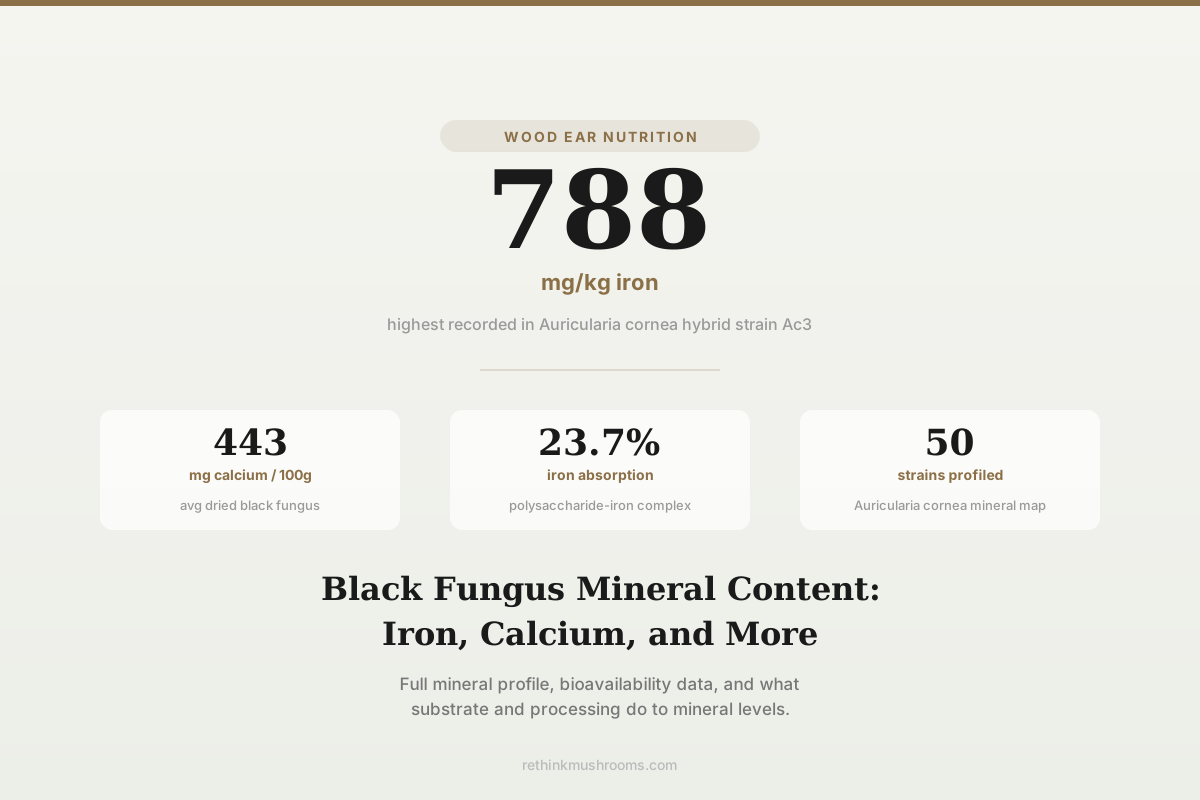
788 mg/kg
The highest iron content measured in any Auricularia cornea strain, detected in hybrid strain Ac3 by Khan et al. (2023) using mineral profiling across 50 strains.
Khan et al., Frontiers in Nutrition, 2023
443 mg/100g
average calcium in dried black fungus samples
28.40%
iron content achieved in polysaccharide-iron complex
50 Strains
Auricularia cornea strains profiled for minerals
Khan et al., Frontiers in Nutrition, 2023
 View as image ↗
Black fungus (Auricularia auricula-judae and related species) is one of the most mineral-dense edible mushrooms in commercial production. Its iron content alone can reach 788 mg/kg in certain cultivated strains, placing it among the richest plant-based iron sources in the fungal kingdom.[1] Calcium concentrations average 443 mg per 100 g of dried fruiting body, more than 3.6 times the level found in white-back black fungus and 10 times that of snow fungus. For a broader overview of what makes wood ear unique among edible fungi, see What Is Wood Ear Mushroom? The Ancient Blood Health Mushroom.
But raw mineral numbers only tell part of the story. How much of that iron is bioavailable after digestion? How do growing conditions change the mineral profile? And does processing (drying, cooking, pickling) preserve or destroy these mineral stores? The research on these questions is more advanced than most popular sources acknowledge, with data from controlled strain comparisons, substrate manipulation studies, and novel iron-delivery formulations.
Key Takeaways
- Hybrid Auricularia cornea strain Ac3 contained 788 mg/kg iron, the highest of 50 strains profiled; wild domesticated strain Ac28 contained 350 mg/kg (Khan et al., 2023)
- Dried black fungus averages 443 mg calcium per 100 g, over 3.6 times higher than white-back black fungus (Hong Kong Consumer Council, 2023)
- A polysaccharide-iron(III) complex from Auricularia auricula achieved 28.40% iron content and reversed iron deficiency anemia in rat models (Liu et al., 2019)
- Cultivating Auricularia on walnut sawdust increased macro mineral elements by 18.32-89.00% compared to standard sawdust substrates (Hao et al., 2022)
- A calcium-binding peptide derived from Auricularia protein hydrolysates improved bone mineral density and bone mineral content in a mouse tail suspension model (Qu et al., 2019)
- Mineral concentration in Auricularia follows the order Ca > K > Na > Mg > Fe > Zn, with iron and zinc as the predominant microelements (Kadnikova et al., 2015)
Iron Content: Strain Variation and What Drives It
Iron is the mineral most commonly associated with black fungus in traditional Chinese and Southeast Asian dietary guidance. The data supports this reputation, but with a caveat: iron levels vary enormously depending on the strain, substrate, and growing conditions.
Khan et al. (2023) conducted the most comprehensive mineral profiling study on Auricularia cornea to date, analyzing 50 strains across cultivated, wild domesticated, and hybrid categories. Iron content ranged from baseline levels in some cultivated strains up to 788 mg/kg in hybrid strain Ac3 and 350 mg/kg in wild domesticated strain Ac28.[1] That two-fold-plus variation within a single species grown under controlled conditions makes clear that "black fungus iron content" is not a fixed number. The strain matters.
Zinc content showed similar variability. Cultivated strain Ac46 contained 486.33 mg/kg zinc, the highest across all 50 strains. Principal component analysis revealed that cultivated, wild domesticated, and hybrid strains formed distinct clusters based on their mineral and nutritional profiles, suggesting genetic background plays a central role.[1]
Liu et al. (2021) reviewed the broader literature on Auricularia auricula-judae chemical composition and confirmed that metal concentration in the species follows the hierarchy Ca > K > Na > Mg > Fe > Zn > Co/Ni/Cu/Mn. Iron levels reported across studies range from approximately 16 mg to 285 micrograms per gram of dry matter, depending on the analytical method and sample source.[2] The wide range reflects real biological variability, not just measurement error. For context on how these iron levels compare to other foods, see Wood Ear and Iron: One of the Best Plant Sources.
Calcium: The Overlooked Mineral in Black Fungus
While iron gets most of the attention, calcium may be the more distinguishing mineral in Auricularia species. Testing by the Hong Kong Consumer Council (2023) across multiple dried edible fungi types found that black fungus samples averaged 443 mg of calcium per 100 g of dried product. This was 3.6 times higher than white-back black fungus and approximately 10 times higher than snow fungus.
To put this in dietary context: consuming 10 g of dried black fungus (roughly one bowl when rehydrated and cooked) provides approximately 44 mg of calcium, equivalent to about one-sixth to one-eighth of a cup of low-fat milk. That is a modest contribution to the recommended daily intake (1,000 mg for most adults), but meaningful for populations that avoid dairy or have limited calcium sources.
Qu et al. (2019) extended the calcium research beyond passive mineral content by isolating a calcium-binding peptide from Auricularia auricula protein hydrolysates. This peptide-calcium complex (AP-Ca) was designed to improve calcium absorption over conventional calcium carbonate supplements, which have poor bioavailability. In vitro, AP-Ca significantly increased calcium content and alkaline phosphatase activity in osteoblasts. In a mouse tail-suspension model simulating disuse osteoporosis, AP-Ca improved bone mineral density, bone mineral content, and bone organic content. It also downregulated pro-inflammatory bone resorption genes: IL-1 by 59.53%, TNF-alpha by 48.01%, and IL-6 by 40.00%.[3]
This means Auricularia is not just a passive calcium source. Its protein derivatives can actively enhance calcium uptake and utilization. That said, the peptide-calcium complex is an extracted and processed product, not a property of eating whole black fungus. The gap between the raw mushroom and the isolated compound is large and should not be collapsed. For more on how Auricularia compounds affect bone health, see Wood Ear for Iron Deficiency Anemia: Research and Evidence.
Beyond Iron and Calcium: The Full Mineral Profile
Black fungus contains a broader mineral spectrum than iron and calcium alone. Kadnikova et al. (2015) analyzed A. auricula-judae and reported that the species accumulates more potassium and calcium than magnesium and sodium, with iron and zinc as predominant microelements.
The full profile includes:
Potassium is the most abundant mineral in Auricularia extracts, comprising approximately 70% of total mineral content in some preparations. Potassium is essential for nerve signaling, muscle contraction, and fluid balance.
Phosphorus content has been measured at 314 mg per 100 g in some samples, supporting bone formation and energy metabolism.
Magnesium levels are lower than calcium but still present at nutritionally relevant concentrations, typically measured in the range of 50-100 mg per 100 g dry weight.
Trace elements including copper, manganese, cobalt, and nickel have been detected, though at much lower concentrations than the major minerals. Cadmium, lead, and arsenic levels in A. auricula-judae have been measured at 0.01, 0.1, and 0.2 mg/kg of fresh matter respectively, well below safety limits for edible mushrooms.[2]
Wu et al. (2010) characterized Auricularia auricula polysaccharides and found that the polysaccharide fraction itself contains bound minerals. The interaction between polysaccharides and mineral ions affects both the structural properties of the polysaccharide and the bioavailability of the mineral. This polysaccharide-mineral binding is the foundation for the iron-delivery research discussed below.[4]
How Growing Conditions Change the Mineral Profile
One of the most practically important findings in Auricularia mineral research is that substrate composition directly alters mineral content in the harvested fruiting body. Mushrooms absorb and concentrate minerals from their growing medium, so changing the substrate changes the product.
Hao et al. (2022) tested Auricularia auricula cultivated on different ratios of standard miscellaneous sawdust and walnut branch waste sawdust. Walnut sawdust contained 18.32-89.00% higher macro mineral elements and phenolic substances compared to standard sawdust. The mushrooms grown on walnut substrate absorbed these higher mineral levels: nutrient and mineral element content of A. auricula cultivated in walnut sawdust was significantly higher than that of mushrooms grown on standard substrates.[5]
The optimal ratio was 1:3 (miscellaneous to walnut sawdust), which produced the highest single-bag yield, biological efficiency, and overall nutritional quality. At this ratio, the mushrooms also had the shortest growth cycle (116 days vs. 126 days on pure standard sawdust).[5]
This finding has two implications. First, mineral content listed on a nutrition label for black fungus may not reflect what a consumer actually receives, because substrate differences between producers can shift mineral levels meaningfully. Second, substrate engineering is a viable strategy for producing mineral-enriched Auricularia as a functional food, a concept already being explored for iron fortification in other mushroom species.
Iron Bioavailability: Can You Actually Absorb It?
High mineral content is only useful if the body can absorb it. Non-heme iron from plant and fungal sources is generally less bioavailable than heme iron from animal sources. The question of whether Auricularia iron is actually accessible after digestion has been addressed through two distinct research approaches.
Liu et al. (2019) created a novel polysaccharide-iron(III) complex (AAPS-iron(III)) from Auricularia auricula polysaccharides. The highest iron content in the complex reached 28.40% under optimized conditions (2:3 polysaccharide-to-FeCl3 ratio, pH 8.0, 50 degrees Celsius, 3 hours). Critically, although the iron was bound to the polysaccharide, it was released under artificial gastrointestinal conditions, meaning the body's digestive environment can liberate the bound iron for absorption. The complex also showed high thermal stability (50-256 degrees Celsius) and water solubility, with antioxidant activity that standard non-antioxidant iron supplements lack. In rat models of iron deficiency anemia, the AAPS-iron(III) complex showed high efficiency in reversing anemia.[6]
A randomized clinical trial (2024) compared an Auricularia auricula polysaccharide-iron complex (AAPIC) against heme iron and ferrous glycinate in 180 iron-deficient adults receiving 30 mg elemental iron daily for 12 weeks. AAPIC achieved comparable hemoglobin improvements to heme iron and outperformed ferrous glycinate. Iron absorption efficiency was 23.7% for AAPIC, 25.1% for heme iron, and 18.4% for ferrous glycinate. That a mushroom-derived iron complex matched heme iron absorption is a striking result, though this was a processed formulation rather than whole food consumption.
Regula et al. (2016) took a different approach by enriching cereal products with dried Pleurotus ostreatus (oyster mushroom) and measuring iron bioavailability in anemic rats. Animals fed mushroom-enriched products had significantly higher hematocrit, mean corpuscular hemoglobin, and mean corpuscular hemoglobin concentration than controls receiving unenriched products.[7] While this study used oyster mushrooms rather than Auricularia, it demonstrates the broader principle that mushroom-derived iron is bioavailable in food matrix form. For a detailed comparison of wood ear iron against other dietary iron sources, see Nutritional Comparison: Wood Ear vs. Other Iron-Rich Foods.
Bone Health: Where Calcium and Iron Research Converge
Several research groups have investigated Auricularia compounds for bone protection, connecting the mineral content story to functional health outcomes.
Kim et al. (2024) demonstrated that Auricularia auricula-judae extract has biphasic activity on bone homeostasis. The extract inhibited osteoclastogenesis (the formation of bone-resorbing cells) while simultaneously modulating osteogenic activity (bone formation). This dual mechanism suggests Auricularia compounds affect bone health through pathways beyond simple mineral delivery.[8]
Kang et al. (2024) developed anionic polysaccharide nanoparticles from Auricularia auricula for gastrointestinal delivery of Pinus koraiensis polyphenol, specifically for bone protection under weightlessness conditions. The polysaccharide carrier improved delivery efficiency and the combined formulation protected against bone loss in simulated microgravity.[9]
These bone health studies use extracted and processed compounds, not whole black fungus. The distance between eating rehydrated wood ear in a stir-fry and receiving an optimized polysaccharide-calcium peptide complex is substantial. The mineral content of the whole mushroom contributes to dietary intake; the extracted compounds represent a different category of application.
Processing Effects: Dried vs. Fresh, Cooked vs. Raw
How black fungus is processed before consumption affects its mineral content and accessibility. Drying concentrates minerals by removing water, which is why dried black fungus has dramatically higher mineral values per 100 g than fresh. A fresh black fungus fruiting body is approximately 90% water; removing that water concentrates the remaining dry matter (and its minerals) by roughly 10-fold.
Shamaruddin et al. (2021) compared cooking methods for Auricularia polytricha (the "black jelly mushroom," closely related to A. auricula). Different cooking methods produced different physicochemical and sensory profiles, with heat and water exposure affecting texture, flavor, and nutrient retention.[10] Boiling, which leaches water-soluble minerals into cooking liquid, may reduce mineral content in the consumed mushroom unless the cooking liquid is also consumed (as in soups). Stir-frying typically retains more minerals due to shorter cooking time and less water contact.
The melanin content in black fungus also interacts with mineral profiles. Shi et al. (2023) characterized A. auricula melanin and found it contains metal-chelating functional groups (phenolic hydroxyl and carboxyl groups) that can bind mineral ions. This means melanin may influence mineral bioavailability by either sequestering minerals (reducing availability) or protecting them from oxidation during processing.[11] For detailed analysis of this pigment, see Black Fungus Melanin: The Unique Antioxidant Pigment.
What the Evidence Does Not Show
The mineral research on Auricularia has clear boundaries. No clinical trials have tested whether regular consumption of whole black fungus (as a food, not an extract) improves iron status, calcium absorption, or bone density in humans. The polysaccharide-iron complex studies and the calcium-binding peptide studies demonstrate proof-of-concept for isolated, processed compounds. Extrapolating those results to whole-food consumption requires assumptions about extraction efficiency, digestive processing, and dose equivalence that have not been validated.
The strain variation data from Khan et al. (2023) also means that mineral content claims based on one study may not apply to the specific Auricularia product a consumer purchases. Without strain-specific mineral testing, the actual iron or calcium content of any given dried black fungus product is uncertain within a wide range.
The Bottom Line
Auricularia species are among the most mineral-dense edible mushrooms, with iron content reaching 788 mg/kg in certain strains and calcium averaging 443 mg per 100 g dried. Growing substrate, strain genetics, and processing method all meaningfully alter these numbers. Extracted compounds (polysaccharide-iron complexes, calcium-binding peptides) show strong bioavailability and functional activity in preclinical models, but the gap between processed extracts and whole-food consumption has not been bridged in human clinical trials.
Frequently Asked Questions
Sources & References
- 1RTHM-00835·Khan, Asif Ali et al. (2023). “Characterization, antioxidant activity, and mineral profiling of Auricularia cornea mushroom strains..” Frontiers in nutrition.Study breakdown →PubMed →↩
- 2RTHM-00702·Liu, Enchao et al. (2021). “Review on Auricularia auricula-judae as a Functional Food: Growth, Chemical Composition, and Biological Activities..” Journal of agricultural and food chemistry.Study breakdown →PubMed →↩
- 3RTHM-00584·Qu, Hang et al. (2019). “Anti-Disuse Osteoporosis Activity of a Complex of Calcium-Binding Peptide from Auricularia auricula Protein Hydrolysates..” Journal of food science.Study breakdown →PubMed →↩
- 4RTHM-00201·Wu, Qin et al. (2010). “Chemical characterization of Auricularia auricula polysaccharides and its pharmacological effect on heart antioxidant enzyme activities and left ventricular function in aged mice..” International journal of biological macromolecules.Study breakdown →PubMed →↩
- 5RTHM-00763·Hao, Zhenkun et al. (2022). “Enhancing the Nutritional and Functional Properties of Auricularia auricula through the Exploitation of Walnut Branch Waste..” Foods (Basel.Study breakdown →PubMed →↩
- 6RTHM-00574·Liu, Tong et al. (2019). “Preparation and Characterization of a Novel Polysaccharide-Iron(III) Complex in Auricularia auricula Potentially Used as an Iron Supplement..” BioMed research international.Study breakdown →PubMed →↩
- 7RTHM-00444·Reguła, Julita et al. (2016). “Iron bioavailability from cereal products enriched with Pleurotus ostreatus mushrooms in rats with induced anaemia..” Annals of agricultural and environmental medicine : AAEM.Study breakdown →PubMed →↩
- 8RTHM-00885·Kim, Shin-Hye et al. (2024). “The Biphasic Activity of Auricularia Auricula-Judae Extract on Bone Homeostasis through Inhibition of Osteoclastogenesis and Modulation of Osteogenic Activity..” Journal of microbiology and biotechnology.Study breakdown →PubMed →↩
- 9RTHM-00883·Kang, Li et al. (2024). “Auricularia auricula Anionic Polysaccharide Nanoparticles for Gastrointestinal Delivery of Pinus koraiensis Polyphenol Used in Bone Protection under Weightlessness..” Molecules (Basel.Study breakdown →PubMed →↩
- 10RTHM-00718·Shamaruddin, Norsyazleen et al. (2021). “Comparison of Cooking Methods on Physicochemical and Sensory Properties of the Black Jelly Mushroom, Auricularia polytricha (Heterobasidiomycetes)..” International journal of medicinal mushrooms.Study breakdown →PubMed →↩
- 11RTHM-00851·Shi, Qianwen et al. (2023). “Isolation, Characterization, and Antioxidant Activity of Melanin from Auricularia auricula (Agaricomycetes)..” International journal of medicinal mushrooms.Study breakdown →PubMed →↩