Wood Ear & Iron Content
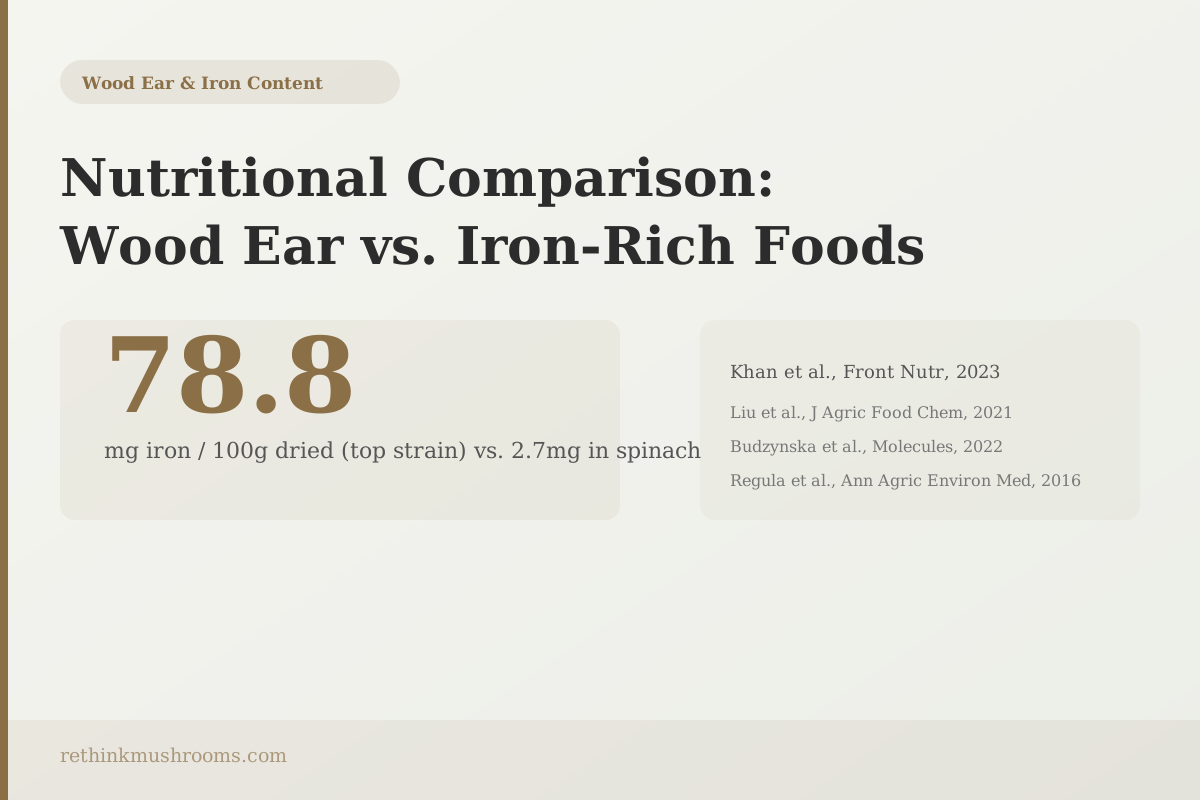
78.8 mg iron / 100g
The highest-iron Auricularia cornea strain measured by Khan et al. (2023) contained 788 mg/kg of iron by dry weight, equivalent to 78.8 mg per 100g dried mushroom, compared to 2.7 mg per 100g in raw spinach.
Khan et al., Frontiers in Nutrition, 2023
350–788 mg/kg
iron content range across Auricularia cornea strains; strain and substrate matter more than species (Khan 2023)
Bioavailable
iron from mushroom-enriched food products showed measurable bioavailability in anemia-induced rat models (Regula 2016)
Biofortifiable
cultivated mushrooms can be significantly enriched with iron salts for functional food use (Budzynska 2022)
Khan et al., Frontiers in Nutrition, 2023
 View as image ↗
Most people who search for high-iron plant foods land on lists that include spinach, lentils, fortified cereal, and tofu. Wood ear mushroom does not appear on those lists despite containing, when dried, dramatically more iron per gram than any of those foods. The reason is a combination of how iron content is measured (fresh weight vs. dry weight matters enormously for mushrooms), how frequently wood ear iron data is published in English, and the fact that even authoritative sources like Healthline cover black fungus without mentioning iron at all.
The data exists. Khan et al.'s 2023 study in Frontiers in Nutrition measured iron content across multiple Auricularia cornea strains and found values ranging from 350 to 788 mg per kilogram of dried mushroom, equivalent to 35 to 78.8 mg per 100 grams.[1] At the lower end, dried wood ear already contains 13 times more iron per gram than raw spinach. At the upper end of strain variation, the gap is even wider.
This article structures the comparison clearly, addresses the fresh-vs-dried issue that causes wildly varying iron claims, and covers what bioavailability research shows about wood ear's iron in real digestive systems. For the full nutritional profile beyond iron, see the wood ear mushroom guide.
Key Takeaways
- Dried Auricularia cornea strains contain 350-788 mg iron per kg (35-78.8 mg/100g) depending on cultivar and substrate, per Khan et al. (2023), dramatically higher than any common plant food on a per-gram basis
- Fresh wood ear mushroom has much lower iron per serving because it is 90%+ water; the iron concentrates during drying, which explains why reported values vary from under 2 mg (fresh per cup) to 35-79 mg (dried per 100g)
- Raw spinach contains approximately 2.7 mg iron per 100g, raw beef 2.7 mg, cooked lentils 3.3 mg, and chicken liver approximately 9 mg (USDA FoodData Central); all below the range of dried wood ear
- Wood ear contains non-heme iron, which has a lower baseline absorption rate (2-20%) than heme iron in meat (15-35%), but vitamin C pairing significantly increases non-heme iron uptake
- Iron from mushroom-based food products showed measurable and significant bioavailability in animal models of anemia, per Regula et al. (2016)
- Strain selection and growing substrate profoundly affect iron concentration in Auricularia, which is why commercial products vary considerably and blanket statements about wood ear iron content are often misleading
The Numbers That Change When You Dry a Wood Ear Mushroom
Wood ear mushroom is roughly 90% water when fresh. A single fresh mushroom contains very little iron per serving weight because most of what you're weighing is water. When that water is removed through drying, the iron stays. The same piece of mushroom that weighed 100 grams fresh might weigh 8 to 10 grams dried. The iron content is unchanged, but the concentration per gram of material has increased dramatically.
This is why iron values for wood ear appear to range from about 1.5 to 2 mg per 100 grams in fresh forms to 35 to 79 mg per 100 grams in dried forms. Both figures can be accurate. They are measuring the same compound (iron) but in different physical states of the same food.
Liu et al.'s 2021 comprehensive review in the Journal of Agricultural and Food Chemistry analyzed the full nutritional composition of Auricularia auricula-judae and confirmed iron as a key trace element in the dried mushroom, alongside zinc and potassium, with protein content at approximately 12.5% of dry matter.[2] The dried form is what most recipes, supplement producers, and traditional medicine practices use; the iron content figures relevant to those applications are the dried figures.
For anyone comparing wood ear to other iron-rich foods, always verify whether the comparison is using the same weight form. Most published food databases report mushroom values for fresh weight. A fair comparison to the foods wood ear is typically used alongside (rehydrated and cooked) should use dried or rehydrated dry-equivalent values.
The Comparison Table: Wood Ear Against Other Iron-Rich Foods
The following data shows iron content per 100 grams for dried wood ear (from research) and common iron-rich foods (from USDA FoodData Central). The comparison uses the same weight unit to make differences visible at a glance.
| Food | Iron (mg/100g) | Type | Notes |
|---|---|---|---|
| Dried wood ear (high-iron strain) | 78.8 | Non-heme | Ac3 hybrid, Khan et al. 2023 |
| Dried wood ear (typical range) | 35.0 | Non-heme | Base strain; substrate-dependent |
| Chicken liver (cooked) | ~9.0 | Heme | High absorption rate |
| Lentils (cooked) | 3.3 | Non-heme | Common plant iron source |
| Spinach (raw) | 2.7 | Non-heme | Oxalate binding reduces absorption |
| Beef (raw, lean) | 2.7 | Heme | Higher per-gram absorption than plant sources |
| White button mushroom (raw) | 0.4 | Non-heme | Standard edible mushroom comparison |
The table shows why dried wood ear is genuinely unusual as a plant-based iron source. Even at the lower end of the strain range (35 mg/100g), it contains more than 10 times the iron of raw spinach. At the upper strain range (78.8 mg/100g), it contains more than 8 times the iron of chicken liver, which most people consider the gold standard high-iron food.
The comparison to spinach deserves additional context. Spinach's iron content (2.7 mg/100g) is further reduced in practice by oxalic acid, a compound naturally present in spinach that binds to iron in the gastrointestinal tract and prevents some of it from being absorbed. Wood ear does not have this same oxalate inhibitor in significant quantities, which means its iron is not subject to the same binding effect.[3]
Why Spinach's Iron Is Often Less Accessible Than It Looks
The iron in spinach has a specific problem. Spinach is rich in oxalic acid, a naturally occurring compound that forms insoluble complexes with iron in the digestive tract. When iron binds to oxalate, the body cannot absorb it effectively. Studies have found that despite its respectable raw iron content, spinach's iron bioavailability is significantly reduced by this mechanism.
Wood ear mushroom does not contain the same level of oxalic acid, which means its iron is not competing with an internal binding agent in the same way. The polysaccharide matrix that makes up much of wood ear's structure may actually function as a delivery vehicle for iron rather than a barrier to it. Research on Auricularia polysaccharide-iron complex preparations has shown that iron bound within this polysaccharide structure releases into simulated gastrointestinal conditions effectively.[2]
Regula et al.'s 2016 study in Annals of Agricultural and Environmental Medicine directly tested iron bioavailability from mushroom-enriched food products in rats with induced anemia.[4] The mushroom-matrix iron was measurable and significant in improving anemia markers, establishing that iron in mushroom-based food products is biologically accessible. The study used Pleurotus ostreatus (oyster mushroom), not Auricularia specifically, but the finding that mushroom-matrix iron is bioavailable in anemia models is relevant to the broader question of whether plant-based mushroom iron can be used by the body.
The practical implication: raw spinach may carry more oxalate-interference than its iron content implies. Dried wood ear, without that inhibitor, may deliver its iron more efficiently to the body than a simple mg-for-mg comparison would suggest. That said, the non-heme form of iron in wood ear still faces the baseline absorption challenge that all non-animal iron sources face.
Strain Matters: 350 vs. 788 mg/kg Iron in the Same Species
One of the most important findings in Khan et al.'s 2023 strain characterization study is not just how much iron Auricularia cornea contains, but how much variation exists between strains of the same species.[1]
The hybrid Ac3 strain contained 788 mg/kg iron. The wild domesticated Ac28 strain contained 350 mg/kg. Both are Auricularia cornea, both were analyzed under the same methods. The difference, a factor of more than two, is attributable to two things: genetics (the cultivar itself) and substrate (what the mushroom was grown on).
Mushrooms absorb minerals from their growing medium. A mushroom grown on a substrate rich in available iron will accumulate more iron than the same species grown on a lower-iron substrate. This is actually the basis for mushroom biofortification research: Budzynska et al.'s 2022 study in Molecules demonstrated that cultivated mushroom species can be intentionally enriched with iron by incorporating iron salts into the growing substrate, significantly boosting iron concentration for functional food use.[3]
This has practical implications for anyone reading a wood ear iron claim. The number you see on a package or in an article reflects a specific strain grown on a specific substrate. Commercial products vary considerably. A product using a high-iron strain on an iron-enriched substrate could deliver substantially more iron per gram than a product using a different cultivar. Without strain and substrate disclosure (which is rare), iron content claims should be treated as estimates within a range.
For context on how the fresh-versus-dried concentration difference compares across mushroom species, the fresh vs. dried shiitake article documents the same concentration phenomenon with a more commonly discussed mushroom. For complete wood ear bioactive compound coverage, the wood ear bioactive compounds article covers the polysaccharide matrix that interacts with iron.
Boosting Absorption: The Vitamin C Strategy for Non-Heme Iron
The iron in wood ear, spinach, lentils, and all plant foods is non-heme iron. The iron in red meat and poultry is largely heme iron. These are chemically different forms that the gastrointestinal tract handles differently.
Heme iron absorption is relatively efficient at 15 to 35% and is not significantly affected by most dietary factors. Non-heme iron absorption varies more widely (approximately 2 to 20%) and is significantly influenced by what else is eaten at the same meal.
The most well-established enhancer of non-heme iron absorption is vitamin C. Ascorbic acid reduces ferric iron (Fe3+) to ferrous iron (Fe2+), a form the gut absorbs more readily. Research consistently shows that consuming vitamin C alongside non-heme iron substantially increases uptake. A practical approach is to consume wood ear alongside foods naturally rich in vitamin C: bell peppers (especially red), citrus, broccoli, or tomatoes. Traditional Chinese preparations that cook wood ear with these types of vegetables may not have been designed for iron absorption, but the pairing is consistent with what absorption research would predict.
The bioavailability gap between non-heme and heme iron is real but not absolute. With consistent vitamin C pairing, the effective absorption rate of non-heme iron can approach the lower range of heme iron absorption. This matters for the wood ear comparison to beef: beef's iron advantage is partly structural (heme form), but that structural advantage can be partially offset through dietary pairing.
Mushroom-based iron research is also moving toward purpose-designed delivery. Budzynska et al.'s biofortification work shows that the fungal matrix can be tuned to carry iron more effectively, and broader research on mushroom iron complexes positions cultivated fungi as an emerging functional food vehicle for iron delivery in plant-based diets.[3]
For the clinical evidence on wood ear and iron deficiency anemia specifically, including the 2026 randomized trial comparing Auricularia polysaccharide-iron complex to heme iron and ferrous glycinate, see the wood ear for iron deficiency anemia research article. The black fungus mineral content article covers how iron fits into wood ear's broader mineral profile. For the full mineral comparison across mushroom species, other species' iron values provide additional context for where wood ear sits in the mushroom landscape.
The Bottom Line
Dried wood ear mushroom (Auricularia cornea) contains 350 to 788 mg of iron per kilogram of dry weight, equivalent to 35 to 78.8 mg per 100 grams, depending on strain and substrate. This places it dramatically above common plant iron sources like spinach (2.7 mg/100g), lentils (3.3 mg/100g cooked), and on par with or exceeding animal sources like chicken liver (~9 mg/100g). Wood ear's iron is non-heme and benefits from vitamin C pairing. Strain selection and growing conditions matter substantially, as the same species can vary more than twofold in iron content.
Frequently Asked Questions
Sources & References
- 1RTHM-00835·Khan, Asif Ali et al. (2023). “Characterization, antioxidant activity, and mineral profiling of Auricularia cornea mushroom strains..” Frontiers in nutrition.Study breakdown →PubMed →↩
- 2RTHM-00702·Liu, Enchao et al. (2021). “Review on Auricularia auricula-judae as a Functional Food: Growth, Chemical Composition, and Biological Activities..” Journal of agricultural and food chemistry.Study breakdown →PubMed →↩
- 3RTHM-01491·Budzyńska, Sylwia et al. (2022). “Biofortification of Three Cultivated Mushroom Species with Three Iron Salts-Potential for a New Iron-Rich Superfood..” Molecules (Basel.Study breakdown →PubMed →↩
- 4RTHM-00444·Reguła, Julita et al. (2016). “Iron bioavailability from cereal products enriched with Pleurotus ostreatus mushrooms in rats with induced anaemia..” Annals of agricultural and environmental medicine : AAEM.Study breakdown →PubMed →↩