Microdosing Research & Placebo
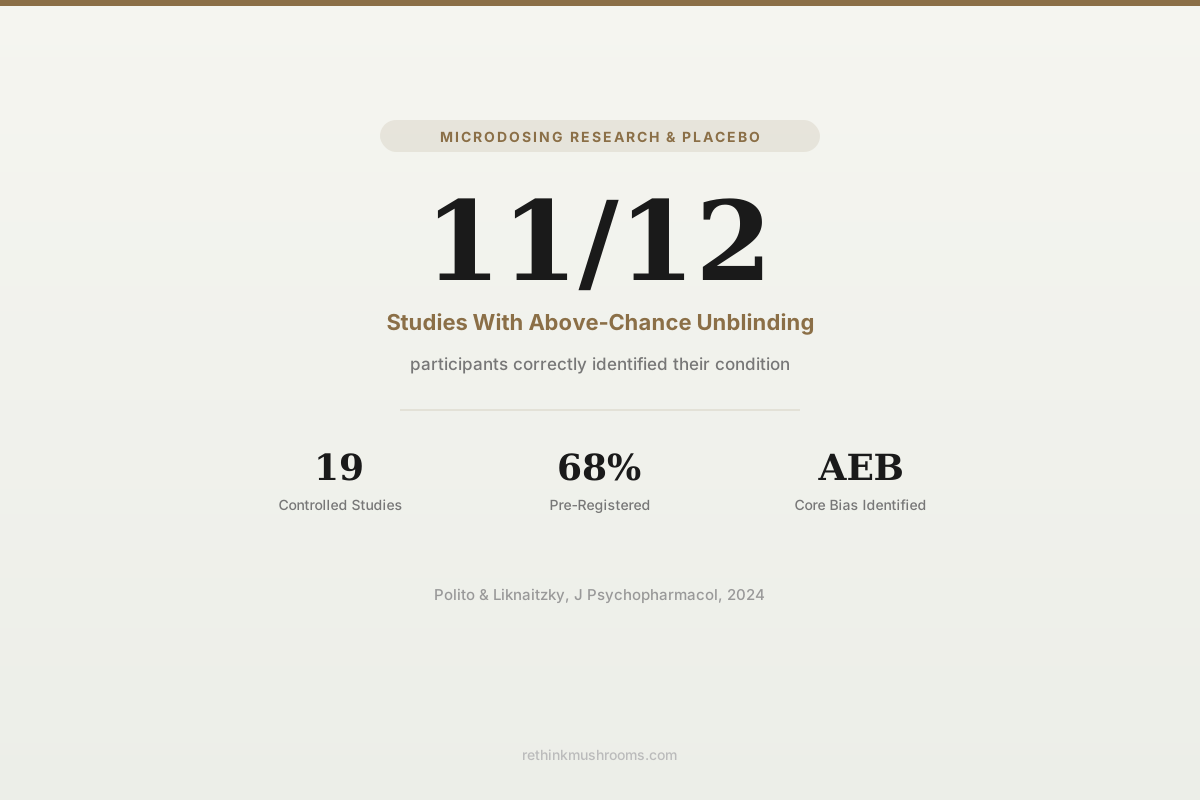
11/12 studies
Of 12 controlled microdosing studies that formally assessed blinding, 11 found participants identified their condition at rates exceeding chance, undermining the placebo control.
Polito & Liknaitzky, J Psychopharmacol, 2024
19
placebo-controlled microdosing papers reviewed
AEB
activated expectancy bias identified as core threat
68%
of studies pre-registered in trial databases
Polito & Liknaitzky, J Psychopharmacol, 2024
 View as image ↗
Psilocybin microdosing occupies an unusual position in research. Millions of people report benefits from sub-perceptual doses of psilocybin mushrooms, yet the controlled studies designed to test those claims keep running into the same methodological wall: participants can often tell whether they received the drug or the placebo. When people know (or believe they know) what they took, the entire architecture of a placebo-controlled trial breaks down. A 2024 rapid review of 19 controlled microdosing studies found that 11 of 12 studies assessing blinding reported that participants broke blind at rates greater than chance.[1]
This is not a minor statistical quibble. It threatens the validity of every positive finding in the microdosing literature and raises the question of whether current research designs can answer the question at all. For related research on psilocybin's receptor-level mechanisms at full doses, see 5-HT2A receptor density and psilocybin response.
Key Takeaways
- A 2024 rapid review of 19 controlled microdosing studies found that microdosing produced changes in neurobiology, physiology, subjective experience, and cognition relative to placebo, but 11 of 12 studies assessing blinding reported above-chance unblinding (Polito & Liknaitzky, 2024)
- In a double-blind psilocybin microdosing study, acute effects were significantly more intense for active doses only among participants who correctly identified their condition, suggesting expectancy drives reported effects (Cavanna et al., 2022)
- A 191-participant self-blinding citizen science study found that both microdose and placebo groups improved equally on well-being, mindfulness, and life satisfaction over four weeks (Szigeti et al., eLife, 2021)
- Activated expectancy bias (AEB) occurs when participants who break blind in the active group experience amplified effects, inflating treatment effect estimates and producing false positives (Polito & Liknaitzky, 2024)
- 13 of 19 controlled microdosing studies (68%) were pre-registered in clinical trial databases, indicating improving methodological rigor in the field (Polito & Liknaitzky, 2024)
- Next-generation designs include active placebos (low-dose niacin for flushing), balanced placebo designs, and micro-PET neuroimaging to identify objective biological markers independent of subjective report (Polito & Liknaitzky, 2024)
Why Blinding Fails in Microdosing Studies
In a standard double-blind trial, neither the participant nor the researcher knows who received the active drug versus the placebo. This prevents expectations from influencing reported outcomes. The method works well when the active drug and placebo are truly indistinguishable.
Psilocybin, even at sub-perceptual doses, produces subtle physiological cues that some participants detect: mild changes in body sensation, slight perceptual shifts, alterations in emotional tone, or simply a feeling of "something different." These cues allow participants to guess their condition. Once a participant believes they received psilocybin, their expectations about microdosing benefits (widely promoted in popular media and online communities) may produce improvements that have nothing to do with the drug's pharmacology.
Polito and Liknaitzky (2024) quantified this problem across the controlled literature. Of 19 placebo-controlled microdosing papers published through early 2024, 12 formally assessed whether participants could guess their condition. In 11 of those 12, participants in at least one condition identified their allocation at rates exceeding statistical chance.[1]
The review identified two distinct categories of blinding failure. In some studies, participants in the active group correctly guessed they received psilocybin. In others, participants in the placebo group correctly guessed they received placebo. Both types undermine the trial, but through different mechanisms.
Activated Expectancy Bias: The Core Threat
Polito and Liknaitzky (2024) coined the term "activated expectancy bias" (AEB) to describe the specific mechanism by which blinding failure inflates microdosing results. AEB occurs through a two-step process:[1]
Step 1: A participant in the active group detects subtle drug cues and correctly identifies their condition.
Step 2: The identification activates their pre-existing positive expectations about microdosing. These expectations produce measurable improvements in mood, creativity, or well-being that are then attributed to the drug.
The result is that the active group shows larger improvements than the placebo group, but the difference is driven by expectations, not pharmacology. This produces false positive findings that look like genuine drug effects in the statistical analysis.
AEB is distinct from the standard placebo effect. In a standard placebo response, both groups improve because both believe they might be receiving the drug. AEB specifically inflates the active group's response because those participants have additional confirmation (from the subtle drug cues) that they received the real thing. This asymmetry is what makes it particularly dangerous for microdosing research: it creates between-group differences that mimic true drug effects.
The Self-Blinding Evidence
The largest placebo-controlled microdosing study to date used a novel "self-blinding" citizen science design. Szigeti et al. (2021) recruited 191 existing microdosers who implemented their own placebo control following online instructions published on the Imperial College London website. Participants prepared identical-looking capsules of their microdose material and matching placebos, shuffled them using QR-coded envelopes, and followed a four-week dosing protocol without knowing which capsules contained active material (Szigeti et al., eLife, 2021; PMID 33648632).
The results showed that both the microdose group and the placebo group improved significantly on measures of well-being, mindfulness, and life satisfaction. There were no significant between-group differences. Participants who believed they were taking a microdose reported similar psychological benefits regardless of whether the capsule actually contained psilocybin.
This finding is frequently cited as evidence that microdosing benefits are "just placebo." That interpretation has limits. The study used self-selected microdosers (already believers), uncontrolled doses and substances, and a home-based protocol without clinical oversight. These factors may have maximized expectancy effects while limiting the ability to detect genuine pharmacological effects. For a deeper analysis of the Imperial College findings, see The Imperial College microdosing self-blinding study: what it actually proved.
What the Double-Blind Lab Studies Show
Cavanna et al. (2022) conducted one of the few fully controlled laboratory-based microdosing studies. In this double-blind, placebo-controlled trial, participants received either psilocybin microdoses or placebo in a laboratory setting with standardized conditions and validated outcome measures.[2]
The critical finding: reported acute effects were significantly more intense for the active dose compared to placebo, but only among participants who correctly identified their experimental condition. Participants who received active psilocybin but believed they received placebo did not report enhanced effects. This directly demonstrates the AEB mechanism in action. The drug produced detectable cues in some participants, those participants activated their expectations, and the expectations drove the reported outcomes.
This pattern appeared across multiple outcome measures. When the data were analyzed without accounting for blinding status, the results suggested a microdosing effect. When blinding status was included as a covariate, the apparent drug effects diminished or disappeared. The study demonstrates that analyzing microdosing data without assessing and adjusting for blinding integrity produces misleadingly positive results.
Next-Generation Research Designs
The 2024 review identified several methodological approaches that newer studies are adopting to address the placebo problem:[1]
Active placebos: Using a substance that produces some physiological sensation (such as low-dose niacin, which causes skin flushing) as the comparator instead of an inert placebo. If the placebo condition also produces body sensations, participants have less ability to distinguish active from control conditions. Several ongoing trials are testing this approach.
Balanced placebo designs: Participants are told they may or may not receive psilocybin, and the actual allocation is crossed with the information given. This creates four groups: told drug/got drug, told drug/got placebo, told placebo/got drug, told placebo/got placebo. The design allows researchers to statistically separate drug effects from expectancy effects. This approach has a long history in alcohol research and is being adapted for microdosing.
Objective biomarkers: Rather than relying on self-reported outcomes (mood, creativity, well-being), next-generation studies are incorporating neuroimaging (PET, fMRI), EEG, and blood-based biomarkers that are less susceptible to expectancy effects. If psilocybin microdoses produce measurable changes in serotonin receptor binding or neural connectivity patterns regardless of what participants believe they received, that would constitute evidence for a genuine pharmacological effect independent of expectancy.
Longer trial durations: Most existing studies span 2-4 weeks. If microdosing produces cumulative biological effects (as proponents claim), longer trials may detect effects that survive expectancy adjustment. Short trials maximize the influence of initial expectations, which tend to fade over time.
Ecological momentary assessment: Repeated real-time measurement throughout the day reduces reliance on retrospective self-report, which is more vulnerable to expectancy bias. Participants report their current state multiple times per day via smartphone, providing a more granular picture of actual experience versus reconstructed memory.
What About Safety?
The placebo problem is primarily a challenge for efficacy research, not safety research. Even if microdosing benefits are partly or entirely explained by expectancy, the safety profile of repeated low-dose psilocybin remains an independent question.
Rouaud et al. (2024) addressed one specific safety concern: whether repeated microdosing could cause cardiac fibrosis or valvulopathy through chronic 5-HT2B receptor activation. Comparing psilocybin's pharmacological profile to known cardiotoxins (fenfluramine, ergotamine, methysergide), they found that psilocybin microdoses produce substantially lower 5-HT2B activation than compounds associated with cardiac valve damage.[3]
This finding is relevant to the placebo debate because it means that even if people are microdosing primarily for placebo-driven benefits, the practice itself is unlikely to cause cardiac harm at typical doses. The safety question and the efficacy question are separate, and the answer to one does not determine the answer to the other. For a broader view of psilocybin's chemical interactions, see Beyond psilocybin: the full chemical profile of psychedelic mushrooms.
The Dose Question
Part of the placebo problem is entangled with the dose question. "Microdose" has no standardized definition. Studies have used doses ranging from 0.5 mg to 3 mg of psilocybin (or equivalent dried mushroom weights from 0.1g to 0.5g), a range that spans potentially sub-threshold to clearly perceptible effects depending on individual sensitivity, body weight, and mushroom potency.
At the lower end of this range, the drug may genuinely produce no detectable pharmacological effect, making any reported benefit purely expectancy-driven. At the higher end, subtle perceptual effects are common, which both enables blinding failure and could indicate genuine neurobiological activity. The field has not resolved whether there is a threshold below which psilocybin has no biological effect or whether even very low doses engage serotonin receptors enough to produce measurable changes.
Polito and Liknaitzky (2024) noted that the studies using lower doses generally found fewer significant effects, while those using higher microdoses found more. This dose-response pattern could indicate a genuine pharmacological effect (more drug produces more effect), or it could indicate that higher doses are easier to detect, producing more unblinding and therefore more expectancy-driven improvement.[1] Disentangling these two explanations is one of the central challenges for next-generation research. For context on how different psilocybin doses affect receptor systems, see Is microdosing just placebo? The self-blinding studies.
Where the Field Stands
The Polito and Liknaitzky (2024) review concluded that microdosing produces "changes in neurobiology, physiology, subjective experience, affect, and cognition relative to placebo," but that these findings must be interpreted cautiously given pervasive blinding failures. The evidence neither confirms nor definitively refutes a genuine pharmacological effect of psilocybin microdosing.[1]
The 68% pre-registration rate across the 19 reviewed studies indicates improving methodological standards. Earlier microdosing research was largely observational and survey-based. The field has moved toward controlled designs, even though those designs are now revealing the depth of the blinding problem.
The most honest summary of current evidence is that microdosing psilocybin probably does something, it changes multiple objective biological markers, but the magnitude and clinical relevance of those changes cannot be separated from expectancy effects using current standard designs. The next generation of studies, using active placebos, balanced placebo designs, and objective biomarkers, will determine whether a genuine pharmacological signal exists beneath the expectancy noise. For broader context on how expectancy shapes the microdosing experience, see Expectancy effects in microdosing: how belief shapes experience.
The Bottom Line
Microdosing research faces a fundamental methodological challenge: participants frequently identify their condition in placebo-controlled trials, activating expectancy effects that inflate apparent drug benefits. Of 12 studies that assessed blinding, 11 found above-chance unblinding rates. Next-generation designs using active placebos, balanced placebo methods, and objective biomarkers aim to separate genuine pharmacological effects from expectancy, but these studies are still in early stages. Whether psilocybin microdosing produces benefits beyond placebo remains an open question.
Frequently Asked Questions
Sources & References
- 1RTHM-00900·Polito, Vince et al. (2024). “Is microdosing a placebo? A rapid review of low-dose LSD and psilocybin research..” Journal of psychopharmacology (Oxford.Study breakdown →PubMed →↩
- 2RTHM-00748·Cavanna, Federico et al. (2022). “Microdosing with psilocybin mushrooms: a double-blind placebo-controlled study..” Translational psychiatry.Study breakdown →PubMed →↩
- 3RTHM-00903·Rouaud, Antonin et al. (2024). “Microdosing psychedelics and the risk of cardiac fibrosis and valvulopathy: Comparison to known cardiotoxins..” Journal of psychopharmacology (Oxford.Study breakdown →PubMed →↩