Lion's Mane Cognition
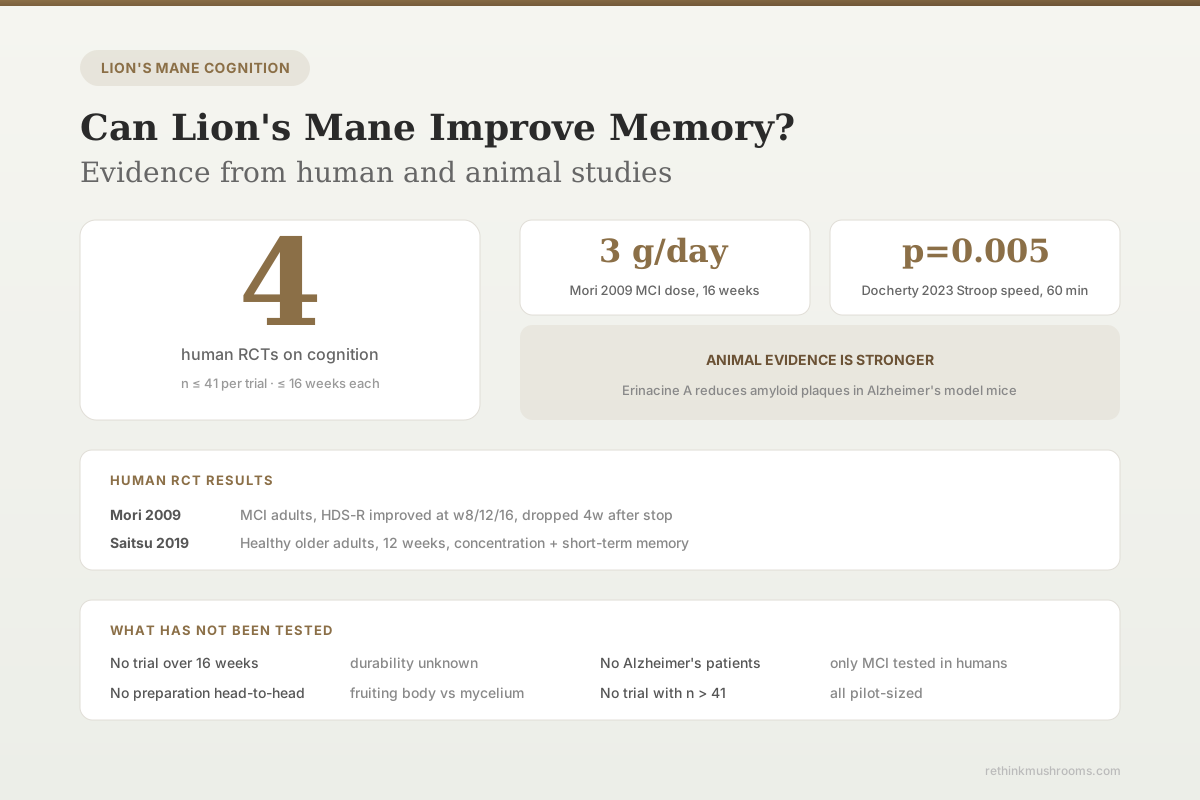
4 human RCTs
Across four randomized placebo-controlled trials in humans, lion's mane has improved cognitive scale scores in adults with mild cognitive impairment, sped up Stroop task performance in healthy young adults, and produced mixed results on other memory tasks.
Mori 2009; Saitsu 2019; Docherty 2023; Surendran 2025
16 weeks
length of the largest MCI trial to show effect
3 g / day
dose used in the Mori 2009 MCI trial
n ≤ 41
sample size of every published lion's mane cognition RCT
Mori 2009; Saitsu 2019; Docherty 2023; Surendran 2025
 View as image ↗
The question "does lion's mane improve memory" has a complicated answer, and anyone who tells you otherwise is ignoring the data. Four randomized controlled trials in humans have tested Hericium erinaceus on cognitive outcomes, and they disagree with each other in instructive ways. Dozens of rodent studies show dramatic effects on hippocampal neurogenesis, NGF production, and maze performance, far stronger than anything measured in people. This article walks through every published human trial, the most cited animal studies, and the specific mechanisms researchers believe connect them, so readers can see exactly where the evidence is strong and where it is still thin. For the broader picture of how lion's mane affects the brain, see Lion's Mane and Cognitive Function: What the Research Shows.
Key Takeaways
- Mori and colleagues' 2009 double-blind RCT in 30 adults with mild cognitive impairment (MCI) found statistically significant improvement on the Hasegawa Dementia Scale at weeks 8, 12, and 16 with 3 g/day of Hericium erinaceus, with scores dropping back toward baseline 4 weeks after supplementation stopped[1]
- Saitsu et al. 2019 ran a 12-week RCT in healthy older Japanese adults and reported significant improvement on cognitive function scales, with the treatment group showing differences in concentration and short-term memory subscales[2]
- Docherty et al. 2023 tested 1.8 g of lion's mane in 41 healthy young adults and found a single acute dose sped up Stroop task performance 60 minutes post-ingestion (p = 0.005), with a 28-day 600 mg protocol showing only a non-significant trend toward reduced subjective stress (p = 0.051)[3]
- Surendran et al. 2025 attempted to replicate acute effects in healthy young adults using a standardized extract and reported inconclusive results, with improvements on some motor dexterity measures but no robust memory benefit[4]
- Tsai-Teng et al. 2016 showed that erinacine A-enriched Hericium erinaceus mycelium reduced amyloid plaque deposition and improved behavioral performance in APPswe/PS1dE9 transgenic Alzheimer's model mice[5]
- Every published human cognition trial has fewer than 50 participants and runs 16 weeks or less, which is why even the positive findings are classified as preliminary by the Alzheimer's Drug Discovery Foundation
What "improve memory" actually means in these studies
Before looking at results, it helps to understand what researchers measure when they say lion's mane "improved memory." The human trials have used very different instruments, and each one captures a different slice of cognitive function.
Mori and colleagues used the Revised Hasegawa Dementia Scale (HDS-R), a 30-point clinician-administered test developed in Japan for screening cognitive decline.[1] A rising HDS-R score suggests improvement in orientation, short-term recall, calculation, and verbal fluency. Saitsu et al. used similar cognitive batteries measuring processing speed and short-term memory in healthy older adults.[2]
Docherty et al. used the Stroop test, which measures attentional inhibition rather than memory directly, along with the Serial Subtraction task (working memory) and the Rey Auditory Verbal Learning Test for episodic memory.[3] The Stroop task improvement was the only statistically significant finding, a specific, narrow result that some reviewers argue is a cognitive speed effect rather than a memory one.
This matters because when headlines say "lion's mane improves memory," the cleanest evidence is for cognitive scale scores in people whose baseline is impaired, not for everyday recall in healthy adults.
The four human trials, in detail
Mori 2009: mild cognitive impairment, the landmark trial
The single most cited lion's mane cognition study is Mori et al. 2009, published in Phytotherapy Research.[1] It randomized 30 Japanese men and women aged 50 to 80 with a diagnosis of mild cognitive impairment into two groups. The active group took four 250 mg tablets of Hericium erinaceus dry powder three times a day (3 g total) for 16 weeks. The placebo group took identical-looking tablets.
Results showed significant between-group differences on the HDS-R at weeks 8, 12, and 16. The Yamabushitake group's scores rose with duration of intake. Four weeks after participants stopped taking the mushroom, scores dropped again, which is the detail most reviewers find most interesting: the effect appeared to be real but not durable without continued intake. Laboratory tests showed no adverse effects.
The trial is small (n = 30), unreplicated at the same dose, and was conducted by a team with ties to the commercial supplier of the extract. Those are standard caveats and do not erase the signal; they put it in proportion.
Saitsu 2019: healthy older adults
Saitsu and colleagues ran a 12-week double-blind placebo-controlled study on healthy older adults who did not have a dementia diagnosis.[2] The supplement contained H. erinaceus fruiting body. The treatment group showed significantly improved cognitive function scores versus placebo, with the published results pointing to concentration and short-term memory components as the areas that moved. The authors argued that lion's mane could help prevent age-related cognitive decline in otherwise healthy adults, which is a different claim than the Mori MCI finding and comes with a different evidence burden.
Again the sample was modest, the intervention short, and the population narrow (middle-aged Japanese adults). Saitsu adds a second positive human signal but does not by itself answer the generalization question.
Docherty 2023: healthy young adults, the first Western RCT
Docherty and colleagues ran the first major Western trial in 2023, a pilot study in 41 healthy adults aged 18 to 45 published in Nutrients.[3] The design was unusual: a single 1.8 g acute dose was tested 60 minutes after ingestion, and a 28-day chronic arm used 600 mg daily.
The headline finding was that Stroop task performance was faster after the acute dose (p = 0.005). No statistically significant effect appeared on other cognitive measures. The 28-day 600 mg arm found only a non-significant trend toward lower subjective stress (p = 0.051), with no memory improvement. The authors presented this as evidence that lion's mane may produce rapid, short-term effects on cognitive speed in healthy young adults, but they did not claim a memory benefit.
This is the study people reach for when they want to say "lion's mane works fast," but the specific effect was on attentional interference, not memory, and the dose was more than double what most commercial supplements recommend.
Surendran 2025: the replication attempt
Surendran and colleagues published a 2025 double-blind RCT in Frontiers in Nutrition that tested a standardized H. erinaceus extract on cognition and mood in healthy younger adults.[4] The results were mixed. Some improvements appeared on measures of motor dexterity, but others contradicted them, and there was no robust memory benefit. The authors described the findings as tentative and underpowered.
Taken together, the four human trials give two positive signals in older or impaired adults (Mori, Saitsu) and two weak or inconsistent signals in healthy young adults (Docherty, Surendran). No trial has tested more than 41 people. No trial has run longer than 16 weeks. Every trial has used a different preparation, which makes direct comparison difficult. For a deeper look at timing, see How Long Does Lion's Mane Take to Improve Cognition?.
Where the animal evidence is much stronger
The rodent literature on Hericium erinaceus and memory is far larger and more dramatic than the human literature, and it is where most mechanistic claims come from.
Tsai-Teng et al. 2016 is one of the most cited preclinical studies.[5] The team fed erinacine A-enriched Hericium erinaceus mycelium to APPswe/PS1dE9 transgenic mice, a model that develops amyloid plaques and cognitive deficits resembling human Alzheimer's disease. Mice receiving the erinacine A-enriched mycelium showed reduced amyloid plaque deposition, lower inflammatory markers, and improved performance on behavioral tests. The effect was tied to erinacine A, one of the cyathin diterpenoids unique to lion's mane mycelium.
Chiu et al. 2018 extended this line of work, reporting that erinacine A-enriched mycelium produced antidepressant-like effects in mice and increased brain-derived neurotrophic factor (BDNF) through the PI3K/Akt/GSK-3β pathway.[6] BDNF is one of the proteins most tightly linked to hippocampal learning and memory, which is why animal studies that show lion's mane raising BDNF are used to argue for a plausible memory mechanism in humans.
Lai et al. 2013 showed that a methanolic extract of lion's mane promoted neurite outgrowth in cultured NG108-15 cells, supporting in vitro evidence that the mushroom can drive the early stages of nerve cell growth.[7] The Khan 2013 review collected and evaluated the existing evidence at that time and concluded that Hericium erinaceus had legitimate neurotrophic potential but that clinical translation remained limited.[8]
The gap between rodent results and human results is the central puzzle of lion's mane cognition research. Rodents show clean NGF and BDNF increases and clean memory-task improvements. Humans show smaller, noisier effects that sometimes reach statistical significance and sometimes do not. One reason is dose: rodent studies often use equivalent doses that would require humans to take 20 grams or more per day, far beyond any supplement protocol. Another is duration and population: rodent models are stressed on purpose, while most human volunteers are already healthy. A third is preparation: mycelial extracts rich in erinacines, fruiting body extracts rich in hericenones, and whole-powder products have different chemical profiles, and almost no human trial has directly compared them. For the mechanism story, see Lion's Mane for Brain Fog: Mechanisms and Clinical Evidence.
The Nagano 2010 mood study and why it gets cited for memory
Nagano et al. 2010 is often cited in memory discussions even though it measured mood.[9] The 4-week trial in 30 menopausal Japanese women found reductions in depression and anxiety scores with lion's mane cookies. The reason it enters memory conversations is that lowered depression and anxiety often correlate with improved subjective cognitive complaints. It is not evidence of a direct memory effect, but readers should know why it keeps appearing in aggregated lion's mane claims.
What the Alzheimer's Drug Discovery Foundation concluded
The Alzheimer's Drug Discovery Foundation, which rates supplements for their Cognitive Vitality project, classifies lion's mane as having "limited evidence" for cognitive benefit. Their summary points to the small sample sizes, short durations, and lack of replication across independent teams as the main obstacles. That position is consistent with the raw data above and is a useful calibration point against marketing claims that call lion's mane a proven nootropic.
Compared with other mushroom nootropics, lion's mane has the strongest human data for mild cognitive impairment specifically, but it is not alone. See Lion's Mane vs. Other Nootropics: How Does It Compare? for direct evidence comparisons.
The dose and preparation problem
The 2009 Mori trial used 3 g of dry powder per day. The 2023 Docherty chronic arm used 600 mg of extract daily. These are not equivalent. 3 g of whole Yamabushitake powder contains a small, variable fraction of the bioactive hericenones and erinacines, while 600 mg of a standardized extract may deliver several times as much. The specific erinacine A concentration is almost never reported on commercial supplement labels. This makes cross-study comparison and consumer dosing difficult.
If a reader wants to match the preparation used in the positive human trials, Mori 2009 used a dry fruiting-body powder and Saitsu 2019 used a fruiting-body supplement. The rodent Alzheimer's trials used erinacine A-enriched mycelium, which is a different product with a different chemical profile. Commercial lion's mane products vary widely on this axis, and the research has not caught up.
The Bottom Line
Four human RCTs have tested lion's mane on memory or cognition. Two found positive effects in older or cognitively impaired adults; two produced mixed signals in healthy young adults. Animal evidence is much stronger, especially for erinacine A-enriched mycelium in Alzheimer's mouse models, but the gap between rodent doses and human supplement protocols is large. The case for lion's mane in mild cognitive impairment is real but preliminary, and the case for everyday memory improvement in healthy adults is not yet established.
Frequently Asked Questions
Sources & References
- 1RTHM-00165·Mori, Koichiro et al. (2009). “Improving effects of the mushroom Yamabushitake (Hericium erinaceus) on mild cognitive impairment: a double-blind placebo-controlled clinical trial..” Phytotherapy research : PTR.Study breakdown →PubMed →↩
- 2RTHM-00585·Saitsu, Yuusuke et al. (2019). “Improvement of cognitive functions by oral intake of Hericium erinaceus..” Biomedical research (Tokyo.Study breakdown →PubMed →↩
- 3RTHM-00821·Docherty, Sarah et al. (2023). “The Acute and Chronic Effects of Lion's Mane Mushroom Supplementation on Cognitive Function, Stress and Mood in Young Adults: A Double-Blind, Parallel Groups, Pilot Study..” Nutrients.Study breakdown →PubMed →↩
- 4RTHM-00952·Surendran, Geyan et al. (2025). “Acute effects of a standardised extract of Hericium erinaceus (Lion's Mane mushroom) on cognition and mood in healthy younger adults: a double-blind randomised placebo-controlled study..” Frontiers in nutrition.Study breakdown →PubMed →↩
- 5RTHM-00452·Tsai-Teng, Tzeng et al. (2016). “Erinacine A-enriched Hericium erinaceus mycelium ameliorates Alzheimer's disease-related pathologies in APPswe/PS1dE9 transgenic mice..” Journal of biomedical science.Study breakdown →PubMed →↩
- 6RTHM-00505·Chiu, Chun-Hung et al. (2018). “Erinacine A-Enriched Hericium erinaceus Mycelium Produces Antidepressant-Like Effects through Modulating BDNF/PI3K/Akt/GSK-3β Signaling in Mice..” International journal of molecular sciences.Study breakdown →PubMed →↩
- 7RTHM-00295·Lai, Puei-Lene et al. (2013). “Neurotrophic properties of the Lion's mane medicinal mushroom, Hericium erinaceus (Higher Basidiomycetes) from Malaysia..” International journal of medicinal mushrooms.Study breakdown →PubMed →↩
- 8RTHM-00293·Khan, Md Asaduzzaman et al. (2013). “Hericium erinaceus: an edible mushroom with medicinal values..” Journal of complementary & integrative medicine.Study breakdown →PubMed →↩
- 9RTHM-00194·Nagano, Mayumi et al. (2010). “Reduction of depression and anxiety by 4 weeks Hericium erinaceus intake..” Biomedical research (Tokyo.Study breakdown →PubMed →↩