Lion's Mane & Cognitive Function
0 head-to-head RCTs
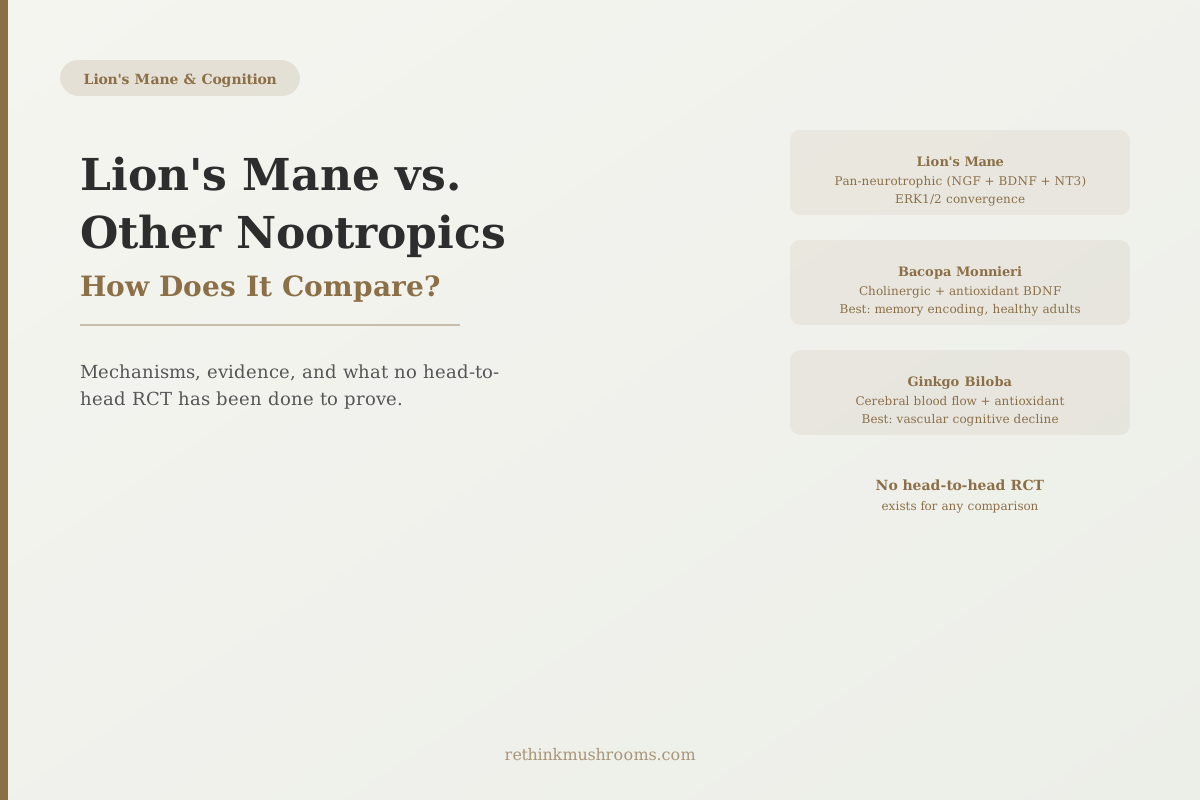
No randomized controlled trial has directly compared lion's mane to bacopa, ginkgo, or any other nootropic for cognitive outcomes. What exists is mechanism analysis and population-matched evidence.
Cha et al., Neuroscience and Biobehavioral Reviews, 2024
Pan-neurotrophic
Lion's mane activates NGF, BDNF, and NT3 simultaneously via ERK1/2 (Martínez-Mármol 2023) — no other common nootropic does this
Cholinergic
Bacopa monnieri's primary mechanism — distinct from lion's mane's neurotrophic route
Vascular
Ginkgo biloba's primary mechanism — distinct from both lion's mane and bacopa
Cha et al., Neuroscience and Biobehavioral Reviews, 2024
 View as image ↗
The honest starting point for any lion's mane vs nootropics comparison is this: no study has tested lion's mane head-to-head against bacopa, ginkgo biloba, or any other nootropic in a controlled trial. Cha et al.'s 2024 systematic review in Neuroscience and Biobehavioral Reviews confirmed this absence — the evidence base for mushrooms and cognition, while growing, has not produced direct comparisons.[4]
What does exist is something more useful: a clear mechanistic picture of how lion's mane works, and a clear mechanistic picture of how other leading nootropics work. These are distinct. The differences suggest which cognitive problems each addresses best — and why combining them may be rational rather than redundant.
This article covers that comparison. For foundational lion's mane research, see our science-based lion's mane overview.
Key Takeaways
- Martínez-Mármol et al. (2023) identified that hericerin derivatives activate a pan-neurotrophic pathway simultaneously engaging NGF, BDNF, and NT3 through ERK1/2 signaling — no other common nootropic activates the full neurotrophin axis through a single mechanism
- Bacopa monnieri works primarily through cholinergic modulation (acetylcholinesterase inhibition) and antioxidant neuroprotection — a different pathway from lion's mane, targeting memory encoding in different ways
- Ginkgo biloba works primarily through improved cerebral blood flow (vasodilation) and antioxidant activity — most relevant for vascular-type cognitive decline
- The Cha 2024 systematic review found lion's mane cognitive benefits most reliable in populations with existing impairment (MCI, early AD), while healthy young adults show more variable results
- Surendran et al. (2025) found a single acute dose of lion's mane extract did not produce global cognitive improvement in healthy young adults — relevant for setting realistic expectations vs. acute-effect nootropics
- Cipriano et al. (2026) propose a third lion's mane mechanism: regulation of non-coding RNA networks that epigenetically control neurotrophic gene expression — a distinct axis from both neurotrophins and anti-neuroinflammation
The Mechanism Comparison: Lion's Mane, Bacopa, and Ginkgo Side by Side
| Lion's Mane | Bacopa Monnieri | Ginkgo Biloba | |
|---|---|---|---|
| Primary mechanism | Pan-neurotrophic (NGF, BDNF, NT3 via ERK1/2) | Cholinergic + antioxidant BDNF | Cerebral blood flow + antioxidant |
| Human RCT evidence | Yes — MCI, early AD populations | Yes — memory in healthy adults | Yes — vascular/age-related decline |
| Acute effects | Task-specific (processing speed) in some trials | Minimal acute effect | Variable |
| Chronic onset | 8-16 weeks for cognitive; 4 weeks for mood | 12+ weeks | 6-12 weeks |
| Best-fit population | MCI, early cognitive decline | Healthy adults, memory encoding | Vascular cognitive impairment |
| Key limitation | Benefits reverse within 4 weeks of stopping | Slow onset, GI side effects common | Modest effect sizes in recent trials |
| Safety profile | Excellent, no serious adverse events | Generally good | Anticoagulant interaction risk |
No head-to-head RCT exists for any of these comparisons. The table reflects mechanism analysis and within-study evidence — not direct comparative trial data.
What Makes Lion's Mane Mechanistically Unique
The mechanism that distinguishes lion's mane from every other common nootropic was defined clearly in 2023.
Martínez-Mármol et al. published a study in the Journal of Neurochemistry examining how hericerin derivatives — a subclass of the hericenone compounds found in lion's mane fruiting bodies — affect hippocampal neurons.[1]
Their finding: hericerin derivatives activate a pan-neurotrophic signaling pathway. "Pan-neurotrophic" means the pathway simultaneously engages multiple neurotrophin systems — NGF (nerve growth factor), BDNF (brain-derived neurotrophic factor), and NT3 (neurotrophin 3) — along with their receptor families (TrkA, TrkB, TrkC). The convergence point is ERK1/2, a protein kinase that acts as a molecular hub for neuronal growth, adaptation, and memory formation.
Mice given lion's mane crude extract or isolated hericene A (one of the active hericerin derivatives) showed significantly enhanced hippocampal spatial memory performance.
The significance of the "pan-neurotrophic" finding: other neurotrophic nootropics work through specific pathways. Bacopa primarily influences BDNF through antioxidant mechanisms. Ashwagandha influences cortisol and BDNF indirectly through stress reduction. Lion's mane hericerins appear to activate the full neurotrophin signaling axis — NGF + BDNF + NT3 + all three Trk receptors — through a single converging mechanism.
No other common nootropic activates this network simultaneously.
How Bacopa Monnieri's Mechanism Differs
Bacopa monnieri (Bacopa monnieri) is one of the best-studied herbal nootropics, with Ayurvedic use extending centuries. Its primary mechanisms are:
Acetylcholinesterase inhibition: Bacopa contains bacosides that inhibit acetylcholinesterase — the enzyme that breaks down acetylcholine. Acetylcholine is critical for memory formation and recall. By slowing its breakdown, bacopa increases cholinergic transmission in memory-related brain regions. This is the same mechanism as some Alzheimer's medications (donepezil, rivastigmine), though at much lower effect sizes.
Antioxidant neuroprotection: Bacosides are also potent antioxidants in neuronal tissue. Oxidative stress damages neurons over time; reducing it preserves neuronal function.
BDNF effects: Bacopa increases BDNF, but through an indirect route — primarily via antioxidant and anti-inflammatory effects that protect BDNF-producing neurons rather than directly stimulating BDNF production. This differs from lion's mane's direct ERK1/2 engagement.
Clinical evidence profile: Human RCTs for bacopa consistently show memory improvements in healthy adults and older adults, but with a characteristic pattern — benefits require 12+ weeks to appear and are most pronounced for delayed word recall and associative memory tasks. Bacopa is less well-studied in MCI or early AD populations than lion's mane.
Practical distinction: Bacopa's cholinergic mechanism makes it most relevant for memory encoding and retrieval — especially for healthy adults seeking memory support. Lion's mane's neurotrophic mechanism targets neuronal health and regeneration — most relevant in populations with declining neurotrophin levels, typically MCI and age-related cognitive decline.
How Ginkgo Biloba's Mechanism Differs
Ginkgo biloba (Ginkgo biloba) is one of the most widely used supplements globally. Its mechanisms are substantially different from both bacopa and lion's mane:
Improved cerebral blood flow: Ginkgo's flavonoids and terpenoids dilate blood vessels and reduce blood viscosity, increasing blood flow to the brain. In populations with vascular-type cognitive impairment (where reduced blood flow to brain tissue is a significant factor), this mechanism is directly relevant.
Platelet aggregation reduction: Ginkgo reduces platelet aggregation — which is why it carries an anticoagulant interaction risk with blood thinners, a significant safety distinction from lion's mane.
Antioxidant activity: Like bacopa, ginkgo provides antioxidant neuroprotection, though through different specific compounds.
Clinical evidence profile: Ginkgo has extensive human trial data, but recent high-quality trials have shown smaller effect sizes than earlier research suggested. Meta-analyses place ginkgo's cognitive effects in the mild-to-moderate range for older adults with vascular cognitive decline, with less effect in young healthy adults.
Practical distinction: Ginkgo addresses a different problem — blood flow and vascular factors — rather than neurotrophic signaling deficits. For cognitive decline with a vascular component, ginkgo has a different and potentially complementary role to lion's mane's neurotrophic mechanism.
What the Cha 2024 Systematic Review Found
Cha et al. (2024), in a systematic review of mushrooms and neurocognitive health across the lifespan published in Neuroscience and Biobehavioral Reviews, provides the most current synthesis of lion's mane cognitive evidence in the context of all mushroom research.[4]
Key findings from the review relevant to the nootropic comparison:
First, lion's mane has the strongest cognitive evidence among mushrooms. Second, cognitive benefits are most reliable in populations with existing cognitive impairment — MCI patients (Mori 2009), early Alzheimer's patients (Li 2020 erinacine A trial) — while results in healthy adults are more variable and task-specific. Third, no mushroom study has been directly compared to a non-mushroom nootropic.
The population-specificity finding is important for the comparison question. It suggests lion's mane is not a general cognitive enhancer for all people in the way that, say, caffeine is. Its benefits appear most pronounced in people whose neurotrophin levels and neuronal health are already declining.
This parallels the evidence profile for some other condition-targeted nootropics. Ginkgo shows stronger effects in vascular cognitive decline than in healthy adults. Bacopa shows larger effects on memory encoding specifically, not on processing speed or executive function.
Mori et al. (2009) remains the landmark human trial: 30 MCI patients, 3g/day of dried lion's mane fruiting body for 16 weeks, with significant cognitive score improvement at weeks 8, 12, and 16 — and return to baseline within 4 weeks of stopping.[2]
Lion's Mane's Acute Evidence Profile: What to Expect on Day One
One dimension where nootropics differ is acute (same-day) effects. Some people seeking nootropics specifically want near-immediate cognitive support — in which case the acute evidence profile matters.
Docherty et al. (2023), in a double-blind pilot RCT, found that a single dose of lion's mane improved Stroop task reaction time at 60 minutes post-consumption.[3] The Stroop task measures processing speed and cognitive control — not memory directly.
Surendran et al. (2025), in a separate double-blind RCT testing a standardized lion's mane extract in healthy young adults, found no significant overall improvement in cognitive performance or mood from a single acute dose.[5] Any benefits observed were task-specific and domain-dependent.
The reconciliation: lion's mane may produce some acute effects on processing speed tasks specifically, while not producing global cognitive improvement from a single dose. Bacopa has even weaker acute effects — its benefits require months of consistent use. Ginkgo has acute vascular effects (improved blood flow is measurable relatively quickly) that may translate to some immediate cognitive effects in vascular-impaired populations.
For people expecting an acute "nootropic feeling" from lion's mane similar to caffeine or stimulant-class compounds, the evidence does not support that expectation.
The Epigenetic Axis: Cipriano 2026's Third Mechanism
Cipriano et al. (2026), in the International Journal of Molecular Sciences, proposed a third mechanistic axis for lion's mane bioactives — distinct from the neurotrophic pathway and the anti-neuroinflammatory pathway.[7]
Their proposal: lion's mane bioactives may regulate non-coding RNA (ncRNA) networks — gene regulatory molecules that control which genes are expressed without changing the DNA sequence itself (an epigenetic mechanism). If lion's mane compounds influence ncRNA networks that regulate neurotrophin gene expression, the mechanism of action goes beyond receptor binding to gene-level modulation.
This is frontier science — a hypothesis-driven review, not an experimental confirmation. No study has directly demonstrated lion's mane changing ncRNA expression in human brain tissue. But it places lion's mane in the same emerging class as other compounds being studied for epigenetic neuroprotection, and suggests the full mechanism of action may be more complex than the neurotrophic model alone captures.
No other common nootropic has this mechanistic hypothesis applied to it with comparable theoretical grounding.
The Stack Question: Combining Lion's Mane With Other Nootropics
Because lion's mane, bacopa, and ginkgo operate through different primary mechanisms, combining them is theoretically rational — they are not redundant.
The 2025 systematic review by Menon et al. confirmed lion's mane's excellent safety profile with no serious adverse events documented across clinical studies.[6] No study has specifically tested safety of lion's mane combined with bacopa or ginkgo. Ginkgo's anticoagulant properties create the most significant potential interaction concern if combined with other blood-thinning compounds or medications.
The lion's mane + bacopa combination is theoretically appealing: lion's mane's neurotrophic mechanism (NGF/BDNF/NT3 induction) supports the health of neurons, while bacopa's cholinergic mechanism supports the transmission signals those neurons generate. Different level of the same cognitive process.
For more on the lion's mane cognitive evidence and its full mechanistic picture, see can lion's mane improve memory? evidence from human and animal studies. For how long the research suggests waiting before evaluating effects, see how long does lion's mane take to improve cognition?. For brain fog specifically and the neuroinflammation mechanism, see lion's mane for brain fog: mechanisms and clinical evidence.
For the compound-level picture of why erinacines from mycelium cross the blood-brain barrier directly, see erinacines: the compounds that cross the blood-brain barrier. For how hericenones stimulate NGF — the foundational mechanism — see hericenones and NGF synthesis: how lion's mane stimulates nerve growth. For broader population-level mushroom cognitive evidence, see the Singapore mushroom study: mushroom intake and cognitive decline.
The Bottom Line
Lion's mane is mechanistically distinct from other common nootropics: Martínez-Mármol et al. (2023) identified a pan-neurotrophic pathway simultaneously activating NGF, BDNF, and NT3 via ERK1/2 — no other common nootropic engages this full neurotrophin axis through a single mechanism. Bacopa works primarily through cholinergic modulation; ginkgo through vascular/antioxidant pathways. No head-to-head RCT has compared any of these directly. Cha et al.'s 2024 systematic review confirms lion's mane cognitive benefits are most reliable in populations with existing impairment (MCI, early AD), while healthy young adult benefits are more variable and task-specific.
Frequently Asked Questions
Sources & References
- 1RTHM-01746·Martínez-Mármol, Ramón et al. (2023). “Hericerin derivatives activates a pan-neurotrophic pathway in central hippocampal neurons converging to ERK1/2 signaling enhancing spatial memory..” Journal of neurochemistry.Study breakdown →PubMed →↩
- 2RTHM-00165·Mori, Koichiro et al. (2009). “Improving effects of the mushroom Yamabushitake (Hericium erinaceus) on mild cognitive impairment: a double-blind placebo-controlled clinical trial..” Phytotherapy research : PTR.Study breakdown →PubMed →↩
- 3RTHM-00821·Docherty, Sarah et al. (2023). “The Acute and Chronic Effects of Lion's Mane Mushroom Supplementation on Cognitive Function, Stress and Mood in Young Adults: A Double-Blind, Parallel Groups, Pilot Study..” Nutrients.Study breakdown →PubMed →↩
- 4RTHM-00868·Cha, Sara et al. (2024). “A review of the effects of mushrooms on mood and neurocognitive health across the lifespan..” Neuroscience and biobehavioral reviews.Study breakdown →PubMed →↩
- 5RTHM-00952·Surendran, Geyan et al. (2025). “Acute effects of a standardised extract of Hericium erinaceus (Lion's Mane mushroom) on cognition and mood in healthy younger adults: a double-blind randomised placebo-controlled study..” Frontiers in nutrition.Study breakdown →PubMed →↩
- 6RTHM-00943·Menon, Arya et al. (2025). “Benefits, side effects, and uses of Hericium erinaceus as a supplement: a systematic review..” Frontiers in nutrition.Study breakdown →PubMed →↩
- 7RTHM-02226·Cipriano, Giovanni Luca et al. (2026). “Beyond Neurotrophins: A Proposed Neurotrophic-Epigenetic Axis Mediated by Non-Coding RNA Networks for Hericium erinaceus Bioactives-A Hypothesis-Driven Review..” International journal of molecular sciences.Study breakdown →PubMed →↩