Lion's Mane & Cognitive Function
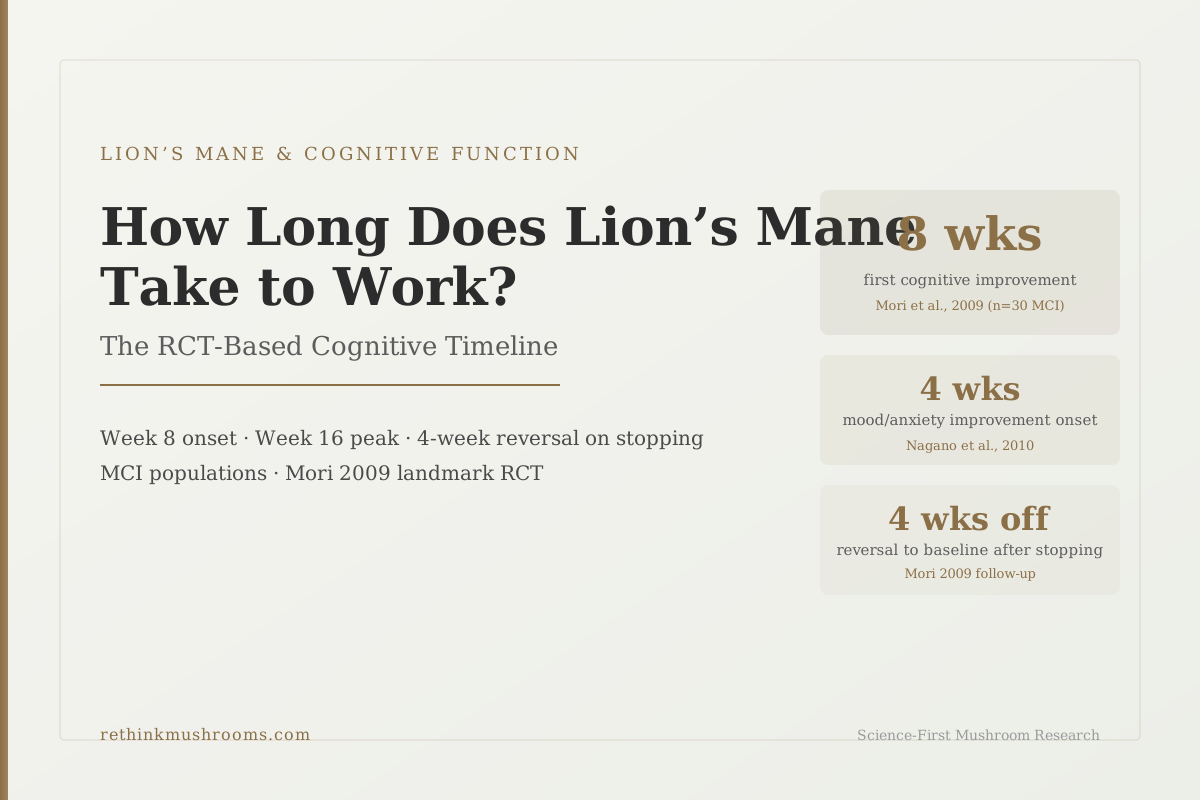
8 weeks to first measurable cognitive improvement
The landmark Mori 2009 RCT found first significant cognitive score improvements at week 8 in MCI patients, with peak effects at 16 weeks, and full reversal within 4 weeks of stopping.
Mori et al., Phytotherapy Research, 2009
60 minutes
Stroop processing speed improved acutely in Docherty 2023 healthy adults pilot
4-week reversal
cognitive gains disappeared within 4 weeks of stopping in the Mori 2009 follow-up
MCI populations
benefits most consistent in people with existing mild cognitive impairment, not healthy young adults
Mori et al., Phytotherapy Research, 2009
 View as image ↗
The answer most forums give is "a few weeks." The answer from the research is more specific, more conditional, and contains a finding that fundamentally changes how the question should be answered.
In the 2009 landmark double-blind randomized controlled trial by Mori et al., 30 patients with mild cognitive impairment (measurable memory and cognitive decline that has not yet reached dementia severity) took 3g of Hericium erinaceus per day for 16 weeks. Significant cognitive improvements first appeared at week 8. They peaked at 16 weeks. Four weeks after stopping, the scores had returned to baseline.
That last sentence is the most practically important finding in all of lion's mane cognition research, and almost no popular guide mentions it. It means that whatever lion's mane does to support cognitive function requires ongoing supplementation to sustain. You are not building permanent neurological improvement that persists after you stop. You are maintaining a state that depends on continued intake.
For an introduction to lion's mane as a species and its full range of research, see What Is Lion's Mane Mushroom? A Science-Based Overview.
Key Takeaways
- Mori et al. (2009) found first significant cognitive score improvements at week 8 in a 16-week RCT of 30 MCI patients taking 3g/day of Hericium erinaceus; scores peaked at 16 weeks and returned to baseline within 4 weeks of stopping
- Docherty et al. (2023) found that a single dose improved Stroop task performance at 60 minutes in healthy young adults, but 28-day supplementation was needed for the more clinically meaningful outcomes: reduced anxiety and improved stress scores
- Surendran et al. (2025) found that a single acute dose did NOT produce significant overall cognitive improvement in healthy young adults; any benefits were task-specific, not global
- The Docherty and Surendran findings are compatible: processing speed tasks (like the Stroop) may show early acute sensitivity, while comprehensive cognitive batteries require longer supplementation in non-impaired populations
- Nagano et al. (2010) found that mood and anxiety improvements appeared within 4 weeks of daily intake, suggesting mood effects may precede cognitive effects in the timeline
- Cha et al. (2024), in a systematic review of mushrooms across the lifespan, concluded that lion's mane's cognitive benefits are most consistent in populations with existing impairment (MCI, early Alzheimer's) and more variable in healthy young adults
The Evidence-Based Timeline: From First Dose to Peak Effect
The most honest way to answer "how long does it take" is to report what specific trials measured at specific time points. Here is what the research shows:
At 60 minutes (single dose): One pilot trial in healthy young adults found improved performance on the Stroop test, a measure of processing speed and attention control. A larger, more rigorous RCT in the same population found no significant overall cognitive improvement. These findings are not contradictory; they reflect that processing speed may respond differently from global cognitive performance.
At 4 weeks: A 30-woman RCT found reduced depression and anxiety scores after 4 weeks of daily intake. Mood effects appear to precede measurable cognitive changes in the timeline.
At 8 weeks: The landmark Mori 2009 RCT found the first statistically significant cognitive score improvements in MCI patients at week 8. Two independent Japanese RCTs confirm this approximate onset.
At 16 weeks: Peak cognitive improvement in Mori 2009. A pilot trial in early Alzheimer's patients using erinacine A-enriched mycelium showed improvements at both 3 and 6 months.
After stopping: In the Mori 2009 trial, cognitive scores declined to baseline within 4 weeks of discontinuation.
The practical summary: for people with mild cognitive impairment, expect 8 weeks before measurable cognitive improvement, with continued improvement to 16 weeks. For healthy adults, mood and stress effects may appear at 4 weeks, while cognitive improvements are modest and task-specific.
Day One and Hour One: Two Studies, Two Different Answers
Two recent RCTs tested what a single dose of lion's mane does to cognition in healthy young adults, and they reached different conclusions. Understanding why is important.
Docherty et al. (2023) ran a double-blind pilot study in young adults.[2] A single dose improved performance on the Stroop task at 60 minutes after administration. The Stroop task measures processing speed and cognitive control, specifically how quickly and accurately someone can name the ink color of a color word written in a different color (the word "RED" in blue ink, for example). It is a focused, time-sensitive measure of a specific cognitive function.
Surendran et al. (2025) ran a larger, more rigorously powered double-blind RCT in healthy young adults.[3] A single acute dose did not produce significant improvements in overall cognitive performance or mood. Any benefits observed were task-specific and domain-dependent rather than reflecting broad cognitive enhancement.
These findings are compatible, not contradictory. A cognitive battery (a standardized set of multiple tests measuring memory, attention, processing speed, and executive function across many domains simultaneously) is a much harder target to move than a single focused processing speed task. The Stroop measures one narrow function; a battery measures global cognition. Lion's mane may have early acute effects on processing speed specifically while not producing the distributed improvement across all cognitive domains that a battery captures.
The honest conclusion from both studies: a single dose of lion's mane should not be expected to produce dramatic or global cognitive improvement in healthy people. The most robust acute signal is task-specific, and the most reliable cognitive effects require weeks, not hours.
Weeks Two to Four: Mood and Stress Effects Appear Before Cognition
An underappreciated finding in the lion's mane timeline is that mood effects appear to precede cognitive effects.
Nagano et al. (2010) studied 30 women, half taking lion's mane-containing cookies and half taking a placebo, for 4 weeks.[6] The lion's mane group showed statistically lower self-reported depression and anxiety scores compared to placebo. This is a 4-week effect on mood, not on memory or processing speed.
Docherty et al. (2023) corroborated this in healthy young adults with a different formulation: 28-day supplementation produced improved self-reported stress and reduced anxiety scores, with Docherty's acute Stroop finding at day one suggesting even earlier processing speed effects.[2]
The practical significance of this sequencing: for people taking lion's mane specifically to improve focus or clear brain fog, early changes in mood and perceived stress at 2-4 weeks may be an early indicator that the supplement is active, even if memory and cognitive test scores have not shifted yet. This is especially relevant because brain fog often has a mood and anxiety component alongside a pure attention/memory component. Reduced anxiety at 4 weeks may contribute to the clearer thinking that shows up as "reduced brain fog" in subjective reports, even without changes on objective cognitive tests at that point.
For more on the mechanisms underlying lion's mane's mood and brain fog effects, see Lion's Mane for Brain Fog: Mechanisms and Clinical Evidence.
Weeks Eight to Sixteen: When Cognitive Test Scores Actually Change
The clearest evidence for lion's mane's cognitive effects comes from trials of 8 weeks or more in people with existing cognitive impairment.
Mori et al. (2009) remains the landmark reference: 30 patients with mild cognitive impairment (a recognized clinical category for measurable memory decline that falls short of dementia), randomly assigned to 3g/day dried lion's mane fruiting body powder or placebo for 16 weeks.[1] Cognitive test scores in the lion's mane group were statistically higher than placebo at weeks 8, 12, and 16. The treatment group showed progressive improvement over the entire 16-week window, suggesting that longer use continued to produce gains rather than effects plateauing early.
Saitsu et al. (2019) replicated this general finding with an independent Japanese cohort taking oral lion's mane fruiting body.[4] Cognitive scores improved at multiple measurement time points. This cross-study replication strengthens the conclusion that the Mori 2009 finding is not an artifact of a single small trial.
Li et al. (2020) extended the evidence to an earlier Alzheimer's disease population using a different formulation: erinacine A-enriched mycelium (a form with direct blood-brain barrier permeability) in a pilot double-blind RCT.[5] Significant improvements on cognitive assessments appeared at both 3 and 6 months, with erinacine A-enriched mycelium showing effects in a population with more severe impairment than the Mori 2009 MCI group. This suggests that more potent or direct-acting formulations may produce effects in more advanced impairment.
For deeper coverage of the memory evidence across human and animal studies, see Can Lion's Mane Improve Memory? Evidence from Human and Animal Studies.
The Most Underreported Finding: Gains Disappear Within 4 Weeks of Stopping
In the Mori 2009 trial, participants were followed for an additional 4 weeks after the 16-week supplementation ended.[1] Cognitive scores in the lion's mane group, which had improved over 16 weeks of supplementation, returned to baseline levels within this 4-week follow-up period.
This finding receives remarkably little attention in popular lion's mane content. Most guides mention the Mori 2009 positive results without noting what happened when participants stopped. The reversal data is equally important for understanding how lion's mane works.
It means that lion's mane's cognitive benefits appear to be maintained by ongoing supplementation rather than permanently encoded. The mechanism behind this makes biochemical sense. Lion's mane stimulates the production of nerve growth factor (NGF) and other neurotrophic proteins, the signaling molecules that support neuronal health, synaptic maintenance, and the chemical environment of cognition. When supplementation ends, the extra stimulus for neurotrophic factor production is removed. The neurons that were being supported by elevated NGF levels are no longer receiving that support at the same level.
This is not unique to lion's mane. Many compounds that work through ongoing biochemical support rather than permanent structural change show this pattern. Stopping creatine eventually reduces the elevated phosphocreatine stores that drive its performance effects. Stopping most sleep supplements reduces the environmental advantage they created. Lion's mane cognitive support appears to work similarly: it is an ongoing biochemical support system, not a one-time neurological renovation.
The clinical and practical implication is significant. The popular nootropic advice to "cycle lion's mane" (take it for 12 weeks, then stop for 4 weeks, then restart) is specifically what the Mori 2009 reversal data argues against. A 4-week off-cycle is apparently long enough to erase the cognitive gains that 16 weeks of supplementation built. Cycling may make sense for other reasons (tolerance breaks, cost management), but not for preserving the cognitive benefit.
Who Gets the Most Benefit: MCI vs. Healthy Young Adults
The population taking lion's mane matters as much as the timeline.
Cha et al. (2024) published a systematic review of mushrooms and neurocognitive health across the lifespan in Neuroscience and Biobehavioral Reviews.[7] Their conclusion on lion's mane: cognitive benefits are most consistent and most meaningful in populations with existing cognitive decline (MCI, early Alzheimer's disease), while effects in healthy young adults are more variable and generally smaller in magnitude.
This finding explains the apparent contradiction between the strong Mori 2009 MCI data and the more mixed results from Docherty 2023 and Surendran 2025 in healthy adults. It is not that lion's mane works for one population and fails for another. It is that the signal is stronger when there is more room for improvement. A healthy 25-year-old with normal cognitive function has less cognitive deficit for lion's mane to address than a 65-year-old with mild cognitive impairment.
The analogy holds in other areas of medicine. Anti-hypertensive drugs produce larger blood pressure reductions in people with high blood pressure than in people with normal blood pressure. Antidepressants show larger effects in clinical depression than in mild mood variation. Lion's mane appears to follow the same pattern: therapeutic doses in impaired populations, more modest effects in healthy ones.
Menon et al. (2025), in a systematic review of HE supplement benefits and side effects, confirmed cognitive and neuroprotective benefits across multiple human studies, with a safety profile showing no serious adverse events and only mild gastrointestinal effects as the occasionally reported side effect.[8]
For the full research picture on lion's mane and cognitive function across all study designs, see Lion's Mane and Cognitive Function: What the Research Shows.
Formulation and Cycling: Two Practical Variables That Affect the Timeline
Fruiting body vs. erinacine-enriched mycelium:
The standard lion's mane supplements sold in most markets use fruiting body powder or fruiting body extract. The active compounds in fruiting bodies are hericenones, which are thought to work by stimulating cells in the body (including astrocytes in the nervous system) to produce NGF. This is an indirect mechanism: hericenones trigger NGF production, which then acts on neurons. The onset of effect involves this multi-step signaling cascade.
Erinacine A-enriched mycelium (the form used in the Li 2020 early AD trial) works differently. Erinacines are produced by the mycelial stage of the fungus and have been shown to cross the blood-brain barrier directly, where they can stimulate NGF production inside the central nervous system. For more on this distinction, see Erinacines: The Compounds That Cross the Blood-Brain Barrier.
Whether this mechanistic difference translates to a meaningfully faster clinical onset has not been tested in a direct head-to-head comparison. The Li 2020 erinacine trial showed effects at 3 months, consistent with the fruiting body timeline.
On cycling:
The Mori 2009 reversal data is the best available evidence on this question. Stopping for 4 weeks erased the cognitive improvements built over 16 weeks. For cognitive purposes specifically, the evidence points toward continuous supplementation rather than cycling. Other practical considerations (cost, preference for periodic breaks) are separate from what the data shows.
The Bottom Line
The evidence-based timeline for lion's mane cognitive effects runs from mood and stress improvements at 4 weeks (Nagano 2010; Docherty 2023) to first measurable cognitive improvements at week 8 in MCI populations (Mori 2009), peaking at 16 weeks. The most under-discussed finding is that effects reversed within 4 weeks of stopping in the Mori trial, suggesting ongoing supplementation is required to sustain benefit. Healthy young adults show more modest and variable effects than cognitively impaired populations. The 2024 Cha systematic review confirms this population-specific pattern.
Frequently Asked Questions
Sources & References
- 1RTHM-00165·Mori, Koichiro et al. (2009). “Improving effects of the mushroom Yamabushitake (Hericium erinaceus) on mild cognitive impairment: a double-blind placebo-controlled clinical trial..” Phytotherapy research : PTR.Study breakdown →PubMed →↩
- 2RTHM-00821·Docherty, Sarah et al. (2023). “The Acute and Chronic Effects of Lion's Mane Mushroom Supplementation on Cognitive Function, Stress and Mood in Young Adults: A Double-Blind, Parallel Groups, Pilot Study..” Nutrients.Study breakdown →PubMed →↩
- 3RTHM-00952·Surendran, Geyan et al. (2025). “Acute effects of a standardised extract of Hericium erinaceus (Lion's Mane mushroom) on cognition and mood in healthy younger adults: a double-blind randomised placebo-controlled study..” Frontiers in nutrition.Study breakdown →PubMed →↩
- 4RTHM-00585·Saitsu, Yuusuke et al. (2019). “Improvement of cognitive functions by oral intake of Hericium erinaceus..” Biomedical research (Tokyo.Study breakdown →PubMed →↩
- 5RTHM-00631·Li, I-Chen et al. (2020). “Prevention of Early Alzheimer's Disease by Erinacine A-Enriched Hericium erinaceus Mycelia Pilot Double-Blind Placebo-Controlled Study..” Frontiers in aging neuroscience.Study breakdown →PubMed →↩
- 6RTHM-00194·Nagano, Mayumi et al. (2010). “Reduction of depression and anxiety by 4 weeks Hericium erinaceus intake..” Biomedical research (Tokyo.Study breakdown →PubMed →↩
- 7RTHM-00868·Cha, Sara et al. (2024). “A review of the effects of mushrooms on mood and neurocognitive health across the lifespan..” Neuroscience and biobehavioral reviews.Study breakdown →PubMed →↩
- 8RTHM-00943·Menon, Arya et al. (2025). “Benefits, side effects, and uses of Hericium erinaceus as a supplement: a systematic review..” Frontiers in nutrition.Study breakdown →PubMed →↩