Lion's Mane Cognitive Health
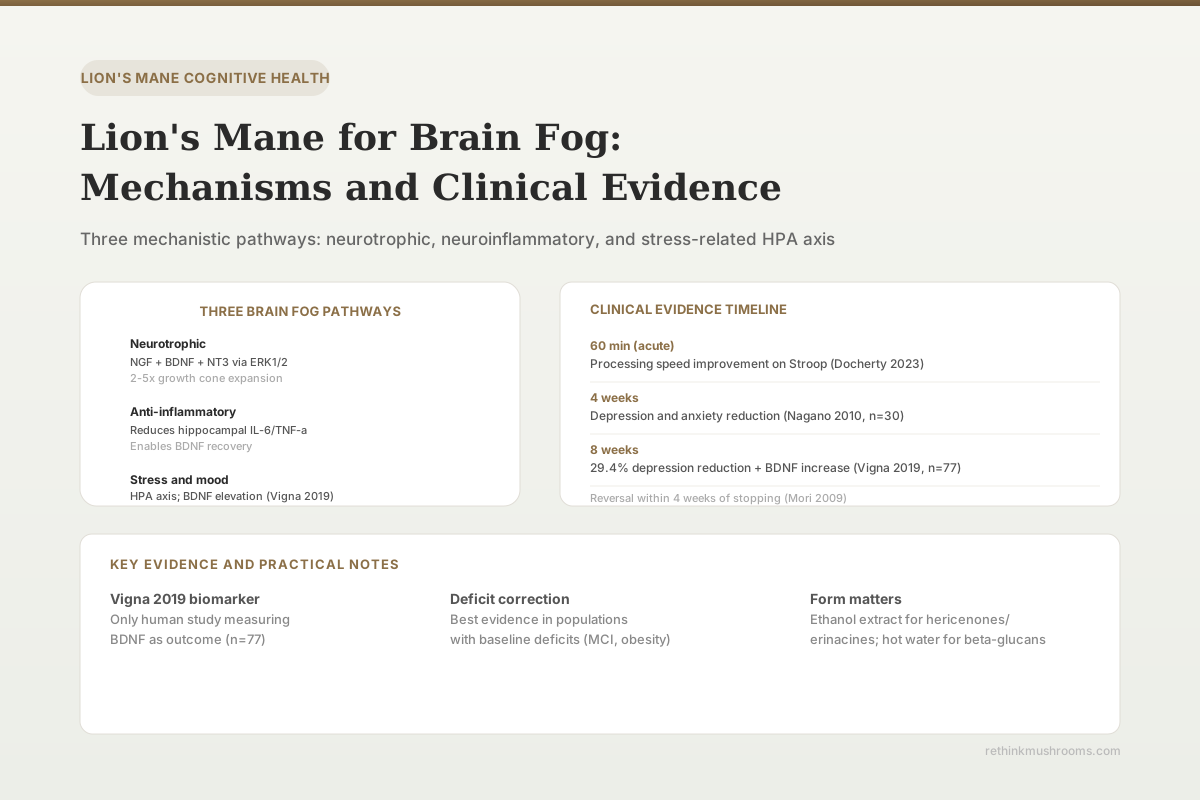
3 pathways to brain fog
Lion's mane addresses brain fog through three mechanistic routes: neurotrophic (a pan-neurotrophic pathway converging on ERK1/2), neuroinflammation reduction, and HPA axis mood-stress regulation.
Martínez-Mármol et al., J Neurochemistry, 2023
pro-BDNF rose
circulating pro-BDNF increased (no change in mature BDNF) in 77 overweight patients (Vigna 2019)
4 weeks
depression scores fell and anxiety complaints trended down in an RCT of 30 menopausal women (Nagano 2010)
4-8 weeks minimum
neuroplasticity timeline for meaningful cognitive changes
Martínez-Mármol et al., J Neurochemistry, 2023
 View as image ↗
Brain fog is not a medical diagnosis. It is a set of symptoms, reduced mental clarity, difficulty concentrating, slowed thinking, and a sense that the brain is not operating at full capacity. These symptoms can come from many different biological sources: elevated neuroinflammation, HPA axis dysregulation from chronic stress, reduced neurotrophin signaling, disrupted sleep, or some combination of all four.
What makes lion's mane for brain fog an interesting area of research is that the mushroom has published evidence for mechanisms relevant to at least three of these causes simultaneously. It is not a single-target compound, and understanding which mechanisms it acts on clarifies both when it might help and how it might help.
For a broader overview of what lion's mane does across applications, see What Is Lion's Mane Mushroom? A Science-Based Overview.
Key Takeaways
- Brain fog has multiple causes; lion's mane has published preclinical and clinical evidence for three mechanistic routes relevant to it: neurotrophin stimulation, neuroinflammation reduction, and stress/mood regulation
- Martínez-Mármol et al. 2023 demonstrated that hericerin derivatives (from the fruiting body) activate a pan-neurotrophic pathway that raises neurotrophin expression and converges on ERK1/2 in hippocampal neurons — notably through a route only partly dependent on the BDNF/TrkB receptor — and enhanced spatial memory in mice
- Lion's mane reduced depression scores in a 4-week RCT of 30 menopausal women (Nagano et al., 2010), and improved mood and sleep with a measurable rise in circulating pro-BDNF (though no significant change in mature BDNF) in 77 overweight patients over 8 weeks (Vigna et al., 2019)
- The neuroinflammation connection: elevated hippocampal cytokines suppress BDNF and impair neurogenesis; lion's mane's anti-inflammatory mechanisms address this route (Chong et al., 2019)
- A 2023 double-blind pilot trial found both acute processing speed improvements (60 minutes) and chronic stress reduction (28 days) in healthy young adults (Docherty et al., 2023)
- A 2025 systematic review confirmed cognitive and neuroprotective benefits across multiple human studies with an excellent safety profile (Menon et al., 2025)
- Cipriano et al. 2026 proposed a fourth mechanism: non-coding RNA networks regulating neurotrophic gene expression at the epigenetic level
What Brain Fog Actually Is and Why Mechanisms Matter
Brain fog is an informal term for cognitive symptoms that fall short of the threshold for a clinical diagnosis but significantly affect daily functioning. The underlying biology is heterogeneous: different people experience brain fog from different causes, and the relevant intervention depends on which biological pathway is causing the symptoms.
Neuroinflammation-driven brain fog occurs when elevated cytokines (particularly IL-6, TNF-alpha, and IL-1 beta) in brain tissue suppress neurotrophin production, impair neurogenesis in the hippocampus, and disrupt the normal regulation of synaptic function. This pattern is common after illness, with chronic inflammatory conditions, and in some people with depression.
HPA axis-driven brain fog occurs when the stress hormone system becomes dysregulated, producing elevated cortisol that impairs hippocampal function and memory consolidation. Chronic stress, anxiety disorders, and burnout produce this pattern.
Neurotrophin-deficit brain fog occurs when NGF (nerve growth factor) and BDNF (brain-derived neurotrophic factor) levels are insufficient to support normal neuronal health and plasticity. This is more common in aging, in people with low dietary intake of neurotrophic-supportive nutrients, and in neurodegenerative conditions.
Lion's mane has evidence for mechanisms that address all three of these patterns. Whether it addresses any individual's specific brain fog depends on which mechanism is relevant to them.
Mechanism map · Brain fog
Three Biological Routes to Brain Fog — and Where Lion’s Mane Acts
Brain fog is not one condition. Lion’s mane has published evidence for mechanisms relevant to three distinct causes. Which route matters depends on the person.
Neurotrophin deficit
The problem
Insufficient NGF and BDNF signaling limits neuronal health and plasticity — common in aging and low-neurotrophic states.
Lion’s mane action
Hericerin derivatives raise neurotrophin expression and drive neurite outgrowth, converging on ERK1/2 — partly independent of the BDNF/TrkB receptor.
Martínez-Mármol 2023; Mori 2008; Lai 2013
Neuroinflammation
The problem
Elevated hippocampal cytokines (IL-6, TNF-alpha) suppress BDNF production and impair neurogenesis, producing cognitive symptoms.
Lion’s mane action
Lion's mane anti-inflammatory mechanisms target the same hippocampal cytokine pathways, allowing BDNF and neurogenesis to recover.
Chong 2019 (review)
HPA axis / stress
The problem
Dysregulated stress signaling and elevated cortisol impair hippocampal function, memory, and clarity — the pattern in chronic stress and burnout.
Lion’s mane action
Trials show reduced depression and anxiety, improved sleep, a rise in circulating pro-BDNF, and lower acute stress with consistent use.
Nagano 2010; Vigna 2019; Docherty 2023
Sources: Martínez-Mármol et al. (2023); Mori et al. (2008); Lai et al. (2013); Chong et al. (2019); Nagano et al. (2010); Vigna et al. (2019); Docherty et al. (2023). Evidence is preclinical or from small human trials; effects are strongest in populations with baseline deficits.
The Pan-Neurotrophic Pathway: More Than Just NGF
The standard explanation for how lion's mane benefits cognition is: hericenones stimulate NGF production in brain support cells called astrocytes, and NGF then supports neuron health. This is accurate but incomplete.
Martínez-Mármol and colleagues in 2023 tested hericerin derivatives, a class of compounds derived from hericenones found in the lion's mane fruiting body, directly in central hippocampal neurons.[1] The result was more complex than the NGF story alone. Two of these compounds, N-de phenylethyl isohericerin (NDPIH) and its derivative hericene A, drove extensive axon outgrowth and neurite branching in cultured hippocampal neurons and raised neurotrophin expression, with the signal converging on a molecular relay called ERK1/2. Strikingly, blocking TrkB — the classical BDNF receptor — with the inhibitor ANA-12 only partly reduced this effect, and NDPIH activated ERK1/2 even in cells lacking TrkB. In other words, the pathway is a complementary neurotrophic route that operates partly independently of the BDNF/TrkB receptor.
ERK1/2 (extracellular signal-regulated kinase 1/2) is a signaling protein that carries growth signals from the cell surface to the nucleus, where it activates gene expression. Because the hericerin-derivative pathway reaches ERK1/2 through more than one route rather than a single receptor, the authors described it as "pan-neurotrophic."
The downstream effect in Martínez-Mármol's experiments was enhanced spatial memory in mice fed lion's mane crude extract and hericene A, accompanied by increased neurotrophin expression and downstream signaling in the hippocampus. The cellular changes — extensive axon outgrowth and neurite branching — represent the structural groundwork for new synaptic connections and increased synaptic capacity.
This pan-neurotrophic activation is mechanistically distinct from the earlier "NGF only" framing. It suggests that lion's mane does not just trigger one neurotrophin pathway but engages the brain's neurotrophic growth signaling network more broadly. For brain fog that results from neurotrophin insufficiency and reduced neuroplasticity, this is the most directly relevant mechanism.
Mori and colleagues established in 2008 that lion's mane extracts stimulate NGF synthesis in human astrocytoma cells in vitro, providing the original cellular evidence for the NGF mechanism that the 2023 study extended substantially.[6] Lai and colleagues in 2013 confirmed neurotrophic properties using lion's mane from different geographic sources and showed neurite outgrowth promotion with both water and ethanol extracts.[7]
For more on hericenone-driven NGF stimulation specifically, see Hericenones and NGF Synthesis: How Lion's Mane Stimulates Nerve Growth. For erinacines, which cross the blood-brain barrier from mycelium and add a direct central pathway, see Erinacines: The Compounds That Cross the Blood-Brain Barrier.
Fact Check
What most brain-fog content claims vs. what the neurotrophin research actually shows
The claim
“Lion's mane clears brain fog by 'boosting NGF' — that single mechanism explains the benefit for everyone.”
Popular supplement content that stops at the first and most famous neurotrophin finding
What research shows
Partly TrueNGF induction is real and was the original in-vitro finding (Mori 2008), but it is only part of the story. The most detailed mechanistic study to date found that hericerin derivatives drive hippocampal neurite outgrowth through a pan-neurotrophic pathway converging on ERK1/2 — a route that persists even when the BDNF/TrkB receptor is blocked, so it is not simply 'NGF stimulation' (Martínez-Mármol 2023). Separate routes address neuroinflammation (Chong 2019) and stress/mood (Nagano 2010; Vigna 2019).
Which route matters depends on the person: the strongest clinical effects appear in populations with baseline deficits (MCI, inflammation, menopause), while effects in healthy young adults are more modest (Docherty 2023). Brain fog is heterogeneous, and lion's mane is not a universal fix.
Mori et al. (2008) [ref 6]; Martínez-Mármol et al. (2023) [ref 1]; Chong et al. (2019) [ref 2]; Nagano et al. (2010) [ref 3]; Vigna et al. (2019) [ref 4]; Docherty et al. (2023) [ref 5]
The Neuroinflammation Pathway: When Inflammation Is the Root Cause
For brain fog driven by neuroinflammation, the mechanism chain is: elevated cytokines (particularly IL-6 and TNF-alpha) in the hippocampus suppress BDNF production, impair the birth of new neurons in the hippocampal dentate gyrus, and disrupt synaptic plasticity. The result is cognitive symptoms that overlap significantly with what people call brain fog.
Chong and colleagues' 2019 review of lion's mane for depressive disorder covers this neuroinflammation-neurotrophin connection in detail.[2] The review identifies the anti-inflammatory mechanisms of lion's mane's compounds as targeting the same hippocampal cytokine pathways that suppress BDNF. When neuroinflammation is reduced, BDNF production can recover, neurogenesis resumes, and cognitive function improves.
The connection between depression, neuroinflammation, and what people call brain fog is tight: approximately 30-40% of depression cases involve measurably elevated inflammatory markers (TNF-alpha, IL-6, CRP), and the cognitive symptoms of these inflammatory depression cases overlap substantially with brain fog symptoms. Reduced concentration, slowed thinking, and poor working memory are prominent.
This means that lion's mane's anti-inflammatory hippocampal mechanisms are relevant not just for mood disorders but for the cognitive symptoms that accompany them. The anti-inflammatory and neurotrophic pathways reinforce each other: reducing cytokine-mediated BDNF suppression while simultaneously stimulating neurotrophic signaling from the hericenone/erinacine pathway addresses the same biological problem from two directions.
The Mood and Stress Connection: When Brain Fog Has an HPA Component
A substantial portion of brain fog has an HPA axis component: the stress response system is dysregulated, cortisol is elevated, and hippocampal function is impaired as a result. Chronic stress, anxiety, and burnout all produce cognitive symptoms through this route.
Nagano and colleagues in 2010 ran a 4-week double-blind, placebo-controlled trial in 30 women using lion's mane-containing cookies, assessing menopausal symptoms (Kupperman Menopausal Index), depression (the CES-D scale), sleep (Pittsburgh Sleep Quality Index), and a set of "indefinite complaints."[3] After 4 weeks, CES-D depression scores fell significantly from baseline in the lion's mane group. Against placebo, two specific indefinite-complaint items reached significance, while items covering concentration, irritability, and feeling anxious trended lower without reaching the significance threshold. The population (menopausal women) is relevant: menopause reduces estrogen, which normally supports BDNF production, creating a neurotrophin deficit that increases vulnerability to mood and cognitive symptoms. Notably, the authors suggested the effect worked through a mechanism distinct from NGF enhancement.
Vigna and colleagues in 2019 tested lion's mane in 77 overweight or obese patients for 8 weeks alongside a low-calorie diet.[4] The lion's mane group showed significant improvements in depression, anxiety, and sleep-disorder scores. Critically, the study also measured the serum balance between BDNF and its precursor, pro-BDNF: circulating pro-BDNF increased significantly, while mature BDNF showed no significant change. This is the only human lion's mane study to directly measure a BDNF-family biomarker, which makes it uniquely informative — but the direction of the shift (pro-BDNF, not mature BDNF) complicates any simple "lion's mane raises BDNF in humans" reading.
The overweight population is relevant because adipose tissue produces pro-inflammatory cytokines that can suppress BDNF signaling. The Vigna 2019 results are consistent with lion's mane acting on the neurotrophic and neuroinflammatory systems in a population with measurable baseline inflammation, alongside improvements in mood and sleep. Because pro-BDNF and mature BDNF can exert opposing effects on neurons, the biomarker shift is best read as evidence that lion's mane influences BDNF biology, rather than proof of a clean rise in mature BDNF. This is the deficit-correction pattern: the effect was most pronounced in a population with measurable baseline inflammation.
Vigna et al. (2019) · Evidence-Based Complementary and Alternative Medicine
- Population
- 77 adults affected by overweight or obesity, each with a mood, sleep, or binge-eating disorder, on a low-calorie diet
- Intervention
- Hericium erinaceus supplementation for 8 weeks
- Comparator
- Before vs. after supplementation, with circulating pro-BDNF and mature BDNF measured by ELISA
- Finding
- Eight weeks of supplementation decreased depression, anxiety, and sleep-disorder scores and improved the quality of nocturnal rest. Circulating pro-BDNF rose significantly, with no significant change in mature BDNF. This is the only human lion's mane study to measure a BDNF-family biomarker — but circulating BDNF is an imperfect proxy for brain BDNF, and a rise in the pro-BDNF precursor is not the same as a rise in the mature, plasticity-promoting form.
Clinical Evidence for Acute and Chronic Cognitive Effects
Docherty and colleagues in 2023 ran a double-blind, parallel-groups pilot RCT in 41 healthy adults aged 18 to 45, testing both acute (single dose, 60 minutes) and chronic (28 days) effects of 1.8 grams per day of lion's mane extract.[5]
The acute results showed improved performance on the Stroop task at 60 minutes post-dose. The Stroop task measures selective attention and processing speed, the cognitive domain most immediately relevant to brain fog. This acute effect was present even in a healthy, young population.
The 28-day chronic results showed a trend toward reduced subjective stress (p=0.051) and significantly reduced anxiety and depression relative to baseline. The stress reduction did not reach conventional significance thresholds, but the direction was consistent across multiple measures.
These results expand the relevant population beyond the MCI patients studied by Mori in 2009, whose 16-week trial at 3 g/day improved cognitive scores that then declined again within weeks of stopping supplementation.[10] Healthy young adults with no cognitive impairment also showed processing speed improvements acutely and stress/mood improvements with chronic use. For someone whose brain fog is primarily stress- and anxiety-related, these results are directly relevant.
A 2025 systematic review of lion's mane as a supplement confirmed cognitive and neuroprotective benefits across multiple human studies, noting the favorable safety profile with mild GI effects as the most common adverse event.[8]
- Cell & Lab Studiescompleted
Hericerin derivatives (NDPIH, hericene A) drive hippocampal neurite outgrowth via a pan-neurotrophic pathway converging on ERK1/2, partly independent of TrkB (Martínez-Mármol 2023); ethanol extracts induce NGF gene expression in human astrocytoma cells (Mori 2008); neurite outgrowth with aqueous and ethanol extracts (Lai 2013)
- Mechanistic & Narrative Reviewscompleted
The neuroinflammation-to-neurotrophin route for depressive symptoms is reviewed in detail (Chong 2019); an epigenetic non-coding-RNA hypothesis extends the neurotrophic story (Cipriano 2026, hypothesis only)
- Small Human Trialscurrent
A 4-week RCT in 30 menopausal women lowered CES-D depression scores (Nagano 2010); an 8-week study in 77 overweight patients improved mood and sleep and raised circulating pro-BDNF (Vigna 2019); a 28-day pilot RCT in 41 healthy adults improved acute Stroop speed and trended toward lower stress (Docherty 2023); a 16-week MCI RCT improved cognition at 3 g/day (Mori 2009)
- Large RCTs in Brain-Fog Populationsmissing
No large, placebo-controlled RCT has enrolled a defined 'brain fog' population or used a brain-fog outcome as a primary endpoint
- Meta-Analysesmissing
A 2025 systematic review summarizes benefits and safety (Menon 2025), but no quantitative meta-analysis of lion's mane for cognitive-clarity outcomes exists
The mechanisms are well-characterized in cells and animals, and several small human trials point in a consistent direction — but the human evidence stops at small, mostly short trials in specific populations. 'Lion's mane clears brain fog' is biologically plausible and clinically suggestive, not established by large controlled trials.
Studies cited in this article: Martínez-Mármol 2023 [ref 1]; Chong 2019 [ref 2]; Nagano 2010 [ref 3]; Vigna 2019 [ref 4]; Docherty 2023 [ref 5]; Mori 2008 [ref 6]; Lai 2013 [ref 7]; Menon 2025 [ref 8]; Cipriano 2026 [ref 9]; Mori 2009 [ref 10]
The Formulation Factor: Why Product Form Matters for Brain Fog
The mechanisms described above come from different compounds in different parts of lion's mane, and which mechanisms are active in your body depends on what you actually consume.
Hericenones, the fruiting body compounds responsible for the pan-neurotrophic ERK1/2 pathway in the Martínez-Mármol 2023 study, are alcohol-soluble. They require ethanol or dual extraction from fruiting body to be concentrated in a supplement. Hot water extract from fruiting body concentrates beta-glucans primarily, not hericenones.
Erinacines, the mycelium compounds that cross the blood-brain barrier directly, also require ethanol extraction from mycelium cultivation. A mycelium product grown on grain substrate and dried without ethanol extraction may contain minimal erinacine concentrations.
For the neuroinflammation and mood-related mechanisms (which are somewhat less dependent on blood-brain barrier crossing), the polysaccharide fraction available from hot water extraction may be sufficient. For the direct central neurotrophic effects that target neurotrophin-deficit brain fog, ethanol-extracted compounds (hericenones or erinacines depending on which part of the mushroom is used) are more relevant.
For a full guide to what different extraction methods deliver, see Lion's Mane Extract vs. Powder: Which Form Is More Effective?.
The Emerging Frontier: Epigenetic Mechanisms
Cipriano and colleagues in 2026 proposed a fourth mechanistic route that goes beyond the classical neurotrophic signaling story.[9] They proposed that lion's mane bioactives modulate non-coding RNA networks, specifically miRNAs and lncRNAs, that regulate neurotrophic gene expression at the epigenetic level.
Non-coding RNAs are RNA molecules that regulate which genes are expressed without changing the DNA sequence. When they regulate the genes encoding BDNF, NGF, and related neurotrophic factors, they can produce lasting changes in how much of these proteins a neuron produces over time, not just an acute boost.
If this epigenetic mechanism is confirmed, it would explain why some users report sustained benefits from lion's mane that persist longer than the simple neurotrophin-stimulation story would predict. It would also suggest that consistent long-term use might produce deeper gene-level changes in neurotrophic capacity beyond the acute effects visible in shorter trials.
Cipriano 2026 is a hypothesis-driven review. The mechanism has not been confirmed in an experimental study. It is worth noting as a direction the science is moving, not as established pharmacology.
What Lion's Mane Cannot Tell You About Your Brain Fog
Brain fog is not a homogeneous condition, and lion's mane is not a universal brain fog remedy.
The mechanisms are best validated in specific populations. The strongest clinical evidence comes from populations with baseline deficits: MCI patients, overweight patients with inflammation, menopausal women with BDNF deficit. The cognitive effects in healthy young adults with no baseline impairment are more modest and less consistent.
The timing is slow for the neurotrophin mechanisms. Neurogenesis takes weeks. New neurons must be born, survive, mature, and integrate into hippocampal circuits before they contribute meaningfully to cognition. The 4 to 8 week timeline from clinical trials is consistent with this biology. Brain fog that has an acute trigger (illness, sleep deprivation) may not be the target lion's mane is best designed for.
The form must match the intended mechanism. A hot water extract will not deliver the hericenones responsible for the Martínez-Mármol 2023 pan-neurotrophic effects. Knowing which compound class is relevant to your specific brain fog profile matters for choosing the right product form.
Brain fog with a medical cause requires medical evaluation. Hypothyroidism, anemia, sleep apnea, and other conditions produce brain fog that a supplement cannot address. If brain fog is new, severe, or worsening, a medical evaluation is appropriate.
Safety — when brain fog needs a doctor, not a supplement
ModerateLion's mane is a research-stage supplement, not a treatment for the causes of brain fog
Concern
Brain fog can be the presenting symptom of a treatable medical condition — hypothyroidism, anemia, sleep apnea, B12 deficiency, medication side effects, or a mood disorder. Reaching for a supplement can delay a diagnosis. The human evidence for lion's mane is also early and concentrated in specific populations (MCI, overweight patients, menopausal women), and several proposed mechanisms touch mood and neuroinflammation, so combining it with prescribed psychiatric or thyroid medication should not be improvised.
What the research says
If brain fog is new, severe, worsening, or paired with other symptoms, see a clinician for evaluation before assuming a supplement is the answer. Treat lion's mane as a research-stage supplement, not a therapy; give it 4-8 weeks of consistent use to judge, and discuss it with your clinician first if you are pregnant or breastfeeding, take psychiatric or thyroid medication, or have a diagnosed medical condition. This article is educational and is not medical advice.
Particularly relevant for: Anyone whose brain fog is new, severe, or worsening, or who takes prescription medication
The Bottom Line
Lion's mane has preclinical and clinical evidence for three mechanistic routes relevant to brain fog: pan-neurotrophic signaling in which hericerin derivatives raise neurotrophin expression and converge on ERK1/2 (through a pathway partly independent of the BDNF/TrkB receptor), neuroinflammation reduction in the hippocampus, and stress and mood regulation via HPA axis-related pathways. Clinical trials show depression and anxiety improvements within 4 weeks, a measurable rise in circulating pro-BDNF (with no significant change in mature BDNF) in patients with inflammatory profiles, and processing speed improvements acutely in healthy adults. The strongest effects are in populations with baseline deficits. Effects require 4 to 8 weeks of consistent use; the product form determines which mechanisms are active.
Frequently Asked Questions
Sources & References
- 1RTHM-01746·Martínez-Mármol, Ramón et al. (2023). “Hericerin derivatives activates a pan-neurotrophic pathway in central hippocampal neurons converging to ERK1/2 signaling enhancing spatial memory..” Journal of neurochemistry.Study breakdown →PubMed →↩
- 2RTHM-01044·Chong, Pit Shan et al. (2019). “Therapeutic Potential of Hericium erinaceus for Depressive Disorder..” International journal of molecular sciences.Study breakdown →PubMed →↩
- 3RTHM-00194·Nagano, Mayumi et al. (2010). “Reduction of depression and anxiety by 4 weeks Hericium erinaceus intake..” Biomedical research (Tokyo.Study breakdown →PubMed →↩
- 4RTHM-00590·Vigna, Luisella et al. (2019). “Hericium erinaceus Improves Mood and Sleep Disorders in Patients Affected by Overweight or Obesity: Could Circulating Pro-BDNF and BDNF Be Potential Biomarkers?.” Evidence-based complementary and alternative medicine : eCAM.Study breakdown →PubMed →↩
- 5RTHM-00821·Docherty, Sarah et al. (2023). “The Acute and Chronic Effects of Lion's Mane Mushroom Supplementation on Cognitive Function, Stress and Mood in Young Adults: A Double-Blind, Parallel Groups, Pilot Study..” Nutrients.Study breakdown →PubMed →↩
- 6RTHM-00268·Mori, Koichiro et al. (2008). “Nerve growth factor-inducing activity of Hericium erinaceus in 1321N1 human astrocytoma cells..” Biological & pharmaceutical bulletin.Study breakdown →PubMed →↩
- 7RTHM-00295·Lai, Puei-Lene et al. (2013). “Neurotrophic properties of the Lion's mane medicinal mushroom, Hericium erinaceus (Higher Basidiomycetes) from Malaysia..” International journal of medicinal mushrooms.Study breakdown →PubMed →↩
- 8RTHM-00943·Menon, Arya et al. (2025). “Benefits, side effects, and uses of Hericium erinaceus as a supplement: a systematic review..” Frontiers in nutrition.Study breakdown →PubMed →↩
- 9RTHM-02226·Cipriano, Giovanni Luca et al. (2026). “Beyond Neurotrophins: A Proposed Neurotrophic-Epigenetic Axis Mediated by Non-Coding RNA Networks for Hericium erinaceus Bioactives-A Hypothesis-Driven Review..” International journal of molecular sciences.Study breakdown →PubMed →↩
- 10RTHM-00165·Mori, Koichiro et al. (2009). “Improving effects of the mushroom Yamabushitake (Hericium erinaceus) on mild cognitive impairment: a double-blind placebo-controlled clinical trial..” Phytotherapy research : PTR.Study breakdown →PubMed →↩