Lion's Mane Practical Guide
2 compound classes, 2 extraction methods
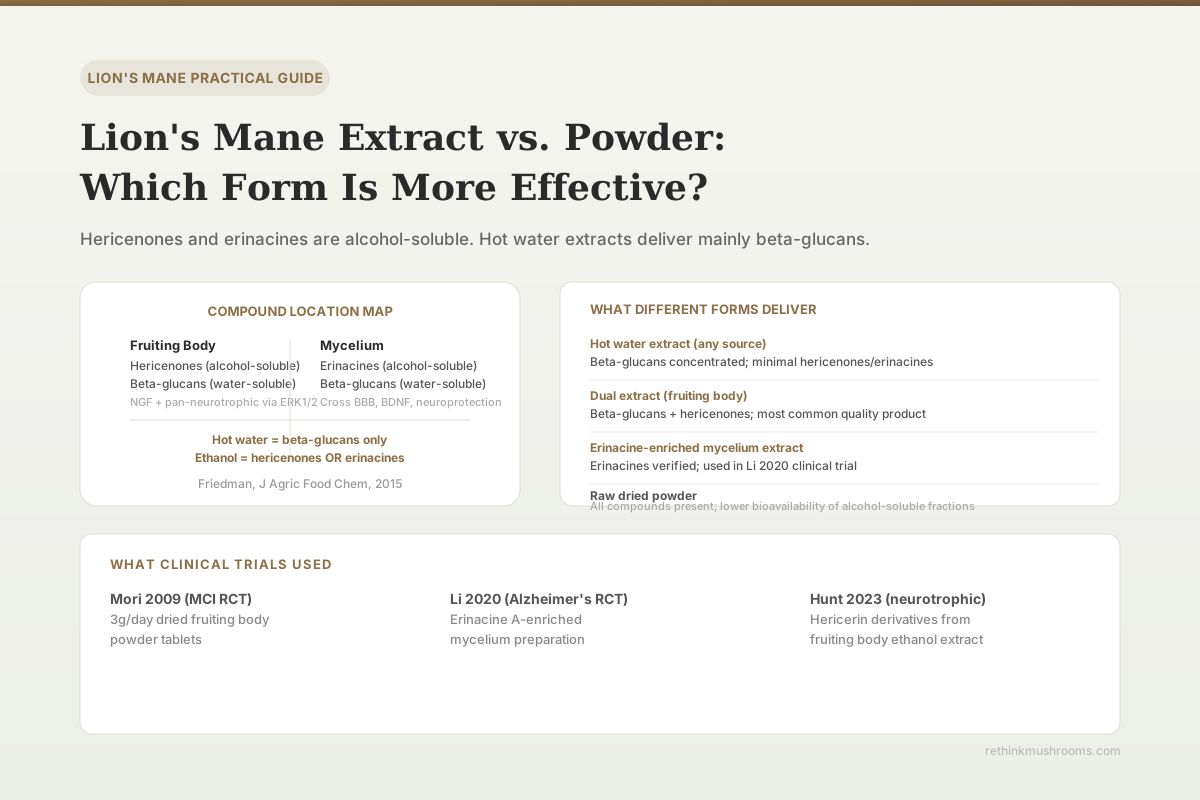
Hericenones (fruiting body) and erinacines (mycelium) are recovered in lipophilic, alcohol-soluble fractions. Hot water extraction concentrates beta-glucans, a different compound class from the neurologically studied ones.
Friedman, J Agric Food Chem, 2015
Hericenones
fruiting body only, lipophilic, NGF-stimulating in lab models
Erinacines
mycelium only, lipophilic; erinacine A confirmed active in the CNS in rats (Li 2018)
Beta-glucans
both parts, water-soluble, immune modulation
Friedman, J Agric Food Chem, 2015
 View as image ↗
Most people buying lion's mane extract vs. powder are trying to make a practical decision about which supplement to choose. What they rarely know is that the answer depends entirely on what compounds they want, and that a single chemistry fact determines almost everything: the neurologically active compounds in lion's mane are alcohol-soluble, not water-soluble.
This matters because most mass-market lion's mane supplements use either raw dried powder or hot water extraction. Both methods produce products with genuine active content, but they deliver different compounds in different concentrations. Understanding which compounds are in which part of the mushroom, and which extraction method releases them, is the practical knowledge that most supplement marketing obscures.
For the broader overview of what lion's mane contains and does, see What Is Lion's Mane Mushroom? A Science-Based Overview.
Key Takeaways
- Hericenones occur only in the lion's mane fruiting body and are recovered from lipophilic, non-aqueous fractions, so ethanol or dual extraction is what concentrates them (Friedman 2015; Wang 2025)
- Erinacines occur only in the lion's mane mycelium and are likewise lipophilic; of the erinacines, only erinacine A has confirmed pharmacological action in the central nervous system, demonstrated in rats (Li 2018)
- Beta-glucans are water-soluble and found in both the fruiting body and mycelium; hot water extraction concentrates them effectively
- A hot water extract delivers mainly beta-glucans; substrate choice and extraction method together drive a product's bioactive profile, with dual extraction using moderate ethanol concentrations outperforming single-solvent methods for lipophilic metabolites (Kała 2025)
- Clinical trials using erinacine A-enriched mycelium (Li 2020) used a specifically cultivated and extracted mycelium product, not standard fruiting body extract
- Fruiting body compounds and mycelium compounds act through different, separately studied routes: hericerin-related isoindolines drive neurite outgrowth via ERK1/2 signaling (Martínez-Mármol 2023), while erinacines show antioxidant, anti-inflammatory, and neurogenic effects in preclinical models (Spangenberg 2025)
- This article is educational and is not medical advice; lion's mane is not an approved treatment for any condition
The Fundamental Chemistry: Why Extraction Method Defines the Product
Medicinal mushroom compounds can be grouped by their solubility in different solvents, which determines which extraction methods will concentrate them.
Water-soluble compounds dissolve in hot water and are efficiently extracted by a hot water step. The primary water-soluble compounds in lion's mane are beta-glucans, a class of polysaccharides that provide immune-modulating effects. Beta-glucans are present in both the fruiting body and mycelium of lion's mane.
Alcohol-soluble compounds (also described as lipid-soluble or ethanol-soluble) are not efficiently extracted by water alone. They require ethanol or a similar solvent to dissolve and concentrate. The primary alcohol-soluble compounds in lion's mane are hericenones and erinacines, the two compound classes most directly associated with neurological effects.
Friedman's comprehensive 2015 review of Hericium erinaceus consolidated the scattered chemistry literature, cataloguing polysaccharides alongside secondary metabolites including erinacines, hericerins, and hericenones across fruiting bodies and mycelia.[1] Hericenones are aromatic isoindolinone compounds found specifically in the fruiting body. Erinacines are cyathane diterpenoids found specifically in the mycelium. Beta-glucans are found in both parts and are water-soluble.
The compartmentalization is not a marketing distinction; it traces back to the original isolation work. The Kawagishi group, which first characterized both compound families, reaffirmed in 2025 that hericenones C–H come from the fruiting bodies and erinacines A–I from the mycelia, and their analytical work recovered the hericenone series from the n-hexane-soluble fraction of the fruiting body.[2] That solvent detail is the practical crux: a compound family isolated in a nonpolar organic fraction is not a compound family that hot water pulls out efficiently.
Extraction chemistry has also been tested directly. Kała and colleagues in 2025 cultivated H. erinaceus fruiting bodies on different plant-based substrates and compared extraction methods head to head, finding that both variables meaningfully changed the resulting bioactive profile, and that dual extraction using moderate ethanol concentrations was the most effective approach for recovering key bioactive compounds.[3] One important limitation to note up front: the compounds Kała's team quantified were ergothioneine, lovastatin, L-phenylalanine, and ergosterol, not hericenones or erinacines. The study establishes that solvent choice governs which metabolites you recover; it does not itself measure hericenone yield.
This is the chemistry foundation for every practical decision about form. A product made only with hot water extraction is delivering primarily beta-glucans. A product made with ethanol or dual extraction from the fruiting body is positioned to deliver hericenones. A product made with ethanol extraction from mycelium is positioned to deliver erinacines. These are different products with different pharmacological profiles, even if they all say "lion's mane" on the label.
Hericenones: The Fruiting Body Compounds
Hericenones are found exclusively in the fruiting body of lion's mane. Chemically, they are aromatic isoindolinone compounds with varying side chains, and the hericenone series has been reported to stimulate NGF (nerve growth factor) synthesis both in vitro and in vivo.[2]
The case for fruiting body compounds was strengthened considerably by Martínez-Mármol and colleagues' 2023 study.[4] They purified two hericerin-related isoindoline compounds from the fruiting body, N-de phenylethyl isohericerin (NDPIH) and its hydrophobic derivative hericene A, and found both were highly potent at promoting axon outgrowth and neurite branching in cultured hippocampal neurons, even without serum. Mechanistically, NDPIH activated ERK1/2 signaling independently of the TrkB receptor, which is the pathway BDNF normally works through. The authors described this as a pan-neurotrophic pathway because it operates alongside, rather than through, conventional neurotrophin receptor signaling. Mice fed H. erinaceus crude extract and hericene A showed increased neurotrophin expression and significantly enhanced hippocampal memory.
Two caveats belong with that result. The neurite outgrowth findings are cell-culture work and the memory findings are in mice, so neither establishes an effect in people. The study also discloses funding from CNG-Bio, a company with a commercial interest in the compounds, which does not invalidate the work but is worth knowing.
The practical implication still holds: to get hericenone-type activity from a lion's mane supplement, you need a product made from the fruiting body with ethanol or dual extraction. NDPIH and hericene A were isolated as hydrophobic compounds, and a hot water-only fruiting body extract will deliver beta-glucans rather than this fraction.
For a deeper understanding of how hericenones drive NGF synthesis specifically, see Hericenones and NGF Synthesis: How Lion's Mane Stimulates Nerve Growth.
Erinacines: The Mycelium Compounds
Erinacines are cyathane diterpenoids found exclusively in the mycelium of lion's mane. Of the fifteen-plus erinacines characterized, one stands well apart from the rest: as Li and colleagues noted in their 2018 review, erinacine A is the only erinacine with confirmed pharmacological action in the central nervous system, demonstrated in rats.[5] That distinction is the basis for describing erinacine A as centrally active rather than only peripherally active, and it is worth holding onto: it applies to one specific compound, established in rats, and does not automatically extend to the other erinacines or to humans.
A 2025 systematic review by Spangenberg and colleagues synthesized the erinacine literature under PRISMA methodology, and it is worth being precise about its scope: it covers cellular and rodent models only.[6] Within that preclinical evidence base, the review found that H. erinaceus mycelial formulations and their derived erinacines produced dose-dependent benefits in motor, cognitive, and depression-like behaviours in animals, induced antioxidant responses, and activated pro-survival signaling. Erinacines A and C uniquely drove accumulation of Nrf2, a master regulator of the antioxidant response, and were also anti-inflammatory while enhancing neurogenesis and cell survival. These are genuinely promising mechanistic findings; they are not clinical outcomes.
Erinacine A has been the most studied individual erinacine compound, and it is not something standard processing delivers by default. The cultivation and extraction dependency is what Kała's 2025 substrate-and-solvent comparison demonstrates in general terms: both what the mushroom is grown on and how it is extracted materially change the bioactive profile of the finished material.[3] Standard mycelium powder, grown on grain substrate and then dried, is not equivalent to a verified erinacine A-enriched mycelium extract.
Chiu and colleagues in 2018 gave erinacine A-enriched mycelium orally to mice at 100, 200, or 400 mg/kg body weight per day for four weeks, using a repeated restraint stress model of depression.[7] The stress-induced behavioral and neurochemical changes were significantly reversed by the extract, with effects most consistent at the 200 and 400 mg/kg doses, and the extract activated BDNF/TrkB/PI3K/Akt/GSK-3β signaling while blocking NF-κB. Applying the standard body-surface-area scaling factor, the 400 mg/kg mouse dose corresponds to roughly 32 mg/kg in humans, or about 2.2 grams for a 70 kg adult. That number is an allometric conversion, not a dose that has been tested in a human trial, and it should be read as a rough order-of-magnitude reference point only. The study used mycelium extract, not fruiting body.
For a comprehensive look at erinacine pharmacology, see Erinacines: The Compounds That Cross the Blood-Brain Barrier.
What Different Lion's Mane Products Actually Contain
Understanding the chemistry translates into a practical product comparison. Here is what different common forms of lion's mane deliver:
Form → Compound Delivery
What each lion's mane product form can actually contain
Two of the three compound classes are locked to a single mushroom part, so no product delivers all three at concentration. “Absent” here means structurally absent, not merely low.
Beta-glucans
Hericenones
Erinacines
Human evidence
Hot water extract
fruiting body
No trial of this form
Ethanol / dual extract
fruiting body
No trial of this form
Raw dried powder
fruiting body
Mori 2009 · n=30 · 16 wk
Standard mycelium
powder or extract, grain-grown
No trial of this form
Erinacine A-enriched mycelium
cultivated + standardized
Li 2020 · pilot RCT
Only two forms in this table have been tested in people, and they were tested separately, in different populations, for different outcomes. No randomized trial has compared one form against another, so the rows are not ranked.
Sources: Friedman (2015) J Agric Food Chem, PMID 26244378; Wang et al. (2025) J Nat Prod, PMID 39723452; Kała et al. (2025) Molecules, PMID 40807268; Mori et al. (2009) Phytother Res, PMID 18844328; Li et al. (2020) Front Aging Neurosci, PMID 32581767.
Hot water extract (fruiting body or mycelium). Concentrates beta-glucans effectively. Some hericenones may be present in trace amounts from the fruiting body, but the primary pharmacological content is the immune-modulating polysaccharide fraction. The ratio on the label (4:1, 8:1, etc.) reflects concentration of total solids, not concentration of any specific active compound. Hot water extracts are appropriate for immune support applications where beta-glucans are the primary target.
Ethanol extract (fruiting body). Concentrates the lipophilic fruiting body fraction. If made from fruiting body material with an ethanol extraction step, this is the form positioned to deliver the hericenone and hericerin-related compounds studied by Martínez-Mármol 2023.[4] Products labeled "dual extract" or "full spectrum" that list fruiting body as the source with both water and ethanol extraction steps should contain both beta-glucans and the alcohol-soluble fraction.
Ethanol extract (mycelium, standard). If made from standard mycelium cultivation, this may contain some erinacines and beta-glucans. Whether it contains meaningful erinacine concentrations depends on the cultivation substrate and conditions. Mycelium grown on grain substrate often contains more grain starch than mushroom compounds; without independent verification of erinacine content, the amount cannot be assumed from the label.
Erinacine A-enriched mycelium extract. This is a specifically cultivated and processed form used in clinical trials like the Li 2020 Alzheimer's prevention study, a pilot double-blind placebo-controlled trial.[8] That trial used an erinacine A-enriched Hericium erinaceus mycelium preparation in which erinacine A content is verified and standardized. This is a different product category from standard mycelium powder or extract.
Raw dried powder (fruiting body or mycelium). Contains the compound classes native to that part of the mushroom in their natural proportions, without the concentration step an extract provides. The most relevant human evidence here is the Mori 2009 trial in adults aged 50 to 80 with mild cognitive impairment.[9] Participants took four 250 mg tablets containing 96% Yamabushitake dry powder three times daily, so 3 grams of tablets per day, for 16 weeks. The treatment group scored significantly higher on a cognitive function scale than placebo at weeks 8, 12, and 16. Two details matter for interpreting this: the trial randomized only 30 people into two groups of 15, and scores dropped significantly four weeks after participants stopped taking it. A single small trial with a washout reversal is suggestive rather than conclusive, but it is real evidence that dried powder at a sufficient daily dose is not inert.
Mori et al., 2009 · 16-week RCT + 4-week washout
The washout reversal: benefit tracks the dosing, not a permanent correction
- Wk 8 · significant vs placebo
- Wk 12 · significant
- Wk 16 · significant (peak, still dosing)
- Wk 16 + 4 · significant decline after stopping
Source: Mori et al., Phytotherapy Research 23(3):367–72 (2009), PMID 18844328. N = 30 (15 lion's mane, 15 placebo). Curve shows the reported direction and significance of change; the trial reported significance, not per-week HDS-R values, so the vertical axis is unnumbered.
What Clinical Trials Used: Form Matters for Interpreting Evidence
One of the most common errors in consumer lion's mane coverage is treating all clinical trial evidence as supporting "lion's mane" generically, without noting what form of lion's mane each trial used.
Evidence Tier × Mushroom Part
Every study tested one form. None tested them against each other.
Read down the ladder: the strongest evidence sits at the top, and the coloured tag on each row shows which part of the mushroom that evidence actually came from.
- Mori 2009·Human trialFruiting body
Dry powder tablets, 3 g/day, 16 wk
Cognitive scores significantly above placebo at wk 8, 12, 16 in 30 adults with mild cognitive impairment; benefit declined 4 wk after stopping.
- Li 2020·Human trialMycelium
Erinacine A-enriched mycelia
Pilot double-blind placebo-controlled study in early Alzheimer’s disease using a standardized erinacine A preparation.
- Chiu 2018·AnimalMycelium
Erinacine A-enriched mycelium, 100–400 mg/kg/day
Reversed restraint-stress depression-like behavior in mice, most consistently at 200–400 mg/kg, via BDNF/TrkB/PI3K/Akt/GSK-3β signaling.
- Martínez-Mármol 2023·Cell cultureFruiting body
Purified NDPIH and hericene A
Potent axon outgrowth and neurite branching in hippocampal neurons; ERK1/2 activation independent of TrkB; mice fed crude extract plus hericene A showed enhanced hippocampal memory.
- Spangenberg 2025·Review / synthesisMycelium
Erinacines across preclinical models
PRISMA systematic review: dose-dependent motor, cognitive and depression-like benefits in animals; erinacines A and C uniquely induced Nrf2. No human data included.
- Li 2018·Review / synthesisMycelium
Erinacine-enriched mycelia
Review concluding erinacine A is the only erinacine with confirmed pharmacological action in the central nervous system, shown in rats.
- Kała 2025·Lab chemistryFruiting body
Substrate × extraction method comparison
Dual extraction with moderate ethanol was most effective for recovering the bioactive metabolites measured; substrate and solvent both shaped the profile. Hericenones were not among the compounds quantified.
The two human trials used different mushroom parts, different preparations and different endpoints, so neither one validates the other's product category. Everything below them is animal, cell or chemistry work.
Sources by PMID: Mori 2009 (18844328); Li 2020 (32581767); Chiu 2018 (29364170); Martínez-Mármol 2023 (36660878); Spangenberg 2025 (40626304); Li 2018 (29951133); Kała 2025 (40807268). Tier assignment reflects the study design reported in each abstract, not an aggregate quality score.
The Li 2020 clinical study of erinacine A-enriched mycelium in early Alzheimer's prevention used a specifically prepared mycelium extract, not standard fruiting body extract and not raw powder.[8] A person buying a standard fruiting body supplement and expecting the same effects as the Li 2020 trial is comparing different products.
The Chiu 2018 antidepressant study used erinacine A-enriched mycelium extract, in mice.[7] The neurite outgrowth and hippocampal memory effects reported by Martínez-Mármol 2023 come from fruiting body compounds, not mycelium erinacines.[4] These are different mechanistic stories with different compound sources, and neither is interchangeable with the other.
The Spangenberg 2025 erinacines systematic review synthesizes preclinical evidence specifically for the mycelium compound class.[6] Citing this review to support a fruiting body product's neurological claims misapplies the evidence twice over: wrong mushroom part, and animal-model findings presented as if they were human outcomes.
Only one of the studies discussed in this article, Mori 2009, tested raw fruiting body powder in humans, and only Li 2020 tested erinacine A-enriched mycelium in humans.[9] Everything else on this page is cell culture or rodent work. That is the honest state of the form-versus-form evidence.
How to Read a Lion's Mane Supplement Label
A few label elements matter most for determining what a product delivers.
Source: fruiting body vs. mycelium. Products that clearly specify "fruiting body" or "mycelium" are providing the minimum necessary information. Products that say only "Hericium erinaceus" without specifying part may be ambiguous.
Extraction method. Look for "dual extract," "hot water and ethanol extract," or similar descriptions. A hot water-only extract from fruiting body will have limited hericenone content. An ethanol or dual extract will concentrate the alcohol-soluble compounds.
Beta-glucan content certification. Products that list beta-glucan percentage have had immune-modulating polysaccharide content independently verified. This is a quality marker.
Erinacine specification. Products claiming erinacine content should specify which erinacines are present (erinacine A, C, S, or others) and ideally at what concentration. Vague "erinacines" claims on a fruiting body product are incorrect; erinacines are not found in fruiting bodies.
The grain problem. Some mycelium products are cultivated on grain substrate (brown rice, oats) and then dried without separating the grain from the mycelium. The resulting product may contain significant grain starch alongside the mushroom compounds. Third-party testing is the only way to verify that mycelium biomass is primarily mushroom material.
What the Research Cannot Tell You About Form
Several important questions about form remain unanswered by the published literature.
Bioavailability of each compound class in humans has not been characterized. Absorption and brain penetration of erinacine A have been measured in rodents, but there are no published human pharmacokinetic studies establishing how much hericenone or erinacine reaches circulation, let alone brain tissue, from an oral supplement. Every statement about one form being "better absorbed" in humans is currently an inference from animal and chemical data.
No trial has ever compared forms head to head. This is the single largest gap, and it is worth stating plainly: there is no randomized trial giving one group fruiting body powder, another an ethanol fruiting body extract, and another erinacine A-enriched mycelium, then comparing outcomes. The comparisons in this article are assembled across separate studies with different populations, durations, and endpoints, which is a much weaker basis for inference than a direct comparison would be.
Optimal form for each application is unknown. Different compounds may be most relevant for different goals: erinacines for the antioxidant and neurogenic effects seen preclinically, hericenone-family compounds for neurite outgrowth signaling, beta-glucans for immune modulation. Whether the best product for cognitive aging differs from the best product for immune support has not been directly tested.
Standardized dosing by compound is not the norm. Most clinical trials specify the weight of extract or powder used, not the concentration of active compound. Comparing trials across forms and doses requires knowing both the form and the compound content, and both are rarely reported together.
A note on scope. Lion's mane is sold as a dietary supplement, not an approved treatment, and nothing here is medical advice. The conditions referenced in this article, including mild cognitive impairment, Alzheimer's disease, and depression, are diagnoses that require clinical care. If you are considering lion's mane for a health concern, or you take prescription medication, discuss it with a physician or pharmacist first rather than substituting a supplement for evaluation and treatment.
The Bottom Line
The distinction between lion's mane extract and powder is fundamentally a question of compound delivery. Hericenones (fruiting body) and erinacines (mycelium) are lipophilic compounds recovered from non-aqueous fractions, so ethanol or dual extraction is what concentrates them, while hot water extraction yields primarily beta-glucans. The clinical trial of erinacine A-enriched mycelium (Li 2020) and the neurite outgrowth work on hericerin-related compounds (Martínez-Mármol 2023) drew on different compound sources from different mushroom parts, and the second of those is animal and cell-culture research rather than human evidence. A product's pharmacological profile depends on which part of the mushroom it is made from and how it was extracted, not on the label's general "lion's mane" claim. No trial has directly compared forms against each other, so form selection is currently reasoned from chemistry rather than settled by outcome data.
Frequently Asked Questions
Sources & References
- 1RTHM-00371·Friedman, Mendel (2015). “Chemistry, Nutrition, and Health-Promoting Properties of Hericium erinaceus (Lion's Mane) Mushroom Fruiting Bodies and Mycelia and Their Bioactive Compounds..” Journal of agricultural and food chemistry.Study breakdown →PubMed →↩
- 2RTHM-02204·Wang, Junhong et al. (2025). “Uncovering Hericenones from the Fruiting Bodies of Hericium erinaceus through Interdisciplinary Collaboration..” Journal of natural products.Study breakdown →PubMed →↩
- 3RTHM-02103·Kała, Katarzyna et al. (2025). “Influence of Plant-Based Substrate Composition and Extraction Method on Accumulation of Bioactive Compounds in Hericium erinaceus (Bull.) Pers. Fruiting Bodies..” Molecules (Basel.Study breakdown →PubMed →↩
- 4RTHM-01746·Martínez-Mármol, Ramón et al. (2023). “Hericerin derivatives activates a pan-neurotrophic pathway in central hippocampal neurons converging to ERK1/2 signaling enhancing spatial memory..” Journal of neurochemistry.Study breakdown →PubMed →↩
- 5RTHM-00973·Li, I-Chen et al. (2018). “Neurohealth Properties of Hericium erinaceus Mycelia Enriched with Erinacines..” Behavioural neurology.Study breakdown →PubMed →↩
- 6RTHM-02184·Spangenberg, E T et al. (2025). “Unveiling the role of erinacines in the neuroprotective effects of Hericium erinaceus: a systematic review in preclinical models..” Frontiers in pharmacology.Study breakdown →PubMed →↩
- 7RTHM-00505·Chiu, Chun-Hung et al. (2018). “Erinacine A-Enriched Hericium erinaceus Mycelium Produces Antidepressant-Like Effects through Modulating BDNF/PI3K/Akt/GSK-3β Signaling in Mice..” International journal of molecular sciences.Study breakdown →PubMed →↩
- 8RTHM-00631·Li, I-Chen et al. (2020). “Prevention of Early Alzheimer's Disease by Erinacine A-Enriched Hericium erinaceus Mycelia Pilot Double-Blind Placebo-Controlled Study..” Frontiers in aging neuroscience.Study breakdown →PubMed →↩
- 9RTHM-00165·Mori, Koichiro et al. (2009). “Improving effects of the mushroom Yamabushitake (Hericium erinaceus) on mild cognitive impairment: a double-blind placebo-controlled clinical trial..” Phytotherapy research : PTR.Study breakdown →PubMed →↩