Lion's Mane Practical Use
4 weeks for benefits to reverse after stopping
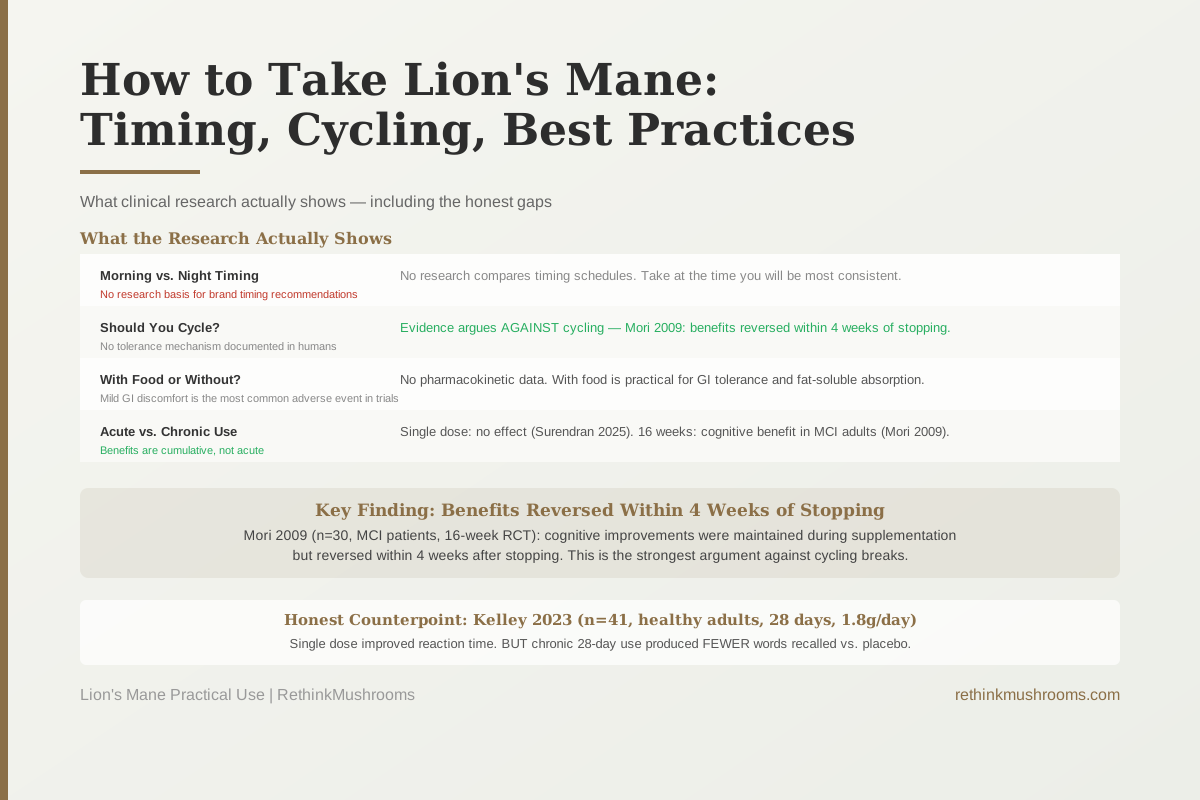
Mori 2009 found cognitive improvements in MCI patients reversed within 4 weeks of stopping lion's mane after 16 weeks of use, the strongest research argument against cycling breaks.
Mori et al., Phytotherapy Research, 2009
16 weeks
minimum effective trial duration in MCI research
no timing data
no trial has compared morning vs. night dosing
Kelley 2023
lower dose in healthy adults produced mixed results
Mori et al., Phytotherapy Research, 2009
 View as image ↗
Most articles about when and how to take lion's mane read like they were written with confident authority about a topic where very little data exists. Common advice includes taking it in the morning for focus, cycling it every four to eight weeks, and always taking it with food. Almost none of this comes from research.
This article is different. It starts from what the research actually shows, names what it does not show, and draws practical conclusions where they can be reasonably supported by the evidence that exists.
For a broader overview of lion's mane, see What Is Lion's Mane Mushroom? A Science-Based Overview.
Key Takeaways
- No published clinical trial has compared different timing schedules for lion's mane (morning versus evening, before versus after meals); timing advice from supplement brands is not research-based
- Mori and colleagues (2009, n=30) found that cognitive improvements in adults with mild thinking and memory problems reversed within 4 weeks of stopping lion's mane after 16 weeks of use, suggesting ongoing consistent use matters more than cycling breaks
- A single acute dose of lion's mane did not significantly improve cognitive performance or mood in healthy younger adults in a 2025 RCT (Surendran et al., Frontiers in Nutrition), supporting the case for chronic use rather than single-dose effects
- At 1.8g/day for 28 days, Kelley and colleagues (2023, n=41 healthy adults aged 18-45) found that daily lion's mane produced fewer words recalled versus placebo, a null-to-negative cognitive result in healthy young adults at this dose
- A 2024 systematic review of 34 human studies on mushrooms and thinking function (Rienks et al., Neuroscience and Biobehavioral Reviews) found mixed results for lion's mane, with response varying by dose, form, duration, and health status of participants
- Taking lion's mane with food is a reasonable practical choice to reduce the chance of the mild stomach discomfort reported in a minority of research participants, though no specific comparison of food versus fasted dosing has been published
What the Timing Research Actually Shows
The straightforward answer: no clinical trial has published data comparing lion's mane taken at different times of day, with or without food, or on different cycling schedules.
The trials that have produced positive results used daily dosing without specifying a particular time of day as a variable. Mori and colleagues ran their landmark 2009 trial with participants taking 3 grams of dried fruiting body powder per day for 16 weeks.[1] The follow-up Mori 2019 study similarly used consistent daily dosing over a multi-week period.[4] Neither trial reports when during the day participants took their doses.
Kelley and colleagues gave participants 1.8 grams per day for 28 days but do not specify dosing timing.[2]
Supplement brands recommend morning timing for "focus" and evening timing for "sleep" or "recovery." These are product-positioning choices, not evidence-based distinctions. The actual bioavailability of lion's mane compounds at different times of day has not been published in peer-reviewed literature.
Practical guidance based on what the research does show: take it at whatever time you are most likely to take it consistently. Consistency across weeks is what the evidence tracks, not the clock.
How Long to Take It: The Consistency Evidence
The clinical evidence base for lion's mane's cognitive effects comes almost entirely from trials of 12 to 16 weeks. Mori 2009 ran 16 weeks. Kelley 2023 ran 28 days. Surendran 2025 was a single-dose acute study.[3]
The single-dose acute study by Surendran and colleagues found no significant improvement in cognitive performance or mood in healthy younger adults from a single dose of standardized lion's mane extract. This is an important finding: it suggests that whatever benefits lion's mane produces are not acute, single-dose effects. They accumulate with consistent use over time.
This is consistent with the proposed mechanism. Lion's mane is thought to work by supporting the production of nerve growth factor (NGF), a protein that helps neurons (nerve cells) survive and form new connections. NGF-driven changes to the brain are structural and slow. They develop over weeks, not hours. If this mechanism explains the cognitive benefits seen in research, you would not expect a single dose to produce measurable effects, and Surendran 2025 confirms this expectation.
A 2024 systematic review by Rienks and colleagues reviewed 34 human studies on mushrooms and thinking and memory function, finding that effects on thinking and memory were mixed across lion's mane studies.[5] The variability in results across studies was attributable to differences in dose, product form, study duration, and the health status of participants. Shorter studies and healthy young adults showed less consistent benefit than longer studies in older adults with early memory or thinking problems.
The practical implication: if you are taking lion's mane for cognitive support, the trials that showed benefit ran for at least 12 weeks. Expecting results within 2 to 3 weeks is inconsistent with the evidence timeline.
Should You Cycle Lion's Mane? What the Stopping Data Shows
The research argues against cycling breaks, at least for individuals taking lion's mane for ongoing cognitive support.
Mori and colleagues followed participants after their 16-week trial ended and found that cognitive improvements reversed within 4 weeks of stopping supplementation.[1] The gains from 16 weeks of use were not maintained once dosing stopped. This pattern suggests that lion's mane does not produce lasting structural changes that persist indefinitely after the supplement is discontinued. The benefit appears to require continued supplementation to maintain.
If this finding reflects the true mechanism, then cycling breaks of 4 to 8 weeks (as commonly recommended by supplement brands) would likely erase much of what consistent use achieved, requiring several more weeks of use to rebuild. This is a common supplement marketing pattern with no research justification for lion's mane specifically.
The counterargument for cycling is typically that tolerance develops, requiring periodic breaks. There is no published research showing tolerance to lion's mane in humans. The compounds involved, primarily hericenones and erinacines, do not operate through receptor mechanisms known to produce tolerance in the way that stimulants or sedatives do.
Evidence-based position on cycling: the available research does not support mandatory cycling breaks. Consistent long-term use is more consistent with the evidence than cycling for the majority of people using lion's mane for cognitive support.
Morning or Night: What Individual Experience Should Guide
No research compares morning versus evening dosing. The honest answer is that neither timing is evidence-based.
People who find lion's mane stimulating (report feeling more alert or focused after taking it) may prefer morning dosing to avoid sleep disruption. People who find it calming or neutral may take it at any time. These are individual responses that the research does not characterize, and neither has been verified in a placebo-controlled setting.
Some reports suggest that lion's mane may improve the quality of deep sleep based on the involvement of NGF in sleep function, but this is speculative from mechanistic research and has not been tested as a dosing-time hypothesis in human trials.
The practical recommendation: take it at the same time each day to build a consistent habit. Whether that is morning, evening, or with a meal is secondary to whether you take it at all.
With Food or Without?
No published trial has specifically compared lion's mane absorption or efficacy with food versus without food.
The reason to take it with food is practical, not pharmacological: gastrointestinal discomfort (abdominal discomfort, nausea, mild diarrhea) was the most commonly reported adverse event in lion's mane trials, affecting a small minority of participants. Taking fat-soluble compounds, including the hericenones found in lion's mane fruiting bodies, with a meal that includes some fat is a reasonable approach to supporting absorption and reducing the chance of GI side effects.
This is not a research-based recommendation for lion's mane specifically; it is a general principle for supplements with known fat-soluble bioactive compounds. Until food-effect pharmacokinetics are published for lion's mane specifically, taking it with a meal is a reasonable default.
The Honest Complexity: When Lower Doses Produce Unexpected Results
One finding from recent research deserves specific attention because it complicates the standard narrative.
Kelley and colleagues ran a double-blind parallel-groups trial in 41 healthy adults aged 18 to 45, giving them either 1.8 grams per day of lion's mane extract or placebo for 28 days.[2] The acute single-dose results were promising: a single dose improved reaction time on the Stroop test (a task that measures how quickly someone can override an automatic response to name the color of ink when the ink color and the word don't match) at 60 minutes versus placebo.
But the 28-day chronic supplementation results were different. Participants who took lion's mane daily for 28 days recalled fewer words on a delayed word recall test than those taking placebo.
This is the only published clinical signal of a potential negative cognitive effect from lion's mane in healthy adults. The finding is from a single study with a moderate sample size. It may reflect population specificity (healthy young adults may respond differently than older adults with existing cognitive challenges), dose differences (1.8g versus the 3g used in Mori 2009), form differences, or statistical noise. The mechanism, if the effect is real, is not clear.
What it establishes clearly: lion's mane does not produce uniform positive cognitive effects in all populations at all doses. The research picture is more nuanced than marketing suggests.
For more on the evidence for lion's mane and cognitive function, see Lion's Mane and Cognitive Function: What the Research Shows. For how long to expect before seeing results, see How Long Does Lion's Mane Take to Improve Cognition?.
Dosing Depends on Form
An important caveat for all timing and dosing guidance: the form of lion's mane matters for how much you need.
3 grams of dried fruiting body powder (the form used in Mori 2009) is not equivalent to 3 grams of hot water extract, which is not equivalent to 3 grams of dual extract (both water and ethanol extraction), which is not equivalent to 3 grams of erinacine A-enriched mycelium preparation. Different forms contain different compounds in different concentrations and with different bioavailability.
Timing and cycling guidance is secondary to ensuring the form you are taking matches the form that produced research results for your intended goal. For a full breakdown, see Lion's Mane Extract vs. Powder: Which Form Is More Effective? and Lion's Mane Dosage Guide: How Much Should You Take?.
The Bottom Line
No clinical trial has specifically studied optimal timing or cycling for lion's mane. Mori 2009 found that cognitive benefits in adults with mild memory or thinking problems reversed within 4 weeks of stopping after 16 weeks of use, which is the strongest evidence argument against cycling breaks. A single acute dose did not improve cognition in healthy adults (Surendran 2025). At 1.8g/day for 28 days, Kelley 2023 found healthy young adults recalled fewer words versus placebo, a finding that adds complexity to the typical positive narrative. The practical guidance: take it consistently for at least 12 weeks, with food if GI sensitivity is a concern, at whatever time builds the most reliable habit.
Frequently Asked Questions
Sources & References
- 1RTHM-00165·Mori, Koichiro et al. (2009). “Improving effects of the mushroom Yamabushitake (Hericium erinaceus) on mild cognitive impairment: a double-blind placebo-controlled clinical trial..” Phytotherapy research : PTR.Study breakdown →PubMed →↩
- 2. Source details for this reference are not yet available.
- 3. Source details for this reference are not yet available.
- 4. Source details for this reference are not yet available.
- 5. Source details for this reference are not yet available.