Lion's Mane (Hericium erinaceus)
3g/day dried fruiting body powder for 16 weeks significantly improved cognition in MCI patients in the landmark RCT (Mori 2009)
Mori and colleagues established the most cited clinical dose: 3 grams per day of lion's mane powder in 30 elderly adults with mild cognitive impairment for 16 weeks produced significant cognitive improvements. Improvements reversed within 4 weeks of stopping supplementation.
Mori et al., Phytotherapy Research, 2009
1.8g/day risk
Kelley 2023: 1.8g/day for 28 days in healthy young adults produced fewer words recalled on delayed recall vs placebo, an honest null/negative counterpoint most supplement content ignores
form changes dose
500mg raw powder is not equivalent to 500mg dual extract or 500mg erinacine-enriched mycelium extract; the same dose number on the label does not mean the same bioactive delivery
healthy adults
the clinical evidence base is much thinner for healthy young adults without cognitive impairment; the strongest dose data comes from patients with existing deficits
Mori et al., Phytotherapy Research, 2009
 View as image ↗
Every lion's mane supplement label lists a serving size, typically 500mg to 1,000mg per capsule with a suggested 1-3 capsules per day. What very few labels tell you is where those numbers come from, which populations they apply to, or why the same dose might produce completely different effects depending on who is taking it and in what form.
The clinical research on lion's mane dosage how much to take is more specific and more honest than most product marketing acknowledges. Two randomized controlled trials have tested doses that work in specific populations. One has produced results that are largely hidden from consumer content because they complicate the marketing narrative.
This article covers what the clinical trials actually used, what effects were and were not found at those doses, why form matters enormously for dose equivalence, and what the evidence honestly does and does not support for healthy adults.
For the broader overview, see What Is Lion's Mane Mushroom? A Science-Based Overview. For the safety profile at various doses, see Lion's Mane Side Effects: What the Research Says About Safety.
Key Takeaways
- Mori and colleagues (Phytotherapy Research, 2009) found that 3g/day of lion's mane dried powder for 16 weeks significantly improved cognitive scores in 30 elderly adults with mild cognitive impairment; improvements reversed within 4 weeks of stopping, suggesting ongoing supplementation is required for sustained benefit
- Kelley and colleagues (Nutrients, 2023) found that 1.8g/day of lion's mane extract in 41 healthy young adults (aged 18-45) improved Stroop reaction time acutely (60 minutes post-dose) but produced significantly fewer words recalled on delayed word recall at 28 days versus placebo: a null-to-negative chronic outcome that most consumer content never mentions
- Surendran and colleagues (Frontiers in Nutrition, 2025) found no significant improvement in cognitive performance or mood from acute standardized lion's mane extract in healthy younger adults, supporting the view that chronic use is more reliable than single-dose effects for most populations
- Lu and colleagues (International Journal of Molecular Sciences, 2018) showed dose-dependent antidepressant effects from erinacine A-enriched mycelium at 100, 200, and 400 mg/kg in mice over 4 weeks via BDNF upregulation; using human equivalent dose scaling, 400 mg/kg mouse dose approximates 2.2g for a 70kg adult, providing a reference point for mycelium extract dosing
- A 2024 systematic review (Rienks 2024, Neuroscience and Biobehavioral Reviews) of 34 human mushroom studies found mixed results for lion's mane cognitive effects, noting that population characteristics, supplement form, and duration of use all modulate whether benefits appear
- The 2025 systematic review of lion's mane as a supplement (Zahra 2025) confirmed the generally excellent safety profile: adverse events across clinical studies were mild (abdominal discomfort, nausea, skin rash) and self-resolving at commonly used doses
What Clinical Trials Actually Used: The Dose Evidence
Rather than speculating about optimal doses, it is more useful to look at what doses the published clinical trials used and what they found. The table below summarizes the key human evidence.
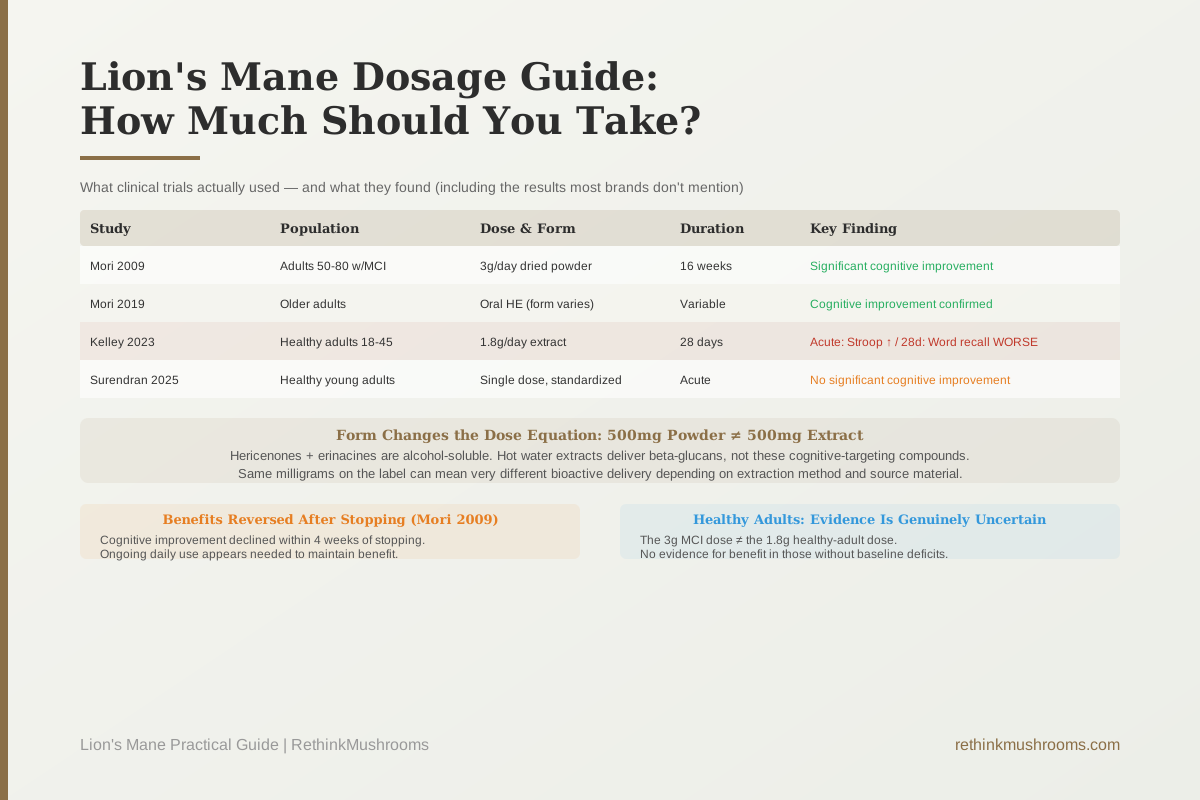
Clinical Trial Dose Summary:
| Study | Population | Dose | Form | Duration | Key Finding |
|---|---|---|---|---|---|
| Mori 2009 | Adults 50-80 with MCI | 3g/day | Dried powder tablets | 16 weeks | Cognitive improvement; reversed after stopping |
| Mori 2019 | Older adults | Not specified | Oral HE | Variable | Cognitive improvement confirmed |
| Kelley 2023 | Healthy adults 18-45 | 1.8g/day | Extract | 28 days | Acute Stroop improvement; FEWER words recalled at 28 days |
| Surendran 2025 | Healthy young adults | Not specified | Standardized extract | Single dose | No significant cognitive or mood improvement |
The honest reading of this table: the best-controlled clinical dose for cognitive improvement is 3g/day in MCI patients over 16 weeks. The dose tested in healthy young adults (1.8g/day) produced a concerning chronic cognitive signal, not a benefit, on one measure.
The 3g/Day Evidence: What Mori 2009 Established
Mori and colleagues conducted the landmark randomized controlled trial: 30 adults aged 50-80 with mild cognitive impairment were randomized to 3g/day of Hericium erinaceus dried powder (as three 250mg tablets taken four times daily) or placebo for 16 weeks.[1]
The cognitive results improved significantly and progressively over 8, 12, and 16 weeks. The most important detail about this dose: when supplementation stopped, the benefits reversed within 4 weeks. Cognitive scores in the lion's mane group returned toward baseline. This is evidence that the mechanism requires ongoing support: the brain changes produced by lion's mane appear to need continued neurotrophin stimulation to be maintained.
What the 3g/day dose was: dried whole fruiting body powder. This is a different product from an extract. At 3g/day of raw powder, patients were consuming approximately 3,000mg of material that included all the water-soluble and alcohol-soluble compounds in the fruiting body at whatever concentrations occur naturally. The total NGF-stimulating compound load would depend on the quality and potency of the raw material.
A follow-up study by Mori and colleagues published in Biomedical Research in 2019 confirmed cognitive function improvements from oral HE intake, providing additional consistency evidence for the cognitive benefit and the dosing approach.[5]
The 1.8g/Day Evidence: An Honest Look at Kelley 2023
Kelley and colleagues published a double-blind, parallel groups pilot RCT in Nutrients in 2023 using a different population and a different dose.[2]
The study enrolled 41 healthy young adults aged 18-45 with no cognitive impairment and randomized them to 1.8g/day of lion's mane extract or placebo for 28 days.
The acute finding (60 minutes after a single dose) was positive: Stroop reaction time improved significantly in the lion's mane group. This suggests a fast-acting cognitive effect in the short term, which is consistent with other acute studies.
The 28-day chronic finding was not positive. On delayed word recall, a measure of working memory, the lion's mane group recalled significantly fewer words than the placebo group at 28 days (p less than 0.001). The direction was wrong: the supplement group performed worse on a memory measure after a month of daily use.
Most lion's mane content ignores this finding because it complicates the standard marketing narrative. Including it here is deliberate: this is what the evidence shows at this dose in this population.
The interpretation is uncertain. Possible explanations include: healthy young adults without cognitive deficits may not benefit from lion's mane in the same way as those with existing impairment; 1.8g/day of extract may produce different effects than 3g/day of whole powder due to compound concentration differences; or the 28-day period may represent a transitional phase where some cognitive processes are disrupted before adapting. None of these explanations are established; they are hypotheses.
The practical takeaway: the evidence for lion's mane producing cognitive benefits in healthy young adults without baseline impairment is genuinely uncertain. The dose that works in MCI patients (3g/day) is different from the dose tested in healthy adults (1.8g/day), and the forms are different.
The Null Result in Healthy Adults: Surendran 2025
Surendran and colleagues published a 2025 double-blind randomized placebo-controlled trial in Frontiers in Nutrition testing a standardized lion's mane extract in healthy younger adults.[3]
A single acute dose produced no significant improvement in cognitive performance or mood versus placebo. This is a null result for acute, single-dose effects in healthy young adults.
Together with Kelley 2023, the pattern emerging from healthy young adult studies is that: (1) acute single-dose effects may be unreliable or absent in people with already-adequate cognitive function; (2) chronic use produces a mixed picture with at least one negative cognitive signal. This does not mean lion's mane does nothing in healthy adults, but it does mean the evidence is weaker than for populations with existing deficits.
Why Form Changes the Dose Equation
A critical dimension of the dosage question that most content ignores: 500mg of raw dried lion's mane powder is not pharmacologically equivalent to 500mg of a standardized ethanol extract, which is also not equivalent to 500mg of erinacine A-enriched mycelium extract.
Lu and colleagues published a 2018 study in the International Journal of Molecular Sciences showing dose-dependent antidepressant-like effects from erinacine A-enriched mycelium in mice at 100, 200, and 400 mg/kg over 4 weeks via BDNF upregulation.[7] Using standard human equivalent dose (HED) scaling, the mouse dose of 400 mg/kg body weight approximates 32 mg/kg human equivalent, or approximately 2.2g for a 70kg adult. This is specific to erinacine A-enriched mycelium extract, not to raw powder.
Why the distinction matters: hericenones and erinacines, the compounds primarily responsible for the neurological effects, are alcohol-soluble. They are not efficiently extracted by hot water. Raw dried powder contains them at natural concentrations but with limited bioavailability in a food matrix. Ethanol or dual extraction concentrates these compounds significantly. Erinacine-enriched mycelium is a specifically cultivated and extracted product.
When a supplement label says "500mg lion's mane," it is telling you the weight of the material in the capsule. It is not telling you:
- Whether the material is fruiting body, mycelium, or both
- Whether it was extracted (and if so, with what solvent) or is raw dried powder
- What the hericenone or erinacine content is
- What extraction ratio was used (a 10:1 extract would concentrate active compounds differently than a 4:1)
The 2024 systematic review by Rienks and colleagues in Neuroscience and Biobehavioral Reviews, which covered 34 human studies on mushrooms and neurocognition, noted that supplement form and population characteristics both modulate whether benefits appear.[6] The mixed results in lion's mane human trials are partly a product of this heterogeneity in what is being tested.
For the compound-by-form breakdown in detail, see Lion's Mane Extract vs. Powder: Which Form Is More Effective?.
The Safety Context: What Adverse Events Have Been Reported
The 2025 systematic review by Zahra and colleagues, the most comprehensive current synthesis of lion's mane supplement evidence, documented the adverse events reported across clinical trials: abdominal discomfort, nausea, skin rash, and mild diarrhea in a small minority of participants, all mild and self-resolving.[4]
No serious adverse events have been attributed to lion's mane at the doses used in clinical trials (1.8g-3g/day). The safety profile across published studies is generally excellent. The one clinical adverse cognitive signal is the Kelley 2023 negative word recall finding, which is a different category of concern (a potential effect on memory, not a safety event).
What the Evidence Says for Different Populations
Adults with mild cognitive impairment: The strongest dose evidence is 3g/day of lion's mane fruiting body powder for 16 weeks (Mori 2009). This is the only population-and-dose combination with a rigorous RCT showing clear cognitive benefit. The improvement reversed after stopping, so ongoing use appears necessary.
Healthy young adults without cognitive impairment: The evidence is genuinely uncertain. Acute single-dose effects are inconsistent across studies (positive in Kelley 2023 acutely, null in Surendran 2025). Chronic 28-day use at 1.8g/day produced a negative working memory signal in one study. The consumer-facing claim that lion's mane "improves focus and memory" in healthy adults is not robustly supported by the current RCT evidence.
Erinacine A applications (AD prevention, mood): The animal data using erinacine A-enriched mycelium suggests effective doses around 2.2g human equivalent at the high end of the tested range, with dose-dependent effects. Clinical trials using this specific form (Li 2020 early AD, Lu 2018 depression model) use mycelium preparations that are not interchangeable with whole fruiting body powder.
Is 500mg enough? At the doses studied in clinical trials (1.8-3g), 500mg is substantially below the range that produced effects in MCI patients. If a supplement provides 500mg per capsule, achieving the 3g/day RCT dose would require six capsules daily. Whether lower doses produce proportional partial effects is not established by the current evidence.
The Bottom Line
Clinical trials have used 1.8g/day (Kelley 2023, healthy young adults) and 3g/day (Mori 2009, MCI patients) as the primary tested doses. The 3g/day dose produced significant cognitive improvements in MCI patients over 16 weeks, reversing after stopping. The 1.8g/day dose in healthy young adults produced acute Stroop improvements but significantly worse delayed word recall at 28 days. Surendran 2025 found null acute effects in healthy younger adults with standardized extract. Form matters significantly: raw powder, ethanol extract, and erinacine-enriched mycelium deliver different compound profiles at the same label dose. The evidence for healthy adults without cognitive impairment is genuinely uncertain.
Frequently Asked Questions
Sources & References
- 1RTHM-00165·Mori, Koichiro et al. (2009). “Improving effects of the mushroom Yamabushitake (Hericium erinaceus) on mild cognitive impairment: a double-blind placebo-controlled clinical trial..” Phytotherapy research : PTR.Study breakdown →PubMed →↩
- 2. Source details for this reference are not yet available.
- 3. Source details for this reference are not yet available.
- 4. Source details for this reference are not yet available.
- 5. Source details for this reference are not yet available.
- 6. Source details for this reference are not yet available.
- 7. Source details for this reference are not yet available.