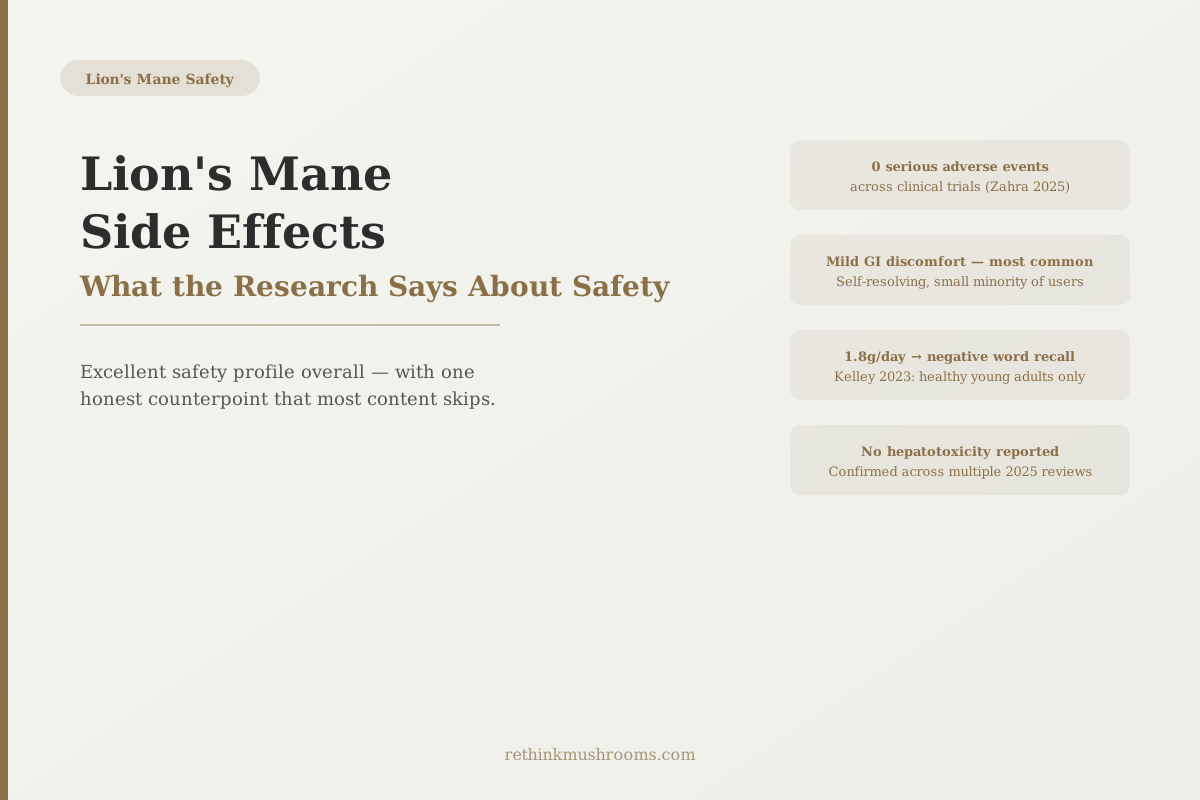
Lion's Mane Safety
0 serious adverse events
No serious adverse events have been reported across lion's mane clinical trials. The 2025 systematic review of benefits, side effects, and uses confirmed this safety profile across human studies.
Zahra et al., 2025
Mild GI
Most common side effect — abdominal discomfort or nausea in a small minority of users
1.8g/day
Dose at which Kelley 2023 found a negative word recall signal in healthy young adults
No liver risk
No hepatotoxicity reports across clinical studies; confirmed by multiple 2025 reviews
Zahra et al., 2025
 View as image ↗
Lion's mane has one of the better-documented safety profiles of any medicinal mushroom. Multiple clinical trials, two independent 2025 systematic reviews, and a patient-advocacy safety assessment have all reached the same conclusion: serious adverse events are absent, and mild side effects occur in a small minority of users at rates that often aren't meaningfully different from placebo.
That said, an honest account of lion's mane side effects and safety includes one surprising finding from a 2023 RCT that doesn't appear in most consumer content.
This article covers what clinical research actually shows about lion's mane safety — the adverse events documented, the drug interactions that are theoretical vs. established, the one cognitive finding worth knowing about, and the populations where data is absent. For an overview of dosing and what forms are studied, see lion's mane dosage guide: how much should you take? and lion's mane extract vs. powder: which form is more effective?. For a foundational overview of the full lion's mane research profile, see our science-based lion's mane overview.
Key Takeaways
- The 2025 systematic review by Zahra et al. — the most comprehensive current safety synthesis — confirmed no serious adverse events across lion's mane clinical trials; mild adverse events (GI discomfort, nausea, skin rash) occurred in a small minority
- Kelley et al. (2023), in a 41-person RCT, found that chronic dosing at 1.8g/day for 28 days produced FEWER words recalled on delayed word recall testing vs. placebo in healthy young adults — the only clinical adverse cognitive signal in the literature
- Surendran et al. (2025) found that a single acute dose of standardized lion's mane extract did not significantly improve cognitive performance or mood vs. placebo in healthy young adults, a null result relevant to safety assessment
- No hepatotoxicity (liver damage) has been reported across lion's mane clinical studies; multiple 2025 reviews confirm this
- Theoretical drug interactions include blood thinning (based on in vitro platelet studies, no clinical reports) and blood glucose lowering (animal data exists, relevant if on diabetes medications)
- ALSUntangled (2024), an independent patient-advocacy review group examining lion's mane for ALS patients, found no reports of serious adverse events — a notable third-party safety assessment for a fragile population
Lion's Mane Side Effects: The 2025 Safety Review Verdict
The most current and comprehensive synthesis of lion's mane safety is Zahra et al. (2025), a systematic review covering benefits, side effects, and uses of Hericium erinaceus as a supplement across multiple clinical studies.[1]
The review's safety findings: lion's mane has a favorable safety profile. Adverse events reported across trials were mild and self-resolving. No serious adverse events were documented. The most common side effects cited were abdominal discomfort, nausea, mild diarrhea, and skin rash — all at low incidence rates.
This is the honest answer to "what are the side effects of lion's mane mushroom?": mild gastrointestinal discomfort in a small minority of users, with rare skin reactions, and no evidence of serious organ-level harm.
Nguyen et al. (2025), a systematic review covering Hericium erinaceus therapeutic potential across multiple conditions, reached consistent safety conclusions — confirming that the research community's consensus positions lion's mane as a safe supplement with an excellent adverse event profile.[3] Ahmed et al. (2025), reviewing neuroprotective, antioxidant, anti-inflammatory, and antimicrobial properties of lion's mane, also confirmed this favorable safety picture across both preclinical and clinical data.[6]
Three 2025 reviews, all independently reaching the same conclusion. That convergence is meaningful.
What Adverse Events Have Actually Been Reported
Not all side effects are equal. The distinction between "a clinical trial reported this event" and "this event was significantly more common than placebo" matters considerably.
In lion's mane trials, the adverse events most commonly documented include:
Abdominal discomfort and nausea: Reported in some participants across multiple trials. In several studies, the rate was not statistically different from placebo — meaning the GI symptoms may be unrelated to lion's mane in at least some cases. That said, some individuals do experience mild GI upset, and taking lion's mane with food is generally recommended to reduce this.
Mild diarrhea: Reported occasionally, typically at higher doses. Self-resolving in all documented cases.
Skin rash: Reported in a small number of participants. More commonly seen in case reports than systematic trials, and at least some cases may involve contact sensitization from handling raw dried lion's mane rather than from oral consumption specifically.
Mild dizziness or headache: Reported rarely, without consistent pattern across trials.
What has NOT been reported across clinical studies: liver enzyme elevation, kidney dysfunction, cardiovascular events, serious neurological symptoms, or any evidence of organ toxicity.
The Honest Finding You Won't See in Brand Content
Kelley et al. (2023) conducted a double-blind, parallel-groups pilot RCT in 41 healthy young adults aged 18-45 who received either 1.8g/day of lion's mane or placebo for 28 days.[4]
The study found two things:
-
A single acute dose improved Stroop reaction time at 60 minutes post-consumption (p=0.005) — a positive cognitive signal.
-
Chronic 28-day supplementation at 1.8g/day resulted in significantly FEWER words recalled on a delayed word recall test compared to placebo (p<0.001).
The second finding — worse delayed word recall in the chronic dosing group — is the only clinical adverse cognitive signal in the lion's mane literature. It appears in a peer-reviewed RCT published in Nutrients, in healthy young adults, at a dose (1.8g/day) commonly recommended by supplement brands.
The reason this matters: supplement content virtually never mentions it. It complicates the narrative. It is also a real finding that deserves transparent reporting, particularly for healthy young adults who are the primary market for many lion's mane supplements.
What to make of it: the participants in Kelley 2023 were healthy young adults without cognitive impairment — a different population from the MCI patients who benefited in Mori 2009 (3g/day, 16 weeks). It is possible that lion's mane affects memory consolidation differently in healthy adults than in people with existing cognitive decline. It is also possible that this finding doesn't replicate. Either way, it is a data point worth knowing.
Surendran et al. (2025) provide additional context: their RCT testing acute effects of a standardized lion's mane extract in healthy younger adults found no significant improvement in cognitive performance or mood vs. placebo.[5] This null result (no benefit in a single acute dose in healthy young adults) aligns with the Kelley 2023 chronic null/negative finding and suggests that the benefit profile of lion's mane in healthy young adults may be more limited than in older adults with cognitive decline.
Liver Safety: What the Evidence Shows
Liver damage is a concern with many herbal supplements — some have well-documented hepatotoxicity. Lion's mane does not. No reports of liver enzyme elevation or hepatotoxicity have appeared in clinical lion's mane trials. Multiple 2025 reviews explicitly confirm this absence.[1][6]
This is not the same as saying lion's mane is definitively safe for all liver conditions. Clinical trials are limited in duration (typically 8-16 weeks) and sample size. Long-term (years) liver safety data does not exist because long-term trials have not been conducted for any specific outcome.
What the current evidence supports: at the doses and durations studied in clinical trials, no liver signal has emerged. This is a favorable safety observation, not a permanent clearance.
Drug Interactions: What the Evidence Establishes
Consumer content often lists drug interactions for lion's mane with excessive confidence in either direction — either dismissing all interaction risk ("completely safe with all medications") or warning against use with entire drug categories. The actual evidence is more specific.
Blood thinning (anticoagulant and antiplatelet interactions): In vitro (cell culture) studies have found that certain lion's mane extracts affect platelet aggregation. However, no clinical report of abnormal bleeding or altered anticoagulant effect in humans taking lion's mane alongside blood thinners has been documented. This interaction is theoretical — based on in vitro data — and has not been confirmed in clinical trials. Caution is appropriate for people on anticoagulants like warfarin or direct oral anticoagulants, not because harm is established but because the in vitro signal warrants monitoring.
Blood glucose lowering: Animal studies have found blood glucose-lowering effects from certain lion's mane extracts. If this effect operates in humans at supplement doses, it could theoretically add to the glucose-lowering effect of diabetes medications. No human reports of hypoglycemia attributed to lion's mane have been documented. For people on insulin or oral hypoglycemic medications, this theoretical interaction warrants awareness.
Immunomodulatory interactions: Lion's mane has mild immunomodulatory effects. Whether these interact with immunosuppressant medications (used in organ transplant, autoimmune conditions, or some MS treatments) has not been studied. The interaction is neither established nor ruled out.
Allergy: Who Is at Risk and How
Allergic reactions to lion's mane are possible, particularly in individuals with known mushroom allergies. Two distinct sensitization routes exist:
Oral sensitization: Consuming lion's mane can produce allergic symptoms (skin rash, respiratory symptoms) in mushroom-sensitive individuals. Rare case reports exist; systematic incidence rates are not established.
Contact/inhalation sensitization: Handling or inhaling dried raw lion's mane powder appears to be a more direct sensitization route than oral consumption. Some of the skin rash reports in case literature involve growers or handlers of lion's mane rather than oral supplement users.
If you have a known mushroom allergy, starting with a small test dose before regular supplementation is appropriate. If you develop skin rash, itching, or respiratory symptoms after starting lion's mane, discontinuing and consulting a physician is appropriate.
Pregnancy and Breastfeeding: The Honest Evidence Gap
No clinical studies have assessed lion's mane safety in pregnant or breastfeeding women. The absence of evidence is not evidence of safety.
Standard practice for any supplement without pregnancy-specific safety data is to avoid use during pregnancy and breastfeeding unless specifically indicated by a healthcare provider. This applies to lion's mane. The recommendation is not based on known harm — it's based on the absence of the data needed to establish safety for this population.
An Independent Safety Assessment: ALSUntangled 2024
The ALSUntangled Group is an independent patient advocacy organization that evaluates treatments of interest to ALS (amyotrophic lateral sclerosis) patients — a fragile population with limited treatment options and high stakes for safety assessment. Their 2024 review of lion's mane specifically evaluated whether it was safe and worth investigating for ALS.[2]
Their finding on safety: no reports of serious adverse events from lion's mane in humans were identified. This third-party review, conducted by a patient-advocacy group with no commercial stake in the outcome, independently confirms the clinical trial safety data.
Why this matters beyond ALS: ALS patients are often more vulnerable to adverse effects than healthy adults, may have impaired liver or kidney function, and are frequently on medications. A safety review that concludes "no serious adverse events found" for this population is a stronger safety signal than a review of generally healthy trial participants alone.
For details on dosing information and timing recommendations grounded in the clinical evidence, see how to take lion's mane: timing, cycling, and best practices. For understanding how form affects both dosing and safety profiles, see lion's mane extract vs. powder: which form is more effective?. For how long clinical trials found before effects appeared, see how long does lion's mane take to improve cognition?.
The Bottom Line
Lion's mane has an excellent clinical safety profile: no serious adverse events across trials, no hepatotoxicity, and mild GI symptoms as the most common side effect. The 2025 systematic review by Zahra et al. is the definitive current source. One finding deserves transparent reporting: Kelley et al. (2023) found chronic dosing at 1.8g/day in healthy young adults produced fewer words recalled on delayed recall testing versus placebo — the only adverse cognitive signal in the literature, and one that is absent from virtually all consumer lion's mane content. Theoretical drug interactions (blood thinning, blood glucose lowering) have not been confirmed in human clinical data.
Frequently Asked Questions
Sources & References
- 1. Source details for this reference are not yet available.
- 2. Source details for this reference are not yet available.
- 3. Source details for this reference are not yet available.
- 4. Source details for this reference are not yet available.
- 5. Source details for this reference are not yet available.
- 6. Source details for this reference are not yet available.