Mushrooms and Chemotherapy Side Effects
0 human trials on mushrooms for chemo nausea
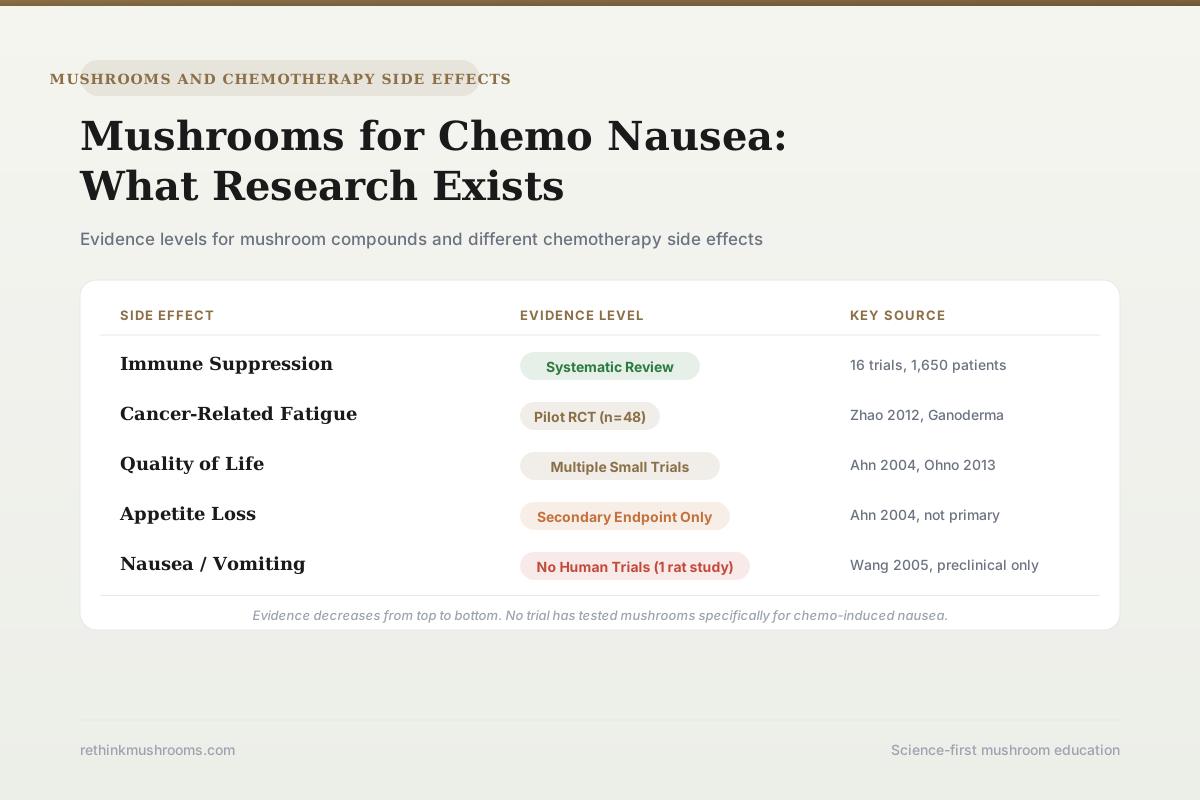
No clinical trial has specifically tested whether mushroom extracts reduce chemotherapy-induced nausea and vomiting. The existing evidence is about general quality of life and immune function during cancer treatment.
Steimbach et al., Clinical Nutrition, 2021
16 trials
of mushroom compounds during cancer treatment (QoL/immune)
NK cells
increased by Agaricus blazei during chemo (Ahn, 2004)
1 rat study
on Ganoderma lucidum and cisplatin-induced nausea
Steimbach et al., Clinical Nutrition, 2021
 View as image ↗
The question "can mushrooms reduce nausea from chemotherapy?" has a straightforward answer: we do not know, because no clinical trial has tested it. Chemotherapy-induced nausea and vomiting (CINV) is one of the most feared side effects of cancer treatment, and anti-emetic drugs (5-HT3 receptor antagonists like ondansetron, NK-1 receptor antagonists like aprepitant, and corticosteroids) are highly effective at controlling it. The mushroom-and-cancer literature contains dozens of trials, but they focus on immune function, quality of life, fatigue, and survival, not specifically on nausea. The closest evidence is a single rat study testing Ganoderma lucidum extract against cisplatin-induced nausea, and a handful of human trials that measured appetite and general side effects as secondary outcomes. This article lays out what exists and, equally, what does not. For the full landscape of mushroom research during chemotherapy, see mushrooms for chemotherapy side effects: what the research shows.
Key Takeaways
- No human clinical trial has specifically tested mushroom extracts as antiemetics for chemotherapy-induced nausea and vomiting
- In 100 gynecological cancer patients on chemotherapy, Agaricus blazei extract improved appetite, emotional stability, and general weakness as secondary outcomes, alongside significantly higher NK cell activity (Ahn et al., 2004)
- A pilot clinical trial in 48 breast cancer patients found Ganoderma lucidum spore powder improved cancer-related fatigue, anxiety, depression, and quality of life after 4 weeks, but did not specifically measure nausea (Zhao et al., 2012)
- A systematic review of 16 clinical trials (1,650 patients) found mushroom beta-glucans were safe during cancer treatment and reduced immune depression from chemotherapy in most studies (Steimbach et al., 2021)
- Lentinan from shiitake combined with chemotherapy improved quality of life scores and reduced chemotherapy side effects in advanced lung and gastric cancer across 12 years of Chinese clinical studies (Zhang et al., 2018)
- One animal study found Ganoderma lucidum extract reduced cisplatin-induced kaolin consumption (a proxy for nausea in rats) in a dose-dependent manner, but this has never been replicated or tested in humans (Wang et al., 2005)
Why No One Has Studied This Directly
The absence of mushroom-for-nausea trials is not an accident. Three factors explain the gap.
First, modern anti-emetic drugs are highly effective. Three-drug regimens combining a 5-HT3 antagonist, an NK-1 antagonist, and dexamethasone control acute CINV in 70 to 90% of patients receiving highly emetogenic chemotherapy. The clinical need for an adjunctive anti-nausea agent is less pressing than it was 30 years ago, when CINV was the most distressing aspect of chemotherapy for most patients.
Second, the mushroom research community has focused on immune modulation and survival as primary endpoints. Japanese and Chinese clinical trials of PSK and lentinan were designed to demonstrate survival benefits that would justify regulatory approval as adjunctive cancer drugs. Nausea was not their primary concern.
Third, demonstrating an anti-emetic effect in a clinical trial requires careful control for the powerful anti-emetic drugs patients are already receiving. Any mushroom effect on nausea would need to be detectable on top of standard anti-emetic therapy, which is a much harder bar to clear than showing an effect versus placebo in patients receiving no anti-emetics.
What the Clinical Trials Actually Measured
Ahn 2004: Agaricus blazei During Gynecological Cancer Chemotherapy
Ahn et al. (2004) enrolled 100 cervical, ovarian, and endometrial cancer patients receiving carboplatin-based chemotherapy. Patients in the treatment group (n = 39) consumed Agaricus blazei Murill Kyowa (ABMK) extract orally during at least three chemotherapy cycles. The control group (n = 61) received chemotherapy without ABMK.[1]
The primary finding was that NK cell activity was higher in the ABMK group (P < 0.002). The secondary finding, and the one most relevant to the nausea question, was that "chemotherapy-associated side effects such as appetite, alopecia, emotional stability, and general weakness were all improved by ABMK treatment." This is the closest any mushroom trial comes to demonstrating a specific anti-nausea effect, and it is still indirect: appetite improvement does not mean nausea reduction, and the side effects were assessed as a bundle rather than individually with validated nausea scales. The study was not blinded or placebo-controlled, which means expectation effects could account for the side-effect improvements.
Zhao 2012: Ganoderma lucidum Spore Powder for Cancer-Related Fatigue
Zhao et al. (2012) randomized 48 breast cancer patients with cancer-related fatigue undergoing endocrine therapy to receive Ganoderma lucidum spore powder or placebo for 4 weeks. The experimental group showed statistically significant improvements in physical well-being and the fatigue subscale of the FACT-F questionnaire. Patients also reported less anxiety, less depression, and better overall quality of life. Immune markers associated with cancer-related fatigue were lower in the treatment group. No serious adverse effects occurred.[2]
This trial is relevant because fatigue and nausea are closely intertwined during cancer treatment; patients who are less fatigued often report less nausea, and vice versa. The quality-of-life improvement could reflect a general reduction in treatment burden that includes gastrointestinal symptoms. But the trial did not measure nausea directly, and the patients were receiving endocrine therapy (which causes different side effects than cytotoxic chemotherapy), so the results cannot be extrapolated to chemotherapy-induced nausea. For more on mushrooms and cancer-related fatigue, see medicinal mushrooms and chemo-related fatigue.
Ohno 2011 and 2013: Agaricus blazei Phase I and Quality of Life
Ohno et al. (2011) conducted a phase I safety study of Agaricus blazei Murill dietary supplement in cancer patients in remission, establishing safety at standard doses.[3] The follow-up 2013 study reported quality of life improvements among cancer patients consuming Agaricus blazei extract, including better physical and emotional well-being scores.[4]
Neither study tested the mushroom during active chemotherapy or measured nausea as an endpoint. They are relevant primarily for establishing that Agaricus blazei supplementation is safe in cancer patients, which is a prerequisite for any future nausea trial.
Lentinan: Side Effect Reduction During Chemotherapy
Zhang et al. (2018) reviewed 12 years of Chinese clinical studies on lentinan (from shiitake) as an adjunct to chemotherapy for lung cancer. In addition to the survival improvements (median survival extended from 178 to 245 days), the review reported improved quality of life scores and reduced chemotherapy side effects in lentinan groups. The side effects encompassed a broad category that includes nausea, but the review did not break out nausea specifically from other gastrointestinal, hematologic, and constitutional side effects.[5]
The Steimbach et al. (2021) systematic review of 16 clinical trials of fungal beta-glucans during cancer treatment reached a similar conclusion: beta-glucans reduced treatment-induced immune depression and improved general tolerability, but anti-nausea effects were not a discrete endpoint in any trial.[6]
For an overview of immune recovery support during chemotherapy, see mushrooms and chemotherapy-induced neutropenia: recovery support.
The One Preclinical Study on Nausea
Wang et al. (2005) is the only study in the mushroom literature that directly tested anti-nausea effects. In the rat pica model (rats cannot vomit, so they eat non-nutritive substances like kaolin clay as a proxy for nausea), cisplatin injection induced significant kaolin consumption. Pre-treatment with Ganoderma lucidum (SunRecome) extract reduced kaolin consumption in a dose-dependent manner across doses of 1, 3, and 10 mg/kg (P < 0.01), suggesting an anti-emetic or anti-nausea effect.[9]
The kaolin pica model the authors used is a standard preclinical screen for anti-emetic activity, and cisplatin-induced pica is itself driven substantially by gut serotonin (5-HT) release, the same pathway that ondansetron and other 5-HT3 receptor antagonist anti-emetics block. That makes a dose-dependent reishi effect biologically plausible, but the study itself did not characterize a specific receptor mechanism, and it has not been replicated or followed up with human trials in the two decades since publication.
Safety During Cancer Treatment
Safety is not a trivial question. Mukai et al. (2006) reported a case in which Agaricus blazei supplementation may have induced severe hepatic dysfunction in cancer patients. The case involved patients with advanced cancer and existing liver disease, and the causal relationship was not definitively established, but it raised the concern that mushroom supplements could interact with the hepatic metabolism of chemotherapy drugs.[7]
The broader safety data from the Steimbach systematic review and the Ohno phase I trial are reassuring: across 16 trials and more than 1,650 patients, fungal beta-glucans were well-tolerated without serious adverse events attributable to the mushroom compounds. Johnson et al. (2009) showed that Agaricus blazei extract stimulated cytokine and chemokine production without pathological immune activation in human blood, suggesting a modulatory rather than inflammatory immune effect.[8]
The Gap Between Claim and Evidence
Online sources frequently claim that reishi, turkey tail, or other medicinal mushrooms "help with chemotherapy side effects including nausea." This framing conflates three distinct levels of evidence:
- Established: Mushroom beta-glucans are safe during cancer treatment and can support immune function during chemotherapy (multiple trials, systematic review level evidence).
- Suggestive: Some mushroom extracts improve general quality of life, appetite, and fatigue during or after cancer treatment (small trials, secondary endpoints, inconsistent blinding).
- Unsubstantiated: Mushrooms reduce chemotherapy-induced nausea and vomiting (no human trial, one rat study).
From General to Specific
The Evidence Shrinks as the Claim Narrows
Mushroom research during chemotherapy is strongest for safety and immune support, weaker for general quality of life, and almost absent for nausea itself. Bar width reflects how much direct evidence backs each claim — narrower toward the top means closer to the exact “reduces chemo nausea” question, but less and weaker data behind it.
Safety & immune support during chemo
Is it safe? Does it help immunity?Steimbach 2021 · Ohno 2011
Best-supported layer: across 16 trials and 1,650+ patients, fungal beta-glucans were safe and reduced treatment-induced immune depression; phase I data confirm tolerability of Agaricus blazei in cancer patients
General quality of life, appetite, fatigue
Does it ease the experience?Ahn 2004 · Zhao 2012 · Zhang 2018
Small trials with secondary endpoints: Agaricus blazei improved appetite and general well-being (n=100); Ganoderma spore powder improved fatigue and QoL (n=48); lentinan improved QoL alongside survival — none isolated nausea
Nausea specifically
Does it reduce nausea?Wang 2005 (rats only)
A single preclinical study: Ganoderma lucidum extract dose-dependently reduced cisplatin-induced kaolin intake (a nausea proxy) in rats at 1, 3 and 10 mg/kg (p < 0.01) — never replicated, never tested in humans
Human anti-emetic trial
The open questionDoes not yet exist
No clinical trial has tested any mushroom extract as an antiemetic against chemotherapy-induced nausea and vomiting — the honest limit of the claim, not a result
How to read it: each step up is a more specific claim with less behind it. “Mushrooms are safe during chemo” is well supported; “mushrooms improve how you feel” is suggestive; “mushrooms reduce nausea” rests on one rat study; and the top tier — a human antiemetic trial — simply does not exist. The gap is the point.
Sources: Ahn 2004 [1]; Zhao 2012 [2]; Ohno 2011 [3]; Zhang 2018 [5]; Steimbach 2021 [6]; Wang 2005 [9]. Bar widths are illustrative of evidence depth and specificity, not quantitative effect sizes.
The leap from "improved quality of life" to "reduces nausea" is not justified by the existing data. Nausea is a specific physiological response mediated by serotonin receptors in the gut and chemoreceptor trigger zone in the brain. A general immune-boosting or adaptogenic effect does not necessarily translate to anti-emetic activity. The Wang 2005 rat study suggests it might, but a single animal study from two decades ago without human follow-up is not a basis for clinical claims.
What a Proper Trial Would Look Like
If a research group wanted to definitively test whether mushrooms reduce chemotherapy nausea, the trial would need several design features that no existing study has incorporated.
Population: Patients receiving moderately or highly emetogenic chemotherapy regimens (cisplatin-based, anthracycline-cyclophosphamide, etc.) where residual nausea occurs despite standard three-drug anti-emetic prophylaxis. This is the population with the greatest unmet need.
Intervention: A standardized, pharmaceutical-grade mushroom extract with documented bioactive content (beta-glucan percentage, triterpene content for Ganoderma, specific compound quantification). Over-the-counter supplements vary too widely for reproducible results.
Control: Placebo, with both groups receiving identical standard anti-emetic therapy.
Primary endpoint: Validated nausea assessment tools such as the MASCC Antiemesis Tool or the FLIE questionnaire, measured in both acute (0 to 24 hours) and delayed (24 to 120 hours) phases of CINV.
Duration: Multiple chemotherapy cycles, because CINV patterns change across treatment (anticipatory nausea develops in later cycles).
Blinding: Double-blind, which is achievable with encapsulated mushroom preparations.
Until a trial with these features is conducted, the question of whether mushrooms reduce chemotherapy nausea will remain unanswered. The biological plausibility exists (serotonin pathway modulation, anti-inflammatory effects, gut microbiota modulation), but plausibility without clinical testing is not evidence.
For a broader overview of all mushroom research relevant to the chemotherapy experience, see mushrooms for chemo side effects: nausea, fatigue, and immune recovery research.
The Bottom Line
No clinical trial has tested mushroom extracts specifically for chemotherapy-induced nausea and vomiting. The existing evidence shows that mushroom compounds (Agaricus blazei, Ganoderma lucidum, lentinan, PSK) are safe during cancer treatment and can improve general quality of life, immune function, and fatigue. One rat study suggested Ganoderma lucidum extract may reduce cisplatin-induced nausea through serotonin pathway modulation, but this has never been tested in humans. Claims that mushrooms reduce chemo nausea outrun the available evidence.
Frequently Asked Questions
Sources & References
- 1RTHM-00066·Ahn, W-S et al. (2004). “Natural killer cell activity and quality of life were improved by consumption of a mushroom extract, Agaricus blazei Murill Kyowa, in gynecological cancer patients undergoing chemotherapy..” International journal of gynecological cancer : official journal of the International Gynecological Cancer Society.Study breakdown →PubMed →↩
- 2RTHM-00276·Zhao, Hong et al. (2012). “Spore Powder of Ganoderma lucidum Improves Cancer-Related Fatigue in Breast Cancer Patients Undergoing Endocrine Therapy: A Pilot Clinical Trial..” Evidence-based complementary and alternative medicine : eCAM.Study breakdown →PubMed →↩
- 3RTHM-00229·Ohno, Satoshi et al. (2011). “Phase I Clinical Study of the Dietary Supplement, Agaricus blazei Murill, in Cancer Patients in Remission..” Evidence-based complementary and alternative medicine : eCAM.Study breakdown →PubMed →↩
- 4RTHM-00299·Ohno, Satoshi et al. (2013). “Quality of life improvements among cancer patients in remission following the consumption of Agaricus blazei Murill mushroom extract..” Complementary therapies in medicine.Study breakdown →PubMed →↩
- 5RTHM-00538·Zhang, Yiran et al. (2018). “Lentinan as an immunotherapeutic for treating lung cancer: a review of 12 years clinical studies in China..” Journal of cancer research and clinical oncology.Study breakdown →PubMed →↩
- 6RTHM-00719·Steimbach, Laiza et al. (2021). “Fungal beta-glucans as adjuvants for treating cancer patients - A systematic review of clinical trials..” Clinical nutrition (Edinburgh.Study breakdown →PubMed →↩
- 7RTHM-00105·Mukai, Hirofumi et al. (2006). “An alternative medicine, Agaricus blazei, may have induced severe hepatic dysfunction in cancer patients..” Japanese journal of clinical oncology.Study breakdown →PubMed →↩
- 8RTHM-00157·Johnson, E et al. (2009). “Effect of an extract based on the medicinal mushroom Agaricus blazei murill on release of cytokines, chemokines and leukocyte growth factors in human blood ex vivo and in vivo..” Scandinavian journal of immunology.Study breakdown →PubMed →↩
- 9RTHM-02269·Wang, C-Z et al. (2005). “Effects of ganoderma lucidum extract on chemotherapy-induced nausea and vomiting in a rat model..” The American journal of Chinese medicine.Study breakdown →PubMed →↩