Mushrooms & Chemotherapy Side Effects
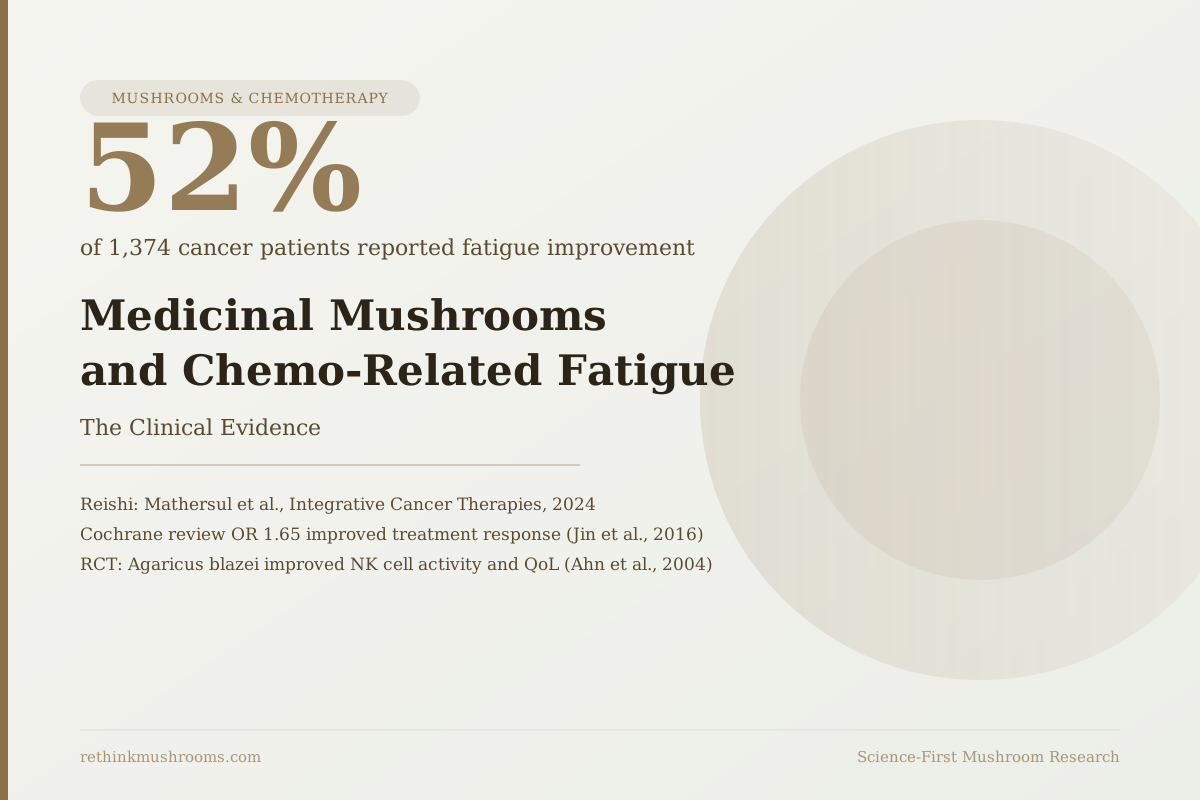
52% of surveyed cancer patients
In a 2024 cross-sectional survey of 1,374 cancer patients taking Reishi mushroom alongside conventional treatment, 52% reported their fatigue had improved quite a bit or very much. This is the largest patient-reported outcomes dataset on mushrooms and cancer fatigue published to date.
Li et al., Integrative Medicine Research, 2024
1,374
cancer patients surveyed
55%
reported nausea improvement
RR 1.50
Reishi patients more likely to respond to chemo, though the 95% CI (0.90-2.51) crosses 1 (Cochrane, 2016)
Li et al., Integrative Medicine Research, 2024
 View as image ↗
Roughly 80 percent of people on chemotherapy develop what oncologists call cancer-related fatigue. It is not tiredness. It is a persistent, bone-deep exhaustion that does not improve with rest, can last for months after treatment ends, and affects work, relationships, and daily function in ways ordinary tiredness does not. Standard medicine has limited tools: exercise therapy helps some patients, corticosteroids are used in advanced cases, and treating underlying anemia resolves fatigue in others. For many patients, it is something to endure.
In 2024, researchers published the largest patient-reported dataset on medicinal mushrooms and chemo fatigue ever collected. A survey of 1,374 cancer patients using Reishi mushroom found that 52% said their fatigue had improved significantly. That finding, from an observational study rather than a controlled trial, raised a question worth examining carefully: what does the clinical research actually show about medicinal mushrooms and chemo-related fatigue?
This article reviews the full evidence: the landmark 2024 Reishi survey, the proposed biological mechanism, the controlled trial data from Agaricus blazei, the Cochrane review findings, and what multiple systematic reviews conclude. For the broader picture of how mushrooms interact with chemotherapy across all side effect categories, see the complete guide to medicinal mushrooms in cancer care.
Key Takeaways
- A 2024 cross-sectional survey of 1,374 cancer patients found 52% reported significant fatigue improvement while taking Reishi mushroom alongside conventional treatment (Li et al., Integrative Medicine Research, 2024)
- The Cochrane systematic review of Reishi (Jin et al., 2016) found that patients combining Reishi with chemotherapy or radiotherapy were about 50% more likely to respond to their treatment (relative risk 1.50), though the 95% confidence interval (0.90 to 2.51) crossed 1; no included trial recorded long-term survival, so a survival benefit remains unproven
- A 2004 randomized controlled trial in 100 gynecologic cancer patients found Agaricus blazei extract increased NK cell activity and improved quality of life including reduced fatigue during active chemotherapy (Ahn et al., International Journal of Gynecological Cancer, 2004)
- Cancer-related fatigue is driven largely by pro-inflammatory signaling molecules (TNF-alpha and IL-6); the triterpenes and beta-glucans in Reishi appear to modulate the same pathways, which is the proposed biological basis for fatigue reduction
- Narayanan et al.'s 2023 systematic review of clinical mushroom studies (Current Oncology Reports) found favorable effects on quality of life and reduced chemotherapy toxicity across multiple species, with adverse effects predominantly grade 2 or lower (mainly nausea, vomiting, and diarrhea)
- The evidence is promising but limited: most studies are observational or small-scale, Reishi is the best-studied species for fatigue specifically, and no trial has compared mushrooms head-to-head against standard fatigue interventions such as exercise therapy or corticosteroids
Cancer-Related Fatigue Is Not Ordinary Tiredness: Why the Distinction Matters
Cancer-related fatigue (CRF) is a clinical condition, not a feeling. Oncologists define it as persistent, overwhelming physical and mental exhaustion that is disproportionate to recent activity and does not improve with rest. A person who is ordinarily tired feels better after a good night's sleep. A person with CRF does not.
The primary biological driver is inflammatory. When chemotherapy destroys cancer cells, it also damages healthy tissue. That damage triggers the release of pro-inflammatory signaling molecules, particularly tumor necrosis factor-alpha (TNF-alpha) and interleukin-6 (IL-6). These are chemicals the immune system uses to coordinate responses to injury. In cancer patients on chemotherapy, these signals stay elevated for extended periods. High, sustained concentrations of TNF-alpha and IL-6 cause fatigue, pain, disrupted sleep, and difficulty concentrating.
This distinction matters for understanding the mushroom evidence because several active compounds in medicinal mushrooms appear to interact with the same cytokine pathways that drive cancer-related fatigue. Reishi specifically contains two well-characterized compound classes: ganoderic acids, which are triterpene molecules with documented anti-inflammatory properties, and beta-glucans, which are large, sugar-based polysaccharides that interact with receptors on immune cells and modulate the amount of inflammatory signal those cells produce.
Whether that laboratory-level interaction translates into clinical fatigue reduction in cancer patients is what the human studies below are trying to establish.
The 2024 Reishi Survey: 1,374 Cancer Patients Report What Happened
The most striking data point in the mushroom-and-fatigue literature comes from Li and colleagues, published in Integrative Medicine Research in 2024.[1]
The researchers surveyed 1,374 cancer patients who were already using Reishi mushroom alongside conventional cancer treatment. They asked how symptoms had changed across multiple categories. The results:
- 52% reported fatigue improved quite a bit or very much
- 55% reported nausea improved
- 51% reported appetite improved
- 50% reported depression improved
The scale is what makes this study significant for this question. No prior study on mushrooms and cancer symptoms had collected data from more than a few hundred patients. Fourteen hundred patients reporting consistent, multi-symptom improvement is a dataset large enough to take seriously, even given its limitations.
The limitations are real. This was a survey of people who were already using Reishi and continued using it, not a randomized trial with a control group. People who found the supplement unhelpful may have stopped using it before the survey. People who notice benefit from something are also more likely to continue using it and report on it. Both of these dynamics can inflate apparent benefits in a survey like this. The improvements were self-reported, not measured with validated clinical instruments.
Those limitations explain uncertainty about the size of the effect, not the direction. The consistency across four symptom categories (fatigue, nausea, appetite, depression) all improving in roughly half of patients suggests the finding is not a quirk of how one question was phrased. And the scale of the dataset puts it in a different category from the single-center trials that dominate this literature.
The Li 2024 survey is the strongest observational signal we have for mushrooms and cancer fatigue. It is not proof. It is a large, clear signal pointing in a consistent direction.
Why Reishi Might Help: The Cytokine Pathway and the Treatment Response Connection
The biological case for Reishi and cancer fatigue works through two distinct pathways.
The Cytokine Loop
How Mushrooms Are Proposed to Ease Chemo Fatigue
Cancer-related fatigue runs on a sustained inflammatory signal. Medicinal mushrooms are proposed to act on the same loop from two angles: dampening the signal directly, and restoring the immune cells whose suppression keeps the signal elevated.
Reishi ganoderic acids + beta-glucans
Reduce TNF-alpha / IL-6 production and shift immune cells toward a less inflammatory state — turning down the alarm at step 2.
Laboratory / mechanistic
Restored natural killer (NK) cell activity
When chemotherapy suppresses NK cells, the body compensates with more inflammation. Restoring NK activity lets that inflammation resolve, easing fatigue downstream.
Ahn 2004 RCT (n=100): higher NK activity + less fatigue
This is the proposed biological basis, not a demonstrated causal chain. The cytokine-lowering effects come largely from laboratory work, and whether they translate into meaningful fatigue reduction in patients is exactly what the limited human evidence is still trying to establish.
Mechanism synthesis; NK-cell arm from Ahn et al. 2004 (see references)
The direct pathway: cytokine modulation. Reishi's ganoderic acids have been shown in laboratory studies to reduce TNF-alpha and IL-6 production. Its beta-glucans bind to receptors on immune cells, shifting those cells toward a less inflammatory state. Both effects are directly relevant to cancer-related fatigue, which is driven by the same inflammatory molecules. If Reishi reduces the sustained elevation of TNF-alpha and IL-6 in cancer patients on chemotherapy, it could reduce fatigue as a downstream consequence.
The indirect pathway: improved treatment response. This angle connects to the Cochrane review data in a way that is easy to miss. Jeitler and colleagues' 2020 narrative review of medicinal mushrooms in integrative oncology found that, across the controlled trials they examined, mushroom preparations improved quality of life and immune function (including natural killer cell activity) when given alongside conventional treatment.[6] The proposed interpretation runs as follows: if mushrooms help the immune system respond more effectively to chemotherapy, patients may achieve the same clinical outcome with lower cumulative drug exposure. Lower cumulative chemotherapy means lower cumulative toxicity, and cancer-related fatigue is substantially a function of cumulative toxicity. This is a mechanistic hypothesis, not a demonstrated causal chain.
Jin and colleagues' 2016 Cochrane systematic review of Reishi for cancer put numbers to this concept.[4] Pooling five randomized controlled trials, the review found that patients who received Reishi alongside conventional chemotherapy or radiotherapy were more likely to respond to their treatment than those receiving conventional therapy alone: a relative risk of 1.50 (95% CI 0.90 to 2.51). In plain terms, that is roughly 50% higher odds of a positive tumour response when Reishi was added, though the confidence interval crossing 1 means the result did not reach conventional statistical significance and should be read as suggestive rather than definitive. Two points of honesty about this figure matter. First, no included trial recorded long-term survival, so the review could not establish whether Reishi prolongs life, and it explicitly concluded that a survival benefit remains uncertain. Second, the Cochrane authors judged the methodological quality of the underlying trials to be generally low.
That quality caveat matters. But the direction of effect is worth noting: Reishi appeared to enhance rather than undermine conventional treatment response, running counter to the assumption that a supplement might interfere with chemotherapy efficacy. For the mechanistic picture of how mushroom polysaccharides interact with the immune system at the cellular level, see how mushroom polysaccharides work during cancer treatment.
Agaricus Blazei in 100 Gynecologic Cancer Patients: NK Cells and Fatigue During Chemo
The most methodologically rigorous human study measuring fatigue and quality of life in cancer patients taking a mushroom supplement comes from Ahn and colleagues, published in the International Journal of Gynecological Cancer in 2004.[2]
One hundred women with cervical, ovarian, or endometrial cancer undergoing chemotherapy were randomized to receive either Agaricus blazei Murill Kyowa (ABMK) extract alongside standard chemotherapy, or standard chemotherapy alone. Researchers measured both biological markers and patient-reported quality of life outcomes.
The biological result: NK cell activity was significantly higher in the ABMK group by the end of treatment. NK cells (natural killer cells) are front-line immune cells that target cancer cells and are particularly vulnerable to the broad immune suppression that chemotherapy causes. When chemotherapy suppresses NK cells, the immune system loses one of its primary ways to efficiently resolve inflammatory threats. The ABMK group maintained better NK cell function throughout treatment.
The quality of life result: patients in the ABMK group reported less nausea, less vomiting, less appetite loss, less hair-loss-related distress, less emotional instability, and less fatigue compared to the chemotherapy-alone group.
The NK cell and fatigue connection is worth spelling out. When NK cells are suppressed, the immune system compensates by keeping inflammatory signaling elevated. Elevated inflammatory signaling is the primary driver of cancer-related fatigue. Restoring NK cell activity may allow that sustained inflammation to resolve, reducing fatigue as a downstream effect. The mechanism is indirect but biologically coherent.
Ahn et al. (2004) · International Journal of Gynecological Cancer
- Population
- 100 women with cervical, ovarian, or endometrial cancer undergoing chemotherapy
- Intervention
- Agaricus blazei Murill Kyowa (ABMK) extract, taken orally alongside standard carboplatin-based chemotherapy
- Comparator
- Standard chemotherapy alone
- Finding
- Natural killer cell activity was significantly higher in the ABMK group (ANOVA, n=39, P < 0.002). Patients in the ABMK group also reported less nausea, vomiting, appetite loss, hair-loss distress, emotional instability, and fatigue than the chemotherapy-alone group.
positive The strongest controlled evidence in this dataset for a mushroom improving fatigue during active treatment, but limited: single center, one species, one cancer category, no long-term follow-up.
Ahn et al. (2004), International Journal of Gynecological Cancer
The study limitations are significant: 100 patients in a single center, one mushroom species, one category of cancer, one measurement approach. But as a randomized controlled trial in real patients during active chemotherapy, it is the strongest controlled evidence in this dataset for a mushroom supplement improving fatigue during treatment. For more on the immune recovery dimension of mushroom research during cancer treatment, see the article on mushrooms and chemotherapy-induced neutropenia.
What Three Systematic Reviews Find Across Multiple Species
Three systematic reviews, each approaching the evidence from a different angle, reach broadly consistent conclusions about mushrooms and chemotherapy quality of life.
Narayanan et al., 2023 (Current Oncology Reports). The most methodologically selective of the three, Narayanan's team included only human clinical studies, excluding laboratory and animal data, and identified 39 qualifying studies covering 12 different mushroom preparations.[3] Across those studies, they found favorable effects on quality of life and symptom burden (reported in 14 studies), positive immunological responses (11 studies), and reduction in chemotherapy toxicity. Reported adverse effects were predominantly grade 2 or lower, mainly nausea, vomiting, diarrhea, and muscle pain. The reviewers concluded the evidence was not yet sufficient to recommend mushrooms as routine adjuncts, but the consistently positive direction across multiple studies and species was notable. Quality of life and symptom burden were among the domains showing improvement.
Dan et al., 2023 (Cureus). A scoping review focused specifically on gastric, breast, and colorectal cancers, which screened more than 2,200 articles and selected nine human studies for final review.[5] The included studies evaluated Lentinus edodes (Shiitake, the source of lentinan), Coriolus versicolor (Turkey Tail, the source of PSK), and Agaricus sylvaticus, reporting effects on symptoms, medication side effects, anti-tumor activity, and survival outcomes. Dan's team found that medicinal mushrooms reduced chemotherapy adverse effects and supported immune function across these cancer types. Lentinan is approved as a pharmaceutical adjuvant drug in Japan, and PSK is used in the adjuvant setting in Japanese oncology.
Jeitler et al., 2020 (Frontiers in Pharmacology). A narrative review of medicinal mushrooms in integrative oncology that examined eight controlled clinical trials of whole-spectrum mushroom preparations (including Agaricus blazei, Coriolus versicolor, and Ganoderma lucidum) given during or after conventional cancer treatment.[6] The reviewers reported beneficial effects on quality of life and reduction of the adverse effects of conventional therapy, along with positive immunomodulation such as increased natural killer cell activity. They were candid about the limits: adverse events were poorly reported, with gastrointestinal reactions and reduced platelet counts occurring in some cases, and they stressed an urgent need to investigate the safety and possible interactions of medicinal mushrooms.
The common thread: multiple reviewers examining different evidence sets reach the same conclusion about direction (positive, with adverse effects that were generally mild), while agreeing that the evidence is not yet mature enough to support routine clinical recommendations. For the broadest synthesis of how different mushroom species compare across all chemo side effect categories, see mushrooms for chemo side effects: nausea, fatigue, and immune recovery.
The Honest Assessment: What the Evidence Does and Doesn't Establish
The evidence for medicinal mushrooms and chemo-related fatigue points consistently in one direction. The quality of that evidence is another matter.
- Cell & Lab Studiescompleted
Ganoderic acids and beta-glucans shown to reduce TNF-alpha and IL-6 signaling and shift immune cells toward a less inflammatory state
- Animal Studiescompleted
Cytokine modulation and immune effects documented in rodent models
- Observational Datacompleted
Large cross-sectional survey: Li 2024 (n=1,374) reported 52% fatigue, 55% nausea, 51% appetite, 50% depression improvement with Reishi
- Small Randomized Trialscurrent
Ahn 2004 (n=100) RCT: improved NK cell activity and quality of life including fatigue during chemotherapy
- Large / Head-to-Head RCTmissing
No large trial, and none comparing mushrooms against standard fatigue interventions (exercise therapy, corticosteroids, ESAs)
- Meta-Analysiscurrent
Jin 2016 Cochrane pooled 5 RCTs (RR 1.50, 95% CI 0.90-2.51, not significant, low quality); three systematic reviews exist but none is fatigue-specific
The mechanism and observational signal are strong, and one supportive RCT and a Cochrane meta-analysis exist. But the meta-analysis pooled low-quality trials and did not reach significance, and no large or head-to-head trial has tested mushrooms specifically against standard cancer-fatigue treatments. The direction is promising; the rigor is not yet there.
Assessment based on Li 2024, Ahn 2004, Jin 2016 Cochrane, and Narayanan/Dan/Jeitler 2020-2023 reviews
What the evidence establishes. A large observational dataset (n=1,374) shows that more than half of cancer patients who use Reishi while on conventional treatment perceive meaningful fatigue improvement. A randomized controlled trial (n=100) shows quality of life improvement including fatigue in gynecologic cancer patients taking Agaricus blazei extract during chemotherapy. The Cochrane review shows a signal toward higher treatment response rates when Reishi is added (RR 1.50), which has indirect implications for fatigue through reduced cumulative toxicity, though that result did not reach statistical significance. Three systematic reviews report a consistently positive direction across species, with adverse effects that were predominantly mild (grade 2 or lower) at clinical doses.
What the evidence does not establish. No randomized controlled trial has compared Reishi or any other mushroom supplement against the standard interventions for cancer-related fatigue: exercise therapy, corticosteroids, erythropoiesis-stimulating agents for anemia, or mindfulness-based stress reduction. No study has established the optimal mushroom species, dose, or duration of use specifically for fatigue. The Cochrane review itself judged the methodological quality of the underlying studies to be generally low.
Where the uncertainty matters most. Cancer-related fatigue is multifactorial. A patient whose fatigue is primarily driven by anemia (low red blood cells reducing oxygen delivery) may not benefit from cytokine modulation. A patient whose fatigue reflects depression or severely disrupted sleep needs different interventions. The mushroom evidence addresses immune and inflammatory mechanisms, not the full range of causes. Whether those mechanisms are the dominant driver of fatigue in any given patient is something the existing research cannot answer at the individual level.
The evidence warrants taking this question seriously as an active research area. It does not yet support strong clinical claims. That gap is where the research currently stands.
Safety: What Cancer Patients Should Know
The safety profile of medicinal mushrooms at clinical doses appears broadly favorable based on the evidence reviewed here, though with an important caveat: adverse-event reporting in these studies was often incomplete. Across the three systematic reviews, reported adverse effects were predominantly mild (grade 2 or lower, mainly nausea, vomiting, and diarrhea), with reduced platelet counts noted in some cases, and the Ahn 2004 randomized trial found no safety signals in the ABMK group during active chemotherapy.[2]
Two specific concerns are worth naming clearly for cancer patients.
Interaction with immunosuppressant drugs. The mechanism behind the potential benefits of medicinal mushrooms is immune activation: mushrooms stimulate and enhance immune cell activity. Patients who take immunosuppressant drugs (used to prevent organ rejection after transplants, or to manage certain autoimmune conditions that sometimes coexist with cancer) may find that mushroom supplements work against the immunosuppressive effect they need. This is a pharmacological concern based on mechanism, not a documented clinical problem at typical supplement doses, but it is grounds for disclosure to an oncologist before use.
Hepatotoxicity at high doses. Long-term use of Agaricus blazei or Reishi at high doses has been associated with elevated liver enzymes in case reports outside the clinical trial setting. The studies reviewed here did not document liver toxicity at trial doses, but cancer patients often have liver function already affected by chemotherapy itself, making liver function monitoring relevant if mushroom supplementation continues long-term during or after treatment.
Safety
ModerateTalk to your oncologist before combining mushroom supplements with cancer treatment
Concern
Medicinal mushrooms work partly by activating the immune system, which can run counter to immunosuppressant drugs (used after transplants or for some autoimmune conditions). Long-term high-dose Agaricus blazei or Reishi has also been linked to elevated liver enzymes in case reports, and chemotherapy can already stress the liver.
What the research says
These are mechanism-based and case-report concerns, not documented problems at typical supplement doses in the trials reviewed here. Ahn 2004 recorded no safety signals in the ABMK group during active chemotherapy, and adverse effects across the systematic reviews were predominantly mild. But adverse-event reporting was often incomplete, so caution is warranted.
Particularly relevant for: Anyone in active cancer treatment, on immunosuppressants, or with impaired liver function
What to do
This article is educational information, not medical advice. Do not start, stop, or combine any supplement with cancer treatment without first consulting your oncologist, and consider liver-function monitoring if you use mushroom supplements long-term.
Ahn et al. (2004); Narayanan et al. (2023); Jeitler et al. (2020)
For more on how nausea evidence compares to the fatigue data, see can mushrooms reduce nausea from chemotherapy. For the Turkey Tail (PSK) evidence on immune protection specifically, see Turkey Tail during chemotherapy: evidence for better outcomes. And for the full chemo side effects overview across all mushroom species, see mushrooms for chemotherapy side effects.
The Bottom Line
The largest dataset on medicinal mushrooms and cancer-related fatigue is a 2024 cross-sectional survey of 1,374 patients (Li et al.), in which 52% reported significant fatigue improvement with Reishi. The Cochrane review of Reishi found a signal toward better treatment response when added to conventional care (RR 1.50, 95% CI 0.90 to 2.51, not statistically significant), relevant to fatigue through reduced cumulative chemotherapy toxicity, and recorded no long-term survival data. A 2004 randomized trial in 100 gynecologic cancer patients found Agaricus blazei extract improved NK cell activity and quality of life including fatigue during active chemotherapy. Three systematic reviews report a consistently positive direction across mushroom species, with adverse effects that were predominantly mild at clinical doses, though the reviews also note that adverse-event reporting was often incomplete. The evidence is real but comes primarily from observational and small-scale studies; no head-to-head trial against standard fatigue interventions has been conducted.
Frequently Asked Questions
Sources & References
- 1RTHM-01931·Li, Xiaotong et al. (2024). “Symptom improvements and adverse effects with Reishi mushroom use: A Cross-Sectional survey of cancer patients..” Integrative medicine research.Study breakdown →PubMed →↩
- 2RTHM-00066·Ahn, W-S et al. (2004). “Natural killer cell activity and quality of life were improved by consumption of a mushroom extract, Agaricus blazei Murill Kyowa, in gynecological cancer patients undergoing chemotherapy..” International journal of gynecological cancer : official journal of the International Gynecological Cancer Society.Study breakdown →PubMed →↩
- 3RTHM-01760·Narayanan, Santhosshi et al. (2023). “Medicinal Mushroom Supplements in Cancer: A Systematic Review of Clinical Studies..” Current oncology reports.Study breakdown →PubMed →↩
- 4RTHM-00788·Jin, Xingzhong et al. (2016). “Ganoderma lucidum (Reishi mushroom) for cancer treatment..” The Cochrane database of systematic reviews.Study breakdown →PubMed →↩
- 5RTHM-01682·Dan, Amit et al. (2023). “Therapeutic Effects of Medicinal Mushrooms on Gastric, Breast, and Colorectal Cancer: A Scoping Review..” Cureus.Study breakdown →PubMed →↩
- 6RTHM-00622·Jeitler, Michael et al. (2020). “Significance of Medicinal Mushrooms in Integrative Oncology: A Narrative Review..” Frontiers in pharmacology.Study breakdown →PubMed →↩
- 7RTHM-00538·Zhang, Yiran et al. (2018). “Lentinan as an immunotherapeutic for treating lung cancer: a review of 12 years clinical studies in China..” Journal of cancer research and clinical oncology.Study breakdown →PubMed →↩