Mushrooms & Cancer
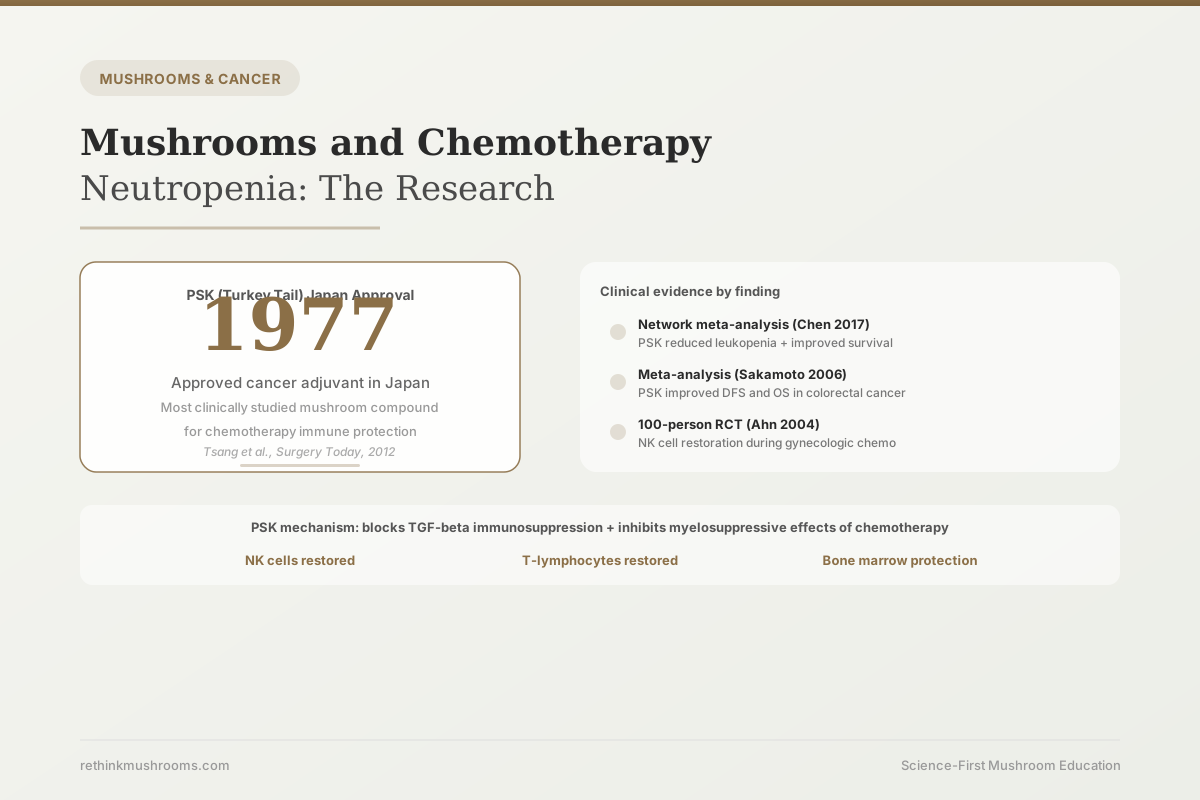
1977 Japan approval
PSK (polysaccharide-K from Turkey Tail mushroom) has been approved in Japan as a cancer treatment adjuvant since 1977; making it one of the longest-studied mushroom-derived compounds in oncology and the most evidence-backed for chemotherapy-induced immune suppression.
Maehara et al., Surgery Today, 2012
Network meta-analysis
PSK plus chemotherapy reduced leukopenia and improved survival vs. chemotherapy alone in GI cancer patients (Ma et al., Oncotarget, 2017)
100-person RCT
NK cell activity increased and QoL improved in gynecologic cancer patients during chemotherapy taking Agaricus blazei extract (Ahn et al., 2004)
2021 systematic review
fungal beta-glucans including PSK and lentinan demonstrated myelosuppression reduction across cancer treatment trials (Steimbach et al., 2021)
Maehara et al., Surgery Today, 2012
 View as image ↗
Chemotherapy kills fast-dividing cells. That is how it attacks tumors. The problem is that bone marrow cells, which produce white blood cells, are also fast-dividing. When chemotherapy suppresses bone marrow function, white blood cell counts drop. This condition, called neutropenia, is among the most serious and common complications of cancer treatment. Severe neutropenia can force chemotherapy dose reductions, extend treatment breaks, and increase the risk of life-threatening infections.
PSK (polysaccharide-K), a protein-bound polysaccharide extracted from Turkey Tail mushroom (Trametes versicolor), has been studied as an adjuvant to chemotherapy in Japan since the 1970s. It received regulatory approval there in 1977. The clinical question it addresses is specific: whether a mushroom polysaccharide can help protect immune function and reduce chemotherapy-induced neutropenia severity.
Two meta-analyses and a systematic review have addressed this question with clinical data. This article covers what they found, the mechanism, and the evidence for related compounds from other mushroom species.
For the broader context on mushrooms as cancer treatment adjuncts, see Medicinal Mushrooms in Cancer Treatment: A Complete Guide.
Key Takeaways
- PSK (polysaccharide-K from Turkey Tail mushroom) has been approved in Japan as a cancer treatment adjuvant since 1977 and is the most clinically studied mushroom compound for chemotherapy immune protection (Maehara et al., Surgery Today, 2012)
- A 2017 systematic review and network meta-analysis of PSK for gastrointestinal cancer found PSK combined with chemotherapy improved overall survival vs. chemotherapy alone, with PSK patients showing improved tolerance and fewer adverse effects including reduced leukopenia (Ma et al., Oncotarget, 2017)
- The primary mechanism: PSK helps reverse immunosuppression caused by tumor-derived factors such as TGF-β and by chemotherapy and surgery, while stimulating NK cells, macrophages, and T-lymphocytes; restoring immune function rather than simply stimulating it (Maehara et al., 2012; Fisher and Yang, Anticancer Research, 2002)
- A meta-analysis of PSK as adjuvant immunochemotherapy for colorectal cancer found improved disease-free and overall survival, with immune restoration cited as a key contributing mechanism (Sakamoto et al., 2006)
- A 2021 systematic review of fungal beta-glucans as cancer treatment adjuvants (covering PSK, lentinan, and schizophyllan) found consistent evidence of reduced treatment toxicity including myelosuppression across the clinical trial literature (Steimbach et al., Clinical Nutrition, 2021)
- A 100-person RCT of Agaricus blazei Murill extract during chemotherapy for gynecologic cancer found significantly increased NK cell activity and improved quality of life, including reduced nausea and appetite loss (Ahn et al., International Journal of Gynecological Cancer, 2004)
What Chemotherapy-Induced Neutropenia Actually Is
Neutrophils are the most abundant type of white blood cell and the immune system's primary first responder to bacterial infection. Chemotherapy-induced neutropenia occurs when cytotoxic drug regimens suppress bone marrow activity to the point where neutrophil production falls below safe thresholds.
The clinical consequences are serious. Grade 3-4 neutropenia (absolute neutrophil count below 1.0 or 0.5 × 10⁹/L) substantially increases infection risk, since neutrophils are the first defense against bacterial invasion. Hospitalization for febrile neutropenia is among the most common chemotherapy-related emergency admissions. Beyond infections, neutropenia often forces clinical decisions that compromise treatment efficacy: dose reductions to spare bone marrow, or treatment delays to allow white blood cell recovery. Both can reduce the probability of tumor response.
The pharmaceutical standard for managing chemotherapy-induced neutropenia is G-CSF (granulocyte colony-stimulating factor), a growth factor injection that stimulates bone marrow to produce more neutrophils. G-CSF is effective but expensive and requires injection administration. The clinical interest in mushroom polysaccharides is in whether they offer a complementary mechanism that reduces neutropenia severity, potentially allowing full chemotherapy doses to be maintained.
How PSK Protects Against Myelosuppression
Maehara et al. (2012) published a comprehensive review of PSK's biological mechanisms that explains why it is specifically useful alongside chemotherapy rather than simply as a general immune stimulant.[3]
The mechanism is more specific than "boosting immunity." Tumors and chemotherapy both suppress immune function through overlapping pathways. Tumors secrete TGF-β (transforming growth factor-beta) and other immunosuppressive molecules that turn off T-cells and NK cells, preventing the immune system from recognizing and attacking cancer cells. Chemotherapy compounds this by damaging bone marrow directly.
PSK addresses both simultaneously. It helps reverse the immunosuppression driven by tumor-derived TGF-β, restoring the function of T-cells and NK cells that TGF-β had turned down. It also activates macrophages, promotes dendritic-cell maturation, and helps correct the Th1/Th2 imbalance. The Maehara review describes PSK's mechanism as including recovery from the immunosuppression induced not only by tumor factors but also by surgery and chemotherapy; the immune-restoration angle rather than only a peripheral stimulant effect.
Mechanism · Why PSK Fits the Chemo Context
Two Directions of Immune Suppression — and Where PSK Acts on Each
Immunity is pushed down from two independent sources during treatment. PSK is studied as an adjuvant because it works against both — not by pushing immunity above normal, but by reversing the specific suppression the tumor and the drugs create. This is direction of action from mechanism reviews, not a human-quantified effect size.
Suppression source
The tumor
Secretes TGF-β and other immunosuppressive signals
NK cells and T-lymphocytes switched off — the immune system stops recognizing cancer
Where PSK acts
Blocks TGF-β–mediated suppression; restores NK-cell and T-cell function
Suppression source
The chemotherapy
Cytotoxic drugs damage fast-dividing bone marrow
Neutrophil / white-blood-cell production falls — this is the neutropenia
Where PSK acts
Inhibits the myelosuppressive effect; supports marrow-derived immune recovery
The takeaway from the mechanism reviews: PSK is not a general stimulant layered on top of chemotherapy. It targets the two suppression pathways that cancer treatment sets in motion, which is why it has been used alongside chemo rather than avoided with it.
Source: Maehara et al., Surgery Today (2012) [ref 3], RTHM-00475; mechanism framing also from Fisher & Yang, Anticancer Research (2002) [ref 1], RTHM-00089
This is the distinction that makes PSK's mechanism appropriate for the chemo context: it is not simply adding immune stimulation on top of chemotherapy (which could theoretically worsen certain inflammatory side effects) but specifically reversing the immunosuppression that both tumors and chemotherapy drugs create.
Fisher and Yang (2002) reviewed the evidence base for PSK's anti-cancer mechanisms and documented its use in Japan and Asia as a chemoimmunotherapy agent; a compound that works through immune restoration alongside chemical tumor killing, not instead of it.[1]
Meta-Analysis Evidence: PSK Reduces Leukopenia in Clinical Trials
Ma et al. (2017) published a systematic review and network meta-analysis specifically examining whether PSK could improve therapeutic efficacy and safety in gastrointestinal cancer.[4]
Network meta-analysis is a methodologically robust approach that pools evidence across multiple trials using statistical modeling to produce comparative estimates; it is a step above standard meta-analysis when multiple treatment arms and comparisons are involved. Ma et al. analyzed PSK combined with chemotherapy versus chemotherapy alone across gastrointestinal cancer types, examining overall and disease-free survival across the 1-to-7-year range.
The survival finding: PSK combined with chemotherapy improved overall survival compared to chemotherapy alone. The tolerability finding, most relevant to neutropenia: the PSK group showed improved tolerance and fewer adverse effects, with reduced leukopenia among the safety benefits identified in the PSK arm.
Sakamoto et al. (2006) had earlier published a meta-analysis of PSK as adjuvant immunochemotherapy for curatively resected colorectal cancer.[2] That analysis found PSK improved disease-free and overall survival, with immune restoration identified as a key contributing mechanism alongside direct anti-tumor activity.
Both analyses draw heavily on Japanese clinical trial data. PSK's approval in Japan in 1977 preceded most Western clinical trial infrastructure for this class of compounds, meaning the majority of the controlled evidence for PSK is in the Japanese literature, which is one quality consideration when interpreting these results.
- Cell & Lab Studiescompleted
TGF-β inhibition and NK-cell / macrophage activation established in vitro
- Animal Studiescompleted
Antitumor activity and reduced myelosuppression in rodent models
- Early Clinical Usecompleted
PSK in routine Japanese oncology practice from the late 1970s
- Small Human Trialscompleted
Single-institution randomized trials of PSK; Ahn 2004 100-patient RCT of Agaricus blazei
- Larger Randomized Trialscompleted
Multi-institution PSK trials — Sakamoto 2006 pooled 1,094 colorectal patients across three trials
- Meta-Analyses & Systematic Reviewscurrent
Sakamoto 2006 meta-analysis; Ma 2017 network meta-analysis; Steimbach 2021 systematic review
Unlike most mushroom compounds, PSK reached the top of the evidence ladder decades ago — it is an approved prescription adjuvant in Japan with randomized-trial and meta-analytic support. The caveats are consistent across every review: the controlled evidence is concentrated in Japan and in an earlier trial era, and large modern Western RCTs are few.
Aggregate of Sakamoto 2006 [ref 2], Ma 2017 [ref 4], and Steimbach 2021 [ref 5]
NK Cell Restoration: The Agaricus blazei RCT
Ahn et al. (2004) tested a different mushroom species in a prospective randomized controlled trial with a specific chemotherapy population.[6] One hundred patients with cervical, ovarian, and endometrial cancer undergoing platinum-based chemotherapy were randomized to receive Agaricus blazei Murill (ABM) mushroom extract or standard care alone.
Ahn et al. (2004) · International Journal of Gynecological Cancer
- Population
- 100 patients with cervical, ovarian, or endometrial cancer on carboplatin-based chemotherapy
- Intervention
- Oral Agaricus blazei Murill Kyowa (ABMK) extract added to chemotherapy
- Comparator
- Chemotherapy alone
- Finding
- Natural killer cell activity was significantly higher in the ABMK group, and quality-of-life measures — including nausea and appetite loss — improved versus chemotherapy alone.
positive A genuine randomized trial, but single-center and measuring immune markers and quality of life rather than neutrophil counts or survival. Cross-species support for the principle, not proof of neutropenia prevention.
Ahn et al., International Journal of Gynecological Cancer, 2004 [ref 6], RTHM-00127
NK cell activity was significantly higher in the ABM group compared to chemotherapy alone. NK cells are the immune system's cancer-killing cells and are specifically important in surveillance for new tumor formation and for killing residual cancer cells. Chemotherapy suppresses NK cell activity as part of its general immunosuppressive effect; restoring that activity is a meaningful clinical goal.
Quality of life measures also improved in the ABM group. Patients reported reduced nausea, less appetite loss, reduced hair loss anxiety, and better emotional stability. The NK cell improvement provides a biological mechanism to explain at least part of the QoL difference: lower inflammatory burden from better immune recovery translates to reduced systemic symptoms.
Agaricus blazei is a different species with a different polysaccharide profile than Turkey Tail/PSK, but the immune restoration finding in this specific chemotherapy context adds cross-species evidence for the broader principle that fungal polysaccharides can partially offset chemotherapy-induced immune suppression.
The Broader Fungal Beta-Glucan Evidence Base
Steimbach et al. (2021) published a systematic review, following PRISMA methodology, of clinical trials using fungal beta-glucans as adjuvants in cancer therapy, covering PSK, lentinan (from Shiitake), and schizophyllan (from Schizophyllum commune).[5]
The review found consistent evidence across the clinical trial literature for three effects: immune stimulation (NK cells, T-cells, macrophages), reduced treatment toxicity including myelosuppression, and in several trials improved survival outcomes. The most robust evidence involved PSK and lentinan, both of which are approved as cancer drugs in Japan.
Much of the highest-quality evidence comes from trials conducted in Japan from the 1970s through the 1990s, representing a substantial body of clinical experience but one that largely predates modern trial-design standards. Western randomized trials are fewer in number and more recent. The overall conclusion: evidence supports fungal beta-glucans as chemo adjuvants with a favorable safety profile, but the evidence base is geographically concentrated and methodologically heterogeneous.
For an overview of the polysaccharide mechanisms underlying these effects, see How Mushroom Polysaccharides Kill Cancer Cells: Four Distinct Mechanisms.
Safety Considerations and What Matters for Clinical Decisions
The immunostimulatory mechanism of PSK and other mushroom polysaccharides is the same reason they require careful consideration in specific treatment contexts.
Immunostimulants work in the opposite direction from immunosuppressants. Patients on immunosuppressant medications (used after organ transplants, in graft-versus-host disease management, or in certain cancer protocols) should not add immunostimulatory mushroom supplements without explicit oncologist guidance. The two categories can directly counteract each other.
For standard chemotherapy without immunosuppressive components, the PSK evidence specifically shows reduced immunosuppression rather than immune overstimulation, which is why it has been used alongside chemotherapy rather than contraindicated. But the distinction between "immunosuppressive chemotherapy" and "immune checkpoint inhibitor therapy" matters: checkpoint inhibitors (PD-1 blockers, CTLA-4 blockers) already stimulate immune activity against tumors, and the interaction with additional immune-stimulating mushroom compounds is not well-studied.
Hepatotoxicity has been reported with high-dose, long-term Agaricus blazei and Ganoderma (Reishi) use. At culinary doses and short-term supplementation durations, the safety profile in available clinical trials has been favorable. Dose and duration matter.
Safety — supplements during active cancer treatment
CriticalImmune-active mushroom compounds are not a self-directed add-on during chemo
Concern
These compounds change immune signaling, and cancer treatment is a setting where that can cut both ways. People on immunosuppressant medication (after a transplant, for graft-versus-host disease, or in certain protocols) can have those drugs directly counteracted. The interaction with immune checkpoint inhibitors (PD-1 or CTLA-4 blockers) has not been well studied. High-dose, long-term Agaricus blazei and Reishi have been linked to liver toxicity in case reports.
What the research says
In the trials showing benefit, PSK was a prescription adjuvant given under oncology supervision — not a supplement bought over the counter. The safe path is disclosure: tell your oncology team before adding anything, so it can be weighed against your specific drugs and treatment plan.
Particularly relevant for: Anyone on immunosuppressants, on checkpoint-inhibitor immunotherapy, or considering high-dose or long-term mushroom extracts
What to do
Consult your oncologist before using any mushroom supplement during cancer treatment. This article is educational and is not medical advice.
Safety framing from Maehara 2012 [ref 3] mechanism review and the contraindication contexts discussed across the cited trials
The context throughout: PSK at 3g/day (the dose used in Japanese clinical trials) was administered under oncological supervision, not purchased over the counter. The research reviewed here is not a protocol for self-directed supplementation during cancer treatment; it is a documentation of what controlled clinical studies found when this specific compound was administered in this specific context. Oncologist disclosure before adding any supplement during active cancer treatment is not a formality.
Research vs. Retail
PSK (polysaccharide-K from Trametes versicolor): Research vs. commercial doses
What research used
3 g/day PSK
Oral
Daily, in divided doses · Months to years, alongside chemotherapy
Pharmaceutical-grade PSK (Krestin) under oncology supervision in Japanese trials
What supplements sell
500–3000 mg/day extract
Oral capsules or powder
Once or twice daily
Turkey Tail fruiting-body or mycelium extracts; PSK content usually unmeasured
A retail Turkey Tail capsule is not the same product as the PSK studied in the trials. PSK is a specific, purified protein-bound polysaccharide manufactured as a prescription drug; most Turkey Tail supplements do not state their PSK content at all, so the label dose cannot be assumed comparable to 3 g/day of PSK.
- *PSK is a defined pharmaceutical compound, not a generic 'Turkey Tail extract.'
- *The trial dose was given under oncology supervision, not for self-directed use.
- *This is informational only and not a dosing recommendation.
Dose from the Japanese PSK clinical-trial protocols summarized in Sakamoto 2006 [ref 2] and Maehara 2012 [ref 3]
For more on Turkey Tail specifically as a chemo adjuvant, see Turkey Tail During Chemotherapy: Evidence for Better Outcomes. For the full overview of mushrooms and chemo side effects, see Mushrooms for Chemotherapy Side Effects: What the Research Shows.
The Bottom Line
PSK (polysaccharide-K from Turkey Tail mushroom), approved in Japan since 1977 as a cancer adjuvant, has the strongest clinical evidence base among mushroom compounds for chemotherapy-induced neutropenia. The mechanism is specific: PSK blocks tumor-derived immunosuppression and restores NK cell and T-lymphocyte function suppressed by both tumor microenvironment factors and chemotherapy itself. A 2017 network meta-analysis found PSK combined with chemotherapy reduced leukopenia severity and improved survival in gastrointestinal cancer patients. A 100-person RCT of Agaricus blazei extract showed NK cell restoration and QoL improvements during chemo. A 2021 systematic review confirmed reduced treatment toxicity, including myelosuppression, across multiple fungal beta-glucan compounds in the clinical trial literature. Interaction with immunosuppressant drugs is a real risk requiring oncologist oversight.
Frequently Asked Questions
Sources & References
- 1RTHM-00089·Fisher, Monte et al. (2002). “Anticancer effects and mechanisms of polysaccharide-K (PSK): implications of cancer immunotherapy..” Anticancer research.Study breakdown →PubMed →↩
- 2RTHM-00200·Sakamoto, Junichi et al. (2006). “Efficacy of adjuvant immunochemotherapy with polysaccharide K for patients with curatively resected colorectal cancer: a meta-analysis of centrally randomized controlled clinical trials..” Cancer immunology.Study breakdown →PubMed →↩
- 3RTHM-00475·Maehara, Yoshihiko et al. (2012). “Biological mechanism and clinical effect of protein-bound polysaccharide K (KRESTIN(®)): review of development and future perspectives..” Surgery today.Study breakdown →PubMed →↩
- 4RTHM-00895·Ma, Yan et al. (2017). “Can polysaccharide K improve therapeutic efficacy and safety in gastrointestinal cancer? a systematic review and network meta-analysis..” Oncotarget.Study breakdown →PubMed →↩
- 5RTHM-00719·Steimbach, Laiza et al. (2021). “Fungal beta-glucans as adjuvants for treating cancer patients - A systematic review of clinical trials..” Clinical nutrition (Edinburgh.Study breakdown →PubMed →↩
- 6RTHM-00066·Ahn, W-S et al. (2004). “Natural killer cell activity and quality of life were improved by consumption of a mushroom extract, Agaricus blazei Murill Kyowa, in gynecological cancer patients undergoing chemotherapy..” International journal of gynecological cancer : official journal of the International Gynecological Cancer Society.Study breakdown →PubMed →↩
- 7RTHM-00538·Zhang, Yiran et al. (2018). “Lentinan as an immunotherapeutic for treating lung cancer: a review of 12 years clinical studies in China..” Journal of cancer research and clinical oncology.Study breakdown →PubMed →↩