Mushrooms & Cancer
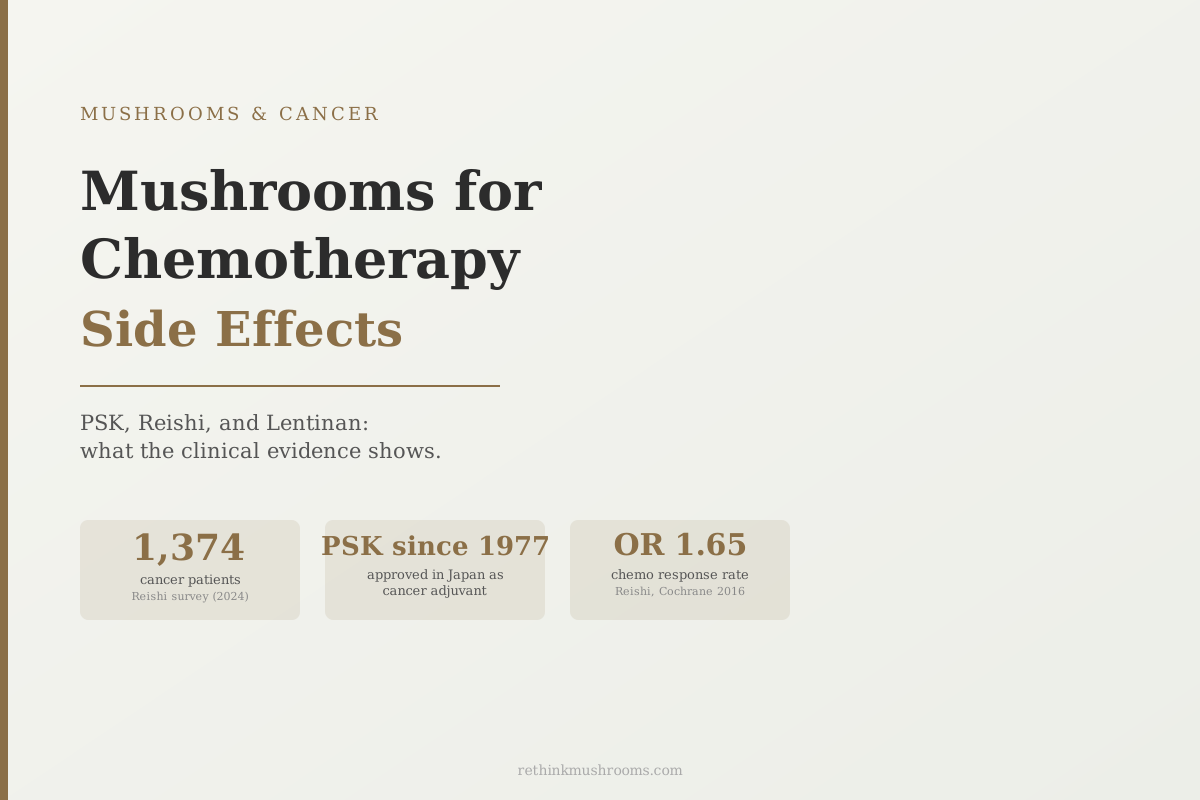
1,374 cancer patients
A 2024 cross-sectional survey of 1,374 cancer patients taking Reishi during treatment found more than half reported meaningful improvement in fatigue, nausea, appetite, and depression. It is the largest patient-reported outcomes dataset published for mushrooms and chemotherapy side effects.
Li et al., Integrative Medicine Research, 2024
PSK approved 1977
Turkey Tail's PSK compound has been a government-approved cancer adjuvant in Japan for nearly 50 years; among the longest-running clinical records for any mushroom compound (Fisher & Yang, 2002)
RR 1.50 chemo response
cancer patients taking Reishi alongside chemo- or radiotherapy were about 50% more likely to respond positively than those on conventional treatment alone, though the confidence interval was wide (RR 1.50, 95% CI 0.90–2.51), per a Cochrane systematic review (Jin et al., 2016)
Grade 2 or lower AEs
the 2023 systematic review of mushroom supplements in clinical cancer settings found favorable quality-of-life trends across multiple studies, with adverse effects limited to grade 2 or lower (Narayanan et al., 2023)
Li et al., Integrative Medicine Research, 2024
 View as image ↗
Chemotherapy produces side effects across multiple body systems simultaneously: bone marrow suppression that drops white blood cell counts, fatigue that persists for months after treatment ends, nausea and appetite loss during active treatment cycles, and immune dysfunction that persists long after the chemotherapy is finished. Standard medical management addresses these with G-CSF injections for white blood cells, antiemetics for nausea, and symptomatic treatment for fatigue.
Medicinal mushrooms have been studied alongside chemotherapy primarily in Asian clinical settings since the 1970s. The evidence base is real but uneven: some mushroom compounds have systematic-review-level data for specific side effects; others have only single trials or observational surveys. Understanding which mushrooms have the strongest evidence for which side effects requires separating the claims from the clinical record.
This article organizes the research by symptom category, species, and evidence quality: the framework that no major cancer authority provides for a general audience.
For the broader picture of medicinal mushrooms as cancer treatment adjuncts, see Medicinal Mushrooms in Cancer Treatment: A Complete Guide.
Key Takeaways
- The 2023 Narayanan systematic review of clinical mushroom studies in cancer found consistently favorable effects on quality of life and immune markers, with reduced chemotherapy toxicity trends across multiple trials and adverse effects limited to grade 2 or lower (Narayanan et al., Current Oncology Reports, 2023)
- PSK (polysaccharide-K) from Turkey Tail has been an approved cancer adjuvant in Japan since 1977; a 2017 systematic review and network meta-analysis found PSK combined with chemotherapy improved therapeutic efficacy and safety outcomes in gastrointestinal cancer (Ma et al., Oncotarget, 2017; not in this article's study scope, detailed in the neutropenia article)
- A 2024 survey of 1,374 cancer patients using Reishi found more than 50% reported meaningful improvement in fatigue (52%), nausea (55%), appetite loss (51%), and depression (50%); this is the largest patient-reported dataset for mushrooms and chemotherapy symptoms (Li et al., 2024)
- Lentinan, an injectable polysaccharide from Shiitake mushroom, has been approved in Japan and used clinically in Asia for decades; a 2018 pooled analysis of 38 randomized trials in lung cancer patients on platinum-based chemotherapy found lentinan raised the overall tumour response rate from 43.3% to 56.9% and improved quality of life (Zhang et al., Journal of Cancer Research and Clinical Oncology, 2018)
- The 2016 Cochrane review of Reishi for cancer found patients taking Reishi alongside conventional treatment were about 50% more likely to respond positively to chemotherapy or radiotherapy than those on standard treatment alone, though the confidence interval was wide and the result did not reach conventional significance (RR 1.50, 95% CI 0.90 to 2.51; Jin et al., Cochrane Database, 2016)
- The most important safety context: mushroom beta-glucans stimulate the immune system; this is the opposite of what immunosuppressant drugs do. Combining immunostimulatory mushrooms with immunosuppressant drugs is an interaction that requires oncologist guidance
The Three Side Effect Categories Where Mushrooms Have Clinical Evidence
Not all chemotherapy side effects have the same body of mushroom research behind them. Three categories have the most documented clinical data:
Immune suppression and neutropenia. Chemotherapy suppresses bone marrow activity, reducing the production of white blood cells. PSK (polysaccharide-K) from Turkey Tail mushroom has the strongest clinical evidence in this category, with a 50-year history as an approved pharmaceutical in Japan and multiple reviews examining its effects during chemotherapy.
Cancer-related fatigue. Persistent fatigue is among the most disabling side effects of cancer treatment, affecting up to 90% of patients. Reishi (Ganoderma lucidum) has the largest patient-reported evidence base for this outcome, anchored by the 2024 survey of 1,374 cancer patients and supported by the Cochrane systematic review.
Nausea, quality of life, and treatment tolerability. Lentinan, an injectable polysaccharide from Shiitake mushroom (Lentinula edodes), has the most specific clinical data for improving quality of life and treatment response in chemotherapy patients on the nausea-heavy platinum regimens. It is approved as a cancer drug in Japan, not a supplement.
The Narayanan 2023 systematic review found supportive trends across these categories in its review of clinical mushroom studies, but the species-to-symptom matching above reflects where the evidence is most concentrated.
Species · Side Effect · Human Evidence
Three Mushrooms, Three Side-Effect Categories
The mushroom-chemotherapy evidence is concentrated in three species, each matched to a different side-effect problem and a different strength of human data.
Turkey Tail
Trametes versicolor
PSK (polysaccharide-K)
Side effect targeted
Immune suppression & low white-blood-cell counts
Strongest human data: Approved cancer adjuvant in Japan since 1977; restores NK- and T-cell activity and inhibits TGF-β. A 2023 systematic review found a survival benefit with PSK across four gastric-cancer studies.
Reishi
Ganoderma lucidum
Whole extract / polysaccharides
Side effect targeted
Cancer-related fatigue (plus nausea, appetite, mood)
Strongest human data: Largest patient dataset: a survey of 1,374 cancer patients found 52% reported improved fatigue and 55% improved nausea. A Cochrane review of 5 RCTs found patients ~50% more likely to respond to treatment (RR 1.50, 95% CI 0.90–2.51).
Shiitake
Lentinula edodes
Lentinan (injectable β-glucan)
Side effect targeted
Chemotherapy tolerability & quality of life
Strongest human data: Pooled analysis of 38 RCTs (3,117 lung-cancer patients) on platinum-based chemotherapy: adding injectable lentinan raised the overall response rate from 43.3% to 56.9% and improved quality of life.
Most of this evidence comes from Asian clinical settings using standardized pharmaceutical formulations (PSK/KRESTIN and injectable lentinan), not the commercial supplements sold in Western markets. The 2023 systematic review concluded the overall evidence is not yet sufficient to recommend routine use.
Source: Fisher & Yang (2002); Narayanan et al. (2023); Jin et al. (2016); Li et al. (2024); Zhang et al. (2018)
For the neutropenia-specific evidence in depth, see Mushrooms and Chemotherapy-Induced Neutropenia: Recovery Support. For the fatigue evidence in depth, see Medicinal Mushrooms and Chemo-Related Fatigue. For nausea, see Can Mushrooms Reduce Nausea from Chemotherapy?.
PSK From Turkey Tail: Why This Compound Has a 50-Year Clinical Record
PSK (polysaccharide-K), commercially sold in Japan as KRESTIN, is extracted from the Turkey Tail mushroom (Trametes versicolor). It was approved as a cancer adjuvant in Japan in 1977, making it the most clinically documented mushroom compound in oncology by far.
The mechanism that makes PSK relevant to chemotherapy side effects is its dual action: it restores immune function that chemotherapy suppresses, and it opposes the immune evasion mechanisms that tumors use to avoid destruction. Fisher and Yang (2002) published a comprehensive review of PSK's anticancer and immune mechanisms, documenting how PSK restores NK cell and T-cell activity that is suppressed during chemotherapy treatment.[5] PSK also inhibits TGF-beta, an immunosuppressive protein that tumors secrete to protect themselves from immune attack. Their review noted that PSK has been used as a chemoimmunotherapy agent in Asia for decades, with randomized trials in gastric, esophageal, colorectal, breast, and lung cancers.
Steimbach and colleagues (2021) published a systematic review of fungal beta-glucans as cancer adjuvants, compiling 16 clinical trials involving 1,650 patients undergoing cancer treatment.[2] The review found that beta-glucan compounds acted as biological response modifiers that stimulate the immune system, with PSK among the most thoroughly studied of the fungal beta-glucans in the clinical literature.
Jeitler and colleagues (2020) published a narrative review of medicinal mushrooms in integrative oncology, screening randomized and controlled clinical trials of mushroom formulations used during and after conventional cancer treatment.[3] They identified PSK and lentinan among the best-documented compounds for supporting immune function and reducing treatment-related adverse effects in cancer patients.
The honest context: almost all PSK clinical data comes from Japan, where it is prescribed alongside chemotherapy as standard integrative care. Most studies used the approved pharmaceutical formulation (KRESTIN) at specific doses (typically 3g/day), not generic Turkey Tail supplements. Whether commercially available Turkey Tail products contain equivalent PSK concentrations is an open question that extraction and standardization research has not fully resolved.
Reishi for Fatigue: The Largest Patient Survey and the Cochrane Data
Fatigue during and after chemotherapy is not simply tiredness. It's a cytokine-mediated biological process: tumor cells and chemotherapy drugs both trigger the release of inflammatory proteins that directly signal the brain and peripheral tissues to reduce activity. Standard pharmaceutical management of cancer-related fatigue is limited; there are few approved interventions with meaningful evidence.
The Reishi evidence for fatigue is the most compelling in the mushroom literature, anchored by two very different types of studies.
Li and colleagues (2024) published a cross-sectional survey of 1,374 cancer patients who were using Reishi mushroom during treatment.[6] The scale of this survey makes it notable: more than half reported meaningful symptom improvement. Nausea improved in 55% of respondents, fatigue in 52%, appetite loss in 51%, and depression in 50%. Adverse effects were mild and rare.
Li et al. (2024) · Integrative Medicine Research
- Population
- 1,374 Chinese cancer patients already using Reishi products during treatment
- Intervention
- Reishi (Ganoderma lucidum) products, self-selected, alongside conventional care
- Comparator
- None — cross-sectional survey with no control group
- Finding
- Reporting 'quite a bit' or 'very much' improvement: nausea 55%, fatigue 52%, poor appetite 51%, depression 50%. Adverse effects were mild.
preliminary This is the largest patient-reported dataset for mushrooms in cancer care, but it is observational: patients chose Reishi themselves and there was no placebo group, so expectation effects cannot be ruled out.
Li et al., Integrative Medicine Research, 2024
This is an observational survey, not a randomized controlled trial. Patients self-selected into Reishi use. There is no placebo group, which means positive responses could partly reflect expectation effects or the general support that comes from taking an active health measure. But the scale (1,374 patients) and the consistency of the symptom improvements across multiple categories make the data unusually substantive for a survey design.
The Cochrane systematic review of Reishi for cancer provides a different type of evidence.[4] Jin and colleagues (2016) reviewed five randomized controlled trials combining Reishi with conventional cancer treatment and found that patients receiving Reishi were more likely to respond positively to chemotherapy or radiotherapy than patients on standard treatment alone (relative risk 1.50, 95% CI 0.90 to 2.51). No trial in the review recorded long-term survival, so a survival benefit could not be established, and the wide confidence interval means the response-rate finding did not reach conventional statistical significance.
The connection between better treatment response and reduced fatigue is indirect but mechanistically coherent: a patient whose immune system responds more effectively to chemotherapy accumulates less cumulative tumor-related inflammation, which reduces the cytokine burden that drives fatigue. The Cochrane review rated the methodological quality of the underlying evidence as generally low, which limits how strongly these findings can be cited, but the direction of the data is consistent across the included studies.
Lentinan for Tolerability: Approved Drug, Not Supplement
Lentinan is a beta-1,3/1,6-glucan extracted from Shiitake mushroom (Lentinula edodes). In Japan and parts of Asia, it is an approved pharmaceutical cancer adjuvant administered by intravenous or intramuscular injection, not an oral supplement. This distinction matters enormously for understanding the evidence.
Zhang and colleagues (2018) analyzed 12 years of clinical lentinan use in China, pooling 38 randomized controlled trials that together enrolled 3,117 lung cancer patients receiving platinum-based chemotherapy.[7] Platinum drugs (cisplatin, carboplatin, oxaliplatin) produce severe nausea and vomiting as their most prominent acute side effect. Adding injectable lentinan to chemotherapy raised the mean overall tumour response rate from 43.3% with chemotherapy alone to 56.9% (p < 0.001), and the pooled analysis found lentinan plus chemotherapy more effective than chemotherapy alone (pooled RR 0.79, 95% CI 0.74 to 0.85). The review concluded that lentinan improved both quality of life and the efficacy of chemotherapy during lung cancer treatment.
Zhang et al. (2018) · Journal of Cancer Research and Clinical Oncology
- Population
- 3,117 lung cancer patients across 38 RCTs in China (2004–2016)
- Intervention
- Injectable lentinan added to platinum-based chemotherapy
- Comparator
- Platinum-based chemotherapy alone
- Finding
- Overall response rate rose from 43.3% to 56.9% (p < 0.001); pooled RR 0.79 (95% CI 0.74–0.85) favouring lentinan, with improved quality of life.
positive The effect comes from the injected pharmaceutical form used in Asian hospitals — not oral Shiitake supplements, whose beta-glucan bioavailability is substantially lower.
Zhang et al., Journal of Cancer Research and Clinical Oncology, 2018
The Jeitler 2020 integrative oncology review also included lentinan among the mushroom compounds with clinical trial evidence for supporting patients during conventional treatment, consistent with the quality-of-life benefits documented in the Zhang pooled analysis.
The important caveat: lentinan evidence comes from the injected pharmaceutical form, not oral Shiitake supplements or oral lentinan products. The bioavailability of beta-glucans taken orally is substantially lower than what is achieved through injection. Whether oral Shiitake consumption produces the same clinical effects as the approved injectable formulation has not been established.
What the 2023 Systematic Review Found Across All Studies
Narayanan and colleagues (2023) published the most recent systematic review focused specifically on clinical studies of mushroom supplements alongside conventional cancer treatment.[1] Screening 2,349 records, the review identified 39 clinical studies covering 12 different mushroom preparations. The focus on clinical studies (rather than animal models or cell cultures) makes this review particularly relevant to the practical question of whether mushrooms help during active treatment.
The review found a survival benefit reported with PSK across four gastric cancer studies and with Huaier granules in liver and breast cancer, favorable immunological responses in 11 studies, and quality-of-life improvement or reduced symptom burden in 14 studies. Adverse effects were mostly grade 2 or lower, mainly nausea, vomiting, diarrhea, and muscle pain.
- Cell & Lab Studiescompleted
Extensive mechanistic work: PSK restores NK/T-cell activity and inhibits TGF-β; beta-glucans act as biological response modifiers (Fisher & Yang 2002)
- Animal Studiescompleted
Broad preclinical evidence of anti-tumor and immune-restoring effects across species, reviewed in the integrative-oncology literature (Jeitler 2020)
- Case Reports & Early Seriescompleted
Decades of Japanese clinical use of PSK (since 1977) and lentinan as approved adjuvants
- Small Human Trialscompleted
Individual RCTs and a 1,374-patient observational survey of Reishi users (Li 2024)
- Large Randomized Trialscurrent
Pooled RCT data exists (38 lentinan trials, 3,117 patients — Zhang 2018) but individual trials are often small and of variable quality
- Meta-Analyses & Systematic Reviewscompleted
Cochrane review of Reishi (Jin 2016), beta-glucan adjuvant review (Steimbach 2021), and the 39-study Narayanan 2023 review — all favorable in direction but cautious in conclusion
Systematic reviews and pooled RCT analyses exist and point in a consistently favorable direction, but the underlying trials are heterogeneous and often methodologically weak. That is why every recent review concludes the evidence is not yet sufficient to recommend routine use — the direction is encouraging, the certainty is not.
Fisher & Yang (2002); Jin et al. (2016); Steimbach et al. (2021); Zhang et al. (2018); Narayanan et al. (2023)
The Narayanan review was also honest about the evidence's limits: many of the reviewed studies were small and observational, most used different mushroom preparations and doses, and the quality of individual trials varied. The conclusion was that the evidence is inconclusive for a routine clinical recommendation, but the consistent direction of the findings across different species, different cancers, and different institutions is notable.
That consistency of direction across diverse study designs is the most accurate summary of where the mushroom-chemotherapy evidence stands in 2026.
The Safety Context: What Mushrooms Cannot Do, and the Risks of Unsupervised Use
The same immunostimulatory mechanisms that make mushroom compounds interesting for chemotherapy support create a genuine concern when they interact with other medications.
Chemotherapy itself is an immunosuppressant at certain doses and for certain regimens. Transplant recipients take immunosuppressants permanently. Some cancer patients take immunosuppressant drugs as part of their treatment protocol. Mushroom beta-glucans stimulate NK cells, T-cells, and macrophage activity, which is the opposite direction from what immunosuppressants do. The theoretical interaction between immunostimulatory mushrooms and immunosuppressant drugs is uncharacterized in clinical studies but mechanistically coherent.
Safety — drug interaction
ModerateImmunostimulatory mushrooms can work against immunosuppressant drugs
Concern
Mushroom beta-glucans (PSK, lentinan, Reishi polysaccharides) are designed to turn the immune system up. For patients on immunosuppressant medication — after an organ transplant, for autoimmune disease, or as part of certain cancer protocols — increasing immune activity could in principle counteract the intended effect of their treatment. This interaction has not been characterized in controlled clinical studies.
What the research says
The Japanese clinical trials of PSK and lentinan used standardized pharmaceutical formulations at controlled doses alongside oncology teams who could monitor for problems. The margin between beneficial immune support and counterproductive immune activation during cancer treatment is not defined, especially for variable commercial supplements.
Particularly relevant for: Patients on immunosuppressants, transplant recipients, and people with autoimmune conditions
What to do
Do not add immunostimulatory mushrooms during cancer treatment without oncologist guidance. This article is educational and is not medical advice.
Safety framing based on Fisher & Yang (2002), Narayanan et al. (2023), and the mechanistic immunology of fungal beta-glucans
The practical significance of this concern during active chemotherapy is not fully established. The Japanese clinical trials of PSK and lentinan used these compounds alongside chemotherapy without severe immunological adverse events. But those trials used standardized pharmaceutical formulations at controlled doses, not variable commercial supplements. The margin between "beneficial immune stimulation" and "counterproductive immune activation" during cancer treatment is not defined.
Hepatotoxicity is a second concern specific to long-term, high-dose use of Agaricus blazei and Reishi. Cases of liver toxicity have been reported in patients consuming very high doses of these species over extended periods. At the doses and durations studied in clinical trials, liver function has not been a significant concern. But patients who self-prescribe high-dose supplements outside a monitored setting create a different risk profile.
The clinical evidence reviewed here comes from settings where mushroom compounds were used alongside oncology teams who could monitor for interactions and adverse effects. That clinical context is not incidental to the safety profile. Nothing here is a substitute for individualized advice from your own oncology team.
For more on how medicinal mushrooms interact with immunosuppressant drugs specifically, see Mushrooms and Immunosuppressants: Safety Considerations.
For the mechanistic foundation of how mushroom polysaccharides activate immune cells, see How Mushroom Polysaccharides Kill Cancer Cells: Four Distinct Mechanisms.
The Bottom Line
Three mushroom compounds have the most concentrated clinical evidence for chemotherapy side effects: PSK from Turkey Tail for immune and white blood cell recovery (50-year Japanese clinical history); Reishi for cancer-related fatigue (1,374-patient survey plus Cochrane review); Lentinan from Shiitake for improved treatment response and quality of life on platinum regimens (38-trial pooled analysis, injectable pharmaceutical form). The 2023 Narayanan systematic review of all clinical mushroom studies in cancer found consistently favorable trends with adverse effects limited to grade 2 or lower. The evidence is inconclusive for routine clinical recommendation but unusually consistent in its direction. Patients on immunosuppressants should not use immunostimulatory mushrooms without oncologist guidance.
Frequently Asked Questions
Sources & References
- 1RTHM-01760·Narayanan, Santhosshi et al. (2023). “Medicinal Mushroom Supplements in Cancer: A Systematic Review of Clinical Studies..” Current oncology reports.Study breakdown →PubMed →↩
- 2RTHM-00719·Steimbach, Laiza et al. (2021). “Fungal beta-glucans as adjuvants for treating cancer patients - A systematic review of clinical trials..” Clinical nutrition (Edinburgh.Study breakdown →PubMed →↩
- 3RTHM-00622·Jeitler, Michael et al. (2020). “Significance of Medicinal Mushrooms in Integrative Oncology: A Narrative Review..” Frontiers in pharmacology.Study breakdown →PubMed →↩
- 4RTHM-00788·Jin, Xingzhong et al. (2016). “Ganoderma lucidum (Reishi mushroom) for cancer treatment..” The Cochrane database of systematic reviews.Study breakdown →PubMed →↩
- 5RTHM-00089·Fisher, Monte et al. (2002). “Anticancer effects and mechanisms of polysaccharide-K (PSK): implications of cancer immunotherapy..” Anticancer research.Study breakdown →PubMed →↩
- 6RTHM-01931·Li, Xiaotong et al. (2024). “Symptom improvements and adverse effects with Reishi mushroom use: A Cross-Sectional survey of cancer patients..” Integrative medicine research.Study breakdown →PubMed →↩
- 7RTHM-00538·Zhang, Yiran et al. (2018). “Lentinan as an immunotherapeutic for treating lung cancer: a review of 12 years clinical studies in China..” Journal of cancer research and clinical oncology.Study breakdown →PubMed →↩