Chaga Dosage, Forms & Side Effects
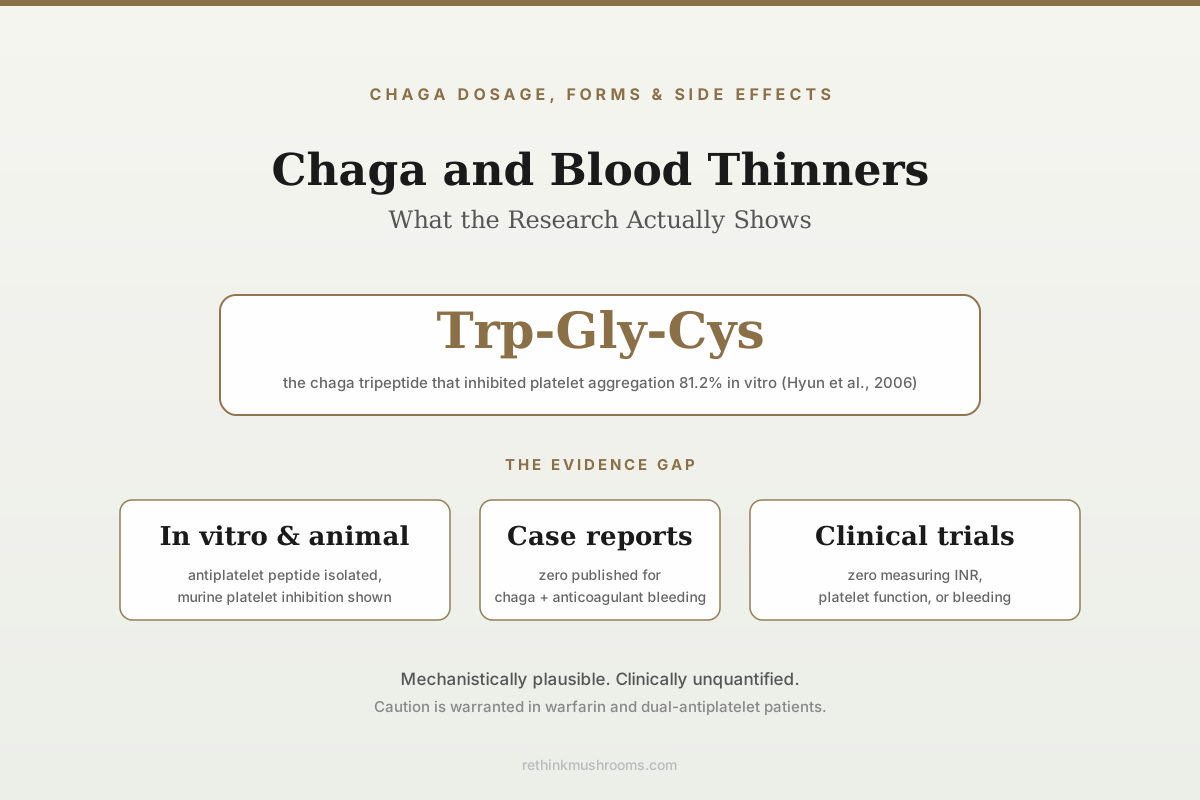
Trp-Gly-Cys
The tripeptide isolated from Inonotus obliquus by Hyun et al. (2006) that inhibits platelet aggregation in vitro. The pharmacological basis for chaga's theoretical bleeding-risk interaction.
Hyun et al., Peptides, 2006
81.2% Inhibition
of platelet aggregation in vitro
No Case Reports
of chaga plus warfarin bleeding
0 Clinical Trials
of chaga in humans on anticoagulants
Hyun et al., Peptides, 2006
 View as image ↗
The concern about chaga interacting with blood thinners rests on a specific piece of pharmacology. Hyun et al. (2006) isolated a novel platelet aggregation inhibitory peptide from the medicinal mushroom Inonotus obliquus. The tripeptide, sequenced as tryptophan-glycine-cysteine with a molecular mass of 365 Da, was extracted from ethanol extracts of I. obliquus mycelia and inhibited platelet aggregation by up to 81.2% in vitro.[1] That finding is the scientific foundation for every warning that chaga may interact with anticoagulant or antiplatelet drugs.
What the literature does not contain is a single published case report of clinical bleeding in a patient taking chaga plus warfarin, aspirin, clopidogrel, or any other anticoagulant. The mechanistic basis for a theoretical interaction exists. Direct evidence of clinical harm, for or against, does not. This article reviews what the published research actually shows, where the warning language comes from, and what the evidence does not yet answer. For a broader safety overview, see can you take chaga long-term: safety considerations.
Key Takeaways
- Hyun et al. (2006) isolated a novel platelet aggregation inhibitory tripeptide (Trp-Gly-Cys) from Inonotus obliquus ethanol extracts, inhibiting platelet aggregation by 81.2% in vitro
- Ern et al. (2024) and Fordjour et al. (2023) review chaga's pharmacology and note theoretical interactions with anticoagulant and antiplatelet medications, based on in vitro and animal data rather than human case reports
- No published case report has documented clinical bleeding in a human taking chaga with warfarin, aspirin, clopidogrel, apixaban, rivaroxaban, or any other anticoagulant
- Kikuchi et al. (2014) and Kwon et al. (2022) published case reports of chaga-induced oxalate nephropathy in patients who consumed chaga long-term, demonstrating that chaga side effects do appear in the peer-reviewed literature when they occur
- No randomized clinical trial has measured prothrombin time, INR, platelet function, or bleeding events in humans taking chaga supplements
- Memorial Sloan Kettering Cancer Center's integrative medicine monograph on chaga lists anticoagulant and antiplatelet drugs among theoretical interactions, based on in vitro and murine evidence
The Pharmacological Basis for the Warning
Blood clotting in humans depends on two overlapping systems: the platelet aggregation cascade (primary hemostasis) and the coagulation cascade (secondary hemostasis). Antiplatelet drugs like aspirin and clopidogrel interrupt the first system. Anticoagulants like warfarin, apixaban, rivaroxaban, and dabigatran interrupt the second. A supplement that inhibits either system can theoretically increase bleeding risk when combined with a prescription drug that acts on the same pathway.
Hyun et al. (2006) identified the specific chaga compound that raises this concern. Working with ethanol extracts from Inonotus obliquus mycelia, they isolated a novel tripeptide with the amino acid sequence tryptophan-glycine-cysteine and a molecular mass of 365 daltons. The peptide inhibited platelet aggregation in a dose-dependent manner, with 81.2% inhibition at the tested concentration.[1]
The finding has several important features. The compound is a peptide, not a polysaccharide or triterpenoid, which puts it in a different pharmacokinetic category than the beta-glucans and phenolics that dominate chaga marketing. The activity was demonstrated in vitro, using isolated platelets rather than a whole-animal or human system. The peptide was extracted from mycelia grown in culture (I. obliquus ASI 74006), not from wildcrafted chaga canker. Whether the same peptide occurs at the same concentration in wild chaga sclerotia or in commercial chaga supplements has not been directly demonstrated.
Beyond the Hyun peptide, chaga contains multiple compound classes with potential effects on hemostasis. Polysaccharides have been shown in various mushroom species to influence coagulation and platelet function in experimental models. Triterpenoids in chaga include betulinic acid and related compounds, some of which have shown vascular and anti-inflammatory effects that could overlap with antiplatelet pathways. Polyphenols, including the novel compounds identified by Lee et al. (2007), can inhibit platelet activation at high in vitro concentrations by mechanisms shared with dietary flavonoids. None of these effects has been quantified in humans consuming chaga at typical supplement doses.
What the Major Reviews Say
Two recent peer-reviewed reviews of chaga pharmacology address drug interactions directly. Ern et al. (2024) published "Therapeutic properties of Inonotus obliquus (Chaga mushroom): A review" in the journal Mycology and surveyed the evidence base for chaga's effects on coagulation, platelet function, glucose regulation, and other pathways.[2] The review catalogued the in vitro and animal evidence for antiplatelet activity and noted that clinical significance in humans remains to be established.
Fordjour et al. (2023) reached similar conclusions in "Chaga mushroom: a super-fungus with countless facets and untapped potential," published in Frontiers in Pharmacology. The review summarized chaga's pharmacology and listed anticoagulant and antiplatelet drugs among the theoretical interaction categories that warrant caution, while acknowledging that the published clinical literature does not contain documented bleeding events attributable to chaga.[3]
Memorial Sloan Kettering Cancer Center maintains a publicly available integrative medicine monograph on chaga that similarly lists anticoagulants and antiplatelet drugs among theoretical interactions. The monograph's rationale cites the same mechanistic basis: chaga extract has been shown to inhibit platelet aggregation in murine and in vitro models, so caution is advised when chaga is combined with prescription anticoagulants or antiplatelet agents.
The key pattern across all three sources is consistent: the warning is mechanistically sound and based on real in vitro data, but the clinical evidence layer is missing. No source cites a human study showing that chaga consumption changes bleeding time, prothrombin time, international normalized ratio (INR), platelet count, or bleeding events at typical supplement doses.
What the Published Case Reports Show (and Don't)
The published medical literature does contain adverse event case reports involving chaga. Kikuchi et al. (2014) published a case report in Clinical Nephrology describing chaga mushroom-induced oxalate nephropathy in a Japanese patient who consumed chaga long-term. The patient developed acute kidney injury attributable to oxalate crystal deposition in renal tubules.[4] Kwon et al. (2022) subsequently published a second case in the journal Medicine, documenting chaga-induced oxalate nephropathy that clinically manifested as nephrotic syndrome.[5]
These cases demonstrate that the medical literature does publish chaga-specific adverse events when they occur. A clinician who encountered a patient on warfarin with unexplained bleeding and a history of chaga supplementation would have ample precedent and incentive to publish the case. The absence of such reports in the published literature is therefore informative, though not conclusive. Case reports require a clinician to suspect the connection, investigate it, and submit it. Patients who bleed while on warfarin often have multiple potential contributors, and chaga would need to be noticed and flagged.
For a detailed look at the oxalate nephropathy concern, see chaga side effects: oxalate risk and kidney concerns.
The interpretation that best fits the evidence is that clinical bleeding from chaga plus anticoagulant combination is either rare, unreported, or both. It is not established as a proven clinical hazard, but it is also not established as safe. The gap reflects the broader state of chaga research, which is heavy on in vitro and animal studies and light on human trials.
Which Medications Warrant the Most Caution
Among the drug classes that overlap mechanistically with chaga's reported antiplatelet activity, the strength of the theoretical concern varies by drug.
Warfarin (Coumadin) has the narrowest therapeutic window of any commonly prescribed oral anticoagulant. Small changes in vitamin K status, hepatic cytochrome P450 activity, or competing pharmacological effects can shift INR significantly. Patients on warfarin have the most to lose from an unpredictable supplement-drug interaction and are the clearest group for whom caution is warranted.
Direct oral anticoagulants (DOACs) including apixaban, rivaroxaban, dabigatran, and edoxaban have more predictable pharmacokinetics than warfarin. They do not require INR monitoring and are less susceptible to dietary and supplement-level perturbations. The theoretical concern with chaga still exists (if chaga adds antiplatelet activity on top of anticoagulation, the combined effect is additive), but the pharmacokinetic resilience of DOACs reduces the practical worry.
Antiplatelet drugs including aspirin and clopidogrel share the most direct mechanistic overlap with chaga's reported in vitro activity. Both the drug and the theoretical chaga compound act on platelet aggregation. The combined effect would be additive inhibition of primary hemostasis. Patients on dual antiplatelet therapy (for example, after coronary stent placement) are already at elevated bleeding risk and would have the least tolerance for additional unmeasured antiplatelet exposure.
Low-dose aspirin for cardiovascular prevention is a middle case. The cardiovascular benefit is well-established, the daily dose is modest, and the bleeding risk is real but low. Adding chaga of unknown antiplatelet potency introduces uncertainty without clinical evidence of either benefit or harm.
Heparin and low-molecular-weight heparin (enoxaparin, dalteparin) are typically used in clinical or hospital settings where anticoagulation is monitored closely. The interaction concern with chaga is most relevant for outpatients taking long-term oral therapy.
Before Surgery or Dental Procedures
Many anesthesiologists and surgeons ask patients to discontinue supplements with antiplatelet activity for 7 to 14 days before elective procedures. Common examples include high-dose fish oil, garlic extract, ginkgo biloba, ginger, and willow bark. Chaga's antiplatelet peptide identified by Hyun et al. (2006) places it conceptually in the same category, though without equivalent clinical evidence.[1]
A reasonable approach for a patient taking chaga before an elective surgery or major dental procedure is to disclose the supplement to the anesthesiology or surgical team along with all other supplements, medications, and herbal products. The clinical team can then apply the same reasoning they use for other supplements with theoretical antiplatelet activity. Chaga does not have a unique or established clinical bleeding profile; it fits the general pattern of mushroom and botanical supplements with in vitro platelet effects but limited human outcome data.
What Would Resolve the Question
The research that would settle the chaga-anticoagulant question does not currently exist and would not be expensive to conduct. A pharmacokinetic and pharmacodynamic study in 20 to 30 healthy adults, measuring platelet aggregation, bleeding time, and standard coagulation parameters before and after a standardized chaga supplement course, would provide the first direct human data on whether typical chaga doses produce measurable antiplatelet effects. A parallel study in patients stable on warfarin, measuring INR before and after chaga supplementation, would specifically address the warfarin interaction concern that dominates consumer warnings.
Neither study has been published. Until they are, consumers and clinicians are working with mechanism-based inference, animal data, and the absence of published case reports. That is enough to justify caution in high-risk groups (patients on warfarin, dual antiplatelet therapy, or approaching surgery) but not enough to declare chaga categorically unsafe with anticoagulants. The honest framing is that a plausible interaction exists on paper, the clinical magnitude is unknown, and the burden of uncertainty falls on consumers and prescribers to make individualized decisions.
For guidance on evaluating chaga product quality so that consumers know what they are actually taking, see cGMP compliance for mushroom products: what manufacturers must do and 7 red flags in mushroom supplements: what to avoid.
The Bottom Line
Chaga contains compounds with documented in vitro antiplatelet activity, most notably a tripeptide isolated by Hyun et al. (2006) that inhibited platelet aggregation by 81.2% in vitro. Major pharmacology reviews by Ern et al. (2024) and Fordjour et al. (2023) list anticoagulant and antiplatelet drugs among theoretical chaga interactions. No published case report documents clinical bleeding from chaga plus warfarin, aspirin, or any other anticoagulant. No randomized clinical trial has measured coagulation or platelet parameters in humans taking chaga. The warning is mechanistically sound and clinically unquantified.
Frequently Asked Questions
Sources & References
- 1RTHM-00100·Hyun, Kwang Wook et al. (2006). “Isolation and characterization of a novel platelet aggregation inhibitory peptide from the medicinal mushroom, Inonotus obliquus..” Peptides.Study breakdown →PubMed →↩
- 2RTHM-01886·Ern, Phoebe Tee Yon et al. (2024). “Chaga Therapeutic Properties: What This 2024 Review Actually Shows.” Mycology.Study breakdown →PubMed →↩
- 3RTHM-01694·Fordjour, Eric et al. (2023). “Chaga mushroom: a super-fungus with countless facets and untapped potential..” Frontiers in pharmacology.Study breakdown →PubMed →↩
- 4RTHM-00329·Kikuchi, Yuko et al. (2014). “Chaga mushroom-induced oxalate nephropathy..” Clinical nephrology.Study breakdown →PubMed →↩
- 5RTHM-00775·Kwon, Ohyun et al. (2022). “Chaga mushroom-induced oxalate nephropathy that clinically manifested as nephrotic syndrome: A case report..” Medicine.Study breakdown →PubMed →↩