Chaga Safety
14.2 g oxalate per 100 g
That is what one laboratory measured in a chaga powder a patient had actually been taking, in the only case where the product itself was ever analysed. It is the hardest number in the entire chaga safety literature, and it is why a mushroom with a benign reputation has three published cases of kidney failure attached to it.
Lee et al., Journal of Korean Medical Science, 2020
3 Human Cases
the entire published record, 2014 to 2026
Whole Powder
the form involved in every documented injury
3x Dose
separated injury from no injury in rats
Lee et al., Journal of Korean Medical Science, 2020
 View as image ↗
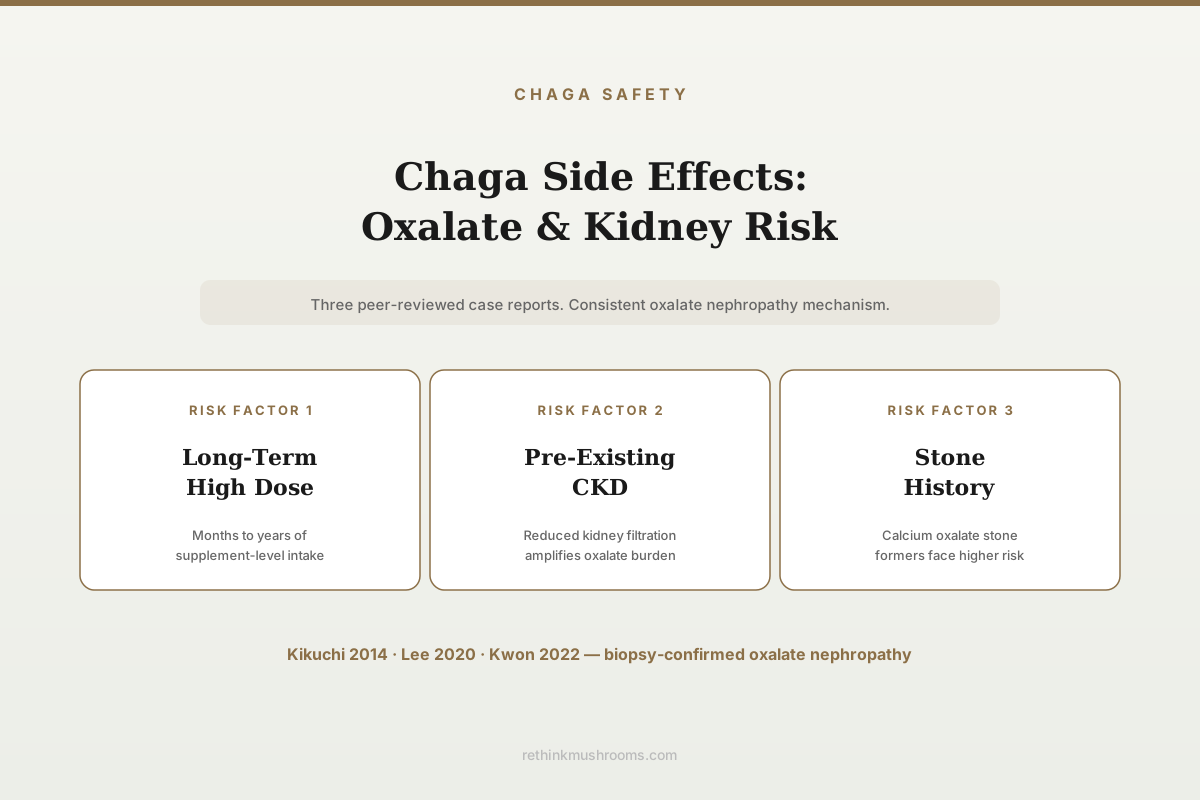
Most chaga safety writing stays vague, falling back on generic advice about consulting a professional and watching for interactions. There is no need for vagueness here. Three peer-reviewed case reports document chaga-induced oxalate nephropathy, the mechanism is well mapped, one laboratory measured the oxalate content of an actual patient's product, and as of January 2026 there is a controlled animal experiment that begins to separate a dose that injures from a dose that does not.[4] Chaga is not a categorically dangerous mushroom, and it has been consumed by very large numbers of people for a very long time. The kidney risk is narrow, real, and concentrated in circumstances that can be described precisely. Kikuchi et al. (2014) reported the index case, and the picture has been sharpening ever since.[1]
For the broader safety landscape, see can you take chaga long-term? safety considerations and chaga and blood thinners: drug interaction warnings.
Key Takeaways
- Three peer-reviewed case reports document chaga-induced oxalate nephropathy, and a PubMed search confirms that three is still the complete human total: Kikuchi et al. (2014), Lee et al. (2020), and Kwon et al. (2022)
- Contrary to how these cases are often summarised, none of the three patients had documented kidney disease before starting chaga; Lee et al. (2020) argue the opposite direction, that chaga is a potential cause of chronic kidney disease
- Lee et al. (2020) measured 14.2 g of oxalate per 100 g in the patient's retained powder, the only time a chaga product involved in a case was ever chemically analysed
- A 2026 Wistar rat study is the first experiment with an exposed-but-uninjured arm: injury appeared across every endpoint at 3,844.8 mg/kg but no endpoint was reported to separate the standard dose from control
- Durations were shorter than "long-term" suggests: Kwon's patient developed acute kidney injury after 3 months, Kikuchi's after 6 months
- Chaga appears in the literature as both nephrotoxic and renoprotective; the variable is preparation, since every protective result used a purified extract fraction and every injury involved whole powder
- Three of the four most-cited modern chaga reviews never use the word "oxalate" anywhere in their full text, and one contains a subsection headed "Renoprotective"
Why Chaga Has an Oxalate Problem
Chaga belongs to the category of foods that oxalate advice normally flags, alongside spinach, rhubarb, and strong tea. Oxalates are organic anions that bind calcium to form insoluble crystals. In the kidney, calcium oxalate is the primary constituent of the most common kidney stone and, at high enough tubular concentrations, deposits inside renal tubules and injures the nephron directly.
Where chaga separates from the rest of that category is concentration. Kikuchi et al. (2014) noted that "Chaga mushrooms contain extremely high oxalate concentrations," and Lee et al. (2020) put a number on it, measuring 14.2 g of oxalate per 100 g in the powder their patient had actually been consuming.[1][2] That single measurement is doing an enormous amount of work in this literature, because it is the only one of its kind.
The biology of dietary oxalate explains why concentration matters so much. Most oxalate you eat is degraded by gut bacteria, notably Oxalobacter formigenes, before it can be absorbed. What does get absorbed enters the bloodstream and is filtered by the kidneys, and healthy kidneys clear it efficiently. Two things break that equilibrium: sustained intake large enough to overwhelm normal clearance, and reduced filtration capacity that shrinks the margin available. The published chaga cases sit at the first of these. The broader oxalate nephropathy literature, discussed below, sits mostly at neither.
What the Case Reports Actually Show
Three peer-reviewed cases are the whole human record. A PubMed search for chaga case reports returns no fourth. Case reports sit low in most evidence hierarchies, and for good reason, but they are precisely the right instrument for documenting a previously unrecognised harm. A great many drug label warnings started life exactly this way.
Kikuchi et al. (2014) is the index report.[1] A 72-year-old Japanese woman, diagnosed with liver cancer a year earlier and having undergone hepatectomy of the left lobe, had been taking 4 to 5 teaspoons of chaga powder daily for six months for the cancer. Renal function declined and hemodialysis was initiated. Biopsy showed diffuse tubular atrophy and interstitial fibrosis, with oxalate crystals in the tubular lumina and urinary sediment. The report does not describe a recovery.
Lee et al. (2020) is the case that matters most, because it is the only one where the product was measured.[2] A 49-year-old Korean man was transferred already in end-stage renal disease. Biopsy review showed chronic tubulointerstitial nephritis with oxalate crystal deposits, and his history revealed long-term chaga powder taken for intractable atopic dermatitis. The retained powder measured 14.2 g oxalate per 100 g, and the authors estimated his daily oxalate intake at roughly twice a usual diet for four years and roughly five times in the final year.
This case is routinely summarised as a patient whose pre-existing kidney disease made him vulnerable to chaga. That reverses the paper's argument. He took chaga for a skin condition, not for a kidney condition, and the authors' conclusion runs the other way: "Chaga mushroom is a potential risk factor of chronic kidney disease considering high oxalate content." The distinction matters, because the common version implies the risk belongs to people who already know their kidneys are compromised.
Lee et al. (2020) · Journal of Korean Medical Science
- Population
- One 49-year-old Korean man, transferred in end-stage renal disease
- Intervention
- Long-term daily chaga mushroom powder, taken for intractable atopic dermatitis
- Finding
- Biopsy showed chronic tubulointerstitial nephritis with oxalate crystal deposits. The retained powder measured 14.2 g oxalate per 100 g. Estimated daily oxalate intake was about 2x a usual diet for four years and about 5x in the final year.
narrow-scope A single case report. It establishes that this happens and quantifies one real exposure, but it cannot establish how often it happens or at what threshold.
Lee et al. (2020), J Korean Med Sci 35(19):e122
Kwon et al. (2022) added a third presentation.[3] A 69-year-old man taking 10 to 15 g of chaga powder daily, together with 500 mg of vitamin C daily, for three months developed acute kidney injury presenting as nephrotic syndrome. Pathology showed focal acute tubular injury with calcium oxalate crystal deposition, interstitial fibrosis and tubular atrophy, and electron microscopy showed podocyte foot process effacement. The diagnosis was acute oxalate nephropathy with minimal change disease. Two details are usually dropped in summaries and both matter. The vitamin C is a genuine confounder, since the body metabolises ascorbate to oxalate, so chaga was not his only oxalate source. And after hemodialysis plus high-dose steroids, his kidney function recovered within a month and the minimal change disease went into complete remission.
Three cases is not a series. What they have is a consistent biopsy finding, consistent exposure histories, and independent publication across three countries and twelve years. What they cannot give is an incidence rate or a threshold. Both Lee and Kwon end with a recommendation to clinicians rather than a claim about the population: nephrologists should consider oxalate nephropathy in patients with chaga exposure, and unexplained acute kidney injury warrants a careful supplement history and a biopsy.
The 2026 Rat Study Changes the Evidence Base
For twelve years, the entire chaga nephrotoxicity literature was those three case reports, and case reports have a structural blind spot: every person in one is already injured. There is no comparison arm, so no dose can ever be shown to be tolerated. In January 2026, Lee et al. published the first experiment built to fix that.[4]
Wistar rats were assigned to three groups at doses extrapolated from a previously reported clinical case. Controls received no supplement. A standard-dose group received chaga powder at 1,281.6 mg/kg body weight, equivalent to 183 mg/kg of oxalate. A high-dose group received 3,844.8 mg/kg, equivalent to 549 mg/kg of oxalate, exactly three times the standard dose.
Wistar Rat Model · Lee et al. 2026
The First Chaga Dose That Was Exposed And Not Injured
Three human case reports cannot locate a threshold, because everyone in a case report is already sick. This is the first chaga experiment with an exposed-but-uninjured arm. Every injury endpoint fired in the high-dose group. None was reported to separate the standard-dose group from control.
What moved in the high-dose group only
- lowerFinal body weightP = 0.011
- higherUrinary protein excretionP = 0.001
- presentOxalate crystals + tubular injury on histologyreported
- higher8-OHdG in serum, urine, kidney tissueP < 0.05
- higherCD68/SR-D1 (macrophage marker)P < 0.050
- higherTUNEL and Bax positive cellsP < 0.05
- lowerBcl positive cellsP < 0.05
Read it this way: tripling the dose was the difference between nothing reported and injury on every axis the authors measured — function, histology, oxidative stress, and apoptosis. Two cautions travel with that. The standard-dose arm showing no reported difference is an absence of evidence in one small rodent study, not a cleared safe dose, and nothing here converts to a human cup of tea. What it does establish is that chaga powder itself, not some peculiarity of three unlucky patients, is sufficient to injure a kidney. Note also that the authors’ own conversion — 183 mg oxalate inside 1,281.6 mg of powder — implies about 14.3 g oxalate per 100 g, which is almost exactly the 14.2 g per 100 g measured in a retained human product six years earlier.
Source: Lee et al. (2026), Journal of Korean Medical Science 41(3):e37. Dose multiple and implied oxalate percentage are arithmetic on the figures the paper reports; the measured 14.2 g/100 g comparison is Lee et al. (2020), J Korean Med Sci 35(19):e122.
The high-dose group separated from the others on every axis measured: lower final body weight, higher urinary protein excretion, oxalate crystal deposition and tubular injury on histology, elevated 8-hydroxy-2'-deoxyguanosine in serum, urine and kidney tissue, increased CD68/SR-D1, more TUNEL-positive and Bax-positive cells, and fewer Bcl-positive cells. The standard-dose group was not reported to differ from control on any endpoint.
Two things follow, and it is worth keeping them apart. The study establishes that chaga powder itself is sufficient to injure a kidney, which the case reports could only suggest, since a case report cannot exclude some peculiarity of the patient. It does not establish a safe human dose. An absence of reported difference in one small rodent study is not a clearance, rodent-to-human dose conversion is not a matter of dividing by body weight, and the doses here were reverse-engineered from a case of documented human harm.
- Case reportscompleted
Three biopsy-confirmed human cases across Japan and South Korea, 2014 to 2022, with consistent histology
- Controlled animal studycurrent
Lee et al. (2026): Wistar rats, three arms, injury at 3,844.8 mg/kg and no reported separation at 1,281.6 mg/kg
- Human dosing or toxicology studymissing
No study has measured urinary oxalate in people consuming chaga at any dose
- Controlled human trialmissing
Not feasible or ethical for a harm endpoint
- Pooled analysismissing
Three cases cannot be pooled into an incidence estimate
The 2026 rat model is the first evidence above the case-report tier and the first with an uninjured comparison arm. The rung that would actually help a consumer, a human study measuring urinary oxalate at realistic intakes, has never been climbed.
Kikuchi et al. (2014); Lee et al. (2020); Kwon et al. (2022); Lee et al. (2026)
The Dose-Duration Pattern
The exposures in the published cases are more varied, and shorter, than the phrase "long-term use" implies. Kwon's patient reached acute kidney injury in three months. Kikuchi's took six months. Only Lee's ran for years. The honest range is three months to roughly five years, not the multi-year picture usually described.
What is consistent is intake far above anything culinary. Four to five teaspoons of powder daily, or 10 to 15 grams daily, is supplement-scale dosing taken for a medical purpose: liver cancer, atopic dermatitis, general therapeutic use. None of the reports describes injury from occasional tea.
So chaga is not categorically nephrotoxic in the way certain drugs are. It is dose-dependently and duration-dependently nephrotoxic, and the 2026 rat data give that framing its first experimental support rather than leaving it as an inference from three anecdotes.
Who Is Actually at Highest Risk
Here the chaga literature has to hand off to the broader oxalate nephropathy literature, because the three chaga cases cannot support risk stratification on their own. None of the three patients had documented kidney disease before starting chaga.
The relevant reference is Lumlertgul et al. (2018), a systematic review of secondary oxalate nephropathy covering 57 case reports and 10 case series from 1950 to January 2018, totalling 108 patients.[5] It reorders the risk picture that chaga articles usually present.
Lumlertgul et al. (2018) · Kidney International Reports
- Population
- 108 patients with biopsy-proven secondary oxalate nephropathy, pooled from 57 case reports and 10 case series, 1950 to 2018
- Intervention
- Observational; causes included fat malabsorption (88%) and excessive dietary oxalate (20%)
- Finding
- 55% required dialysis. None had complete recovery, 42% had partial recovery, and 58% remained dialysis-dependent. 33% of patients died. Mean 24-hour urinary oxalate excretion was 85.4 mg/day.
narrow-scope Pooled case reports and series, not a cohort study, so it describes the outcomes of diagnosed cases and cannot estimate risk in the general population.
Lumlertgul et al. (2018), Kidney Int Rep 3(6):1363-1372
Two findings from that review deserve to change how the risk factors are ranked.
Fat malabsorption is the dominant cause, not reduced kidney function. It was the attributed cause in 88% of cases, far ahead of excessive dietary oxalate at 20%. The mechanism is well understood: when fat is not absorbed properly, unabsorbed fatty acids bind calcium in the gut, and calcium bound to fat is no longer available to bind oxalate, so much more free oxalate crosses into the bloodstream. Conditions that produce this include inflammatory bowel disease, coeliac disease, chronic pancreatitis, and bariatric or other bowel surgery. Anyone in that group is handling dietary oxalate on a completely different curve, which is why it belongs at the top of a chaga risk list rather than as an afterthought below kidney disease.
The outcomes are severe. Not one of the 108 patients had a complete recovery, 58% remained dialysis-dependent, and a third died. Kwon's patient, who fully recovered, is genuinely unusual against that background, which is worth knowing before treating his case as reassurance.
The remaining risk factors are mechanistically sound and mostly inherited from general oxalate physiology rather than from anything chaga-specific. Reduced glomerular filtration means less reserve to clear an oxalate load. A history of calcium oxalate stones demonstrates a renal environment that already supports crystal formation. Dehydration concentrates urine and raises supersaturation. High-dose vitamin C adds a second oxalate source, as it did in Kwon's case. And diabetic nephropathy sits awkwardly beside the fact that diabetes is one of chaga's better-supported preclinical indications.
Renal
CriticalSustained high-dose chaga powder has caused biopsy-confirmed kidney injury, and no safe dose has ever been established
Concern
Three published human cases all involved daily chaga powder for three months to five years, and all three required dialysis. The mechanism, oxalate crystal deposition in renal tubules, was consistent on every biopsy and was reproduced in rats in 2026. Chaga's oxalate density was measured at 14.2 g per 100 g in the one product ever analysed.
What the research says
Incidence is unknown and cannot be derived from three cases; chaga is consumed very widely and these reports are published precisely because they are unusual. But there is no established safe dose, no human toxicology study, and no oxalate content on any commercial label, so exposure cannot be calculated even by a careful and motivated consumer.
Particularly relevant for: Highest risk: fat malabsorption conditions including inflammatory bowel disease, coeliac disease, chronic pancreatitis and bariatric surgery; existing kidney disease; prior calcium oxalate stones; dehydration; and concurrent high-dose vitamin C, which the body metabolises to oxalate.
What to do
If you take chaga daily and long-term, tell your physician and ask whether kidney function monitoring is appropriate. Seek medical attention for reduced urine output, unexplained swelling, foamy urine, flank pain, or persistent unexplained fatigue. This article is educational and is not medical advice; it cannot account for your history, medications, or kidney function.
Kikuchi et al. (2014); Lee et al. (2020); Kwon et al. (2022); Lee et al. (2026); Lumlertgul et al. (2018)
The Renoprotective Contradiction
Anyone searching this topic will quickly hit an apparent contradiction. Alongside the injury reports sits a body of rodent work in which chaga protects kidneys. Chou et al. (2016) found that a low-molecular-weight polysaccharide fraction reduced urinary albumin-to-creatinine ratio in diabetic nephropathy mice.[10] Chiang et al. (2023) found that an ethanol-ethyl acetate extract improved creatinine, blood urea nitrogen and albumin-creatinine ratio while reducing fibrosis markers in a diabetic nephropathy model.[11]
Both bodies of work are real. The variable that separates them is not species or dose but preparation.
Reconciling A Contradiction
Chaga Protects Kidneys And Destroys Them, Depending On What Is In The Cup
Both literatures are real and neither is fringe. What separates them is not dose or species but preparation: every protective result used a purified fraction, and every injury used the whole powder.
Protective
Purified extract fractions, rodent models
Chou et al. (2016)
RTHM-00776
Low-molecular-weight polysaccharide fraction (10-100 kDa), 300 mg/kg, 8 weeks
HFD/STZ diabetic nephropathy mice
Decreased urinary albumin/creatinine ratio; improved glucose handling and lipids
Chiang et al. (2023)
RTHM-01676
Ethanol crude extract, ethyl acetate layer, 100-500 mg/kg
STZ + 1/3 nephrectomy diabetic nephropathy mice
Improved creatinine, BUN and ACR; reduced TGF-beta and alpha-SMA
Harmful
Whole powder, humans and rats
Kikuchi et al. (2014)
RTHM-00605
Powder, 4-5 teaspoons/day, 6 months
72-year-old woman
Oxalate nephropathy on biopsy; hemodialysis initiated
Lee et al. (2020)
RTHM-01231
Powder, long-term daily; measured 14.2 g oxalate/100 g
49-year-old man
Chronic tubulointerstitial nephritis with oxalate crystals; end-stage renal disease
Kwon et al. (2022)
RTHM-01559
Powder, 10-15 g/day, 3 months, with vitamin C 500 mg/day
69-year-old man
Acute oxalate nephropathy with minimal change disease; recovered at 1 month
Lee et al. (2026)
RTHM-02379
Powder, 3,844.8 mg/kg (549 mg/kg oxalate)
Wistar rats
Oxalate crystal deposition, tubular injury, oxidative stress, apoptosis
Read it this way: the plausible reading is that the compounds credited with protecting kidneys and the oxalate that injures them are separable, and that fractionation separates them. That reading has a real limit and it should be said out loud: none of the protective studies measured the oxalate content of the fraction it used, and no experiment has ever compared an extract against whole powder in the same model. So this reconciles the contradiction without licensing the further claim that any commercial extract is low in oxalate. Products are not labelled for oxalate, and “extract” on a package is not a controlled term.
Sources: Chou et al. (2016), Int J Mol Sci 17(9):1535; Chiang et al. (2023), Int J Mol Sci 24(5):4443; Kikuchi et al. (2014), Clin Nephrol 81(6):440-4; Lee et al. (2020), J Korean Med Sci 35(19):e122; Kwon et al. (2022), Medicine 101(10):e28997; Lee et al. (2026), J Korean Med Sci 41(3):e37.
Every protective result used a purified fraction. Every documented injury, human or rat, involved whole powder, which is what carries the oxalate. The plausible reading is that the compounds credited with protecting kidneys and the oxalate that injures them are separable, and that fractionation separates them.
That reading has a hard limit and it should be stated rather than buried. None of the protective studies reported the oxalate content of the fraction it used, and no experiment has ever compared an extract against whole powder in the same model. So this resolves the contradiction in the literature without licensing the conclusion that any commercial extract is low in oxalate. "Extract" is not a controlled term on a supplement label, and no chaga product discloses oxalate content.
Marketing vs Literature
Is chaga good for your kidneys?
The claim
“Chaga is renoprotective and supports kidney health.”
Rodent studies of purified chaga fractions in diabetic nephropathy models, amplified by review articles that report those results without mentioning the human case literature.
What research shows
MisleadingThe renoprotective findings are genuine but were produced with isolated extract fractions in diabetic rodents. Every documented human kidney injury involved whole chaga powder, and a 2026 rat study reproduced that injury with powder.
Preparation, not the mushroom, appears to determine the direction of the effect. Since no protective study measured the oxalate content of its fraction and no product labels oxalate, the finding does not transfer to anything a consumer can buy.
Chou et al. (2016); Chiang et al. (2023); Kikuchi et al. (2014); Lee et al. (2020); Kwon et al. (2022); Lee et al. (2026)
What the Reviews Actually Say
Most people checking whether chaga is safe will end up reading a review article rather than a case report, because reviews are what surface in search and what get cited. So it is worth asking directly whether the major chaga reviews communicate this risk. Each of the four most-cited modern reviews was searched in full text, reference lists included, for "oxalate" and "nephropath".
Full-Text Audit · Four Major Chaga Reviews
Three Of Four Reviews Never Say “Oxalate” Once
Reviews are where a curious reader usually lands. Each of these four was searched in full text, bibliography included, for “oxalate” and “nephropath”. The bar is the raw count of “oxalate”.
Szychowski et al. (2021)
J Tradit Complement Med
RTHM-01442
Its one nephropathy mention in the body text is diabetic nephropathy in mice. The review closes by asking for evidence-based-medicine-grade studies, without naming the harm already documented in humans.
Duru et al. (2019)
Phytotherapy Research
RTHM-01052
Neither word appears anywhere in the full text. The review is a pharmacology survey and does not take up safety.
Ern et al. (2024)
Mycology
RTHM-01886
Contains a subsection titled "Renoprotective" describing chaga extracts improving kidney markers in mice. Published two years after the third human case report, it never mentions oxalate.
Fordjour et al. (2023)
Frontiers in Pharmacology
RTHM-01694
The one review that engages: it summarises the Kikuchi case, warns that extended use "in any form" may raise blood oxalate in sensitive individuals, and cites the secondary oxalate nephropathy systematic review.
Read it this way: this is not a claim that the three silent reviews are wrong about what they do cover, and a review is entitled to scope itself. It is a claim about what a reader actually encounters. Someone checking chaga’s safety through the review literature has a three-in-four chance of reading a paper that never raises the only serious documented harm, and a real chance of reading one whose kidney section is headed “Renoprotective”. That is why the risk feels obscure relative to how well documented it is.
Counts from case-insensitive search of the PubMed Central full text of each review (PMC8240111, PMC13300323, PMC11132974, PMC10728660), reference lists included.
Fordjour et al. (2023) is the one that engages.[6] It summarises the Kikuchi case, cites Lee et al. (2020) and the Lumlertgul systematic review, and warns that "with time extended use of chaga in any form may lead to increased levels of oxalate in the blood," posing a risk for sensitive individuals.
The other three do not. Szychowski et al. (2021) never uses the word "oxalate"; its one nephropathy mention in the body text concerns diabetic nephropathy in mice, and its closing caution is a general call for evidence-based-medicine-grade studies rather than a safety warning.[7] Duru et al. (2019) contains neither term anywhere in its full text; it is a pharmacology survey that does not take up safety.[8] Ern et al. (2024) is the most striking: published two years after the third case report, it never mentions oxalate, and its kidney content sits in a subsection headed "Renoprotective."[9]
None of this makes those reviews wrong about what they cover, and a review is entitled to define its scope. But it explains something real: the risk feels obscure relative to how well documented it is, because the literature layer most readers actually reach is, three times out of four, silent about it.
What the Evidence Still Does Not Establish
Honest reading requires being explicit about the gaps, several of which remain wide even after the 2026 study.
- No human dose threshold is established. The rat study locates a separation between 183 and 549 mg/kg of oxalate in rats, which does not convert to a human intake.
- Incidence is unknown. Three cases identify a phenomenon; they cannot estimate how often it occurs among chaga consumers, and the denominator is not known even approximately.
- Oxalate content across products is essentially unmeasured. One product from one case has been analysed. Whether wild-harvested and cultivated chaga, or different grades, differ in oxalate density is unknown.
- Preparation effects are unquantified. Tea, tincture and capsule plausibly deliver very different oxalate loads, and no study has measured this.
- No trial has tested whether protective measures help. Calcium taken with food binds oxalate in the gut and reduces absorption in other contexts, but this has never been studied for chaga.
- No study has measured urinary oxalate in people drinking chaga. This is the single most tractable missing experiment, and it would be inexpensive.
Symptoms That Would Suggest Kidney Involvement
Oxalate nephropathy is often not preceded by obvious warning signs. Presentations across the case literature range from progressive fatigue and reduced urine output to injury detected only on routine bloodwork. In the Lumlertgul pooled series, proteinuria was reported in 69% of patients, haematuria in 32%, and urinary crystals in 26%.[5]
Reduced urine output, persistent unexplained fatigue, swelling of the lower legs, flank discomfort, foamy urine, and unexplained rises in serum creatinine are the features worth attention in anyone with a relevant exposure history. Definitive diagnosis requires renal biopsy showing calcium oxalate crystal deposition. Without biopsy it is a diagnosis of exclusion resting on exposure history.
The practical point for chaga consumers is narrow: a new kidney symptom or laboratory abnormality in someone with sustained chaga intake deserves the chaga to be raised explicitly, not left as an incidental line in a medical history. Both Lee and Kwon make exactly this recommendation to clinicians, and it only works if the patient volunteers the exposure.
What This Means in Practice
A reader translating this evidence into decisions can defensibly conclude the following. This is educational context, not medical advice, and it cannot substitute for a clinician who knows your history and kidney function.
- Chaga has documented nephrotoxicity in humans through a consistent oxalate mechanism, now reproduced experimentally in rats
- Risk concentrates in sustained supplement-scale powder intake, not in occasional tea, and no documented case involved culinary use
- The clearest risk group is people with fat malabsorption conditions, ahead of those with existing kidney disease, prior oxalate stones, dehydration, or concurrent high-dose vitamin C
- Duration matters but the window is shorter than usually implied: injury appeared after three months in one case
- Renoprotective claims come from purified fractions in diabetic rodents and do not transfer to whole powder
- No safe dose exists, no product labels oxalate, and no human study has measured urinary oxalate on chaga, so exposure cannot be calculated by a consumer even in principle
- If you take chaga daily and long-term, that belongs in your medical record, and kidney function monitoring is a reasonable thing to ask about
For broader long-term safety considerations, see can you take chaga long-term? safety considerations. For dosing context, see chaga dosage guide: how much should you take?.
The Bottom Line
Three peer-reviewed case reports document oxalate nephropathy from chaga, with consistent biopsy findings and exposures ranging from three months to about five years. None of the three patients had documented kidney disease beforehand; Lee et al. (2020) argue chaga is a potential cause of chronic kidney disease rather than a hazard only for those who already have it. A 2026 Wistar rat study reproduced the injury experimentally and is the first work with an exposed-but-uninjured arm. Chaga also appears in the literature as renoprotective, but only as purified extract fractions, while every documented injury involved whole powder. Three of the four major chaga reviews never mention oxalate at all. Occasional tea in healthy adults is not associated with documented harm, but no safe dose has been established and no product discloses its oxalate content.
Frequently Asked Questions
Sources & References
- 1RTHM-00329·Kikuchi, Yuko et al. (2014). “Chaga mushroom-induced oxalate nephropathy..” Clinical nephrology.Study breakdown →PubMed →↩
- 2RTHM-00630·Lee, Sua et al. (2020). “Development of End Stage Renal Disease after Long-Term Ingestion of Chaga Mushroom: Case Report and Review of Literature..” Journal of Korean medical science.Study breakdown →PubMed →↩
- 3RTHM-00775·Kwon, Ohyun et al. (2022). “Chaga mushroom-induced oxalate nephropathy that clinically manifested as nephrotic syndrome: A case report..” Medicine.Study breakdown →PubMed →↩
- 4RTHM-02379·Lee, Sua et al. (2026). “Kidney Injury Induced by High-Dose Chaga Mushroom Consumption: Experimental Evidence in a Rat Model..” Journal of Korean medical science.Study breakdown →PubMed →↩
- 5RTHM-02380·Lumlertgul, Nuttha et al. (2018). “Secondary Oxalate Nephropathy: A Systematic Review..” Kidney international reports.Study breakdown →PubMed →↩
- 6RTHM-01694·Fordjour, Eric et al. (2023). “Chaga mushroom: a super-fungus with countless facets and untapped potential..” Frontiers in pharmacology.Study breakdown →PubMed →↩
- 7RTHM-00722·Szychowski, Konrad A et al. (2021). “Inonotus obliquus - from folk medicine to clinical use..” Journal of traditional and complementary medicine.Study breakdown →PubMed →↩
- 8RTHM-00553·Duru, Kingsley C et al. (2019). “The pharmacological potential and possible molecular mechanisms of action of Inonotus obliquus from preclinical studies..” Phytotherapy research : PTR.Study breakdown →PubMed →↩
- 9RTHM-01886·Ern, Phoebe Tee Yon et al. (2024). “Chaga Therapeutic Properties: What This 2024 Review Actually Shows.” Mycology.Study breakdown →PubMed →↩
- 10RTHM-00423·Chou, Yen-Jung et al. (2016). “Renal Protective Effects of Low Molecular Weight of Inonotus obliquus Polysaccharide (LIOP) on HFD/STZ-Induced Nephropathy in Mice..” International journal of molecular sciences.Study breakdown →PubMed →↩
- 11RTHM-00819·Chiang, Kuang-Hsing et al. (2023). “Renoprotective Impacts of Inonotus obliquus Ethanol-Ethyl Acetate Extract on Combined Streptozotocin and Unilateral Nephrectomy-Induced Diabetic Nephropathy in Mice..” International journal of molecular sciences.Study breakdown →PubMed →↩