Chaga Safety & Dosing
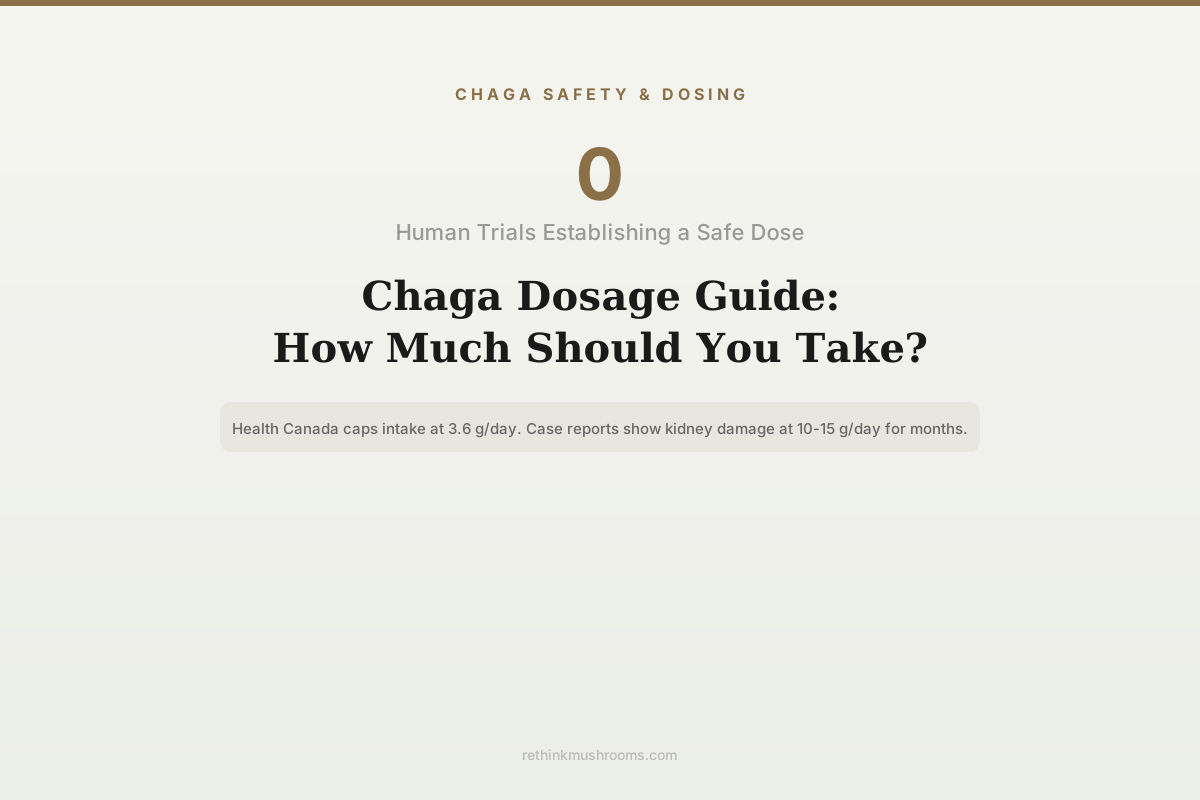
0 RCTs
Zero randomized controlled trials have established a safe daily chaga dose in humans. Published case reports show kidney failure at roughly 10-15 grams of powder daily sustained for months.
Kikuchi et al., Clin Nephrol, 2014
3.6 g/day
Health Canada's upper intake limit for chaga
14.2 g/100g
oxalate concentration measured in one chaga product (Kwon 2022)
4-5 tsp
daily powder intake that produced oxalate nephropathy (Kikuchi 2014)
Kikuchi et al., Clin Nephrol, 2014
 View as image ↗
The most honest answer to "how much chaga should I take?" is that nobody knows. No randomized controlled trial has tested any dose of chaga (Inonotus obliquus) in humans over any duration. Every dose recommendation currently circulating online traces back to either traditional use patterns, supplement industry convention, or extrapolation from animal studies. What we do have are three published case reports of people who developed kidney failure from chaga use, and those cases define the upper edge of what is clearly unsafe. Everything below that edge is an educated guess. This article compiles the dose-related data that actually exists: the case report intakes, animal study dose ranges, product variability measurements, and the single regulatory ceiling (Health Canada's 3.6 g/day upper limit). For the broader safety profile, see can you take chaga long-term: safety considerations.
Key Takeaways
- Health Canada's natural health product monograph sets an upper daily intake of 3.6 grams of chaga; no other national regulator has issued a comparable limit
- The Kikuchi et al. (2014) case report documented oxalate nephropathy at 4-5 teaspoons of chaga powder daily (~10-15 g) for 6 months
- Kwon et al. (2022) measured 14.2 grams of oxalate per 100 grams of chaga in a product implicated in nephropathy, roughly 18-24x the oxalate density of spinach
- Windsor et al. (2025) found wide variation in bioactive compound content across commercial chaga supplements, meaning equal doses by weight can deliver unequal active compound exposures
- Animal studies showing safety typically use aqueous extracts at defined doses over weeks, not powdered chaga at self-administered doses over years (Mishra et al., 2012)
- The dose-response curve for benefit in humans is undefined; all efficacy data comes from cell and animal work (Fordjour et al., 2023; Ern et al., 2024)
The Regulatory Ceiling: Where 3.6 g/day Comes From
Health Canada's Natural Health Products Directorate publishes monographs that define permitted claims and dose ranges for ingredients used in licensed natural health products. The chaga monograph caps daily intake at 3.6 grams of dried mushroom equivalent. This is not a safety threshold derived from human trials. Health Canada acknowledges in its monograph framework that dose ranges reflect traditional use patterns and industry submissions rather than experimental dose-finding work.
The 3.6 g/day figure functions as a regulatory ceiling for licensed products sold in Canada. It is not endorsed by the U.S. Food and Drug Administration, the European Food Safety Authority, or Japan's Ministry of Health, Labour and Welfare. No other national regulator has published a quantitative upper intake for chaga. Consumers encountering higher doses on U.S. product labels are not seeing products that violate any enforced U.S. limit, because no such limit exists.
This regulatory gap matters because chaga's oxalate content means dose and duration both scale with risk. The Kikuchi et al. (2014) case, at 4-5 teaspoons of powder daily (approximately 10-15 grams) for 6 months, was well above the Canadian ceiling.[1] The Lee et al. (2020) case involved long-term intake estimated to deliver 2-5 times the oxalate load of a typical diet.[2] Both cases produced irreversible kidney damage.
Case Report Intakes: What Caused Harm
The only human dose data that exists for chaga comes from adverse event reporting. Three published cases document the intakes that preceded kidney failure.
Kikuchi et al. (2014) reported a 72-year-old Japanese woman consuming 4-5 teaspoons of chaga powder daily for approximately 6 months. A teaspoon of chaga powder weighs roughly 2-3 grams, putting her daily intake at 8-15 grams. She developed oxalate nephropathy requiring hemodialysis, with renal biopsy confirming calcium oxalate crystal deposits in tubules.[1]
Lee et al. (2020) described a 49-year-old Korean man who developed end-stage renal disease after long-term chaga consumption. The published report did not quantify daily grams but estimated his chaga-derived oxalate intake at 2-5 times the typical dietary oxalate load.[2] A typical Western diet delivers roughly 100-200 mg of oxalate per day, so his chaga intake was supplying an additional 200-1000 mg daily from the mushroom alone.
Kwon et al. (2022) documented a third case with unusual presentation (nephrotic syndrome) and provided the first laboratory measurement of oxalate content in an implicated product: 14.2 grams of oxalate per 100 grams of chaga.[3] At that concentration, 1 gram of chaga delivers approximately 142 mg of oxalate. A 3-gram daily dose delivers around 425 mg, already above typical dietary oxalate intake from food.
These intakes define the upper edge of documented harm. They do not define a threshold below which chaga is safe. The lowest dose at which oxalate nephropathy has been observed is unknown because subclinical tubular damage does not generate case reports.
Product-by-Product Dose Equivalents
Commercial chaga is sold in four primary forms. Each delivers different amounts of total mushroom mass and different concentrations of bioactive compounds.
| Form | Typical Serving | Approximate Equivalent Dry Mushroom | Notes |
|---|---|---|---|
| Raw powder | 1-3 g | 1-3 g | Highest oxalate per gram; no extraction losses |
| Chaga tea (from chunks or powder) | 1-2 cups, 1-2 g per cup | 1-4 g | Water-extractable fraction only; some oxalate may remain in solids |
| Tincture (hydroalcoholic) | 1-2 mL (typically 1:4-1:5 ratio) | 0.2-0.5 g equivalent | Alcohol extracts different compounds than water |
| Dual extract (8:1 or 10:1) | 250-500 mg, 1-3x daily | 2-12 g equivalent | Concentrated; label math often cites "mushroom equivalent" |
The problem with this table is that product labels use "equivalent" differently and inconsistently. A "10:1 extract" nominally means 10 grams of raw mushroom reduced to 1 gram of extract, but the extraction process may concentrate some compounds (polysaccharides) while discarding others (water-insoluble triterpenoids). Windsor et al. (2025) compared commercial chaga supplements using complementary analytical techniques and documented wide variation in betulin, betulinic acid, inotodiol, and polysaccharide concentrations.[4] Two products labeled with the same "10:1 extract ratio" can deliver substantially different active compound exposures at the same milligram dose.
For a form-specific comparison of bioactive delivery, see chaga tea vs. tincture vs. capsule: best forms for bioactives.
The Animal Study Dose Ranges
Most preclinical chaga research uses oral aqueous extracts at doses defined in mg/kg body weight. Translating these to human equivalents is imperfect (interspecies allometric scaling inflates uncertainty), but the ranges offer context for what "active" doses look like in controlled conditions.
Mishra et al. (2012) administered aqueous extract of I. obliquus orally to mice in a DSS-induced colitis model and reported anti-inflammatory activity without evident liver or kidney toxicity at the tested doses.[5] The extract, not the raw powder, was used, which almost certainly reduced oxalate delivery per unit of mushroom mass.
Chiang et al. (2023) showed renoprotective effects of an I. obliquus ethanol-ethyl acetate extract in streptozotocin-induced diabetic nephropathy mice, again using a defined extract rather than crude powder.[6] Peng et al. (2022) tested chaga and its bioactive compounds for effects on non-alcoholic fatty liver disease pathways in rodents.[7]
The common pattern across these animal studies is use of standardized extracts at doses that have been adjusted for body weight. Consumer chaga use involves self-dosing of non-standardized products, a very different exposure profile. Kim et al. (2020) documented that triterpenoid composition of I. obliquus depends on growth conditions and extraction method, which means animal studies using one extract cannot be assumed to predict outcomes from consumer products made differently.[8]
Oxalate as the Dose-Limiting Factor
For most supplements, dose is limited by the concentration of the active ingredient and the goal of clinical effect. For chaga, the oxalate content creates an upper bound that is independent of therapeutic intent. The question is not "how much chaga do I need for benefits?" but "how much oxalate can the kidneys safely handle?"
Normal urinary oxalate excretion is 20-40 mg/day in healthy adults. Hyperoxaluria is defined at >40 mg/day in men and >35 mg/day in women. Dietary oxalate absorption is typically 10-20%, meaning 100-200 mg of dietary oxalate adds 10-40 mg to urinary excretion. At 14.2 g of oxalate per 100 g of chaga (the Kwon measurement), a 3-gram daily chaga dose delivers approximately 425 mg of oxalate, roughly 2-4x a typical dietary oxalate load.[3]
This calculation uses one measured product. Other products may contain more or less oxalate. Lazic et al. (2024) demonstrated that green extraction technologies change the chemical composition of chaga extracts, suggesting oxalate content likely varies with extraction method as well as raw material.[9] Without product-specific oxalate labeling, the oxalate load of any given dose is unknowable without lab testing.
For a full breakdown of the oxalate mechanism, see chaga side effects: oxalate risk and kidney concerns.
What "Traditional Use" Doses Look Like
Traditional chaga use in Russia, Scandinavia, and East Asia involved brewing tea from chunks of the sclerotium harvested from birch trees. Szychowski et al. (2021) reviewed the historical transition of I. obliquus from folk medicine to contemporary clinical interest.[10] Fordjour et al. (2023) noted that Japanese traditional use delivered roughly 6 mg/kg/day of extract-equivalent, which corresponds to approximately 420 mg for a 70-kg adult, well below the Kikuchi case intake.[11]
Two differences separate traditional use from current consumer exposure. First, traditional preparation was almost exclusively hot water tea, which extracts water-soluble compounds (including some oxalate, but not all) while leaving much of the solid mass behind. Modern powder-based products deliver the entire biomass including all insoluble oxalate. Second, traditional use was intermittent and seasonal rather than continuous daily supplementation over years.
The Kikuchi, Lee, and Kwon cases all involved sustained daily consumption of concentrated products rather than the seasonal tea brewing of traditional practice. Traditional safety patterns do not translate cleanly to modern supplement use.
Product Variability and Why "A Gram Isn't A Gram"
Two chaga products labeled at the same dose can deliver fundamentally different exposures. Windsor et al. (2025) quantified this variation across commercial supplements and found meaningful differences in every measured bioactive category.[4] A consumer switching products while maintaining the same labeled dose may experience a substantial change in compound exposure without knowing it.
Kim et al. (2020) showed that triterpenoid composition depends on growth substrate (wild-harvested from birch vs. cultivated on alternative substrates), harvest timing, and extraction solvent.[8] Lazic et al. (2024) added that modern "green extraction" methods (ultrasonication, microwave-assisted extraction) produce different compound profiles than conventional hot-water extraction.[9]
Product quality factors that affect dose equivalence:
- Source: Wild-harvested vs. cultivated mycelium vs. cultivated sclerotium
- Part used: Sclerotium (the hardened mass on birch) vs. mycelium (less bioactive) vs. fruiting body (produced only after tree death)
- Extraction method: Hot water only, dual (water + alcohol), or solvent-free powder
- Concentration ratio: Nominal (8:1, 10:1) vs. measured bioactive content
- Testing: Third-party verification of compound levels and contaminants (rare)
For context on bioactive compound variation, see chaga bioactive compounds: betulinic acid, melanin, and polysaccharides.
The Unknown Therapeutic Dose
The second half of the dose question, how much chaga produces any clinical benefit, has no answer. Every efficacy claim associated with chaga rests on cell or animal studies. Park et al. (2004) demonstrated antioxidant effects in human lymphocytes in vitro.[12] Kim et al. (2007) showed anti-inflammatory activity in macrophages.[13] Fordjour et al. (2023) and Ern et al. (2024) comprehensively reviewed the preclinical literature and both noted the complete absence of human efficacy trials.[11][14]
Without human efficacy data, any claim that "X grams per day" delivers benefit is extrapolation. Supplement industry conventions (1-3 grams of powder, 250-500 mg of 8:1 extract) reflect product positioning and pricing, not dose-response work. The minimum effective dose for any clinical outcome in humans is undefined. The optimal dose is undefined. The dose at which additional mushroom provides no additional benefit is undefined.
For readers comparing chaga to medications with established dose-response curves, this is the structural difference: chaga's dose recommendations exist in a vacuum where no trial has ever tested a dose against a placebo in humans.
Populations Where Lower Bounds Don't Apply
Several groups face dose considerations that override general guidance. Based on the case report evidence and known oxalate physiology:
- Existing kidney disease: Reduced renal reserve means less tolerance for any oxalate load. The Kikuchi and Lee cases both progressed from normal baseline function to dialysis-dependent failure.[1][2]
- History of kidney stones: Calcium oxalate stones are the most common stone type; chaga's oxalate load is a known trigger category.
- Anticoagulant medication use: Chaga has been reported to affect coagulation parameters. For drug interaction context, see chaga and blood thinners: drug interaction warnings.
- Diabetes: Chaga affects glucose metabolism in preclinical models (Wang et al., 2017; Chen et al., 2022) and additive effects with hypoglycemic medications are plausible but untested in humans.
What the Evidence Supports and What It Does Not
| Question | Evidence | Confidence |
|---|---|---|
| Is there a safe daily dose established by human trial? | No; zero RCTs exist | None |
| Does Health Canada's 3.6 g/day limit have safety data behind it? | No; it is a regulatory convention, not a trial-derived threshold | None |
| Do intakes at 10+ g/day for months cause kidney damage? | Yes; three published case reports | Moderate |
| Do 1-3 g/day doses cause kidney damage? | Unknown; no evidence either way | None |
| Do 1-3 g/day doses produce clinical benefit? | Unknown; no human efficacy trials | None |
| Do product ratios (8:1, 10:1) reliably predict bioactive exposure? | No; product analysis shows wide variability | Moderate |
| Does preparation method affect oxalate load? | Plausible but unquantified | Very low |
The Bottom Line
No randomized trial has established a safe or effective chaga dose. Health Canada caps daily intake at 3.6 g as a regulatory convention. Three case reports show kidney failure at ~10-15 g/day of powder sustained for months. Animal studies use standardized extracts at defined doses and cannot be assumed to predict outcomes from consumer products. Product variability means equal doses by weight deliver unequal bioactive exposure.
Frequently Asked Questions
Sources & References
- 1RTHM-00329·Kikuchi, Yuko et al. (2014). “Chaga mushroom-induced oxalate nephropathy..” Clinical nephrology.Study breakdown →PubMed →↩
- 2RTHM-00630·Lee, Sua et al. (2020). “Development of End Stage Renal Disease after Long-Term Ingestion of Chaga Mushroom: Case Report and Review of Literature..” Journal of Korean medical science.Study breakdown →PubMed →↩
- 3RTHM-00775·Kwon, Ohyun et al. (2022). “Chaga mushroom-induced oxalate nephropathy that clinically manifested as nephrotic syndrome: A case report..” Medicine.Study breakdown →PubMed →↩
- 4RTHM-02209·Windsor, Coleton et al. (2025). “What This 2025 Chaga Supplement Authentication Study Actually Found.” International journal of molecular sciences.Study breakdown →PubMed →↩
- 5RTHM-00258·Mishra, Siddhartha Kumar et al. (2012). “Orally administered aqueous extract of Inonotus obliquus ameliorates acute inflammation in dextran sulfate sodium (DSS)-induced colitis in mice..” Journal of ethnopharmacology.Study breakdown →PubMed →↩
- 6RTHM-00819·Chiang, Kuang-Hsing et al. (2023). “Renoprotective Impacts of Inonotus obliquus Ethanol-Ethyl Acetate Extract on Combined Streptozotocin and Unilateral Nephrectomy-Induced Diabetic Nephropathy in Mice..” International journal of molecular sciences.Study breakdown →PubMed →↩
- 7RTHM-00789·Peng, Ankang et al. (2022). “Inonotus obliquus and its bioactive compounds alleviate non-alcoholic fatty liver disease via regulating FXR/SHP/SREBP-1c axis..” European journal of pharmacology.Study breakdown →PubMed →↩
- 8RTHM-01218·Kim, Jaecheol et al. (2020). “Composition of Triterpenoids in Inonotus obliquus and Their Anti-Proliferative Activity on Cancer Cell Lines..” Molecules (Basel.Study breakdown →PubMed →↩
- 9RTHM-00888·Lazić, Vesna et al. (2024). “The Effect of Green Extraction Technologies on the Chemical Composition of Medicinal Chaga Mushroom Extracts..” Journal of fungi (Basel.Study breakdown →PubMed →↩
- 10RTHM-00722·Szychowski, Konrad A et al. (2021). “Inonotus obliquus - from folk medicine to clinical use..” Journal of traditional and complementary medicine.Study breakdown →PubMed →↩
- 11RTHM-01694·Fordjour, Eric et al. (2023). “Chaga mushroom: a super-fungus with countless facets and untapped potential..” Frontiers in pharmacology.Study breakdown →PubMed →↩
- 12RTHM-00076·Park, Yoo Kyoung et al. (2004). “Chaga mushroom extract inhibits oxidative DNA damage in human lymphocytes as assessed by comet assay..” BioFactors (Oxford.Study breakdown →PubMed →↩
- 13RTHM-00117·Kim, Ho-Gyoung et al. (2007). “Ethanol extract of Inonotus obliquus inhibits lipopolysaccharide-induced inflammation in RAW 264.7 macrophage cells..” Journal of medicinal food.Study breakdown →PubMed →↩
- 14RTHM-01886·Ern, Phoebe Tee Yon et al. (2024). “Chaga Therapeutic Properties: What This 2024 Review Actually Shows.” Mycology.Study breakdown →PubMed →↩