Chaga Safety
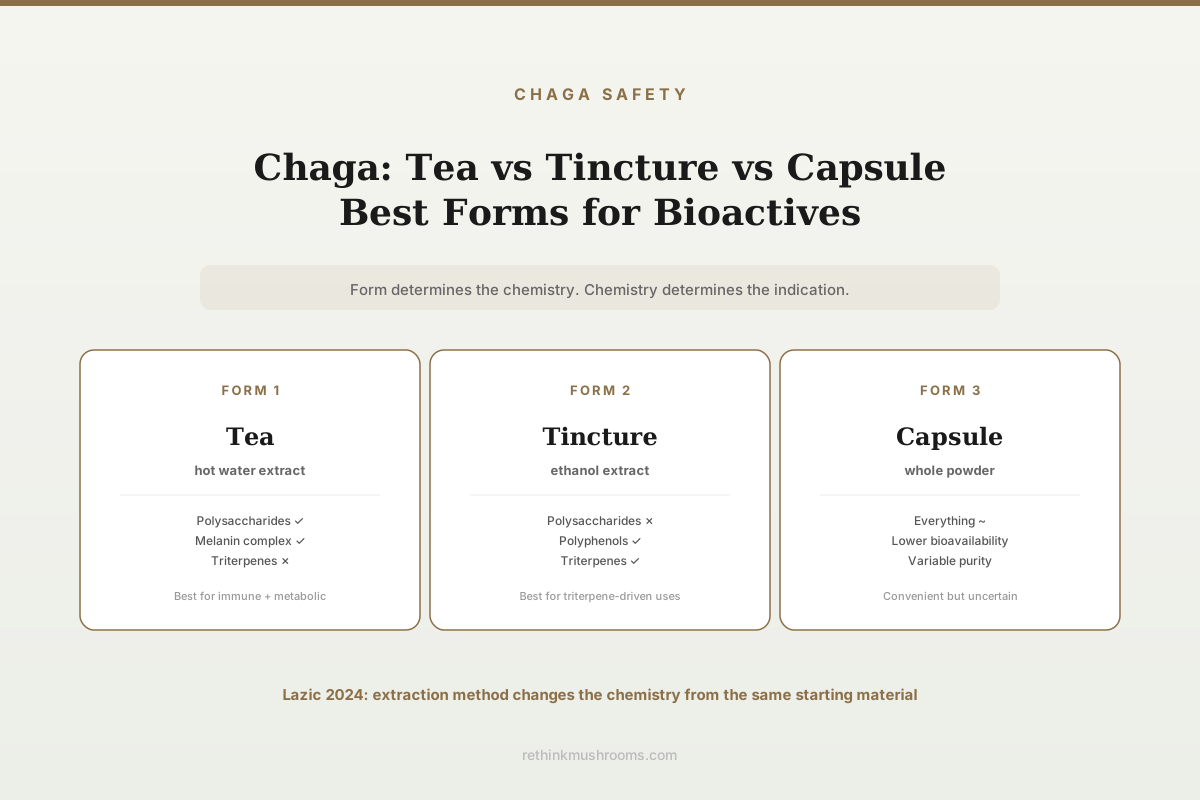
3 forms, 3 different chemistries
Water-based tea, ethanolic tincture, and encapsulated powder deliver fundamentally different ratios of chaga's polysaccharides, polyphenols, melanin, and triterpenes. The choice of form determines which compounds you actually consume.
Lazic et al., Journal of Fungi, 2024
Tea = Water Extract
polysaccharides + melanin
Tincture = Ethanol Extract
polyphenols + triterpenes
Capsule = Whole Powder
everything, lower bioavailability
Lazic et al., Journal of Fungi, 2024
 View as image ↗
The most important fact about chaga supplements is that the form determines the chemistry. A water-based chaga tea, an ethanolic chaga tincture, and an encapsulated chaga powder are not the same product with different packaging. They are three different chemical preparations of the same starting material, each delivering a different ratio of the mushroom's compound classes. A consumer choosing between them is, whether they realize it or not, choosing between different pharmacological profiles. Lazic et al. (2024) demonstrated this directly by applying multiple extraction methods to the same chaga starting material and measuring the resulting compound profiles.[1] The differences are not subtle.
For the broader compound chemistry behind these distinctions, see chaga bioactive compounds: betulinic acid, melanin, and polysaccharides. For the dosing context, see chaga dosage guide: how much should you take?.
Key Takeaways
- Lazic et al. (2024) showed that subcritical water, ultrasound, microwave, and conventional hot-water extraction methods recover substantially different ratios of polysaccharides, polyphenols, and triterpenes from the same chaga starting material
- Hot water extraction (the basis of traditional chaga tea) maximizes recovery of beta-glucan polysaccharides and the melanin-polyphenol complex
- Ethanol extraction (the basis of chaga tinctures) maximizes recovery of small polyphenols and triterpenes including betulinic acid, while leaving most polysaccharides behind
- Encapsulated chaga powder delivers the whole-mushroom compound profile but with lower bioavailability than extracted preparations because the gut must extract the actives in vivo
- Windsor et al. (2025) found wide variability in beta-glucan and polyphenol content across 19 commercial chaga supplements, including frequent species misidentification (Windsor et al., 2025)
- The "best" form depends entirely on the indication: water-based forms favor immune and metabolic effects; ethanolic forms favor antioxidant and triterpene-mediated effects; combined or sequential preparations capture both
What Determines Compound Recovery
When you put chaga in water, ethanol, or any other solvent, only some of the mushroom's compounds dissolve. The choice of solvent is the single biggest determinant of what ends up in your final extract.
Polysaccharides including the immune-active beta-glucans are large, hydrophilic molecules. They dissolve in water, especially hot water, and are essentially insoluble in ethanol. A water extract recovers most of them; an ethanolic extract recovers almost none.
Polyphenols vary widely. Small free polyphenols dissolve in both water and ethanol with somewhat different selectivity. The high-molecular-weight melanin-polyphenol complex partitions into water more than into pure ethanol but is recovered less efficiently than smaller polyphenols by either solvent alone.
Triterpenes including betulinic acid, inotodiol, and lanostane derivatives are relatively hydrophobic and dissolve much better in ethanol than in water. A water extract recovers very little of the triterpene fraction; an ethanolic extract is the better choice for triterpene capture.
Insoluble fiber and structural cell-wall components stay in the spent material regardless of solvent. They reach a consumer only if the whole powdered mushroom is consumed.
This solvent-dependent selectivity is the chemistry behind the practical form differences below. For deeper cluster context on extraction effects, see 10:1 extract ratios: what they mean and what they don't.
Chaga Tea: the Traditional Hot-Water Extract
Chaga tea is a hot-water extraction of chunked or powdered chaga sclerotium, typically prepared by simmering for 30 minutes to several hours. This is the traditional preparation across Eastern European, Siberian, and Korean folk medicine.
The compound profile of chaga tea is dominated by:
- Beta-glucan and other water-soluble polysaccharides
- The melanin-polyphenol complex (extracted as a brown-black colored fraction)
- Small free polyphenols
- Minimal triterpenes (which stay in the residue)
- Minimal betulinic acid (which is hydrophobic and birch-derived; it stays with the residue)
This profile maps to the indications where chaga has the strongest preclinical evidence. The polysaccharide fraction is the active component for the diabetes, immune-modulation, and gut-health applications discussed in the rodent literature. Hot water tea is the right preparation if those are the indications of interest.
The trade-off is that chaga tea recovers the polysaccharide-driven activities at the expense of the triterpene-driven activities. For someone interested in chaga's anti-cancer triterpene chemistry (betulinic acid mechanism studies), a water tea is not the right preparation.
Chaga Tincture: the Ethanolic Extract
A chaga tincture is an ethanolic extract, typically using 40-70% ethanol with extended maceration. Some commercial tinctures use a "double extraction" approach combining ethanol and water phases sequentially to capture both compound families, but a pure ethanol tincture has a distinct profile.
The compound profile of an ethanolic tincture is dominated by:
- Triterpenes including betulinic acid, inotodiol, and lanostane derivatives
- Small polyphenols
- Minimal polysaccharides (which precipitate out of ethanol)
- A different fraction of the melanin-polyphenol complex than the water extract recovers
This profile favors the triterpene and polyphenol arms of chaga's pharmacology. The mechanism studies on betulinic acid mitochondrial apoptosis, the in-vitro antioxidant activity of the polyphenol fraction, and the NF-kB inhibition data from ethanolic chaga extracts (Kim et al., 2007) all align with this preparation.
The trade-off is that pure ethanolic tinctures recover essentially none of the polysaccharide fraction. The immune-modulation and antidiabetic preclinical evidence, both of which are polysaccharide-driven, do not translate to ethanolic preparations.
Chaga Capsules: the Whole-Powder Option
Encapsulated chaga preparations deliver dried, powdered chaga material directly to the gut, where the consumer's digestive system performs whatever extraction is going to happen. The compound profile reaching circulation depends on:
- What dissolves in gastric acid and small-intestinal contents (favors smaller polyphenols, some triterpene fraction)
- What is fermented by colonic bacteria (favors polysaccharide fraction, with short-chain fatty acid byproducts that may have their own bioactivity)
- What passes through unabsorbed (insoluble fiber and unfermented residue)
The advantage is comprehensive coverage. A whole-powder preparation does not throw away any compound class. The disadvantage is bioavailability. Compounds that would be readily extracted into hot water or ethanol may be incompletely released from the powder matrix during gastrointestinal transit, especially if the chaga material is coarsely ground.
A second important consideration is product variability. Windsor et al. (2025) used multiple complementary analytical techniques to characterize 19 commercial chaga dietary supplements and found wide variation in beta-glucan and polyphenol content, plus frequent species misidentification.[2] Encapsulated products are particularly subject to mycelium-on-grain substitution, in which the capsule contains a mixture of fungal mycelium and grain substrate rather than the wild sclerotium implied by the chaga label. These products have a different chemical profile than wild-sclerotium-based preparations.
A Compound-Class to Form Map
A simple matching of indications to forms based on the dominant compound class:
Immune support and beta-glucan dependent effects. Hot water tea or capsules from properly characterized whole sclerotium. Ethanolic tinctures are the wrong choice.
Antidiabetic preclinical evidence. Hot water tea, water-extracted concentrated extracts, or capsules. Ethanolic tinctures are the wrong choice.
Anti-inflammatory effects driven by NF-kB inhibition. Either ethanolic or water-based preparations have evidence here, with the ethanolic Kim et al. (2007) work being one prominent reference.
Triterpene and betulinic acid effects. Ethanolic tincture, ethanolic-water double extract, or whole sclerotium powder from wild birch-grown chaga. Pure water tea is a poor choice.
Antioxidant polyphenol-melanin chemistry. Hot water tea captures the major melanin-polyphenol fraction; ethanolic tinctures capture different smaller polyphenols. Both have evidence; combined or sequential preparations cover both.
General "wellness" or non-specific use. Any well-sourced preparation will deliver some bioactive load. The form matters less when the indication is non-specific.
For the specific indication-by-form mapping in detail, see chaga in skincare products: topical application research (relevant for which extract type matters in cosmetics) and chaga for gut health: gastroprotective and prebiotic effects (where water-extracted polysaccharides drive the activity).
Wild Sclerotium Versus Cultivated Mycelium
Crossing the form question with the source question creates a 2x3 grid of possible chaga products. Both axes matter independently.
Wild sclerotium has the full chaga chemistry: betulinic acid (from the birch), the mature melanin-polyphenol complex (from years of UV exposure), and fungal beta-glucans. Cultivated mycelium grown on grain or in liquid fermentation has the fungal beta-glucans but lacks the betulinic acid and has a different, less mature pigment complex.
A wild-sclerotium hot-water tea and a cultivated-mycelium hot-water tea are not the same product. Both deliver beta-glucans. Only one delivers betulinic acid (in the residue, not the tea, but at least it is in the starting material). Both have different antioxidant chemistries. The labeling rarely distinguishes between them clearly.
Glamoclija et al. (2015) chemically characterized European wild chaga and tied the polyphenolic-melanin and polysaccharide content to documented antioxidant and antimicrobial activities.[3] Cultivated chaga has not been characterized with the same depth, but the existing studies show consistently lower polyphenolic content and a different pigment maturation.
What the Reviews Say About Form
The major chaga reviews acknowledge form-related differences without always calling them out as central.
Ern et al. (2024) discussed extraction methodology in the context of which compounds are believed to drive each indication, framing form-specific differences as a research-design issue as much as a consumer issue.[4]
Fordjour et al. (2023) emphasized chaga's compound diversity and the implication that no single extraction captures the full pharmacological profile.[5]
Szychowski et al. (2021) noted form-related variability as one factor contributing to the difficulty of designing standardized clinical trials of chaga.[6]
The unifying message is that "chaga" as a single label disguises substantial product diversity that matters chemically and may matter clinically.
A Note on Preparation Time and Temperature
The chaga tea literature does not converge on a single optimal brew protocol, but the chemistry imposes some constraints. Polysaccharide extraction from chunked or coarsely powdered chaga is slow at simmer temperatures, with optimal recovery typically requiring 30 minutes to several hours of sustained heat. Boiling can degrade some of the heat-labile polyphenols but does not destroy the polysaccharide fraction, which is structurally robust. Cold-brew approaches recover a different and generally smaller compound load, including less of the high-molecular-weight melanin polymer.
The traditional Russian samovar approach of holding chaga at simmer for many hours and re-using the chaga chunks across multiple infusions is reasonable for polysaccharide capture but produces a progressively weaker pigment-polyphenol fraction in each subsequent infusion. The implication is that the first infusion is more polyphenol-rich than the third, even when polysaccharide content is more sustained.
This is one of those preparation details that gets lost in the supplement-industry framing of chaga as a single product. A tea brewed at a controlled temperature for a defined time delivers a different exposure than a tincture macerated at room temperature for weeks, even when both are labeled simply as "chaga."
Practical Reading of the Evidence
A defensible summary of the form question as of 2026:
- Form changes the chemistry, and the chemistry changes the indication-relevance
- Hot water tea is the right preparation for polysaccharide-driven activities (immune, metabolic, gastrointestinal)
- Ethanolic tincture is the right preparation for triterpene-driven activities (anti-cancer mechanism studies, some anti-inflammatory work)
- Combined or sequential extracts can capture both major fractions but vary substantially across products
- Whole-mushroom capsules deliver everything but with bioavailability dependent on the consumer's gastrointestinal extraction
- Source (wild sclerotium vs. cultivated mycelium) interacts with form to produce a wider range of products than labeling typically conveys
- Independent product testing (such as Windsor et al., 2025) shows that the on-label compound content of commercial chaga products is variable enough that brand-level diligence matters
The "best" form is the one whose extracted compound profile matches the indication of interest, sourced from material that contains the relevant compounds in the first place.
The Bottom Line
Chaga form determines chaga chemistry. Hot water tea favors polysaccharides and the melanin complex. Ethanolic tincture favors polyphenols and triterpenes including betulinic acid. Whole-powder capsules deliver everything with variable bioavailability. The "best" form is the one whose extracted compound profile matches the intended indication, and product variability across the commercial market is high enough that brand-level diligence matters.
Frequently Asked Questions
Sources & References
- 1RTHM-00888·Lazić, Vesna et al. (2024). “The Effect of Green Extraction Technologies on the Chemical Composition of Medicinal Chaga Mushroom Extracts..” Journal of fungi (Basel.Study breakdown →PubMed →↩
- 2RTHM-02209·Windsor, Coleton et al. (2025). “What This 2025 Chaga Supplement Authentication Study Actually Found.” International journal of molecular sciences.Study breakdown →PubMed →↩
- 3RTHM-00373·Glamočlija, Jasmina et al. (2015). “Chemical characterization and biological activity of Chaga (Inonotus obliquus), a medicinal "mushroom"..” Journal of ethnopharmacology.Study breakdown →PubMed →↩
- 4RTHM-01886·Ern, Phoebe Tee Yon et al. (2024). “Chaga Therapeutic Properties: What This 2024 Review Actually Shows.” Mycology.Study breakdown →PubMed →↩
- 5RTHM-01694·Fordjour, Eric et al. (2023). “Chaga mushroom: a super-fungus with countless facets and untapped potential..” Frontiers in pharmacology.Study breakdown →PubMed →↩
- 6RTHM-00722·Szychowski, Konrad A et al. (2021). “Inonotus obliquus - from folk medicine to clinical use..” Journal of traditional and complementary medicine.Study breakdown →PubMed →↩