Chaga Skin Research
19 products tested
A 2025 multi-technique analysis of 19 commercial chaga dietary supplements found wide variation in beta-glucan content and frequent species misidentification. The same problem applies to topical chaga products, which face less regulatory scrutiny.
Windsor et al., International Journal of Molecular Sciences, 2025
Stratum Corneum
the barrier most chaga compounds cannot cross
Extraction Method
changes which compounds reach the formulation
No Pen-K Studies
skin penetration kinetics never measured
Windsor et al., International Journal of Molecular Sciences, 2025
 View as image ↗
The cosmetic industry adopted chaga long before the dermatology research community paid it much attention. Walk into any wellness-leaning skincare aisle and the word "chaga" appears on serums, creams, eye masks, and shampoo. The question this article addresses is straightforward: what does the published research actually show about chaga in topical skincare products? The honest answer is that the published research on topical chaga skin penetration, on chaga compound delivery from cosmetic formulations, and on clinical efficacy of any specific topical chaga product is essentially absent. What exists is the underlying chemistry of chaga's compound classes, the chemistry of skin penetration in general, and a small set of preclinical studies on chaga's anti-inflammatory and antioxidant activity in cell culture. The skincare-product translation has not been done.[1]
For the broader skin-research context, see chaga for skin health: melanin protection research and chaga for psoriasis and eczema: anti-inflammatory skin effects.
Key Takeaways
- Windsor et al. (2025) tested 19 commercial chaga dietary supplements with multiple analytical techniques and found wide variation in beta-glucan and polyphenol content plus frequent species misidentification (Windsor et al., 2025)
- Lazic et al. (2024) demonstrated that extraction method changes which compound classes are recovered: water, ethanol, ultrasound, and microwave extraction each produce different ratios of polysaccharides, polyphenols, and triterpenoids
- Chaga's high-molecular-weight melanin polymer and beta-glucan polysaccharides do not cross intact human stratum corneum, regardless of formulation
- Smaller polyphenols and certain triterpenes might penetrate to varying depths, but no published study has measured actual chaga compound penetration in human or animal skin
- Cosmetic regulations in the United States and most of Europe do not require pre-market efficacy testing for plant-derived ingredients, so a product can claim "chaga extract" with minimal substantiation requirements
- The preclinical anti-inflammatory and antioxidant evidence for chaga is real, but its relevance to topical cosmetic use depends on delivery questions that have not been answered (Ern et al., 2024)
Why Topical Application Is a Different Question
The chaga literature is dominated by oral and intraperitoneal studies in rodents and cell culture experiments using direct chaga extract exposure. Both designs bypass the central problem of topical skincare: getting an active compound through the stratum corneum into living skin tissue at a useful concentration.
The stratum corneum is a 10 to 40 micrometer-thick layer of dead, keratinized cells embedded in a lipid matrix. It is the principal barrier between the outside world and living skin. Compounds that successfully penetrate it tend to share certain properties: molecular weight under 500 daltons, balanced lipophilicity, and uncharged at physiological pH. Compounds that fail to penetrate include almost all polysaccharides (too large), most proteins (too large and too hydrophilic), and certain ionic compounds.
Chaga's compound classes line up unevenly against these criteria. Polysaccharides, including the immune-active beta-glucans, are far too large to cross the stratum corneum. Melanin is a large polymer with similar penetration constraints. Polyphenols vary widely in molecular weight; some are small enough to penetrate, others are not. Triterpenes such as betulinic acid and inotodiol are within the right molecular weight range but have lipophilicity profiles that vary.
The implication is that the topical effect of a chaga product, if any, comes from a different subset of compounds than the systemic effect of an oral chaga product. Marketing materials rarely make this distinction.
What Lazic 2024 Tells Us About Formulation Chemistry
Lazic et al. (2024) is the most relevant published study for anyone trying to understand what is actually in a chaga product.[2] The study compared four extraction technologies (subcritical water, ultrasound-assisted, microwave-assisted, and conventional hot water) applied to a single chaga starting material, with chemical composition measured for each output.
The findings were not subtle. The same starting material produced extracts with substantially different polysaccharide-to-polyphenol ratios depending on the method used. Subcritical water tended to maximize polysaccharide recovery. Ethanol-based extraction shifted the balance toward polyphenols and triterpenes. Microwave and ultrasound methods produced intermediate profiles with their own characteristic biases.
For a topical product, this matters in two ways. First, the compound profile of the extract determines which biological activities are even possible. A polyphenol-rich ethanolic extract has different antioxidant chemistry than a polysaccharide-rich water extract. Second, the compound profile determines what the formulator is actually putting into the cream or serum. A label that says "chaga extract" does not tell the consumer or the dermatologist which fraction of chaga's chemistry is present.
For the broader compound chemistry, see chaga bioactive compounds: betulinic acid, melanin, and polysaccharides.
What Windsor 2025 Tells Us About Product Variability
Windsor et al. (2025) ran a multi-technique analysis of 19 commercial chaga dietary supplements available on the consumer market.[1] The study used complementary analytical methods to characterize beta-glucan content, polyphenol content, and species authenticity across the product range.
The headline result was substantial product-to-product variation. Some products met the chemical profile expected of wild chaga sclerotium. Others contained a different fungal species or a chaga-mycelium-on-grain preparation with a fundamentally different chemistry than wild material. Beta-glucan content varied across the panel by a factor that has clinical implications for any indication where polysaccharide dose matters.
This was a study of dietary supplements, not topical products. The relevance to topical chaga is that cosmetic products face even less regulatory scrutiny than dietary supplements. If 19 supplements with at least some FDA quality oversight show this much variability, the variability among cosmetic chaga products is likely worse, not better.
The Stratum Corneum Problem in Detail
A topical chaga claim only matters if the active compound reaches the layer of skin where the claimed biological effect happens. For inflammation, this means the dermis or the epidermal-dermal junction. For melanocyte interaction, it means the basal layer of the epidermis. For superficial antioxidant action, it might mean the upper epidermis only.
Published skin-penetration data for chaga compounds in any of these target layers does not exist. What does exist is the general skin-penetration literature for plant polyphenols, polysaccharides, and triterpenes, which provides constraints rather than answers.
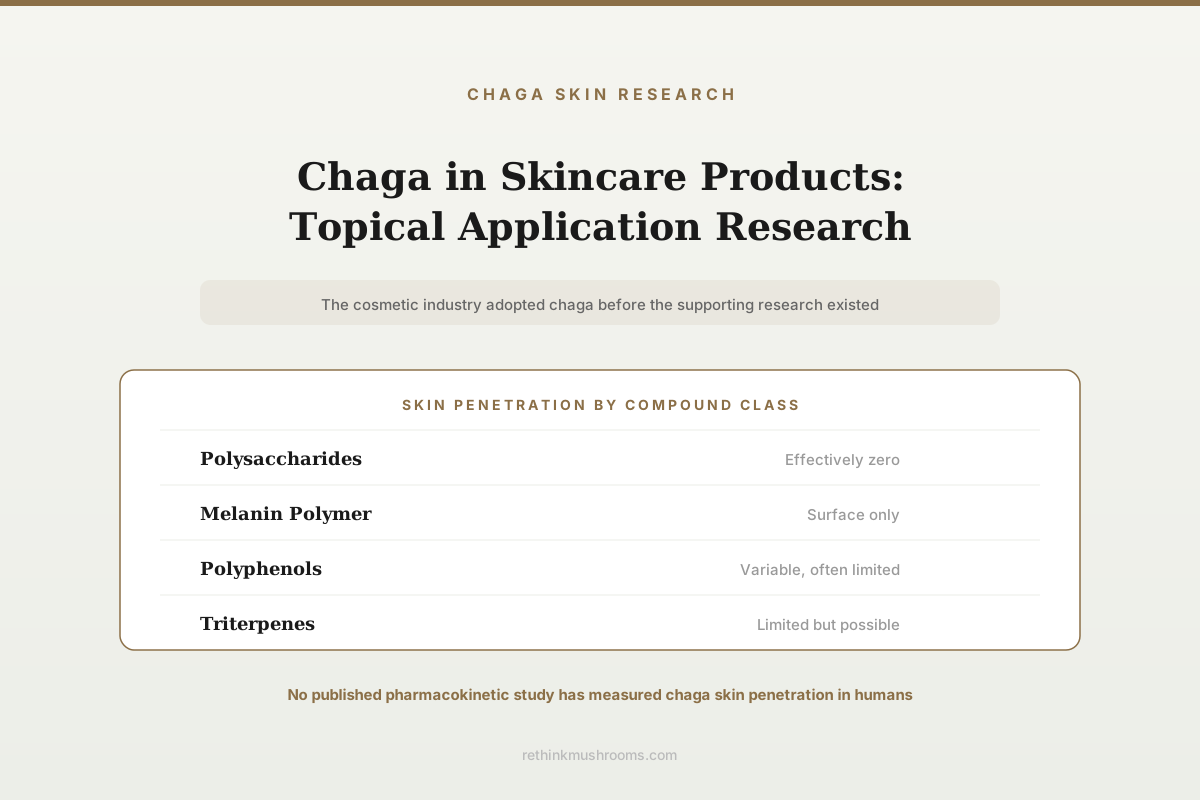
Polysaccharide and melanin penetration: essentially zero through intact stratum corneum. These compounds work, when they work topically, through humectant or film-forming effects on the skin surface, not by penetrating to deeper layers.
Polyphenol penetration: variable. Small phenolic acids like caffeic acid and ferulic acid penetrate. Large polymeric polyphenols do not. Chaga's polyphenol fraction includes both classes, with the larger melanin-associated polymers staying on the surface and the smaller free polyphenols having some potential to penetrate.
Triterpene penetration: limited but possible. Betulinic acid has poor topical penetration in published studies of birch-bark formulations. Penetration enhancers and lipid carriers can improve this, but no chaga-specific topical formulation has been studied for penetration kinetics.
The general pattern is that chaga's high-value bioactive compounds for systemic indications are largely the wrong compounds for topical penetration, while the compounds that might penetrate topically have weaker preclinical evidence for skin-relevant biological activity.
What Cosmetic Marketing Tends to Claim
Three claims appear repeatedly in chaga skincare marketing, each with a different relationship to the evidence.
"Chaga is an antioxidant powerhouse." True at the chemistry level, much weaker at the in-vivo skin level. Lee et al. (2007) and Glamoclija et al. (2015) document strong in-vitro antioxidant activity for chaga's polyphenol-melanin complex.[3][4] Whether antioxidant activity in a beaker translates to reduced oxidative damage in living skin from a cosmetic formulation is a separate question with no published answer for chaga.
"Chaga calms inflammation." True at the molecular and oral-administration level, untested topically. Kim et al. (2007) showed NF-kB inhibition in macrophages and Javed et al. (2019) showed attenuation of histamine-induced vascular inflammation in rats.[5][6] Whether topical application produces equivalent effects in human skin has not been studied.
"Chaga protects against UV damage." Mechanistically plausible, clinically untested. Park et al. (2004) demonstrated DNA protection in human lymphocytes; nothing comparable has been published for chaga in skin cells under UV exposure, and no human topical photoprotection trial exists.[7]
The honest reframing of all three is the same: the chemistry is interesting and the systemic mechanisms are documented; the topical-skin-effect demonstration has not been published.
The Regulatory Context
Cosmetic regulation in the United States is largely about safety, not efficacy. Plant-derived ingredients with established safety records can be added to skincare products without pre-market efficacy testing. The European Union and most other jurisdictions follow similar approaches for non-active cosmetic ingredients.
This regulatory architecture means that "chaga extract" can appear on a label with no requirement to demonstrate that the extract delivers a measurable skin benefit at the concentration used in the formulation. Brands that want to substantiate their claims have to do so voluntarily, and the cost of clinical skin testing means that very few do for ingredients that are not the central differentiator of their product line.
For chaga, the practical consequence is that the mainstream cosmetic literature on chaga is overwhelmingly company-published rather than peer-reviewed. The peer-reviewed dermatology literature on topical chaga is, as of 2026, essentially empty.
What Would Constitute Real Evidence
If a cosmetic brand wanted to make a substantive evidence-backed claim about a topical chaga product, the rough outline of what that evidence would look like:
- Pharmacokinetic measurement of skin penetration for the specific compound class claimed to be active, using human skin in a Franz cell or equivalent ex-vivo system
- Demonstration that active concentrations reach the target skin layer at the use concentration of the formulation
- A randomized, vehicle-controlled clinical trial measuring an objective skin endpoint (transepidermal water loss, erythema response, skin barrier markers, instrumental measurements of pigmentation or roughness) in the appropriate population
- Replication or independent confirmation of the clinical finding
The supplement industry has produced this kind of evidence for some niche dermatology actives. Chaga-specific products have not, to the best of the published record. Szychowski et al. (2021) framed this as part of the broader chaga clinical-translation gap, and the cosmetic application is one of the most underserved areas in that gap.[8]
Honest Reading for Consumers and Practitioners
A clear summary of where the evidence sits for topical chaga:
- The compound chemistry is well-characterized and includes legitimate antioxidant and anti-inflammatory candidates
- The systemic preclinical pharmacology is real and reproducible
- The skin-penetration kinetics of any chaga compound from any topical formulation has not been measured in any published study
- The clinical efficacy of any specific topical chaga product against any specific skin endpoint has not been demonstrated in a randomized trial
- Product-to-product variability in chaga raw material is high, and topical product variability is likely higher than dietary supplement variability
For the historical context behind chaga's traditional skin applications, see chaga in traditional medicine: from 12th century Europe to modern research. Fordjour et al. (2023) called chaga's potential "untapped"; the cosmetic application is a textbook case of that description.[9]
The Bottom Line
Chaga's underlying chemistry is well-characterized and includes plausible antioxidant and anti-inflammatory candidates, but no published study has measured skin penetration of any chaga compound from any topical formulation, and no randomized clinical trial has tested a specific topical chaga product for any skin endpoint. The cosmetic industry adopted chaga ahead of the supporting research, and the research has not caught up.
Frequently Asked Questions
Sources & References
- 1RTHM-02209·Windsor, Coleton et al. (2025). “What This 2025 Chaga Supplement Authentication Study Actually Found.” International journal of molecular sciences.Study breakdown →PubMed →↩
- 2RTHM-00888·Lazić, Vesna et al. (2024). “The Effect of Green Extraction Technologies on the Chemical Composition of Medicinal Chaga Mushroom Extracts..” Journal of fungi (Basel.Study breakdown →PubMed →↩
- 3RTHM-00118·Lee, In-Kyoung et al. (2007). “New antioxidant polyphenols from the medicinal mushroom Inonotus obliquus..” Bioorganic & medicinal chemistry letters.Study breakdown →PubMed →↩
- 4RTHM-00373·Glamočlija, Jasmina et al. (2015). “Chemical characterization and biological activity of Chaga (Inonotus obliquus), a medicinal "mushroom"..” Journal of ethnopharmacology.Study breakdown →PubMed →↩
- 5RTHM-00117·Kim, Ho-Gyoung et al. (2007). “Ethanol extract of Inonotus obliquus inhibits lipopolysaccharide-induced inflammation in RAW 264.7 macrophage cells..” Journal of medicinal food.Study breakdown →PubMed →↩
- 6RTHM-00562·Javed, Sumreen et al. (2019). “Inonotus obliquus attenuates histamine-induced microvascular inflammation..” PloS one.Study breakdown →PubMed →↩
- 7RTHM-00076·Park, Yoo Kyoung et al. (2004). “Chaga mushroom extract inhibits oxidative DNA damage in human lymphocytes as assessed by comet assay..” BioFactors (Oxford.Study breakdown →PubMed →↩
- 8RTHM-00722·Szychowski, Konrad A et al. (2021). “Inonotus obliquus - from folk medicine to clinical use..” Journal of traditional and complementary medicine.Study breakdown →PubMed →↩
- 9RTHM-01694·Fordjour, Eric et al. (2023). “Chaga mushroom: a super-fungus with countless facets and untapped potential..” Frontiers in pharmacology.Study breakdown →PubMed →↩
- 10RTHM-01886·Ern, Phoebe Tee Yon et al. (2024). “Chaga Therapeutic Properties: What This 2024 Review Actually Shows.” Mycology.Study breakdown →PubMed →↩