Chaga Skin Research
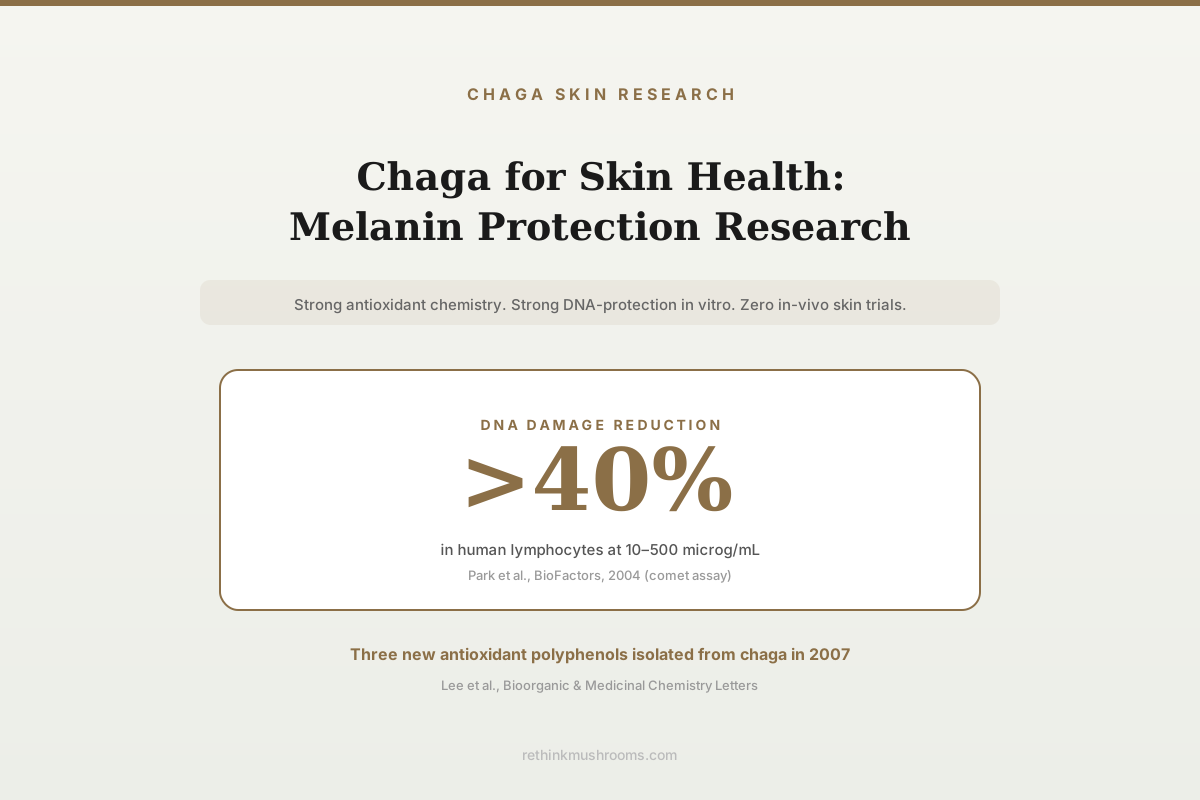
>40% DNA damage reduction
Chaga extract reduced oxidative DNA fragmentation by over 40% in human lymphocytes at 10-500 microg/mL in the comet assay, the same kind of damage UV light produces in skin cells.
Park et al., BioFactors, 2004
Chaga Melanin
fungal pigment, not human eumelanin
Polyphenol Complex
Lee 2007 isolated three new antioxidants
Zero In-Vivo Skin Trials
no human or rodent skin model
Park et al., BioFactors, 2004
 View as image ↗
The most repeated claim about chaga and skin is that its melanin protects skin the way the body's own melanin does. The claim is partly right and partly wrong, and the difference matters. Chaga melanin is a real compound, chemically related to but distinct from human eumelanin, and it does have measurable antioxidant and DNA-protective activity in cell-based assays. What chaga melanin has not been shown to do is protect human skin from UV damage when applied topically or consumed orally. The gap between the molecular evidence and the cosmetic claim is large enough to deserve its own article. Glamoclija et al. (2015) chemically characterized chaga's pigment and polyphenol fraction in detail, and that characterization is the starting point for any honest answer to the skin question.[1]
For the inflammatory-skin angle, see chaga for psoriasis and eczema: anti-inflammatory skin effects. For the photoprotection question specifically, see chaga melanin and UV protection and chaga and UV damage: photoprotective properties.
Key Takeaways
- Chaga aqueous extract reduced hydrogen peroxide-induced oxidative DNA damage in human lymphocytes by over 40% at 10-500 microg/mL in the comet assay, mechanically similar to the damage UV exposure causes in skin cells (Park et al., 2004)
- Lee et al. (2007) isolated three new antioxidant polyphenols from I. obliquus with radical-scavenging activity exceeding several reference antioxidants at equivalent concentrations
- Chaga's pigment is a fungal melanin chemically distinct from human eumelanin; it absorbs UV light and quenches free radicals through different polymer chemistry (Glamoclija et al., 2015)
- The melanin-polyphenol complex is one of the most concentrated antioxidant systems among edible fungi, but high in-vitro antioxidant capacity does not automatically translate to in-vivo skin benefit
- No published human or rodent skin study has tested chaga melanin or its extracts for UV photoprotection, photoaging, or skin cancer prevention as of 2026 (Szychowski et al., 2021)
- Extraction method dramatically changes which compounds reach a topical or oral product: water extracts capture melanin and polysaccharides, ethanol extracts capture polyphenols and triterpenoids (Lazic et al., 2024)
What "Chaga Melanin" Actually Is
The black color of a chaga sclerotium comes from a high-molecular-weight pigment polymer the fungus produces in response to oxidative stress and UV exposure during its decade-long growth on a birch tree. The pigment is a melanin in the broad chemical sense: a heterogeneous polymer built from phenolic and indolic subunits, with broad absorbance across the visible and ultraviolet spectrum and the capacity to quench free radicals.
It is not the same molecule as human eumelanin. Human eumelanin is built from tyrosine via the tyrosinase enzyme cascade. Chaga melanin is built from different phenolic precursors via fungal biosynthetic pathways. The two pigments share certain biophysical properties, including UV absorbance and radical-scavenging capacity, but their molecular structures differ.
This distinction matters because the claim "chaga contains melanin" is sometimes interpreted as "chaga delivers the same molecule your skin uses for tanning." It does not. What chaga delivers is a chemically related, biophysically similar pigment with its own properties.
For the broader cluster context, see what is chaga mushroom and Inonotus obliquus: the antioxidant-dense birch parasite.
The Antioxidant and Polyphenol Chemistry
Chaga's overall antioxidant capacity is unusually high. Among edible fungi tested with standard chemical assays such as ORAC, DPPH, and ABTS, chaga consistently appears at or near the top of the rankings. This is the chemical basis of every "antioxidant superfood" claim the supplement industry has ever made about chaga.
Lee et al. (2007) isolated three structurally novel antioxidant polyphenols from I. obliquus and characterized their radical-scavenging activity in vitro.[2] The activity exceeded several reference antioxidants at equivalent concentrations. These compounds are part of the broader polyphenol-melanin complex that gives chaga its color and its antioxidant profile.
Glamoclija et al. (2015) ran a complete chemical characterization of wild European chaga, quantifying total phenolic content, flavonoid content, and biological activity in parallel.[1] The polyphenolic fraction tracked closely with the antioxidant and antimicrobial activity observed across their assay panel.
Duru et al. (2019), reviewing the molecular pharmacology of I. obliquus, identified the polyphenol-melanin antioxidant system as one of three pillars of chaga's overall pharmacological profile, alongside polysaccharides and triterpenes.[3]
For the broader compound landscape, see chaga bioactive compounds: betulinic acid, melanin, and polysaccharides.
DNA Protection and the UV Connection
The strongest cell-based evidence relevant to skin is Park et al. (2004), which used the comet assay to measure DNA fragmentation in human lymphocytes after exposure to hydrogen peroxide.[4] Chaga extract at 10 to 500 microg/mL reduced oxidative DNA fragmentation by over 40%.
The relevance to skin is mechanistic. UV exposure damages skin cell DNA through two main routes: direct UV absorption by DNA bases (forming pyrimidine dimers) and indirect oxidative damage from UV-induced reactive oxygen species. The hydrogen peroxide model in Park's study captures the second mechanism. A compound that reduces oxidative DNA damage in human lymphocytes is a plausible candidate for reducing UV-induced oxidative DNA damage in keratinocytes and melanocytes.
Plausible is not demonstrated. The translation requires:
- Confirmation in skin-relevant cell types (keratinocytes, melanocytes, fibroblasts)
- Demonstration that chaga compounds reach skin tissue at active concentrations from oral or topical administration
- An in-vivo skin model showing reduced UV damage with chaga pretreatment
- A controlled human trial measuring a clinical endpoint such as erythema response, sunburn cell formation, or photoaging markers
None of these has been published for chaga as of 2026. The mechanistic case is strong; the translation case is empty.
Why High ORAC Does Not Equal Skin Protection
The chaga supplement industry leans heavily on antioxidant capacity values to imply skin and anti-aging benefits. This deserves explicit pushback.
The FDA removed the ORAC database from its website in 2012 in part because marketers were systematically using chemical antioxidant assay values to imply human health effects that had not been demonstrated. Chemical antioxidant capacity is a property of a molecule in a test tube. It predicts very little about whether the molecule, after digestion and absorption, reaches tissues at concentrations that meaningfully affect cellular oxidation, and it predicts even less about clinical endpoints in chronic conditions like photoaging.
Chaga has high in-vitro antioxidant activity. That is real and reproducible. The leap from there to "chaga protects your skin from aging" requires data that no one has published.
For the broader antioxidant story across all of chaga's documented activity, see chaga antioxidants: the highest ORAC in the mushroom kingdom.
What Topical Versus Oral Delivery Would Actually Do
Two routes of administration are in play for skin applications, and each has its own evidence problem.
Oral chaga delivers polyphenols, polysaccharides, and triterpenes into systemic circulation, with bioavailability that varies by compound class and is mostly uncharacterized in humans. Polyphenols are extensively metabolized by gut bacteria and liver enzymes before they reach skin. Polysaccharides do not enter circulation intact. Triterpenes have poor oral bioavailability. Whether any chaga compound reaches dermal tissue at meaningful concentrations after oral ingestion is unknown.
Topical chaga is a different problem. The high-molecular-weight melanin polymer cannot cross the stratum corneum. Polysaccharides do not penetrate intact skin either. Smaller polyphenols and certain triterpenes might penetrate to varying depths, but no published study has measured the actual penetration profile of chaga-derived compounds in human or animal skin.
Lazic et al. (2024) demonstrated that the extraction method substantially changes which compound classes are recovered from chaga.[5] Subcritical water extraction favors polysaccharides and a portion of the melanin complex. Ethanol extraction favors polyphenols and triterpenes. A topical product based on a polysaccharide-rich water extract delivers a different molecular mixture than a polyphenol-rich ethanolic extract, and the skin-penetration profile of each mixture has never been compared head-to-head.
What the Anti-Inflammatory Data Adds
Even setting aside photoprotection, chaga's documented anti-inflammatory activity has indirect relevance to skin. Inflammation accelerates skin aging through chronic immune activation, mast cell degranulation, and oxidative damage to dermal collagen. Anti-inflammatory compounds, in principle, slow that process.
Kim et al. (2007) demonstrated that chaga ethanol extract suppresses NF-kB signaling in macrophages, and Javed et al. (2019) showed chaga attenuates histamine-induced microvascular inflammation.[6][7] Both pathways are active in chronically inflamed skin and contribute to photoaging through ongoing low-grade inflammation.
This does not equal a demonstrated anti-aging effect on skin. It does mean chaga's anti-inflammatory and antioxidant activities point in the same direction at the molecular level. Whether that pointing translates to clinical benefit is, again, empirically untested.
Wild Versus Cultivated: a Sourcing Note for Skin Claims
The melanin-polyphenol complex that drives chaga's antioxidant identity is largely a feature of the wild sclerotium grown over many years on a birch tree. The pigment develops slowly as the fungus is exposed to repeated cycles of UV light, freeze-thaw stress, and mechanical injury. A young, fast-grown cultivated mycelium has a different pigment profile, with less of the mature polymer that gives wild chaga its black exterior and high antioxidant assay values.
For any skin or antioxidant-related chaga product, this sourcing distinction matters more than for almost any other indication. A polysaccharide-driven immune effect can plausibly be reproduced from cultivated mycelium because the fungal cell wall structure is similar across growth conditions. A melanin-driven antioxidant or photoprotective effect, if it exists, is unlikely to come from a product made entirely from cultivated mycelium that has not had time to develop the mature pigment complex. This is one of the few cases where the consumer-facing distinction between wild-harvested whole sclerotium and cultivated liquid-fermentation mycelium has direct relevance to the indication being marketed. A skin product based on cultivated chaga mycelium and a skin product based on wild Siberian chaga sclerotium are not the same chemistry and should not be assumed to have the same biological effect, even when both products carry the same generic "chaga" label on the front of the package.
What the Evidence Actually Supports
A precise statement of what the chaga skin literature supports as of 2026:
- Chaga melanin and its polyphenol complex have measurable in-vitro antioxidant activity that ranks among the highest of any edible fungus
- Chaga extract reduces oxidative DNA damage in human lymphocytes at clinically relevant concentrations
- The compound classes responsible for these effects (polyphenols, melanin polymer, polysaccharides) are well characterized chemically
- The mechanistic alignment with UV-induced skin damage is plausible
What it does not support:
- A demonstrated photoprotective effect in human skin
- A demonstrated reduction in skin cancer risk
- A demonstrated reduction in photoaging endpoints
- Any specific recommendation for dose, formulation, or duration of use for skin applications
Szychowski et al. (2021) summarized the broader chaga clinical-translation gap, and the dermatology piece of that gap is among the larger ones.[8] Fordjour et al. (2023) called the unrealized potential "untapped," which is an accurate description: the chemistry is interesting, the mechanisms are mapped, the targeted clinical experiments have not been run.[9]
For the cosmetic and skincare product landscape, see chaga in skincare products: topical application research. For the historical context behind chaga's reputation as a skin tonic, see chaga in traditional medicine: from 12th century Europe to modern research.
The Bottom Line
Chaga melanin is a fungal pigment with strong in-vitro antioxidant activity and demonstrated DNA-protective effects in human lymphocytes. It is chemically related to but distinct from human eumelanin. The mechanistic case for skin photoprotection is plausible; the in-vivo and clinical evidence is absent. High antioxidant capacity in a test tube does not equal skin protection in a person.
Frequently Asked Questions
Sources & References
- 1RTHM-00373·Glamočlija, Jasmina et al. (2015). “Chemical characterization and biological activity of Chaga (Inonotus obliquus), a medicinal "mushroom"..” Journal of ethnopharmacology.Study breakdown →PubMed →↩
- 2RTHM-00118·Lee, In-Kyoung et al. (2007). “New antioxidant polyphenols from the medicinal mushroom Inonotus obliquus..” Bioorganic & medicinal chemistry letters.Study breakdown →PubMed →↩
- 3RTHM-00553·Duru, Kingsley C et al. (2019). “The pharmacological potential and possible molecular mechanisms of action of Inonotus obliquus from preclinical studies..” Phytotherapy research : PTR.Study breakdown →PubMed →↩
- 4RTHM-00076·Park, Yoo Kyoung et al. (2004). “Chaga mushroom extract inhibits oxidative DNA damage in human lymphocytes as assessed by comet assay..” BioFactors (Oxford.Study breakdown →PubMed →↩
- 5RTHM-00888·Lazić, Vesna et al. (2024). “The Effect of Green Extraction Technologies on the Chemical Composition of Medicinal Chaga Mushroom Extracts..” Journal of fungi (Basel.Study breakdown →PubMed →↩
- 6RTHM-00117·Kim, Ho-Gyoung et al. (2007). “Ethanol extract of Inonotus obliquus inhibits lipopolysaccharide-induced inflammation in RAW 264.7 macrophage cells..” Journal of medicinal food.Study breakdown →PubMed →↩
- 7RTHM-00562·Javed, Sumreen et al. (2019). “Inonotus obliquus attenuates histamine-induced microvascular inflammation..” PloS one.Study breakdown →PubMed →↩
- 8RTHM-00722·Szychowski, Konrad A et al. (2021). “Inonotus obliquus - from folk medicine to clinical use..” Journal of traditional and complementary medicine.Study breakdown →PubMed →↩
- 9RTHM-01694·Fordjour, Eric et al. (2023). “Chaga mushroom: a super-fungus with countless facets and untapped potential..” Frontiers in pharmacology.Study breakdown →PubMed →↩
- 10RTHM-01886·Ern, Phoebe Tee Yon et al. (2024). “Chaga Therapeutic Properties: What This 2024 Review Actually Shows.” Mycology.Study breakdown →PubMed →↩