Chaga Skin Research
5 anti-inflammatory studies
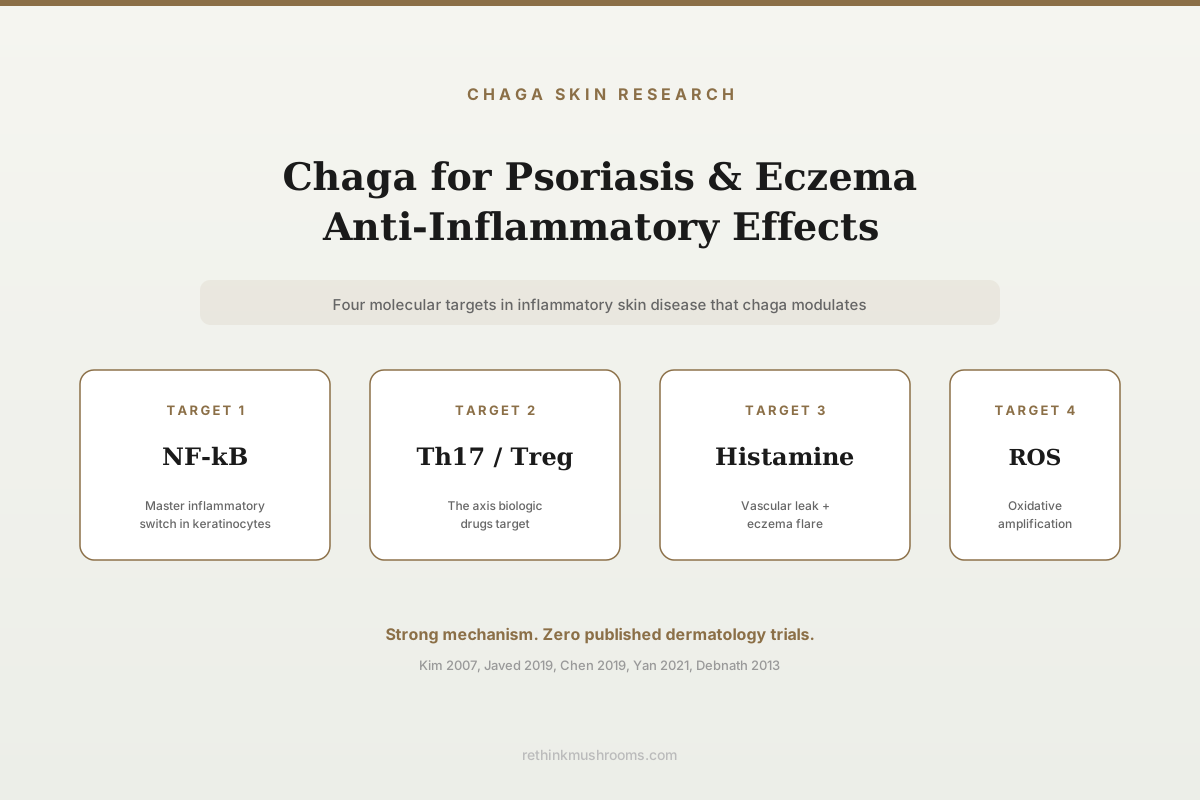
Chaga suppresses the same inflammatory pathways driving psoriasis and eczema: NF-kB signaling, histamine-induced vascular leak, and Th17-skewed cytokine release in rodent models.
Kim et al., J Ethnopharmacology, 2007
NF-kB Inhibition
the master inflammatory switch
Histamine Microvascular
attenuated vascular leak
Zero Dermatology Trials
all evidence is preclinical
Kim et al., J Ethnopharmacology, 2007
 View as image ↗
Psoriasis and eczema share a molecular spine: chronic, dysregulated inflammation driven by the same cytokines and transcription factors that dominate every other inflammatory disease. NF-kB runs too hot. Th17 cells produce too much IL-17 and IL-23. Mast cells degranulate on too little provocation. Any compound that attenuates those pathways attracts interest as a candidate for inflammatory skin disease. Chaga has been tested against NF-kB signaling, histamine-induced vascular leak, and DSS-induced colitis inflammation, and the results consistently show suppressive activity on the same molecular targets that dermatologic drugs aim at. What chaga has not been tested in is a randomized human trial for psoriasis, atopic dermatitis, or any other skin condition.[1]
This article collects the preclinical evidence that is relevant to inflammatory skin disease and names, clearly, what does not yet exist. For the broader cluster context, see chaga for skin health: melanin protection research and chaga in skincare products: topical application research.
Key Takeaways
- Ethanol extract of I. obliquus inhibited LPS-induced NF-kB activation and pro-inflammatory cytokine release in RAW 264.7 macrophages, the central pathway driving psoriatic plaque inflammation (Kim et al., 2007)
- Chaga extract attenuated histamine-induced microvascular inflammation and vascular leak in a rat model, the same mechanism responsible for the redness and swelling in eczema flares (Javed et al., 2019)
- Three independent rodent colitis studies show chaga dampens Th1/Th2 and Th17/Treg immune imbalance, the exact axis targeted by IL-17 and IL-23 biologics in psoriasis (Choi, Mishra, Chen et al.)
- I. obliquus polysaccharide reduced pro-inflammatory cytokine release from infected macrophages in a separate disease model, extending the anti-inflammatory signal beyond the colitis literature (Yan et al., 2021)
- Chaga's polyphenolic fraction has documented antioxidant activity against oxidative stress, a secondary driver of both psoriasis plaque progression and atopic dermatitis barrier damage (Debnath et al., 2013; Lee et al., 2007)
- No published human randomized controlled trial has tested chaga for psoriasis, eczema, atopic dermatitis, or contact dermatitis as of 2026 (Szychowski et al., 2021)
Why the Mechanism Maps to Skin Disease
Psoriasis, atopic dermatitis, and most other chronic inflammatory skin conditions converge on a small number of molecular targets. Understanding why chaga is a plausible candidate requires a brief map of those targets.
NF-kB is the transcription factor that turns on pro-inflammatory gene expression in keratinocytes, immune cells, and endothelial cells. It is chronically overactive in psoriatic skin. Every major psoriasis therapy, from topical corticosteroids to systemic biologics, ultimately reduces NF-kB-driven cytokine output either directly or downstream.
Th17 cells and the IL-23/IL-17 axis are the specific immune cell population and cytokine family that drive psoriatic plaque formation. The modern biologic revolution in psoriasis treatment (secukinumab, ustekinumab, risankizumab) targets this axis specifically.
Mast cells and histamine are the dominant drivers of the itch and vascular leak that characterize eczema and atopic dermatitis. Antihistamines, calcineurin inhibitors, and barrier-repair emollients all intervene in this pathway.
Oxidative stress compounds both conditions. Reactive oxygen species damage keratinocytes, amplify inflammation, and impair skin barrier function.
Chaga has documented effects on all four targets in preclinical models. Ern et al. (2024), in their comprehensive review of I. obliquus therapeutics, grouped anti-inflammatory and immunomodulatory activity as one of the three best-supported indication clusters for the mushroom.[1]
NF-kB Inhibition: the Kim 2007 Macrophage Study
The most-cited mechanistic study on chaga anti-inflammatory activity is Kim et al. (2007), which tested an ethanol extract of I. obliquus in the RAW 264.7 macrophage cell line challenged with lipopolysaccharide (LPS).[2]
LPS is a bacterial cell wall component that triggers TLR4 signaling and drives NF-kB activation in macrophages. The resulting cytokine storm (TNF-alpha, IL-1-beta, IL-6, nitric oxide) is the same inflammatory output that dermatologists see magnified in chronic inflammatory skin disease.
The findings:
- Chaga extract suppressed LPS-induced nitric oxide production in a dose-dependent manner
- Pro-inflammatory cytokine mRNA expression was reduced at the transcriptional level
- The inhibitory activity tracked with suppression of NF-kB nuclear translocation, the defining molecular event of inflammatory gene induction
- The active fraction included both polyphenolic and triterpenoid components
This is not a skin experiment. It is a macrophage experiment. The reason to care about it for psoriasis and eczema is that the NF-kB pathway in macrophages is mechanistically identical to the NF-kB pathway in dermal macrophages and keratinocytes. Compounds that suppress macrophage NF-kB activation in vitro routinely translate to anti-inflammatory activity in whole skin, though not every compound survives that translation.
Histamine, Vascular Leak, and the Eczema Connection
Javed et al. (2019) addressed a different arm of the skin inflammation problem: histamine-driven vascular inflammation.[3]
In eczema and acute allergic dermatitis, mast cell degranulation releases histamine, which causes endothelial cells in dermal capillaries to contract. The resulting gaps in the vascular wall let fluid leak into the surrounding tissue, producing wheal, flare, and itch. Javed's group tested I. obliquus extract against histamine-induced microvascular inflammation in a rat model and documented attenuation of the inflammatory response. The implication is that chaga may reduce the vascular component of allergic skin inflammation, not just the cytokine signaling in immune cells.
This fits with traditional Eastern European use of chaga for itchy, inflammatory skin conditions. Traditional use is not evidence of efficacy, but a molecular mechanism that would explain traditional use, if the traditional use is real, is worth noting.
The Th17/Treg Axis and the Psoriasis Connection
The closest chaga gets to modern psoriasis biology is in the DSS colitis literature. Three independent rodent studies show that chaga extract or purified I. obliquus polysaccharide shifts the Th17/Treg balance toward anti-inflammatory Treg dominance.[4][5]
The cellular biology of colitis and psoriasis overlaps substantially. Both are Th17-driven. Both respond to IL-17 and IL-23 pathway blockade. A compound that shifts Th17/Treg balance in inflamed colon tissue is, mechanistically, the same kind of compound that could shift it in psoriatic skin. This is a reasonable inference; it is not a demonstration. The only way to demonstrate it is a human psoriasis trial.
For the immune-cell cascade in detail, see chaga beta-glucans and immune cell activation.
Polysaccharide-Driven Cytokine Suppression
Yan et al. (2021) tested purified I. obliquus polysaccharide against the inflammatory response in Toxoplasma gondii-infected RAW 264.7 macrophages.[6] The study extends the anti-inflammatory signal beyond the classical LPS-stimulated model to a live-pathogen context. The polysaccharide reduced pro-inflammatory cytokine output without impairing the macrophages' underlying anti-pathogen activity.
This distinction matters for inflammatory skin disease. The goal in psoriasis and eczema is not immunosuppression. It is the normalization of dysregulated inflammation while preserving the skin's ability to respond to actual pathogens. A compound that broadly suppresses immune function would be the wrong choice for chronic skin disease; a compound that rebalances without ablating is closer to the ideal profile. Chaga's signal in this study is closer to the latter.
The Antioxidant Dimension
Oxidative stress is a secondary but real driver of both psoriasis and atopic dermatitis. Reactive oxygen species produced by infiltrating immune cells damage keratinocytes, amplify inflammatory signaling, and contribute to the barrier dysfunction that defines atopic skin.
Debnath et al. (2013) documented combined antioxidant and anti-inflammatory activity in I. obliquus extracts, with chemical radical-scavenging and cellular anti-inflammatory endpoints tested in parallel.[7] Lee et al. (2007) characterized three new antioxidant polyphenols from chaga with radical-scavenging activity exceeding reference antioxidants at equivalent concentrations.[8]
Whether chaga's in-vitro antioxidant activity translates to reduced oxidative damage in inflamed skin has not been tested directly. The inference is plausible; the data is absent. For the broader antioxidant story, see chaga antioxidants: the highest ORAC in the mushroom kingdom.
What Has Not Been Studied
The list of things that would be obvious next experiments, and that have not been done, is long.
No controlled trial of oral chaga in psoriasis patients. No controlled trial of oral chaga in atopic dermatitis patients. No head-to-head comparison of water versus ethanol chaga extracts for anti-inflammatory skin activity. No imiquimod-induced psoriasis mouse model with chaga intervention, despite this being one of the most common preclinical psoriasis screens. No oxazolone or DNCB-induced atopic dermatitis mouse model with chaga intervention. No published case series of chaga use in dermatology patients with any skin condition. No topical formulation pharmacokinetics for any chaga compound relevant to dermatology.
Szychowski et al. (2021) framed this gap in their folk-medicine-to-clinical-use review: the preclinical literature is substantial and the clinical translation is mostly missing.[9] The gap is particularly striking for dermatology, where the mechanistic alignment is strong but the targeted experiments have not been published.
Topical Versus Oral: a Formulation Question Without an Answer
Two delivery routes are theoretically possible for chaga in inflammatory skin disease. Each has its own evidence problem.
Oral chaga has the bulk of the preclinical data behind it. The colitis studies, the macrophage NF-kB studies, the antidiabetic and antioxidant studies all used oral, intraperitoneal, or systemic administration. If chaga's anti-inflammatory effects translate to skin disease, oral administration is the route most directly supported by the existing literature. The challenge is that the active compounds need to reach inflamed skin tissue at sufficient concentrations after oral absorption, and the human pharmacokinetics of chaga's polyphenols, polysaccharides, and triterpenoids have not been characterized.
Topical chaga is the more intuitive approach for a localized skin condition, and it is also where the consumer-product market has concentrated. The problem is that the molecular weight of chaga polysaccharides puts them in a size range that does not readily cross the stratum corneum. Smaller polyphenols and triterpenes might penetrate, but no published study has characterized how much of any active compound reaches dermal layers from a topical chaga preparation. Cosmetic products labeled with chaga extract are widely available; rigorous topical pharmacokinetic data is not.
The implication for any reader trying to evaluate a chaga skincare claim is that the compound class of interest matters enormously. A water extract rich in polysaccharides applied topically may not deliver those polysaccharides past the skin barrier. An ethanol extract may penetrate better but contains a different compound profile. The label rarely specifies which.
How to Read the Evidence Honestly
Chaga has a biologically coherent anti-inflammatory profile that maps well onto the known drivers of psoriasis and eczema. The mechanism story includes NF-kB inhibition, Th17/Treg rebalancing, histamine pathway attenuation, and antioxidant protection. Four distinct targets, each supported by independent preclinical data, each relevant to inflammatory skin disease. Fordjour et al. (2023) characterized the combined anti-inflammatory activity as one of chaga's best-supported pharmacological properties.[10]
What cannot be concluded from this evidence base:
- That chaga treats psoriasis in humans
- That chaga treats eczema or atopic dermatitis in humans
- That topical chaga formulations reach active compound concentrations in the skin
- That any specific dose, preparation, or duration produces a clinical effect in dermatology patients
What can be concluded:
- The molecular targets that chaga modulates in preclinical studies are the same targets that dermatologic drugs aim at
- The replication across three independent colitis studies of the same immune-axis shift is stronger evidence than any single unreplicated finding
- The absence of dermatology-specific trials is a research gap, not a negative result
The translation from "the mechanism looks right" to "this works in patients" requires data that does not yet exist. For historical context on chaga's skin applications in traditional medicine, see chaga in traditional medicine: from 12th century Europe to modern research.
The Bottom Line
Chaga has documented activity against the core molecular drivers of psoriasis and eczema: NF-kB transcription, Th17/Treg immune balance, histamine-induced vascular inflammation, and oxidative stress. The mechanistic alignment with dermatologic drug targets is strong. The clinical evidence is absent: no human trial has tested chaga for any inflammatory skin condition.
Frequently Asked Questions
Sources & References
- 1RTHM-01886·Ern, Phoebe Tee Yon et al. (2024). “Chaga Therapeutic Properties: What This 2024 Review Actually Shows.” Mycology.Study breakdown →PubMed →↩
- 2RTHM-00117·Kim, Ho-Gyoung et al. (2007). “Ethanol extract of Inonotus obliquus inhibits lipopolysaccharide-induced inflammation in RAW 264.7 macrophage cells..” Journal of medicinal food.Study breakdown →PubMed →↩
- 3RTHM-00562·Javed, Sumreen et al. (2019). “Inonotus obliquus attenuates histamine-induced microvascular inflammation..” PloS one.Study breakdown →PubMed →↩
- 4RTHM-00177·Choi, Se Young et al. (2010). “Anti-inflammatory effects of Inonotus obliquus in colitis induced by dextran sodium sulfate..” Journal of biomedicine & biotechnology.Study breakdown →PubMed →↩
- 5RTHM-00549·Chen, Yi-Fang et al. (2019). “Inonotus obliquus polysaccharide ameliorates dextran sulphate sodium induced colitis involving modulation of Th1/Th2 and Th17/Treg balance..” Artificial cells.Study breakdown →PubMed →↩
- 6RTHM-00730·Yan, Kexin et al. (2021). “Inhibitory Effects of Inonotus obliquus Polysaccharide on Inflammatory Response in Toxoplasma gondii-Infected RAW264.7 Macrophages..” Evidence-based complementary and alternative medicine : eCAM.Study breakdown →PubMed →↩
- 7RTHM-00283·Debnath, Trishna et al. (2013). “Anti-oxidant and anti-inflammatory activities of Inonotus obliquus and germinated brown rice extracts..” Molecules (Basel.Study breakdown →PubMed →↩
- 8RTHM-00118·Lee, In-Kyoung et al. (2007). “New antioxidant polyphenols from the medicinal mushroom Inonotus obliquus..” Bioorganic & medicinal chemistry letters.Study breakdown →PubMed →↩
- 9RTHM-00722·Szychowski, Konrad A et al. (2021). “Inonotus obliquus - from folk medicine to clinical use..” Journal of traditional and complementary medicine.Study breakdown →PubMed →↩
- 10RTHM-01694·Fordjour, Eric et al. (2023). “Chaga mushroom: a super-fungus with countless facets and untapped potential..” Frontiers in pharmacology.Study breakdown →PubMed →↩