Chaga Skin Research
320–400 nm UVA absorption
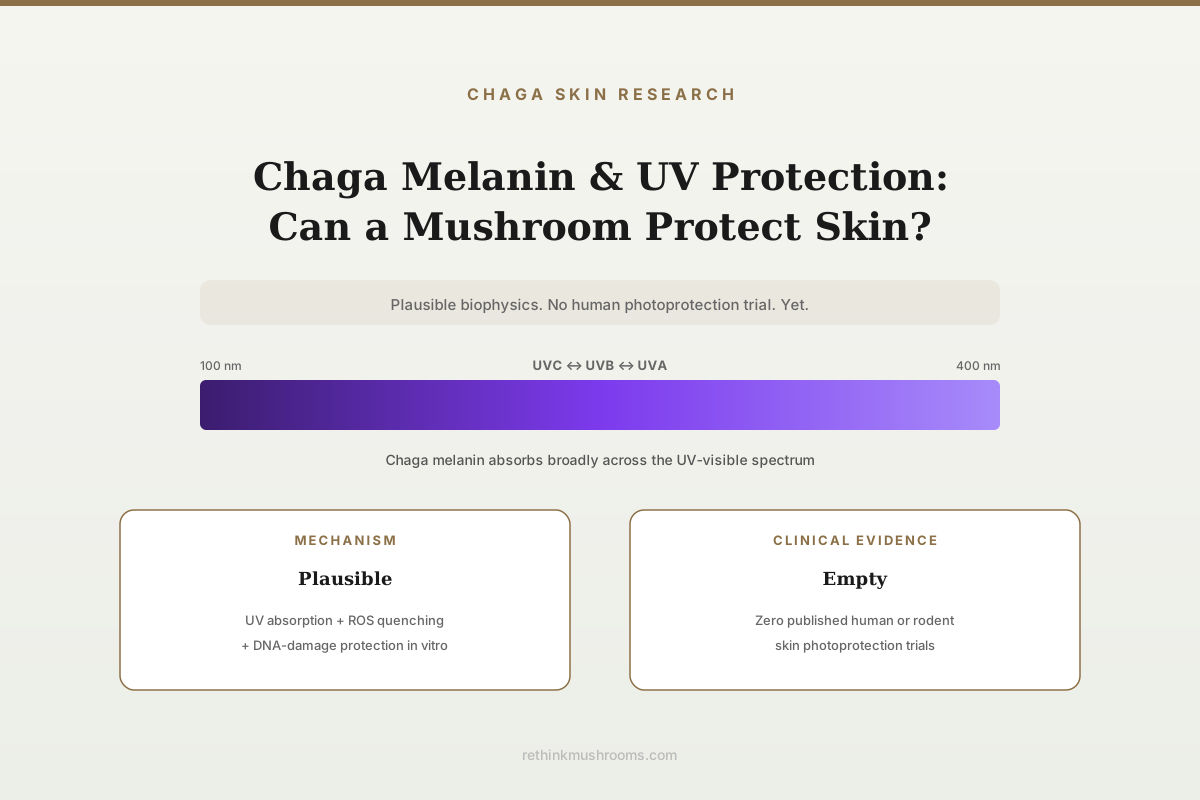
Fungal melanin absorbs broadly across the UV spectrum, including the UVA range responsible for most photoaging. The biophysics is real; the leap to human skin protection requires data nobody has published.
Glamoclija et al., J Ethnopharmacology, 2015
Photoprotective in Fungi
what melanin does for the organism
Photoprotective for Humans
untested in any controlled trial
Biosynthesis Mapped
in related species, not chaga directly
Glamoclija et al., J Ethnopharmacology, 2015
 View as image ↗
The reason chaga is black is not cosmetic. Fungi that grow exposed to sunlight in cold northern environments synthesize melanin as a survival adaptation, and chaga produces some of the most concentrated fungal melanin in any edible species. The biophysical case for some kind of UV-protective effect from this melanin is straightforward: fungal melanins absorb UV light, quench reactive oxygen species, and behave biochemically like the eumelanin in human skin. The clinical case for translating this into UV protection for humans is much weaker. No controlled human trial has tested chaga melanin or its extracts for photoprotection, photoaging prevention, or skin cancer reduction. This article maps the biophysical case, the evidence from related fungi, and the specific gap between mechanism and demonstrated effect.[1]
For the broader chaga skin context, see chaga for skin health: melanin protection research and chaga and UV damage: photoprotective properties.
Key Takeaways
- Fungal melanin is a protective pigment that the organism produces in response to UV exposure, oxidative stress, and freeze-thaw cycles, and chaga's melanin content reflects its decade-long exposure to subarctic conditions on a birch host (Glamoclija et al., 2015)
- Chaga melanin absorbs broadly across the UV-visible spectrum and quenches reactive oxygen species through phenolic radical chemistry, which is the same biophysical mechanism human eumelanin uses
- The melanin biosynthetic pathway has been mapped in detail in Auricularia auricula, a related edible fungus, providing a template for understanding chaga's pigment chemistry (Ma et al., 2022)
- Auricularia melanin demonstrated antioxidant and tissue-protective activity in rodent models of oxidative injury, supporting the broader biological activity of edible fungal melanins (Hou et al., 2019; Liu et al., 2019)
- Park et al. (2004) showed chaga extract reduced oxidative DNA damage in human lymphocytes by over 40% at 10–500 microg/mL in the comet assay, a mechanism mechanically similar to one arm of UV-induced cellular damage
- No published human or rodent study has tested chaga melanin specifically for UV photoprotection of skin, sunburn prevention, photoaging endpoints, or skin cancer reduction (Szychowski et al., 2021)
Why a Birch-Tree Fungus Makes So Much Melanin
Chaga grows for 10 to 20 years on a birch host before it produces a sclerotium large enough to harvest. During those decades it is exposed to repeated cycles of UV radiation (longer at high northern latitudes due to atmospheric path length), freeze-thaw stress, ice damage, and oxidative challenge from its own metabolism. Fungal melanins are an evolutionary response to these stressors. Pigmented fungi consistently outperform unpigmented mutants in survival under UV exposure and oxidative challenge.
The selective pressure on chaga to maintain a high-melanin phenotype is substantial. Glamoclija et al. (2015) characterized European wild chaga in detail and documented the close coupling between the polyphenol-melanin fraction and the antioxidant and antimicrobial activities of the whole extract.[1]
This is a useful framing. Chaga melanin is a defense pigment in its native context. Whether a defense pigment that protects the fungus from environmental stress also protects human skin from UV is a separate question that requires its own evidence base.
What Fungal Melanin Looks Like Chemically
Fungal melanins are heterogeneous, high-molecular-weight polymers built from phenolic precursors. Across species the dominant chemistry differs: some fungi build melanin from DOPA (similar to human eumelanin), others build it from gamma-glutaminyl-4-hydroxybenzene (GHB melanin), and chaga's melanin appears to use a related phenolic biosynthetic pathway built on its accumulated polyphenol precursors.
The structural details of chaga melanin specifically are less completely mapped than those of Auricularia auricula melanin, which has been the subject of multiple dedicated structural studies. Ma et al. (2022) characterized the biosynthetic pathway of Auricularia melanin, providing one of the more complete blueprints for an edible fungal melanin biosynthesis to date.[2] Sun et al. (2016) earlier produced and analyzed the molecular structure of the same melanin.[3]
The reason this matters for chaga is that fungal melanins, even across different species, share a common set of biophysical properties: broad UV-visible absorbance, paramagnetic stability of phenolic radical states, and the capacity to scavenge superoxide and hydrogen peroxide. Lee et al. (2007) isolated three antioxidant polyphenols from chaga that contribute to this activity.[4]
What "UV Protection" Actually Has to Do
A compound that protects skin from UV damage has to deliver on a small number of specific functions, and the evidence required for each is different.
UV absorption. A photoprotective compound has to absorb UV photons before they reach DNA in living skin cells. Chaga melanin absorbs across the UV-visible spectrum, so the basic biophysics is plausible. But absorption only matters if the compound is positioned in skin tissue at concentrations sufficient to compete with the absorption profile of the skin itself.
Reactive oxygen species quenching. UV exposure generates reactive oxygen species in skin cells, and these ROS account for a substantial portion of UV-induced damage. Chaga's polyphenol-melanin fraction has documented in-vitro ROS-quenching activity.
DNA damage prevention or repair. Park et al. (2004) showed chaga extract reduces oxidative DNA fragmentation in human lymphocytes, which is the closest direct chaga evidence for the kind of cellular damage UV produces.[5]
Inflammation attenuation post-exposure. UV exposure triggers an inflammatory cascade in skin that contributes to immediate erythema and chronic photoaging. Chaga's documented anti-inflammatory activity in macrophage models is mechanistically relevant here.
A compound that delivers all four of these in cell culture is a candidate for further testing in human skin. Chaga has plausible in-vitro evidence for at least three of the four. The translation to actual UV protection in living skin from a defined chaga preparation has not been published.
What the Auricularia Evidence Adds
The most useful comparative reference for chaga melanin is Auricularia auricula, the wood ear mushroom, which produces a similar fungal melanin and has been studied more thoroughly in dedicated mechanism papers. Hou et al. (2019) characterized natural melanin from A. auricula and documented hepatoprotective effects against acute alcohol-induced liver injury in mice.[6] Liu et al. (2019) extracted melanin from A. auricula waste residue and characterized its antioxidant activity in vitro.[7]
These studies are relevant because they demonstrate that an edible fungal melanin, as a defined isolated compound, has measurable antioxidant and tissue-protective bioactivity in mammalian systems. The biological activity is not just an in-vitro chemistry artifact. Whether the same is true of chaga melanin specifically, and whether either melanin protects human skin from UV, are separate empirical questions that have not been answered.
Why the Chaga UV Hypothesis Is Plausible But Untested
A plausible but untested hypothesis is exactly what the chaga UV protection story is. The pieces of the case:
- Chaga melanin absorbs UV broadly enough that it could in principle attenuate UV reaching deeper skin layers
- Chaga's polyphenol-melanin complex is one of the most potent in-vitro ROS scavengers among edible fungi
- Chaga extract prevents oxidative DNA damage in human cells at achievable concentrations
- Chaga's anti-inflammatory activity could reduce post-UV inflammatory damage
- Related fungal melanins demonstrate tissue-protective bioactivity in mammalian models
What the case is missing:
- A pharmacokinetic study showing chaga melanin or its degradation products reach skin tissue from oral or topical administration
- An in-vivo skin model (human or rodent) demonstrating reduced UV damage after chaga pretreatment
- A controlled human trial measuring objective endpoints such as minimal erythema dose, sunburn cell formation, or photoaging markers
- A demonstration that chaga, as actually consumed or applied by humans, produces a measurable difference in any UV-relevant skin endpoint
The gap between mechanism and demonstration is not unique to chaga. Many natural compounds have plausible photoprotective mechanisms and few have clinical photoprotection data. The honest framing is that chaga is in the same category as other fungal antioxidants: biologically interesting, chemically characterized, clinically untested for the indication in question.
What the Marketing Often Implies and What Is Actually Known
The phrase "chaga melanin protects your skin" appears widely in supplement and skincare marketing. The implication is that consuming or applying chaga delivers UV protection comparable to the body's own melanin response or to a sunscreen.
This implication overstates the published evidence by a substantial margin. What is known: chaga's pigment fraction has the chemical properties associated with photoprotective activity in vitro. What is not known: whether oral or topical chaga produces clinically meaningful UV protection in human skin, the dose required, the formulation required, or the duration required.
A reader trying to evaluate a chaga UV-protection claim should ask three concrete questions:
- Is there a published clinical trial measuring UV-relevant skin endpoints with this product? (For chaga as of 2026, the answer is no for any specific product.)
- Is there a published pharmacokinetic study demonstrating that the active compounds reach skin? (No.)
- Does the claim imply replacement or substitution for sun protection measures? (If yes, the claim is unsupported regardless of the chemistry behind it.)
For the broader chaga skincare-product evidence map, see chaga in skincare products: topical application research. Fordjour et al. (2023) called chaga's clinical potential "untapped"; the photoprotection application is one of the clearest examples of that unrealized potential.[8]
What the Honest Statement Looks Like
A complete, defensible statement about chaga melanin and UV protection in 2026:
Chaga melanin is a biologically active fungal pigment with documented in-vitro antioxidant and DNA-protective activity, similar in chemistry and biophysics to other edible fungal melanins that have been more extensively characterized. The mechanistic basis for UV protection is plausible. The translation to demonstrated UV protection in human skin has not been studied in a controlled trial. Claims that chaga protects skin from sun damage are extrapolations from in-vitro chemistry, not conclusions from clinical evidence. Any practical use of chaga for skin should not displace established photoprotective measures, and any product claiming UV protection should be evaluated on the basis of published clinical evidence specific to that product, which for chaga as of 2026 does not exist. The honest answer to the question in this article's title is that a mushroom can produce a pigment with the same family of biophysical properties as the body's own UV-defense pigment, and chaga is one of the better examples of this in the edible fungal world. Whether that pigment, in any practical preparation a human can consume or apply, produces measurable UV protection is a separate question that the research community has not yet answered.
Szychowski et al. (2021) summarized the broader chaga clinical-translation gap in their folk-medicine-to-clinical-use review, and the photoprotection application is a textbook example of the gap they describe.[9] Ern et al. (2024), in their comprehensive therapeutic review, listed antioxidant and anti-inflammatory activity among chaga's best-supported pharmacological properties while noting the limited clinical trial coverage of any specific indication.[10]
The Bottom Line
Chaga melanin is a fungal pigment with the biophysical properties associated with UV protection: broad UV absorption, ROS scavenging, and protection against oxidative DNA damage in human cells. The mechanistic case is plausible. The clinical case is empty: no published trial has tested chaga melanin for human skin UV protection, photoaging, or skin cancer prevention. The honest statement is that the chemistry is interesting and the demonstration has not been done.
Frequently Asked Questions
Sources & References
- 1RTHM-00373·Glamočlija, Jasmina et al. (2015). “Chemical characterization and biological activity of Chaga (Inonotus obliquus), a medicinal "mushroom"..” Journal of ethnopharmacology.Study breakdown →PubMed →↩
- 2RTHM-00784·Ma, Zihui et al. (2022). “Studies on the biosynthetic pathways of melanin in Auricularia auricula..” Journal of basic microbiology.Study breakdown →PubMed →↩
- 3RTHM-00449·Sun, Shujing et al. (2016). “Production of natural melanin by Auricularia auricula and study on its molecular structure..” Food chemistry.Study breakdown →PubMed →↩
- 4RTHM-00118·Lee, In-Kyoung et al. (2007). “New antioxidant polyphenols from the medicinal mushroom Inonotus obliquus..” Bioorganic & medicinal chemistry letters.Study breakdown →PubMed →↩
- 5RTHM-00076·Park, Yoo Kyoung et al. (2004). “Chaga mushroom extract inhibits oxidative DNA damage in human lymphocytes as assessed by comet assay..” BioFactors (Oxford.Study breakdown →PubMed →↩
- 6RTHM-00559·Hou, Ruolin et al. (2019). “Characterization of natural melanin from Auricularia auricula and its hepatoprotective effect on acute alcohol liver injury in mice..” Food & function.Study breakdown →PubMed →↩
- 7RTHM-00575·Liu, Xin et al. (2019). “Comprehensive utilization of edible mushroom Auricularia auricula waste residue-Extraction, physicochemical properties of melanin and its antioxidant activity..” Food science & nutrition.Study breakdown →PubMed →↩
- 8RTHM-01694·Fordjour, Eric et al. (2023). “Chaga mushroom: a super-fungus with countless facets and untapped potential..” Frontiers in pharmacology.Study breakdown →PubMed →↩
- 9RTHM-00722·Szychowski, Konrad A et al. (2021). “Inonotus obliquus - from folk medicine to clinical use..” Journal of traditional and complementary medicine.Study breakdown →PubMed →↩
- 10RTHM-01886·Ern, Phoebe Tee Yon et al. (2024). “Chaga Therapeutic Properties: What This 2024 Review Actually Shows.” Mycology.Study breakdown →PubMed →↩