Chicken of the Woods Research
5 species in North America
Lindner and Banik (2008) resolved the Laetiporus sulphureus species complex in North America into five distinct phylogenetic species, each with its own host tree preference and safety profile.
Lindner & Banik, Mycologia, 2008
Pores, never gills
diagnostic underside feature
Oak hosts
safest identification context
Omphalotus illudens
toxic orange lookalike
Lindner & Banik, Mycologia, 2008
 View as image ↗
Chicken of the woods is widely described as a beginner-friendly foraging target because the combination of bright yellow-orange coloration, shelf-forming growth on wood, and a pored underside separates it from most other fungi in a single glance. That reputation is deserved, but it is also incomplete. Field guides written before 2001 treated Laetiporus sulphureus as a single cosmopolitan species; molecular phylogenetics has since split it into at least five North American species with different host trees, different pore colors, and different safety records.[1] A safe identification routine for beginners has to account for that. This chicken of the woods identification guide walks through the diagnostic features that matter, the lookalikes that cause poisonings, and the host tree rules that determine whether a correctly identified specimen is actually safe to eat.
The goal here is not to replace a field guide or a local mycological society outing. It is to give a beginner enough evidence-based structure that their first harvest is the right species, from the right host, at the right stage of growth. For general background on the organism, see what is chicken of the woods? edibility and health research. For a full review of why some people react badly even to correctly identified specimens, see can chicken of the woods cause allergic reactions? safety guide.
Key Takeaways
- Lindner and Banik (2008) resolved the North American Laetiporus sulphureus complex into five phylogenetic species (L. sulphureus s.s., L. cincinnatus, L. gilbertsonii, L. huroniensis, L. conifericola) using ITS, nuclear LSU, and mitochondrial SSU rDNA sequences
- The single most reliable diagnostic feature is the pored underside: true Laetiporus species have tiny uniform pores, never the knife-edge orange gills of the toxic Omphalotus illudens (jack-o'-lantern)
- French and Garrettson (1988) documented 14 cases of Omphalotus illudens poisoning with vomiting in 8, diarrhea in 5, and weakness in 2, with onset within 30 minutes to 2 hours and full recovery by 18 hours
- Adamska (2023) notes specimens from coniferous hosts (especially hemlock Tsuga and yew Taxus) are associated with higher adverse reaction rates than those from hardwood hosts like oak
- Laetiporus produces hemolytic lectins (LSL) that share structural homology with bacterial aerolysin-family pore-forming toxins, making thorough cooking and first-time portion restriction non-negotiable even for perfectly identified specimens (Tateno et al., 2003)
- Li et al. (2018) sequenced the 101,111 bp L. sulphureus mitochondrial genome, confirming the genus as a well-resolved clade within Polyporales that is not closely related to any gilled toxic lookalikes
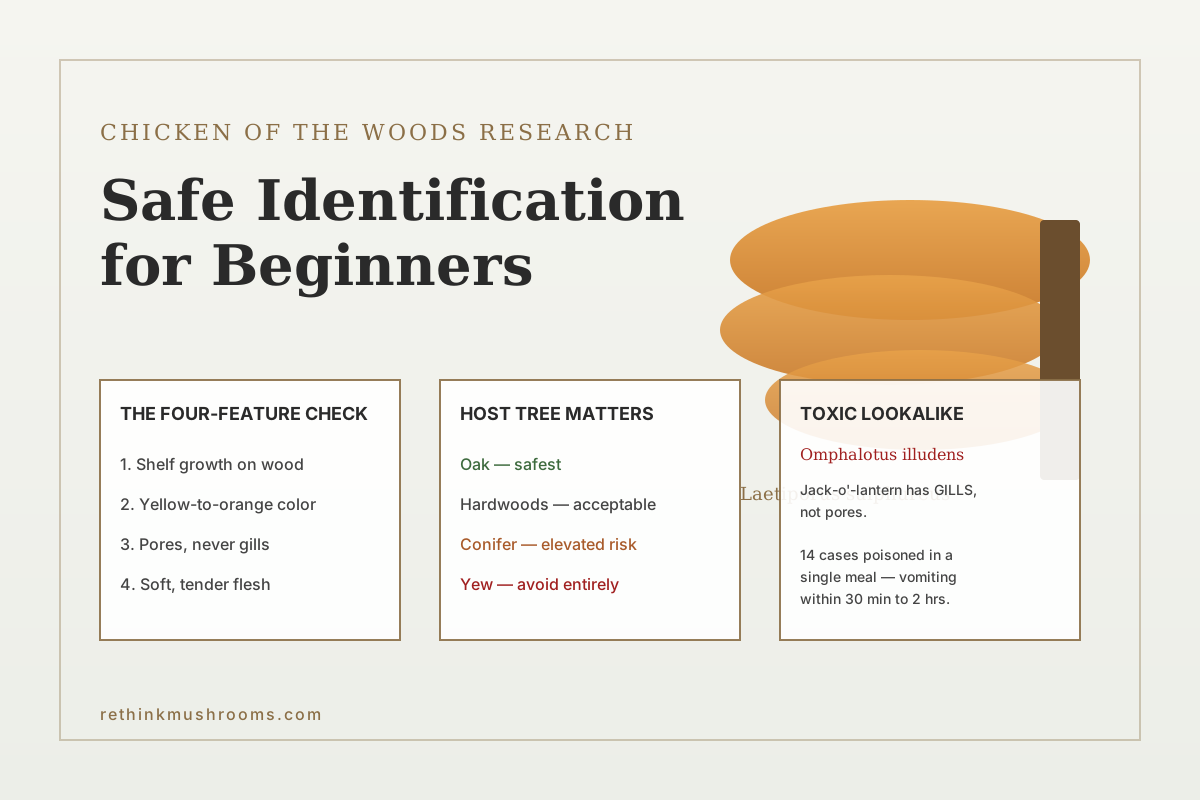
The Four-Feature Check Every Beginner Should Run
A safe identification starts with a short, ordered checklist. Each feature has to match before the specimen is considered a candidate; a single failure stops the process. The checklist below is derived from the morphological descriptions in Lindner and Banik (2008)[1] and the review by Adamska (2023).[5]
1. Shelf or rosette growth on wood. Laetiporus grows as overlapping shelves (most species) or as a rosette emerging from the ground above buried roots (L. cincinnatus). It does not grow as a capped, stemmed mushroom with a central stipe. Anything with a conventional mushroom stem is not chicken of the woods.
2. Bright yellow-to-orange coloration on the upper surface. Fresh fruiting bodies range from pale yellow-cream through sulfur yellow to bright salmon-orange. The color fades with age to pale tan or white. A specimen that is uniformly dark brown, rusty red, or black is either badly aged or a different species entirely.
3. Pored underside. This is the diagnostic feature that matters most. Turn the bracket over. Laetiporus has a surface covered in tiny pores (roughly 2-4 per millimeter), looking like fine honeycomb. Pores may be bright yellow, sulfur-yellow, white, or cream depending on species. They are never the bladelike ridges of a gilled mushroom. If the underside shows gills, stop.
4. Soft, fleshy, suede-like texture when young. Fresh Laetiporus has moist, tender flesh that cuts easily with a knife and has a faint mushroom-lemon smell. Older specimens become dry, fibrous, chalky, and crumble when pressed. The edible specimens are always the young, fleshy ones.
Any specimen that fails one of these four checks is not a safe chicken of the woods candidate. Beginners should discard it rather than try to reason around the failure.
The Species Complex: Why "Chicken of the Woods" Is Not One Mushroom
Burdsall and Banik (2001) first proposed splitting the North American L. sulphureus sensu lato into multiple species based on mating compatibility tests. Lindner and Banik (2008) confirmed and extended that split using molecular phylogenetics. Their analysis of ITS, nuclear large subunit, and mitochondrial small subunit rDNA sequences resolved five distinct clades within the core Laetiporus group in North America.[1]
- Laetiporus sulphureus sensu stricto: Eastern North America, bright yellow pores, primarily on oak and other hardwoods. This is the species most field guides described before the complex was resolved.
- Laetiporus cincinnatus: Cream-to-white pores, typically emerges as a rosette directly from the soil above buried oak or other hardwood roots. Often considered the best-tasting of the group by foragers.
- Laetiporus gilbertsonii: Western North America, cream-to-white pores, hardwoods including eucalyptus. The type collection came from a eucalyptus in Golden Gate Park, San Francisco.
- Laetiporus huroniensis: Great Lakes region, yellow pores, restricted to conifers (especially hemlock).
- Laetiporus conifericola: Western North America, conifers.
The distinction matters for safety. Adamska (2023) summarizes the pattern that mycological field reports have described for decades: specimens from coniferous hosts (the huroniensis/conifericola group) are associated with a higher rate of adverse reactions than specimens from oaks and other hardwoods.[5] The proposed explanation is that the fungus absorbs resins and terpenes from the wood of its host. Specimens from yew (Taxus) are a special case because yew wood contains cardiotoxic taxine alkaloids, which the fungus could theoretically concentrate. No direct chemical analysis has confirmed taxine in Laetiporus from yew, but mycological guides universally recommend avoiding yew-hosted specimens.
Li et al. (2018) sequenced the complete mitochondrial genome of L. sulphureus (101,111 bp, the largest Polyporales mitochondrial genome reported at the time) and used it to confirm the genus as a well-supported clade within the Polyporales.[7] This matters for beginners only because it demonstrates that the closest genetic relatives of Laetiporus are other bracket polypores, not any of the gilled mushrooms with which it is sometimes visually confused.
Host Tree Identification Is Part of Mushroom Identification
A safe identification of chicken of the woods includes identification of its host tree. This is the step most beginner guides skip, and it is the step that most often separates a safe meal from a hospital visit.
Oak (Quercus). The gold standard host. Oak-hosted L. sulphureus and L. cincinnatus have the longest human consumption history and the best safety record. Bark is deeply furrowed or scaly, leaves are lobed, and decaying oak wood has a distinctive reddish-brown color.
Other hardwoods. Black cherry, beech, maple, sweet chestnut, willow, and locust all host Laetiporus species with generally acceptable safety profiles. Eucalyptus is a common host for L. gilbertsonii on the U.S. west coast.
Conifers (Pinus, Picea, Tsuga, Pseudotsuga). Elevated risk. L. huroniensis on hemlock is the most commonly reported conifer specimen in the Great Lakes region. Foragers who want to eat conifer-hosted specimens should start with a very small portion and accept a higher probability of GI upset.
Yew (Taxus). Avoid entirely. The theoretical risk of concentrated taxine alkaloids is not worth the mushroom.
Unknown host (stump without bark, dead log, buried wood). Treat as elevated risk. L. cincinnatus rosettes emerging from the ground make host identification harder because the substrate is buried; the safest approach is to harvest only when the host tree species can be confirmed.
For cluster articles on specific health-relevant compounds from the mushroom, see chicken of the woods: Laetiporus antimicrobial and antioxidant research and Laetiporus sulphureus: antimicrobial and antioxidant properties.
Toxic Lookalikes and How to Rule Them Out
The lookalike problem for chicken of the woods is smaller than it is for many edible mushrooms, but it is not zero. Three lookalikes come up repeatedly in poisoning reports and field guides.
Jack-o'-Lantern (Omphalotus illudens / O. olearius)
The most important lookalike. Orange-to-yellow color, grows in clusters at the base of hardwood trees, and glows faintly in the dark when fresh. French and Garrettson (1988) reported a cluster of 14 people poisoned by a single Omphalotus illudens meal. Symptoms started 30 minutes to 2 hours after ingestion: vomiting in 8 of 14, diarrhea in 5, weakness in 2. All 14 recovered within 18 hours.[6] The toxic agents are illudin S and illudin M, sesquiterpenes that damage DNA by creating lesions that block transcription.
Discriminator: Omphalotus has true gills on the underside, not pores. Laetiporus has pores, not gills. This single feature separates the two reliably in the field. The gills of Omphalotus are sharp, decurrent (running down the stem), and orange. If the underside shows any gill structure, the specimen is not chicken of the woods.
Velvet-Top Fungus (Phaeolus schweinitzii)
A brown-rot polypore that grows on conifers and can have yellow-orange margins when young.
Discriminator: Phaeolus has dark brown to black flesh inside, develops a woolly or velvety upper surface, and becomes corky to woody rather than fleshy with age. Laetiporus has pale yellow-white flesh and remains relatively soft.
Sulfur Tuft (Hypholoma fasciculare)
Yellow-orange gilled mushroom, grows in clusters on decaying wood, toxic. Occasionally confused by beginners because of the yellow color and wood-based growth.
Discriminator: Sulfur tuft is a classic capped, stemmed, gilled mushroom. It has no shelf morphology and no pored underside. The same first-step rule (shelf growth on wood) rules it out immediately.
Age, Decay, and When to Pass on a Find
Even a correctly identified chicken of the woods from an oak host can make someone sick if it is past its prime. Adamska (2023) notes that older specimens accumulate secondary metabolites and may harbor bacterial contamination.[5] The bioactive chemistry of Laetiporus is rich: Duan et al. (2022) catalogued over 80 identified small-molecule compounds across the genus.[4] Some of these are beneficial (antimicrobial acids, anti-inflammatory triterpenoids), some are problematic (hemolytic lectins), and the balance shifts as the fruiting body ages.
Signs a specimen is past its prime:
- Flesh is dry, chalky, crumbly, or fibrous rather than moist and tender
- Color has faded to pale tan, white, or dusty grey
- Insect damage, boring holes, or visible frass
- Soured, fermented, or musty smell rather than faint mushroom-lemon
- Pores are discolored, crushed, or full of debris
A good rule: if the edge of the bracket is tender enough to cut with a fingernail, it is young enough to eat. If it requires a knife to sever, it is likely past its best stage.
The Non-Negotiables Even for a Perfect ID
Correct species, oak host, fresh specimen: all three checks can pass and a beginner can still get sick. Tateno et al. (2003) identified a family of hemolytic lectins (LSL) in L. sulphureus with 80-90% sequence identity and structural homology to bacterial pore-forming toxins from the aerolysin family.[2] Mancheño et al. (2010) solved the crystal structure and confirmed a two-domain architecture: an N-terminal lectin module that binds lactose and N-acetyllactosamine on cell surfaces, and a C-terminal module that resembles the pore-forming domain of aerolysin.[3] Thorough cooking is believed to denature much of this activity, though no study has published controlled thermostability data specifically for LSL.
The practical rules that follow from this:
- Cook thoroughly. Fifteen minutes at high heat minimum. Raw or rare chicken of the woods is not appropriate under any circumstance.
- Start small on first exposure. Fifty to one hundred grams for a first meal, then wait 24 hours before eating more. This limits the dose if an adverse reaction occurs.
- Do not eat it at all if you have a diagnosed mold allergy (Alternaria, Aspergillus, Cladosporium) without discussing it with your allergist, because cross-reactive fungal allergens can trigger systemic reactions to any edible mushroom.
- Do not serve it to guests on first exposure. Even if you have eaten it safely, a first-time eater may react. Offer a small portion and other food alongside.
The Beginner's Workflow, End to End
Pulling all of this together into a single decision tree:
- You see a bright yellow-orange shelf fungus on wood. Approach.
- Confirm it grows as shelves or a ground-rosette, not as a capped/stemmed mushroom.
- Turn it over. Confirm tiny uniform pores, not gills. If gills, stop.
- Press the flesh. Confirm it is soft, moist, tender, suede-like. If dry/fibrous, the specimen is too old.
- Identify the host tree. Oak is ideal. Other hardwoods are acceptable. Conifers are elevated risk. Yew is a hard no.
- Check for insect damage, discoloration, bad smell. If any, pass.
- Harvest the outer inch or two of the fresh bracket edge. Leave the older, harder base on the tree.
- At home, clean thoroughly, remove any tough or fibrous sections, and cook at high heat for 15+ minutes.
- For first-time consumption, eat 50-100 g and wait 24 hours before eating more.
Anywhere in this workflow, the correct answer to uncertainty is "pass on the specimen." Chicken of the woods is a common mushroom with a long fruiting season; missing one find is not costly. For further reading on the research base behind the cluster, see chicken of the woods: Laetiporus antimicrobial and antioxidant research.
The Bottom Line
Safe identification of chicken of the woods rests on a four-feature check (shelf growth on wood, yellow-orange color, pored underside, soft fresh flesh), an identified host tree (oak and hardwoods safest, conifers elevated risk, yew avoided entirely), and ruling out the toxic Omphalotus illudens by its gilled underside. The Laetiporus sulphureus complex resolves into five North American species with distinct host preferences, a distinction that matters for safety. Even a perfectly identified specimen requires thorough cooking and a small first-time portion because of the hemolytic lectins that all members of the genus produce.
Frequently Asked Questions
Sources & References
- 1RTHM-00142·Lindner, Daniel L et al. (2008). “Molecular phylogeny of Laetiporus and other brown rot polypore genera in North America..” Mycologia.Study breakdown →PubMed →↩
- 2RTHM-00063·Tateno, Hiroaki et al. (2003). “Molecular cloning, expression, and characterization of novel hemolytic lectins from the mushroom Laetiporus sulphureus, which show homology to bacterial toxins..” The Journal of biological chemistry.Study breakdown →PubMed →↩
- 3RTHM-00193·Mancheño, José Miguel et al. (2010). “Laetiporus sulphureus lectin and aerolysin protein family..” Advances in experimental medicine and biology.Study breakdown →PubMed →↩
- 4RTHM-00756·Duan, Yingce et al. (2022). “Bioactive components of Laetiporus species and their pharmacological effects..” Applied microbiology and biotechnology.Study breakdown →PubMed →↩
- 5RTHM-00812·Adamska, Iwona (2023). “The Possibility of Using Sulphur Shelf Fungus (Laetiporus sulphureus) in the Food Industry and in Medicine-A Review..” Foods (Basel.Study breakdown →PubMed →↩
- 6RTHM-00008·French, A L et al. (1988). “Poisoning with the North American Jack O'Lantern mushroom, Omphalotus illudens..” Journal of toxicology. Clinical toxicology.Study breakdown →PubMed →↩
- 7RTHM-00517·Li, Qiang et al. (2018). “Characterization and phylogenetic analysis of the complete mitochondrial genome of the medicinal fungus Laetiporus sulphureus..” Scientific reports.Study breakdown →PubMed →↩